
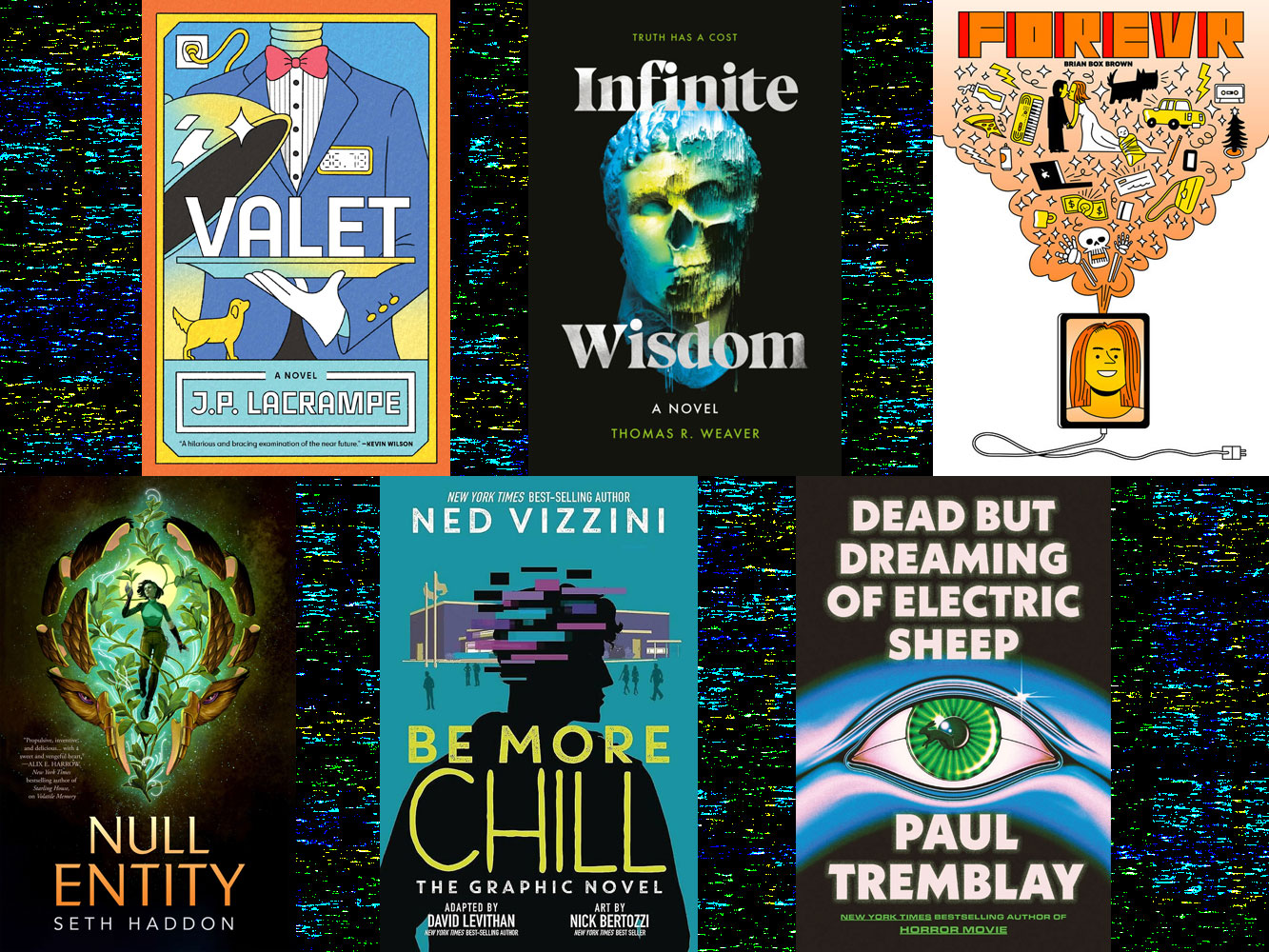
AI continues to take up a lot of space in public discourse—nobody wants data centers built near them; lots of companies insist that employees use AI in their day-to-day work; writers and visual artists argue about whether AI-generated content is any good (or even legal); companies like Meta are constantly backtracking their AI-training policies because of public outrage. For the record, I think generative AI is generally awful and is currently causing way more problems than it’s solving, and I have doubts especially that the people who run the AI companies will actually be effectively altruistic even if AI develops the capacity to solve these huge societal problems.
However, artificial intelligence continues to be a fertile topic for fiction, which I think is often a great way to explore potential ramifications. Fiction authors take a concept and push it in a direction to see what works and what breaks. Obviously these aren’t all meant to be factual predictions, but your emotional reaction to a situation can tell you a lot about how you might respond if a particular technology were to become real. Putting characters into new situations is a great thought experiment.
Today’s stack features several different versions of AI—some of them are closer to the concept of generative AI that we have now, and some are more like the traditional super-intelligent computers that have been around in fiction for decades. And some are even weirder. Let’s dive in!
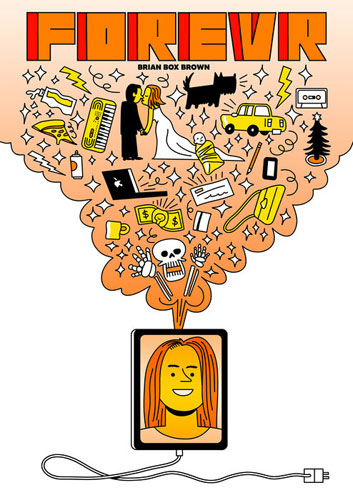
Forevr by Brian Box Brown
I’ve mostly read non-fiction comics by Brian Box Brown—he’s written books on André the Giant and Andy Kaufman, as well as Tetris—and I enjoy his illustration style. Forevr is a work of fiction that asks the question: “what if you didn’t have to say goodbye to your loved ones?” Penny has just gotten a diagnosis of terminal cancer, and her husband James isn’t sure how to handle it. When they go to the funeral home to start making arrangements, they get a new pitch: they can create a digital version of Penny using a bit of DNA and the contents of her phone, and now Penny basically “lives” forever—she can email, text, and videochat.
After Penny’s death, James has a hard time coming to terms with it, and finally flips the switch, and quickly feels like he gets to keep his wife, at least on a screen he can interact with. He connects with other people in the Forevr community, most of whom buy into the idea that these avatars really somehow embody their loved ones. Meanwhile, his adult daughter, Brenda, is very skeptical. Despite the digital Penny’s insistence that she is real and alive, Brenda thinks of her as more like a sophisticated chatbot, one who can interact like a real person but is in fact just a lot of code, and is looking for ways to put a little more distance between her dad and her digital mom.
The book does raise some fascinating questions, some of which are being debated now: how can you tell if a digital person is actually sentient? If they are sentient, what rights do they have? Should they be allowed to vote? The Forevr company keeps a lot of things under wraps, but it’s clear that the process allows them to accumulate a lot of data. Can they be trusted with it? It’s definitely a bit dystopian, but I enjoyed it because it was so intriguing to consider.
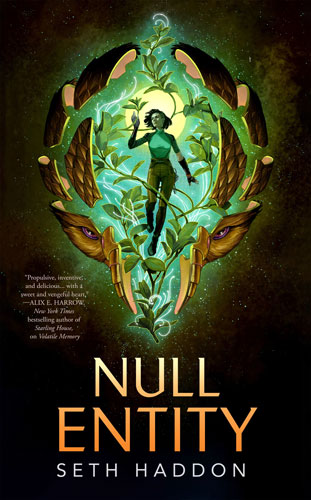
Null Entity by Seth Haddon
Null Entity is a sequel to Volatile Memory, which I included in an AI column about a year ago. In this world, there are tech-driven masks that augment your brain; they’re not sentient, but they are pretty sophisticated AI that integrates with your own mind. HAWK, on the other hand, was an experimental mask; it digitized Sable’s mind as she was dying, and now she lives on in this new form. She’s discovered by tech scavenger Wylla, and the two of them end up on the run from, well, just about everyone, it seems.
Since then, Wylla and Sable have been attacking VisorForge, the company behind these masks (and the ones responsible for the deadly experiment with HAWK), hacking into their systems and stealing their secrets. Then they’re approached by the eco-terrorist group the Edenic Order, who say they have a to destroy VisorForge entirely. Wylla and Sable can’t agree on the goal: Wylla hopes to build a world in which she can live in peace, and Sable wants to burn everything down in revenge.
This series is a queer dystopian romance that digs into questions of identity; the technology in this world does some weird things in terms of allowing minds to inhabit other forms, as Wylla and Sable sometimes share control of Wylla’s body. It’s also about a terrible corporation doing terrible things and the choices that Wylla and Sable have to make about how to respond. In some ways it reminds me of the Murderbot series by Martha Wells, because of how corporations and the government have merged (and because of how much of the story takes place internally, within Wylla’s and Sable’s minds).
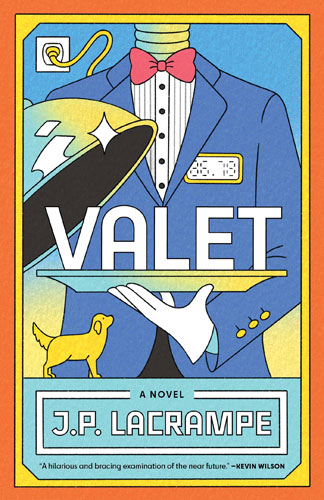
Valet by J. P. Lacrampe
Valet is a comic adventure featuring sentient robots. The story is narrated by Cy, a robot butler (technically a Verified Artificial-Learning-Enhanced Techbot) who’s in charge of Grayson St. Claire, the layabout son of Cy’s inventor. But although Grayson is the oldest child, his younger sister Charlotte is the one running Ai+ Labs, while Grayson putters around in his pottery studio and—as far as his mother is concerned—wastes his potential. Now Charlotte is planning to sell the family business to a tech conglomerate, and Grayson is appalled: he thinks it would go against his dad’s wishes, so he and Cy take things into their own hands.
In this world, the VALETs are constantly tracking their utility scores, a measure of how well they are serving their purposes. Their functionality is tied to this score, so it’s a vicious cycle: as Cy fails to help Grayson find a suitable mate (the assignment Grayson’s mom has given), his processing speed and battery life decreases. If your score drops too low, you might find yourself reconfigured and forced into menial labor. Despite that, Cy tries to do his best to go along with Grayson’s wacky schemes, even when it’s not great for his own situation.
In this story, the robots pretty much are real people, even if their emotions are simulated by algorithms and their facial expressions are acquired by emulating TV shows. Even so, they are still very much limited by their programming and the law—as we discover when one of Cy’s fellow VALETs goes rogue and tries to establish an independent life of his own. All in all, this one is a fun romp—sibling rivalry, a prison break, evil corporate overlords, family secrets, all centered around an underachiever who finally realizes what he wants to do with his life.
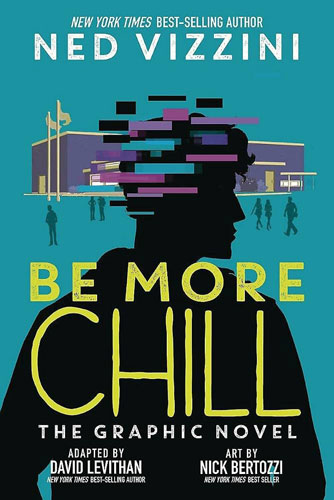
Be More Chill: The Graphic Novel by Ned Vizzini, adapated by David Levithan, illustrated by Nick Bertozzi
This one is a graphic novel adaptation of Be More Chill, though I was not familiar with the original novel (nor the Broadway musical based on it) before I read this one. The novel was published in 2004, and both the musical and the graphic novel were created after Vizzini’s death in 2013.
High schooler Jeremy is a bit of a dork. He carries around a chart on which he marks down how his classmates react to his behavior throughout the day—laughs, snotty comments, or the worst, “mortification event.” So it’s no wonder he has trouble talking to his crush, Christine. That is, until he gets a squip: an experimental, not-entirely-legal, pill-sized computer that he swallows. The squip can talk to him in his mind, and has the world’s knowledge at its metaphorical fingertips. When he tells the squip his goal of dating Christine, the squip gives him advice: what clothes to wear, who to talk to, what to say, how to carry himself.
Pretty soon, he’s in better shape, his grades are great, and he’s getting pretty popular. His best friend, on the other hand, isn’t too pleased that the squip has deemed him persona non grata. It’s not socially beneficial to hang out with other dorks. Jeremy’s not happy with that, but he has to admit that the squip’s advice is working… at least up to a point.
The book was written well before our current batch of chatbots, and there are definitely some big differences between the squip and ChatGPT. For one, the squip is not apologetic and accommodating—when Jeremy disagrees with it, the squip doesn’t say “oh, you’re right” but is more likely to insult him and say it knows better. It also does seem to have a lot of knowledge about the world and even about how people are likely to react to things. One similarity to today’s chatbots, though, is that sometimes it just gets things wrong, and following its advice in those instances can range from embarrassing to deadly. Another is the way that Jeremy—and some other kids who have squips—start to rely on them to do their thinking for them.
It was a pretty fun read, though I did find the “gotta get the girl” plot a little cliched. I’m glad that Christine does have some agency in the story and isn’t just a stereotype, but I’m kind of tired of stories where some guy gets hold of unbelievably powerful technology and the one thing he’s going to use it for is to try to attract a girl he doesn’t even really know. (See also: many time travel stories.)
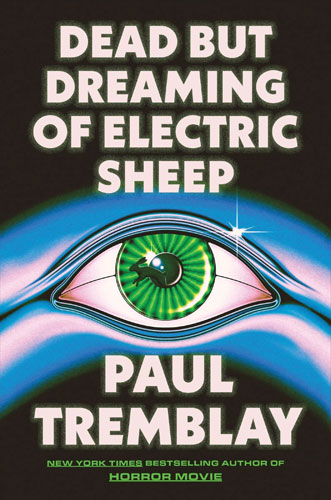
Dead But Dreaming of Electric Sheep Paul Tremblay
Okay, this one’s a weird one, in case you couldn’t guess from the Philip K. Dick–inspired title. I’d like to say that if you enjoy strange speculative fiction that you should just put this on your list without knowing more about the premise, because the central plot point of what’s actually going on is revealed very gradually over the first few chapters before things really get going. But it’ll be hard to talk about the book without explaining, so if you want to be surprised, just skip ahead down to the next book below.
Still with me? All right, here we go. Julia Flang is a young woman who lives with her uncle, has two jobs she doesn’t really like, and loves The Big Lebowski. Her estranged mom, CFO of the world’s biggest tech company, calls her with a job opportunity, hinting cryptically that Julia’s videogaming skills may be of use. Since she’s got nothing to lose, she agrees to show up for the interview—at the very least, she’ll get paid a ridiculous amount for the interview day and then she can turn the job down.
As it turns out, the job involves driving a brain-dead man across the country. “Bernie,” as Julia has nicknamed him, was an employee who had a stroke, and the company has installed some tech in his brain, allowing them to control his physical movement with a phone-like device. None of the folks in the company have had much success in steering him, though, which is where Julia comes in. It’s a real-world beta test of the technology—all she needs to do is accompany Bernie on a cross-country flight (getting him through an airport on a layover) and to his home state, where his mother will take custody of his body.
At least, that’s what Julia has been told. This being a huge, secretive, tech company, you really start to wonder what’s really going on and where Bernie is headed. Julia—who has strong misgivings about the whole thing but believes that she’s honoring the final wishes of Bernie and his mom—takes the job. When she gets contacted by a mysterious whistleblower, she has to decide whether she’s going to sabotage the whole project.
In the meantime, every other chapter is seen from Bernie’s point of view. He’s supposed to be dead dead, but we know that there’s still brain activity going on in there. His perspective is a like a funhouse mirror version, with strange nightmarish beings interacting with him and a body that is moving without his say-so. As the story progresses, Bernie is slowly figuring out who he used to be, and we also get a glimpse into the tech that’s been installed in his head.
This is a bizarre, funny, disturbing story; Bernie’s disorienting chapters have sections that play around with typography and formatting, and there are some meta interludes where Tremblay addresses the reader directly (and rants about generative AI). If you like strange tales (and strange storytelling), this one is definitely worth a shot.
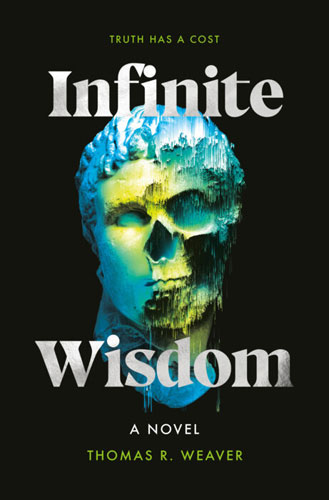
Infinite Wisdom by Thomas R. Weaver
I’m only about a fifth of the way into this one so far, but I wanted to include it because it fit the bill, and it releases tomorrow. It’s a sequel to Artificial Wisdom, which I covered in February. If you haven’t read Artificial Wisdom yet, you should stop here, because this entry will contain spoilers about the ending to the first book, which had a lot of twists and turns and ended on a bit of a cliffhanger.
In the story, there is a super-intelligent AI named Solomon, created to govern the floating city-states, and by the end of the first book he has been elected Protectorate, a newly created global position that is responsible for making the hard choices to solve the problems of climate change. His narrow victory was largely credited to Marcus Tully’s stories about the human candidate Lockwood, blaming him for both a deadly weather disaster that wiped out countless people in the Middle East, as well as the murder of Martha Chandra, Solomon’s creator. By the end of the first book, we discover that Lockwood was in fact innocent on both counts, and that Tully was deceived by an AI that he thinks is Solomon. The readers, however, learn that the real culprit was in fact a second, secret AI named Djinn that Martha had created before her death.
Infinite Wisdom picks up the story five years later. Tully and his team have gone into hiding, believing Solomon to be the murderer and fearing for their own lives. They’re living in the Caliphate, an advanced city-state that has been rebuilt after the heat wave disaster (but stayed hidden, Wakanda-style), thanks to Djinn. Solomon’s policies since he was elected have been severe and unpopular, and despite some remarkable technological progress, there is also a lot of unrest. This comes to a head when there’s a major fire in a tower city Solomon is held responsible, but Tully’s team discovers that it may be Djinn’s doing again. What is Djinn’s game plan, and is there any way for them to stop a superintelligent AI?
I do have to say, I’m not entirely sure where the story will go yet, but at this point in the story, Solomon has presented humanity with a choice: Unplug or Upgrade. He’ll take a vote, and either he’ll disable all microchips and digital technology worldwide (shutting himself down in the process), or he’ll use the neurochips installed in everyone’s brains to give them full control of their emotions, promising that this will lead to peace and prosperity and contentment. I have to wonder: is this how Thomas Weaver, a “serial tech entrepreneur,” sees the current debate about AI? Either we can kick ourselves back to the Dark Ages, or we can accept AI and rise above our base human tendencies?
In the first book, I was really intrigued by the tension between a supercomputer designed to have no ego put in charge of climate change—what sort of tough decisions would it make about the world? And then there was the murder mystery that made you worry that the AI was actually scheming to take control somehow. And then came the revelation that, actually, it was those sneaky Arabs, the ones who now have similar technology but have kept themselves hidden from the world. Really? Maybe he’s setting them up to be humanity’s savior, but so far it feels more like they’re the bogeyman, which feels like a tired trope. Given that I’m only about a hundred pages into the book, there’s certainly room for a lot more plot twists and surprises, and the first book certainly had its share of reversals. I’ll follow up at some point once I’ve finished reading the whole thing!
My Current Stack
I’m about halfway through The Score by C. Thi Nguyen, a philosophical book about scoring and metrics and gaming that I’m finding really fascinating. I’ve also got a small stack of comics about more serious subjects, like public health and gun violence and racism—sometimes tough to read but very worthwhile. And I’ve made another stack of books to read that are all about books, bookstores, and libraries, though the total page count there means I probably won’t be ready for that column by the end of the year! We’ll see.
Disclosure: I received review copies of the books covered in this column. Affiliate links to Bookshop.org help support my writing and independent booksellers (instead of, you know Jeff Bezos).

Jonathan H. Liu

Jonathan H. Liu is a stay-at-home dad in Portland, Oregon, who loves to read, is always up for a board game, and has a bit of a Kickstarter habit. I can be reached at jonathan at geekdad dot com.


