
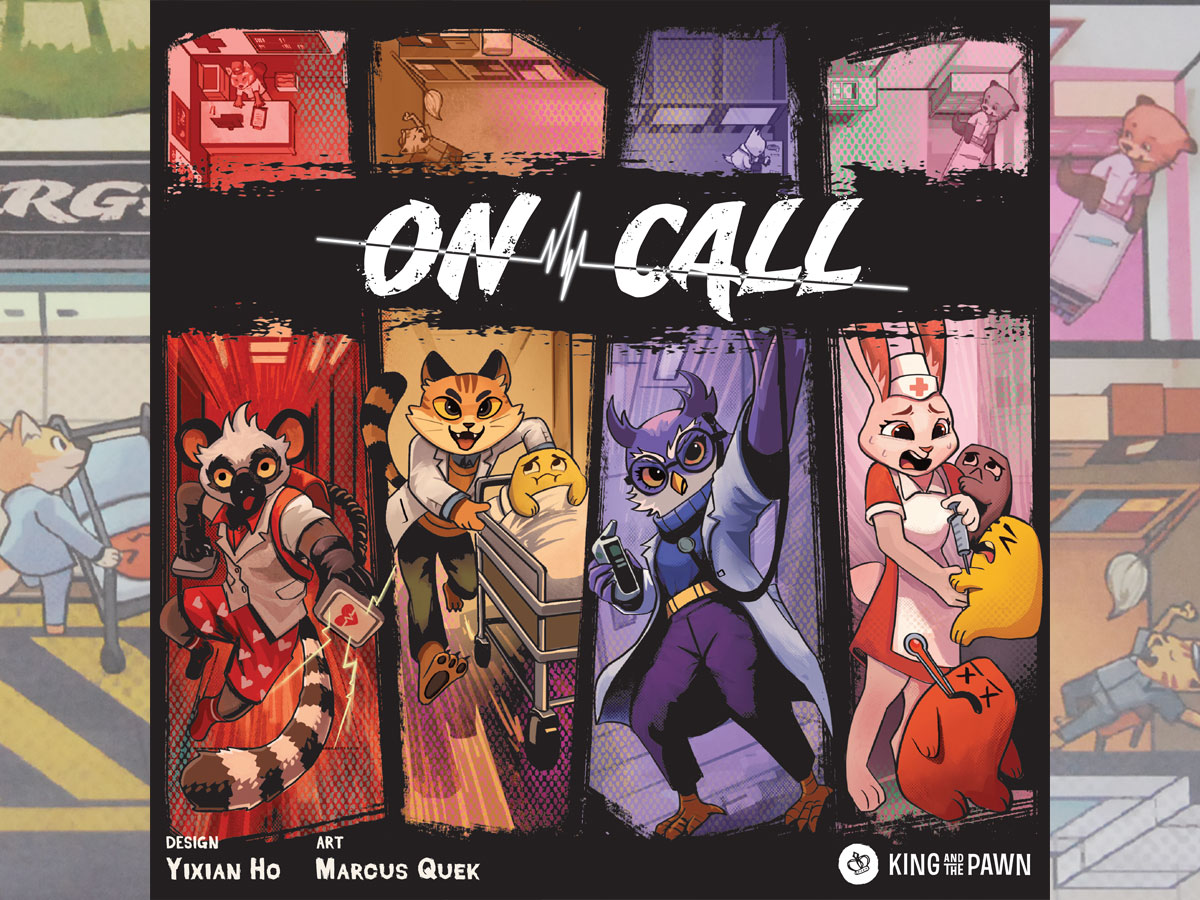
Manage a busy emergency department in this cooperative game.
What Is On Call?
On Call is a cooperative game for 2 to 4 players, ages 10 and up, and takes about 60 minutes to play. It’s currently seeking funding on Kickstarter, with a pledge level of $48 for a copy of the game, $70 for the game with expansion, and $95 for the game and expansion with deluxe components. The cooperative nature of the game means that you can play this with a mix of experience levels, though the harder mode with limited communication is a lot more challenging.
On Call was designed by Yixian Ho and published by King and the Pawn, with illustrations by Marcus Quek.
New to Kickstarter? Check out our crowdfunding primer.
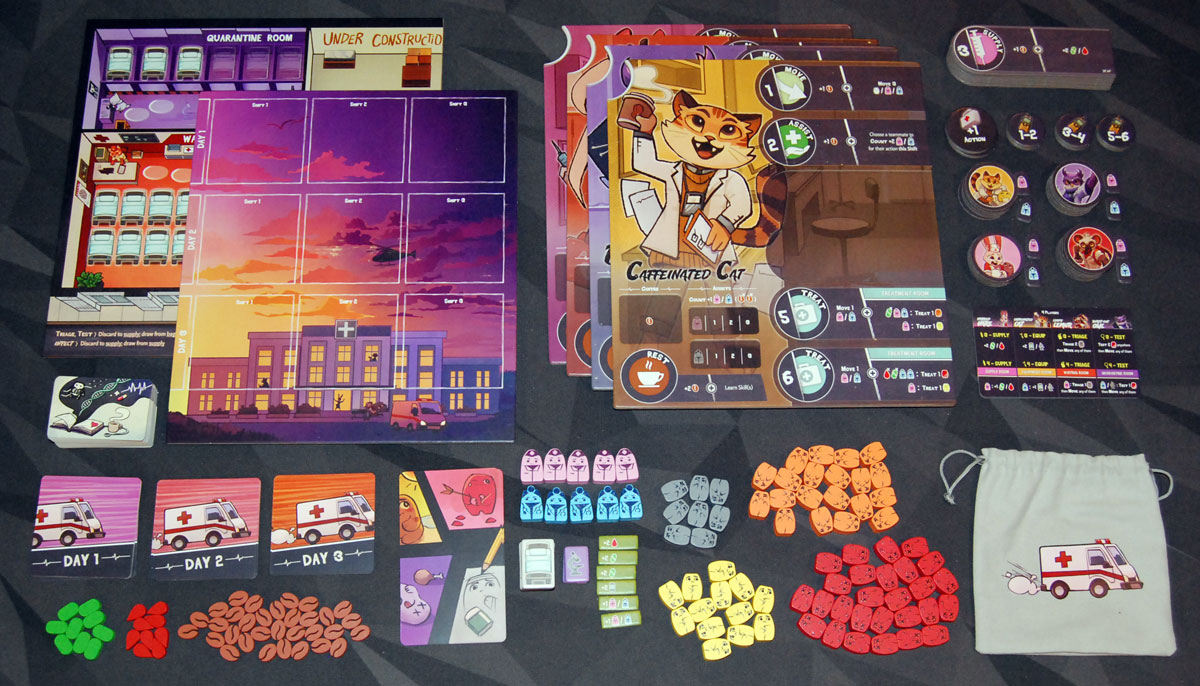
On Call Components
Note: My review is based on a prototype copy, so it is subject to change and may not reflect final component quality. My prototype was only for the base game, with a limited number of scenario cards. The prototype has a mix of the standard and deluxe components—the meds, blood, and coffee are wooden in the deluxe but cardboard in the standard, and the printed ambulance bag is also deluxe (instead of the blank bag in the standard). The action tokens will be clay poker-style chips in the deluxe, but the prototype used cardboard like the standard.
Here’s what comes in the box:
- Emergency Department board
- Shift board
- 4 Player boards
- 10 Action tiles
- 2 “+1 Action” tokens (for 2-player game)
- 6 Signal tokens
- 25 Action tokens (6 per player)
- 4 Virtual Nurse tokens
- 4 Virtual Doctor tokens
- 4 Player Aid cards
- 70 Skill cards
- 30 Shift cards (10 per day)
- 20 Scenario cards
- 9 Medicine tokens
- 9 Blood tokens
- 28 Coffee tokens
- 5 Nurse meeples
- 5 Doctor meeples
- 12 Beds
- 4 Microscopes
- 6 Bonus tokens
- 70 Patient meeples:
- 10 Walk-in (grey)
- 13 Low Priority (yellow)
- 20 Medium Priority (orange)
- 27 High Priority (red)
- Patient bag
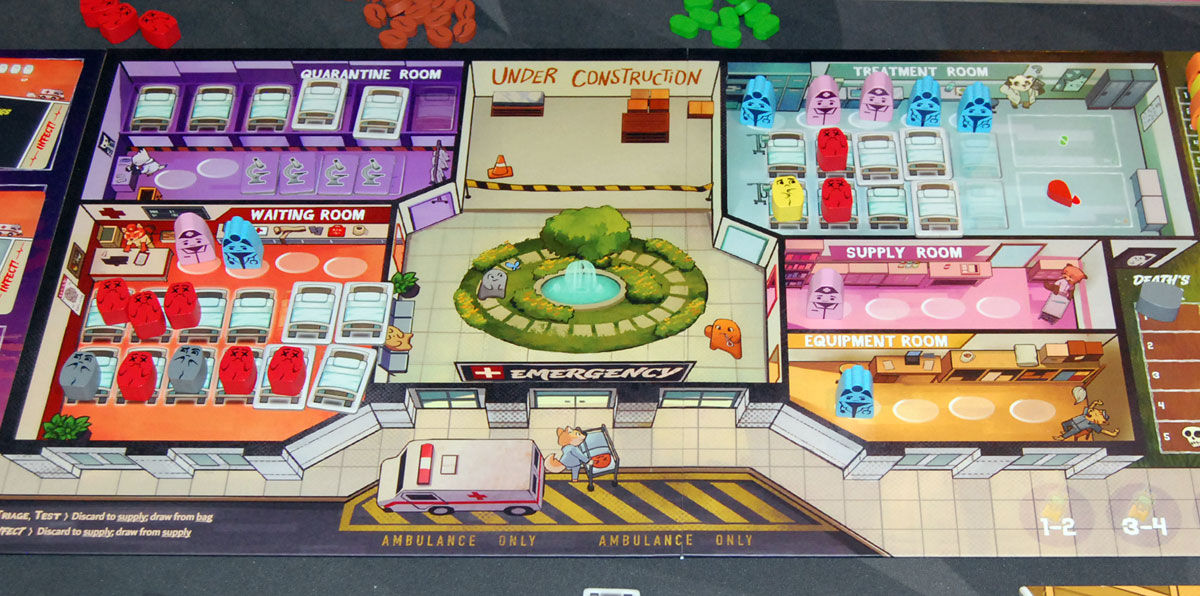
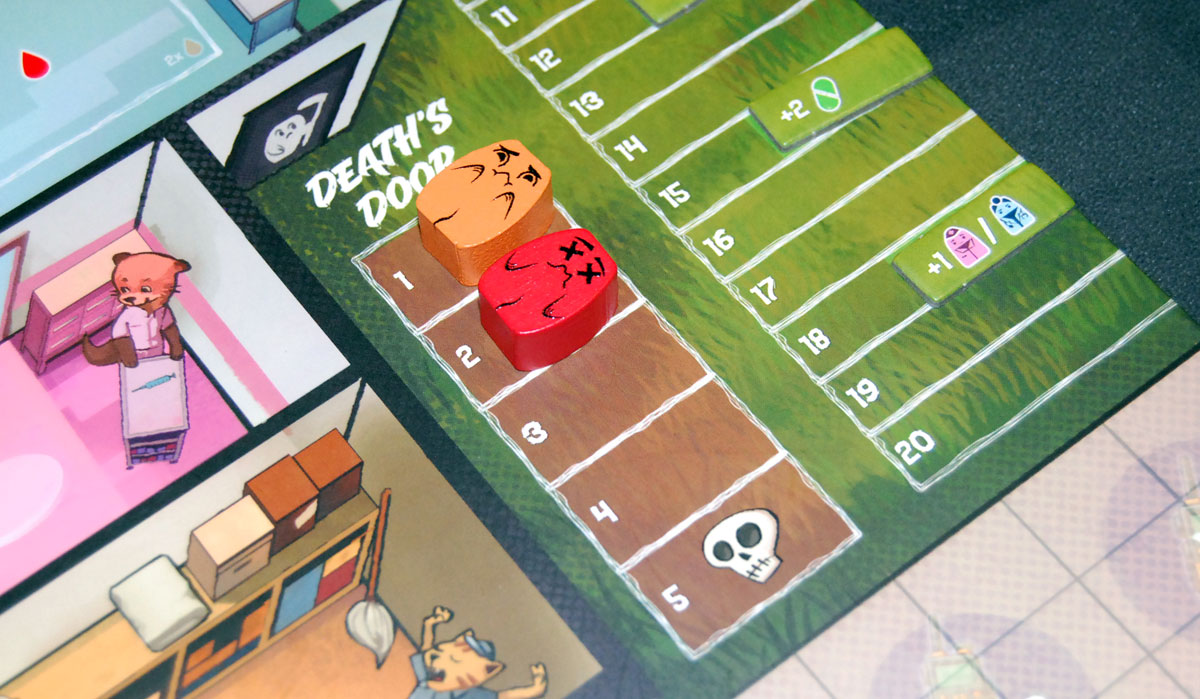
The main board is fairly large, depicting a top-down view of the emergency department with several rooms and an “Under Construction” area (which may have a card added to it depending on the scenario). Outside the hospital there’s an ominous “Death’s Door” section, and then on the far right there’s a track for treated patients with various bonuses.
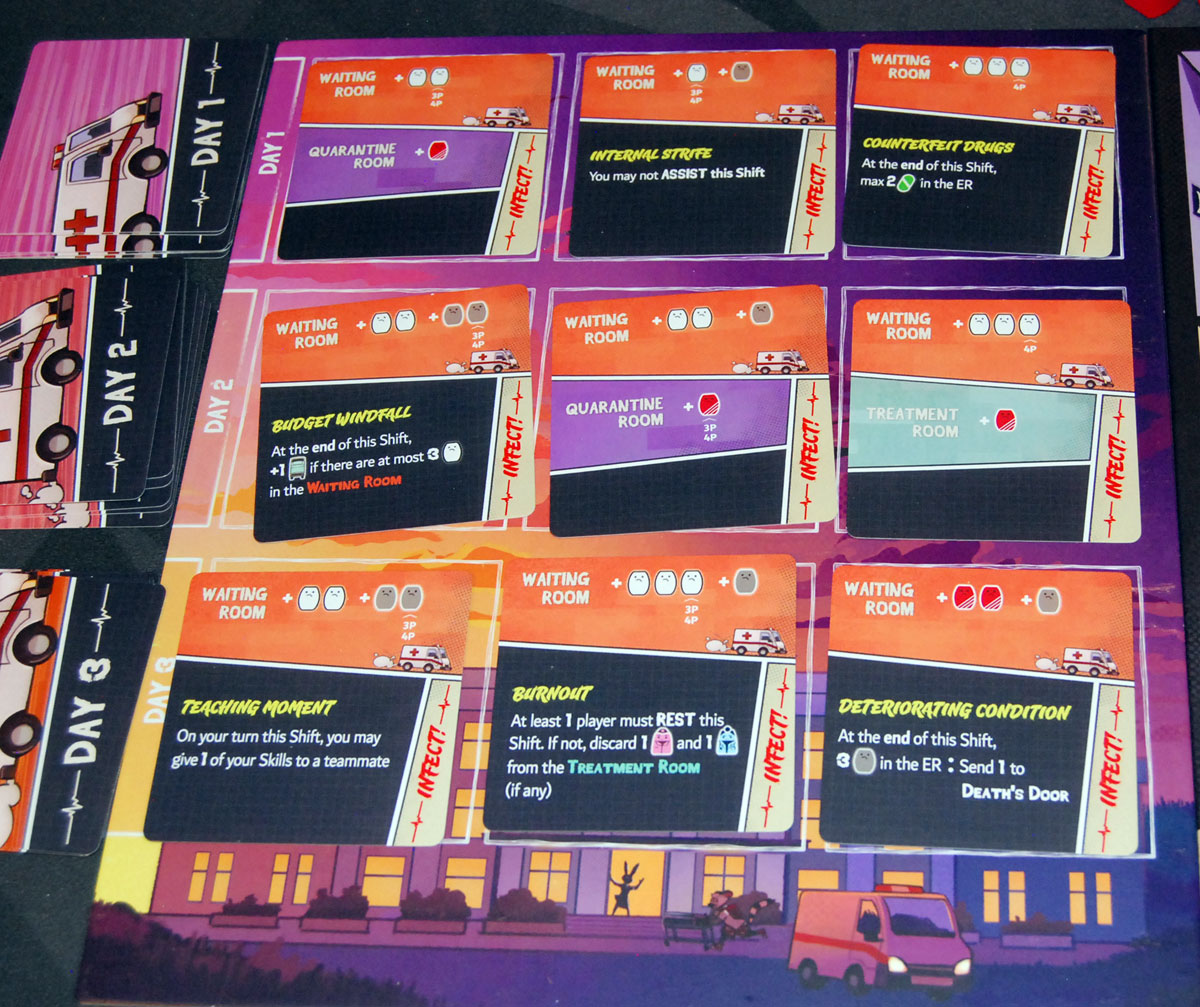
The shift board is just a large 3 x 3 grid where event cards will be placed for each shift—it doesn’t feel entirely necessary since you rarely need to refer to previous events. I think a single stacked deck and discard pile would probably do the job and save a bit of room on the table; the main benefit is being able to tell how far along you are in the game at a glance.
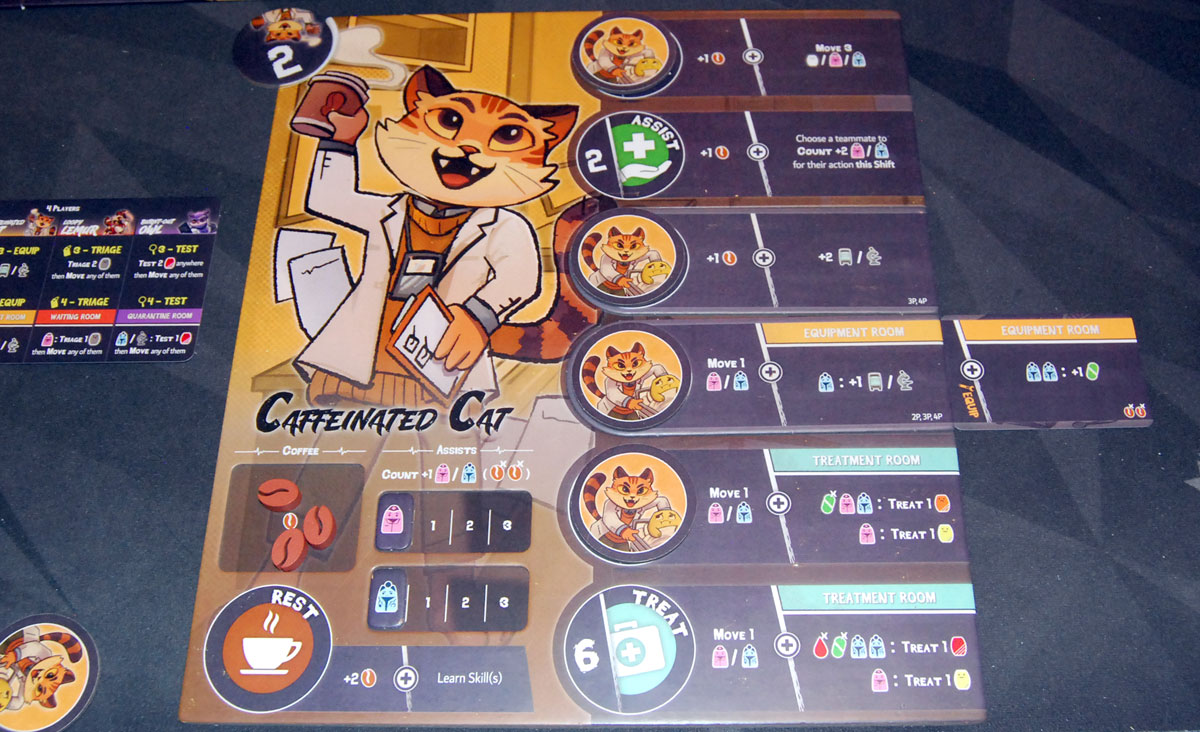
The player boards and action tokens have illustrations of the animal characters: Loopy Lemur, Harried Hare, Caffeinated Cat, and Burnt-Out Owl. Are these the folks you want to entrust your health to? Well, they’re what you’ve got. (Judging by the fact that the components include 3 times as much coffee as blood or medicine, it seems that this particular emergency room really runs on caffeine, which may explain why everyone is loopy, harried, caffeinated, and burnt-out…) The player boards are dual-layered, with a few cut-outs to keep components from sliding away, and two large cut-outs for the “3” and “4” action tiles, which can change depending on player count and scenario.
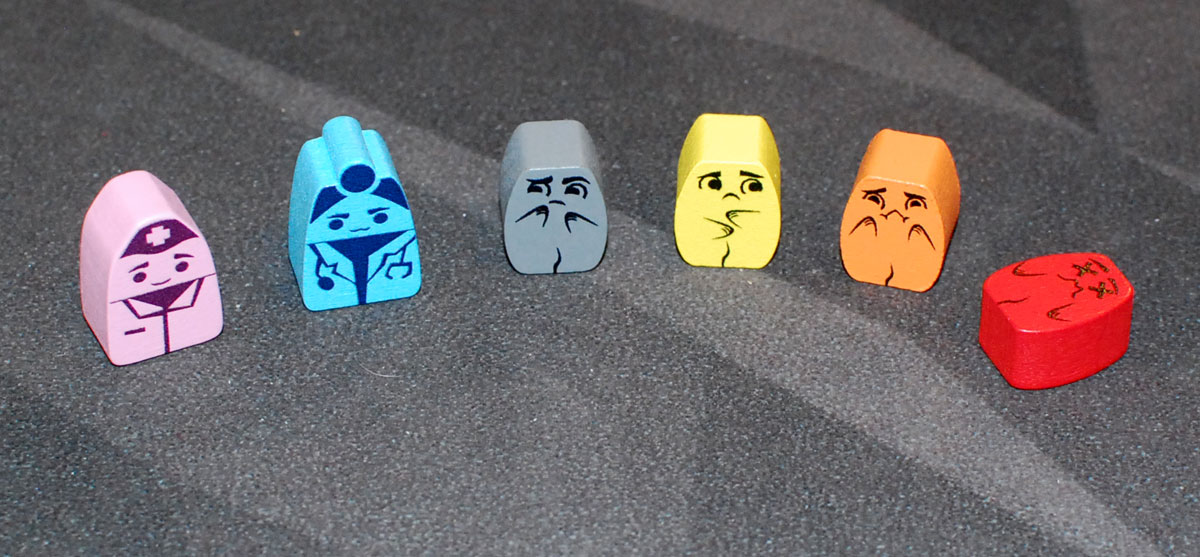
The patients, doctors, and nurses are all represented by little oval-ish meeples. I’m not entirely sure what they’re supposed to be (though you can also see the cartoon versions of them on the cover). They do make for an easy shape to mix up in the bag and place onto the various beds on the board. The patients are colored yellow, orange, and red based on how sick they are (with increasingly distressed expressions), as well as grey for the walk-in patients whose health is unknown. The doctor and nurse meeples are also oval creatures with headgear and white coats, and I was peeved to see that the doctors are blue and the nurses are pink—sure, those colors don’t have to represent male and female, but it reinforces a stereotype. As somebody whose wife is a physician, I’d advocate for using different colors that don’t have the same gender associations.
The prototype included only a handful of scenarios, but the rulebook lists 18 total scenarios so the game can get increasingly challenging as you progress through the cards. Each scenario has its own objective and adjustments to the rules.
How to Play On Call
You can download a draft of the rulebook here.
There are two modes of play: full communication or limited communication. I’ll explain the overall gameplay with full communication, and then describe the way the limited communication works.
The Goal
The exact goal depends on which scenario you play, but generally the goal is to treat a minimum number of patients while staying below a certain threshold of high-priority patients by the end of the three days.
Setup
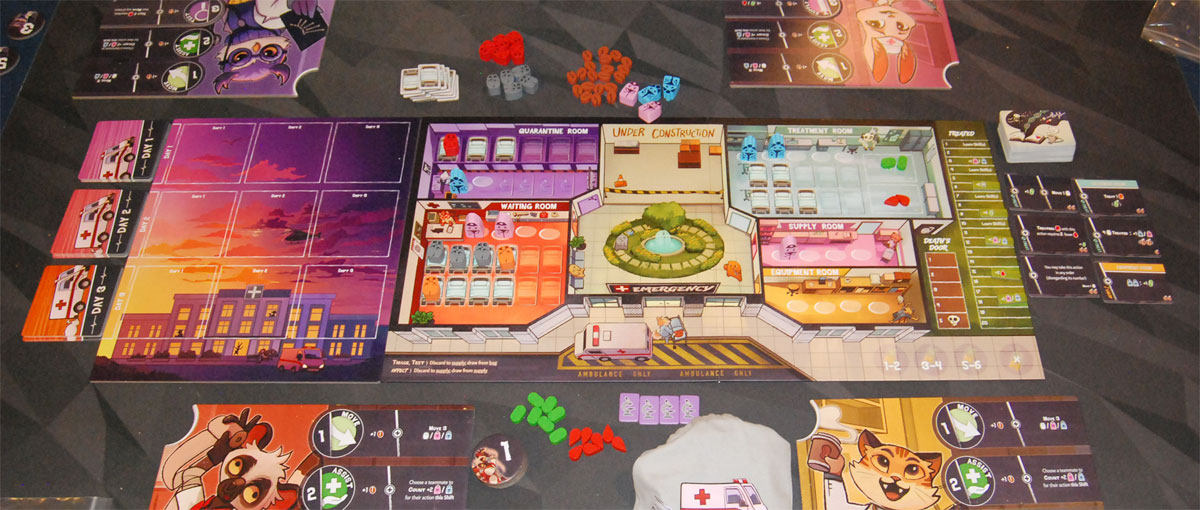
Set up the emergency department board and the shift board. The Shift board should have the three decks of shift cards next to each row. Mix up the bonus tokens and place 5 of them at random on the “treated” track in the empty spaces. Shuffle the skill cards and place 6 of them face-up as a market.
Set all the walk-in patients (grey) and 5 high-priority patients (red) next to the board as a supply, and put the rest of the patients in the bag. Make a supply of medicine, blood, beds, microscopes, doctors, and nurses near the board.
The board starts with a few nurses, doctors, and walk-in patients in specific rooms, as well as 2 medicine and 2 blood in the treatment room. You’ll also draw 3 patients from the bag: red patients go in the quarantine room, and any others go in the waiting room.
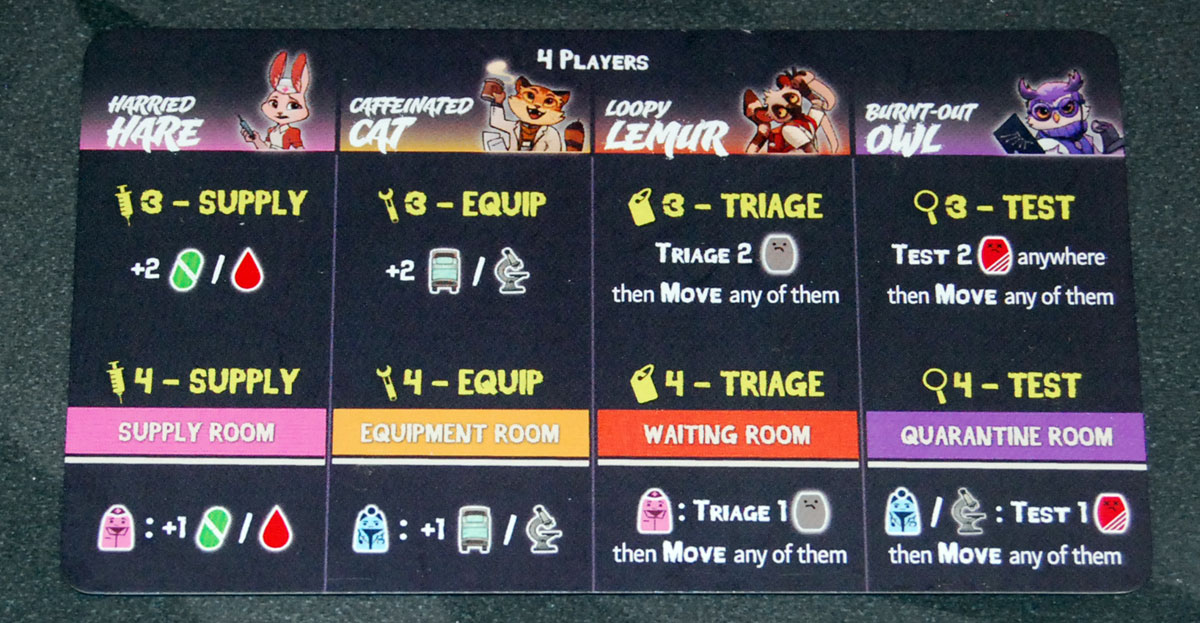
Each player gets a player board, 3 coffee, and the virtual nurse and doctor tokens, placed on the “0” spaces of the corresponding tracks. They also get 6 action tokens matching their player. (In a 2-player game, each player also gets a “+1 Action” token.) The rulebook will indicate which character gets which “3” and “4” action tiles based on the player count.
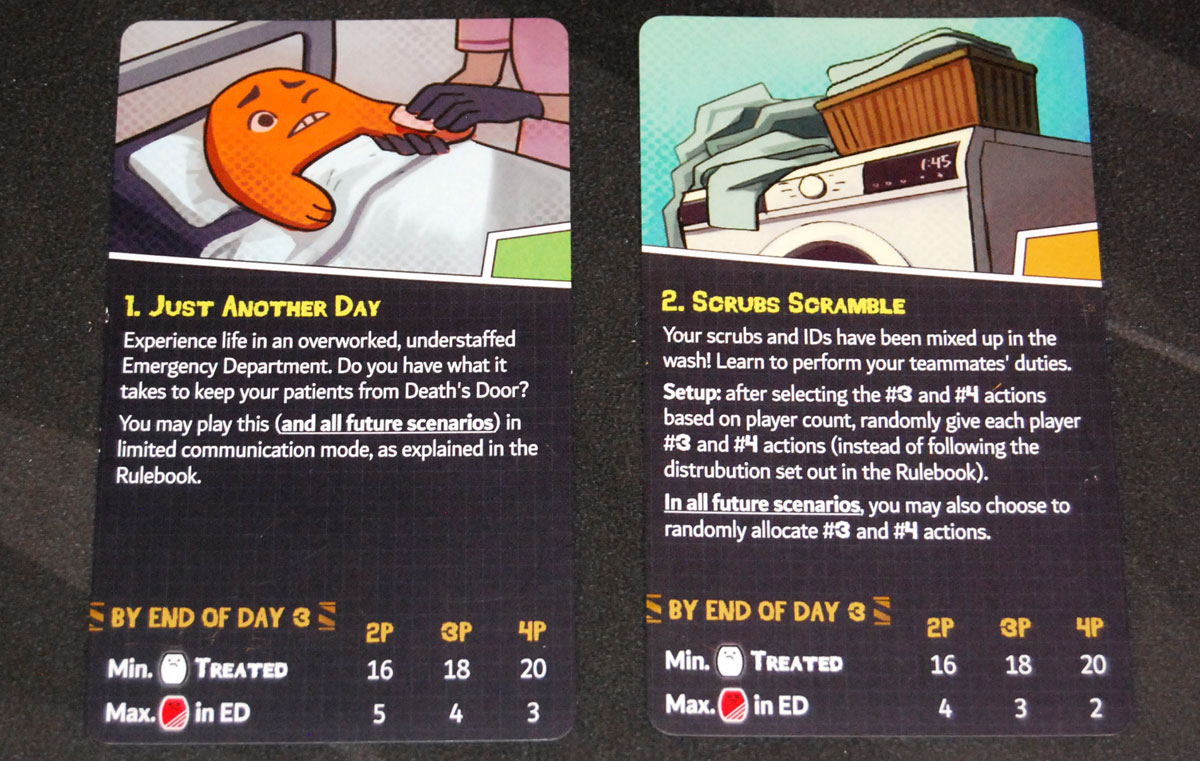
Select a scenario card and perform any additional setup.
Gameplay
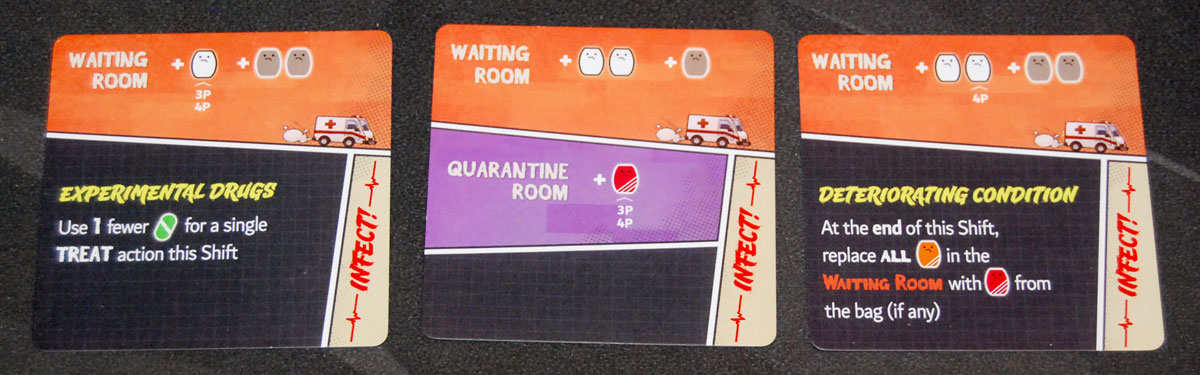
At the start of each shift, draw the next shift card and follow its instructions. The top of the card indicates how many patients to add to the waiting room. A white icon indicates that you draw a random patient from the bag, grey patients are taken from the supply, and any specific colors means you take that color from the bag. If there aren’t enough beds in the waiting room, then the patient is sent to Death’s Door instead.
Next, you follow any special event instructions on the shift card.
Finally, you infect patients: in the waiting room and treatment room, if there are any red patients present and fewer than 2 empty beds, then 1 nearby patient will get infected, replacing it with a red patient from the supply. (Orange patients get infected first, then yellow, then grey). In the quarantine room, all the patients are separated from each other so infections don’t spread.

Now, everyone gets to choose an action to perform. You select one of your available action tokens and place it at the top corner of your player board. Then, in numerical order, players will perform the actions. Each action has two effects—you get both of those, in any order. Everyone has the same actions for 1, 2, 5, and 6, but the 3 and 4 actions are unique to each player.
Move (1) lets you move doctors, nurses, and patients (as indicated) around the board—movement is from any room to any room, as long as there is space available. Assist (2) lets you choose a different player, and they can increase their virtual doctor/nurse counter for the round, which can make actions more effective.
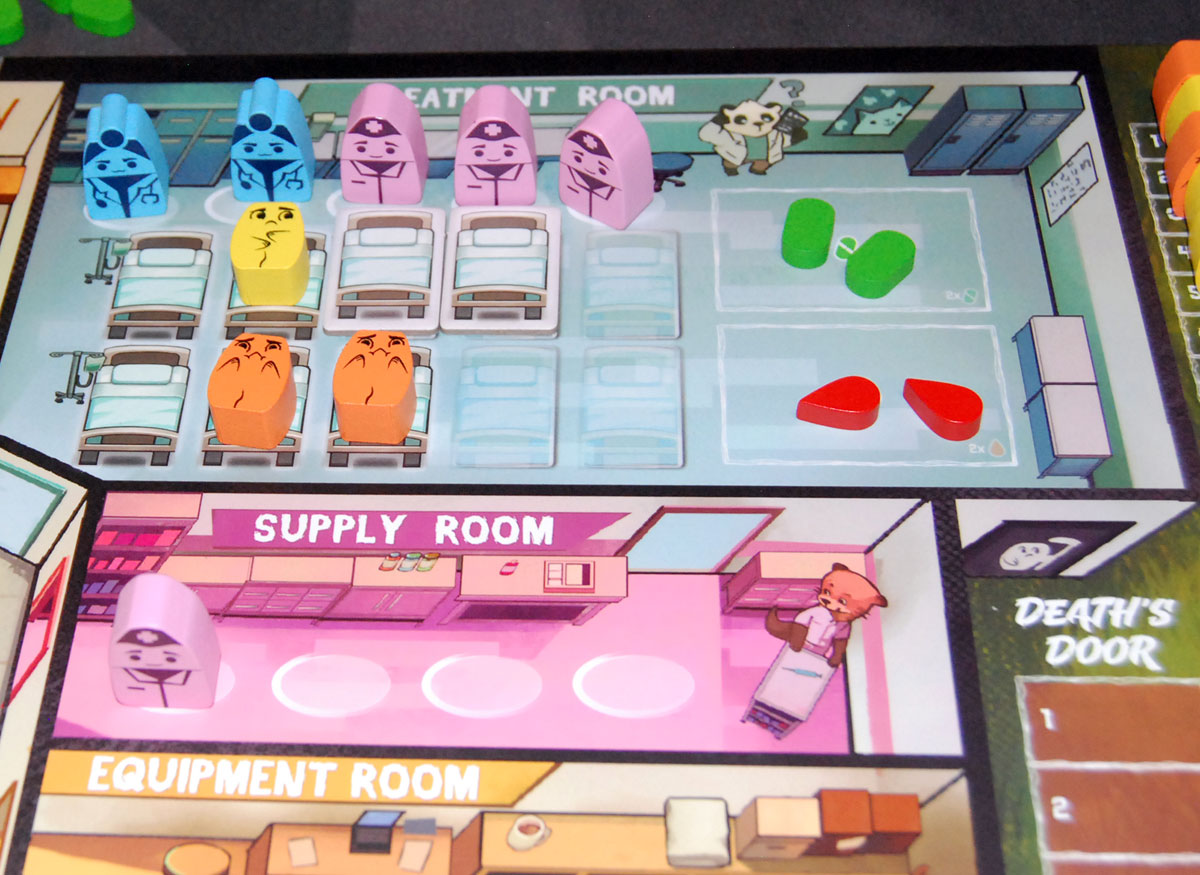
Treat (5 and 6) is how you treat patients, sending them on their way. Depending on which treatment action you use, you can either treat orange patients or red patients, but both also allow you to treat yellow patients. Each treatment requires a certain number of doctors, nurses, meds, and blood to be present in the treatment room, but you may treat as many patients as you can afford with a single action. (Meds and blood are discarded when they’re used.) Treated patients are placed on the treated track (outside the hospital), and the player who treated them immediately gains any bonuses that they cover on the track.
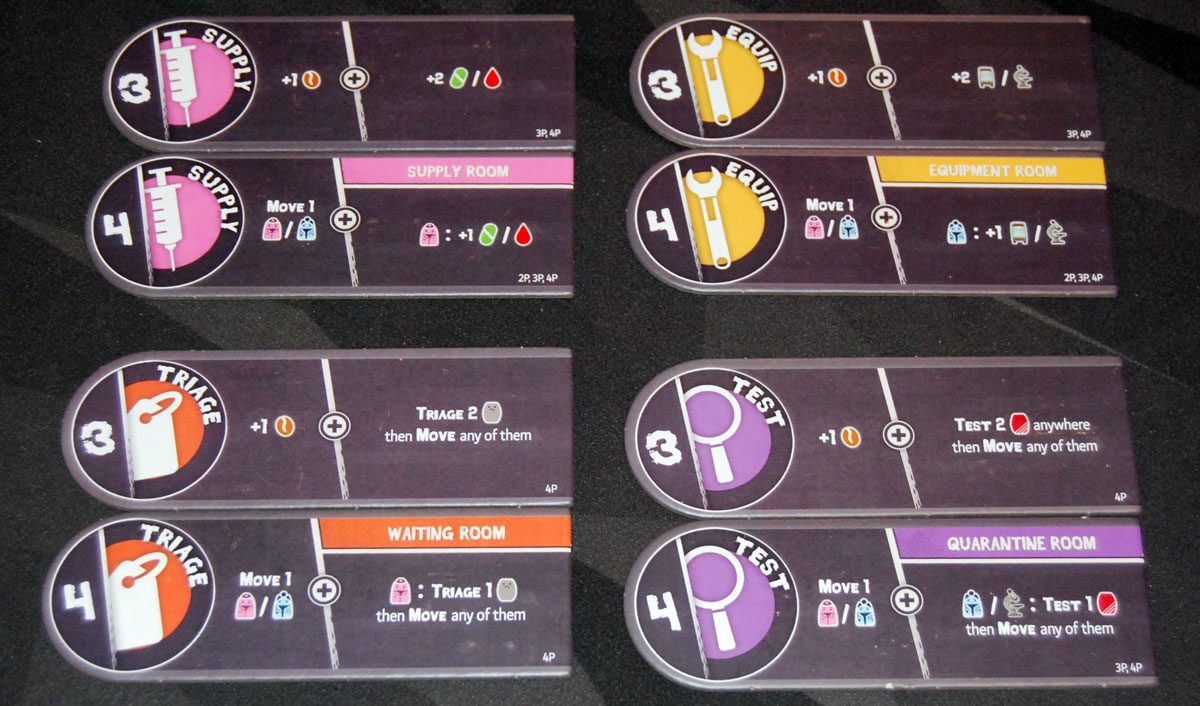
There are four options for the 3 and 4 actions, and you’ll have a different mix of them depending on the player count. Supply is used to add meds and blood to the treatment room. Equip adds more beds to any room or microscopes to the quarantine room.
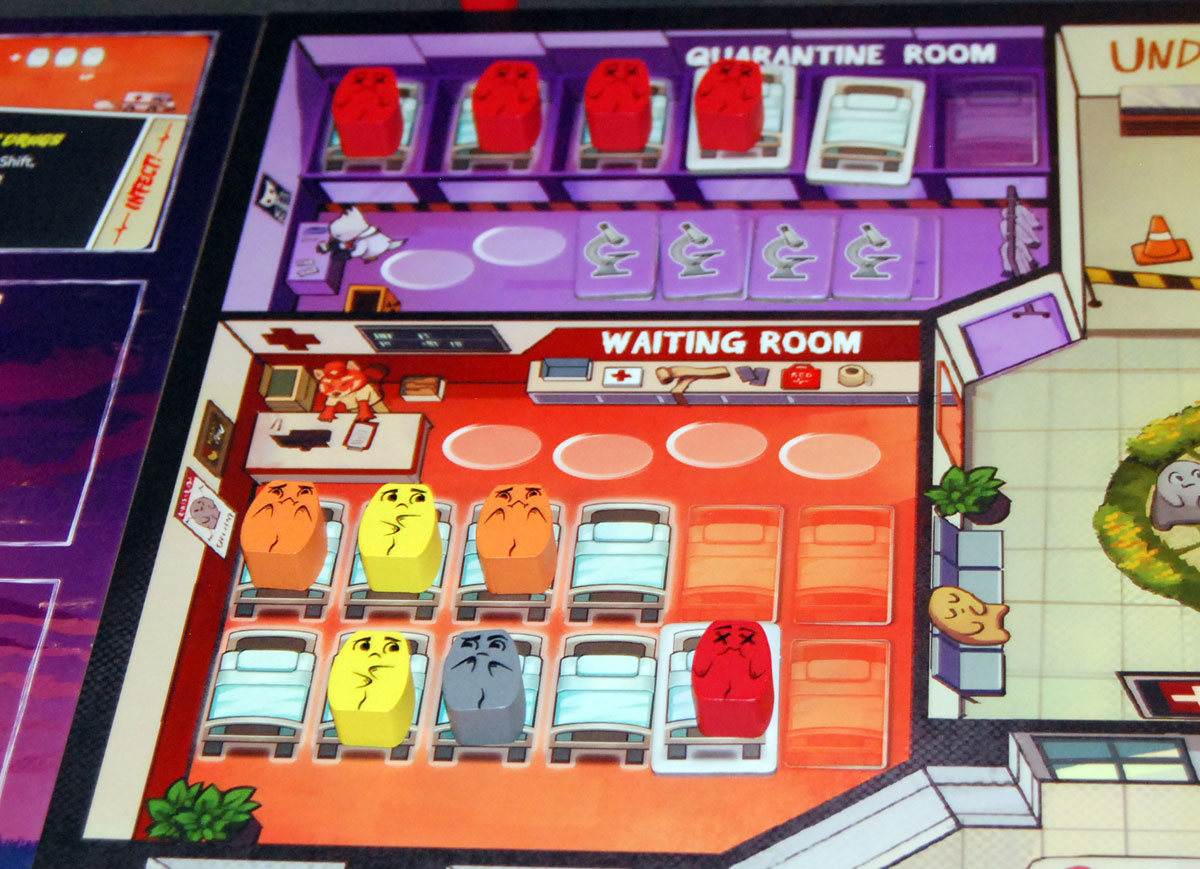
Triage lets you test the walk-in patients in the waiting room: you remove the grey meeple and draw a random one from the bag (now you know how sick they are), and then you may optionally move them to a different room. Test lets you re-test red patients in the quarantine room, removing them from the board and drawing a random replacement from the bag; these may also be moved after testing. (Sometimes really sick patients recover a little bit so they’re no longer as sick and infectious.)
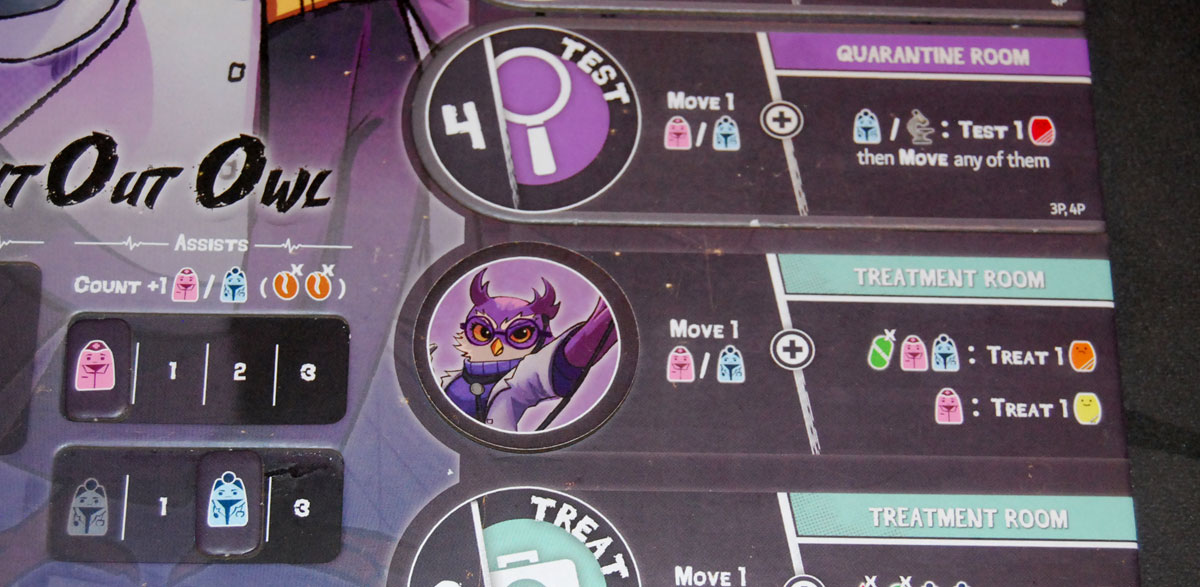
Many of the actions will count the number of doctors and/or nurses in a specific location, giving you an effect based on the number. If you have increased your virtual doctor or nurse this round thanks to assist, that increase the effect of the action. You may also spend 2 coffee to gain 1 virtual doctor or nurse (but only once per shift). Virtual doctors and nurses reset to 0 at the end of the round.
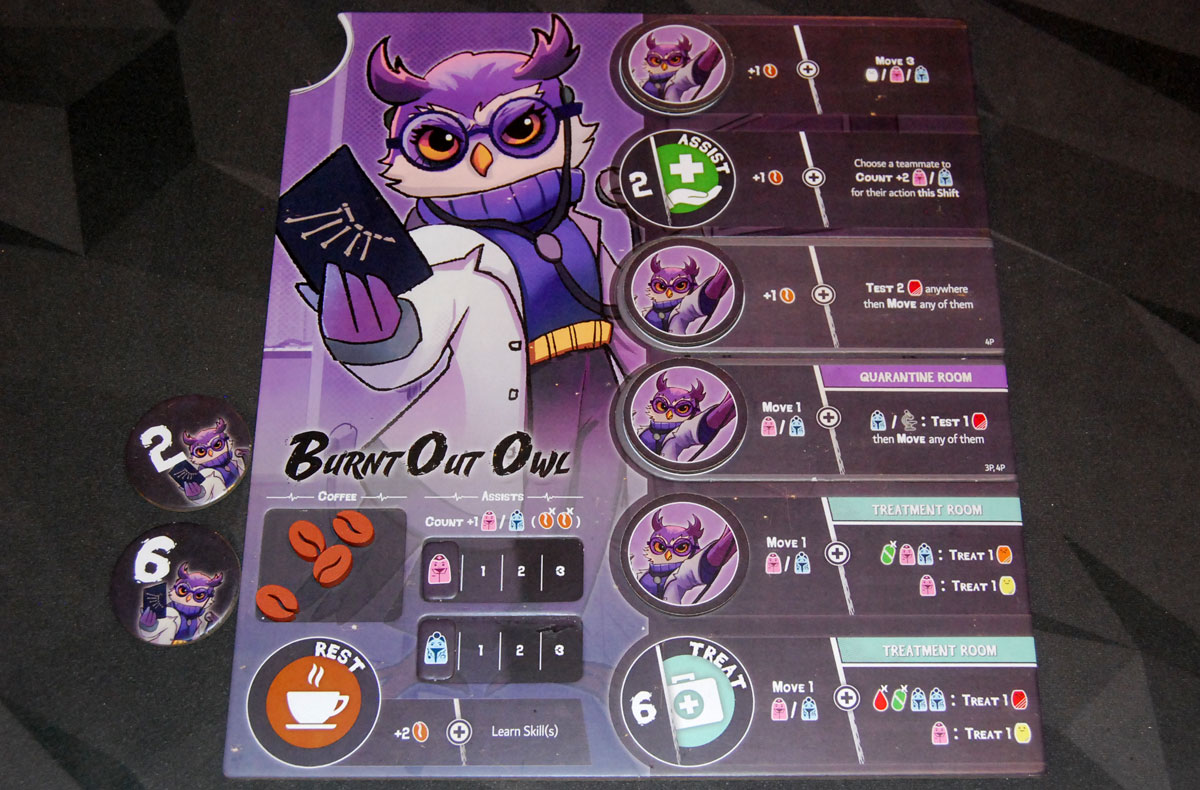
After you take your action, place your action token face-down on the matching action—you may not take this action again until you rest. Note that if it is your last token, you must rest, because otherwise you wouldn’t be able to take any more turns for the rest of the game. (You think the owl is burnt-out now? You should see them after 6 straight shifts…)
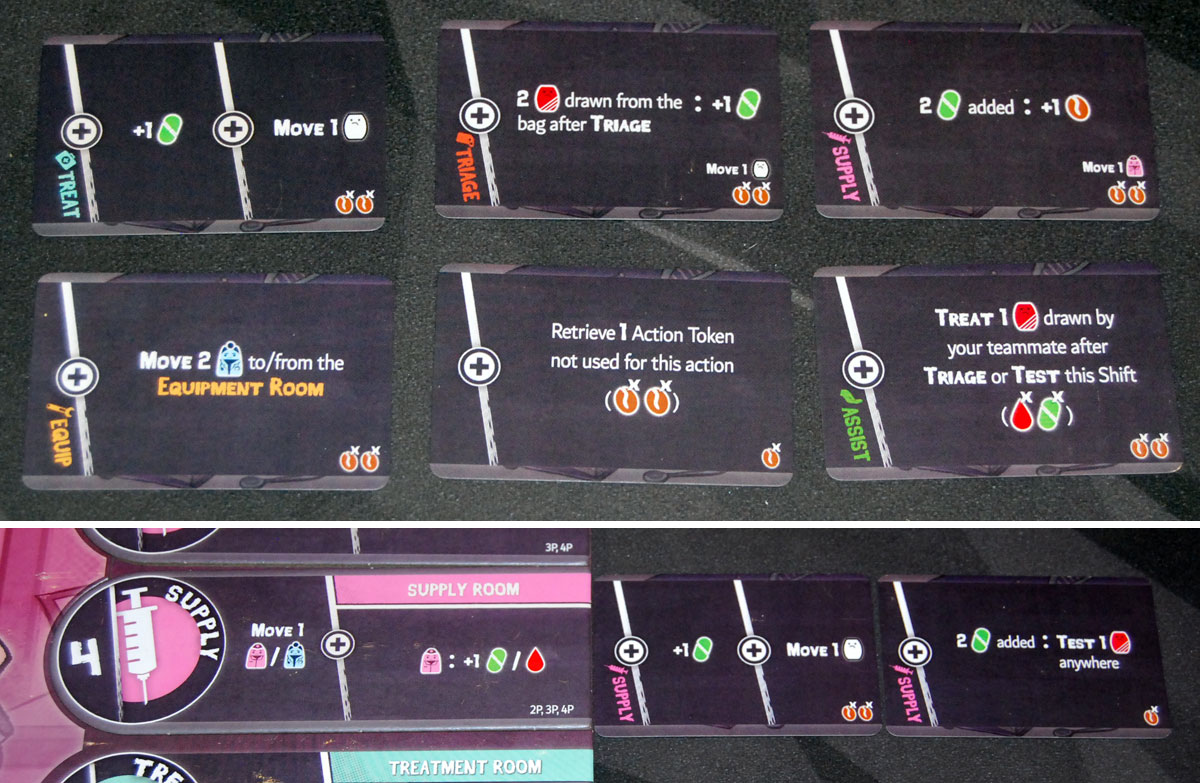
When it is your turn, instead of taking your numbered action, you may instead rest: this gives you all of your action tokens back, plus you gain 2 coffee, and you may learn skills. Skills are cards that can be purchased (with coffee, of course!) and added to an action. Some skills have specific actions printed on them, but if not they can be added to any action. Place them to the right of your player board. Now, when you take the associated action, you get all the action’s printed effects plus the effects on any of the attached skills. (Some skills also have a one-time bonus effect when purchased.)
Game End
If you ever have 5 patients at Death’s Door, then you lose immediately. Otherwise, the game ends after Day 3. If you have achieved your objectives, you win! Otherwise, you lose.
Limited Communication Mode
If you want more of a challenge, you can play in limited communication mode. (There is a Level 0 training mission intended as practice for this mode, and there are some scenarios that can only be played with limited communication.)
At the start of each day, you have a morning huddle where you can freely discuss strategy and actions—though you haven’t seen what the shift cards may throw at you yet! Once the first shift card is drawn, players must be completely silent for the rest of the day (3 shifts). When you select action tokens, you place them face-down and then everyone reveals them at once.
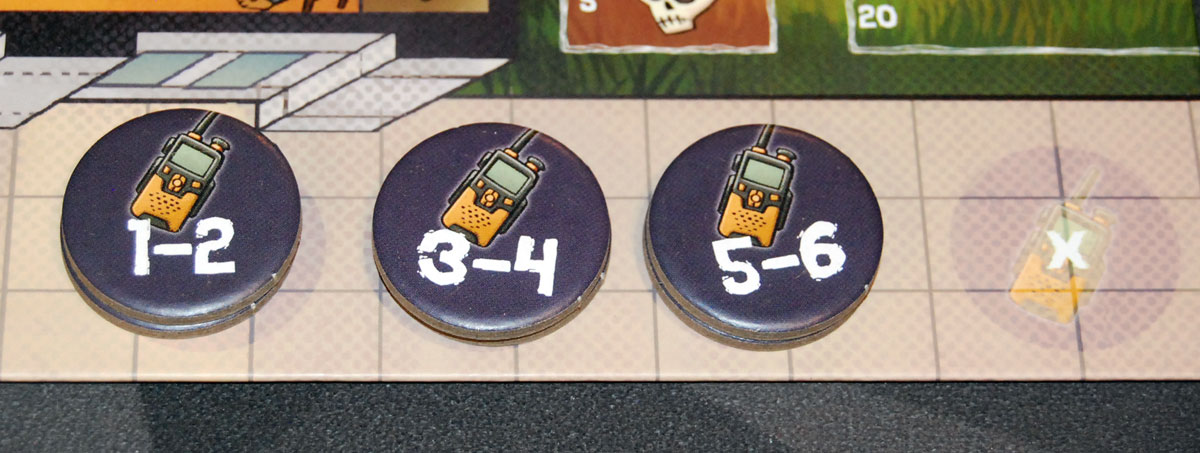
During setup, you place the 6 signal tokens at the bottom of the main board. There are two copies each of three tokens, showing “1-2,” “3-4,” and “5-6.” After selecting an action token, you may optionally take a signal token and place it on your action token to indicate what action you’ve chosen, and then once everyone has revealed tokens, the signal token is discarded and may not be used for the rest of the game.
Why You Should Play On Call
Hospitals seem to be a popular setting for board games, particularly cooperative games. (I have played competitive games with a medical theme, but those tend to be about competing hospitals … and it still feels a little inappropriate to compete when it comes to treating patients and saving lives, even if that is kinda the reality in American healthcare.) The tension of managing a bunch of patients, dwindling supplies, limited staff, and—of course—caffeine makes for a stressful challenge that requires both careful coordination and the ability to shift strategies when random events throw a wrench into your plans. On Call keeps you on high alert, balancing the needs of your patients with your staff’s exhaustion.
Thematically, I’m not 100% sure who the players actually represent in On Call. I mean, you’re animals, and most of them are dressed as if they are doctors, nurses, lab techs, or something. But you are not actually present on the board—instead, there are various generic doctors and nurses in the emergency department, and the players are directing them, moving them around to perform actions, without actually being those doctors and nurses. Are we more like administrators?
While it doesn’t specifically say so in the rulebook, it seems like this emergency department is dealing with some sort of epidemic: the high-priority patients are infected and contagious, requiring quarantine to keep the infection from spreading. That doesn’t sound like you’re dealing with car accidents or severe wounds. Maybe a zombie outbreak? (Hmmm, fertile ground for a sequel… maybe you don’t want Death’s Door right outside the door to the hospital after all.)

At any rate, we have our work cut out for us. Every day there are more patients entering the emergency department, and the first thing we need to make sure is that there are enough beds in the waiting room, or they’re immediately headed for Death’s Door. And then it turns out we’d really like to have a couple extra beds, because if we don’t, the infections will spread from one patient to the next—and highly infectious patients are the hardest to treat. But do we get more beds using the Equip action, or simply by moving the patients to the treatment room and treating them? I mean, treating patients is the ultimate goal, so let’s try that.
Then you realize it’s not that simple. Somebody needs to resupply the medicine cabinet because we’re running short. Also, you can’t treat a patient if you don’t know what’s wrong with them, so we really need to triage those walk-ins before they can be moved out of the waiting room. And since it’s less costly to treat the patients who aren’t as sick, maybe somebody should re-test those patients in the quarantine room and see if they’re okay to move out yet.
Since everyone has some specialized actions, it means that who does what really matters. There’s only one person who can restock the medicine and blood, and you can only do it so many times before you have to rest. So then you want to make the most of it: maybe somebody assists you so your action is more effective. The same goes for any of the other specialized actions—part of the puzzle is figuring out when each player does what, when it feels like there’s never enough time for all of it.
And, of course, don’t forget to rest, because caffeine only goes so far. Not only does it get your action tokens back so you can repeat an action, it lets you buy skills, making those actions even more powerful. There’s no limit to the number of skills you can have per action, so in theory you could load up an action with a whole lot of skills, and then every time you take that action, you get lots of different effects. The flipside of that is you’re only going to do any action a few times during the whole game, unless you spend every other turn resting. (The other way to gain skills is as a bonus for treating patients, so it’s important to take turns doing that so everyone gets a chance to learn some skills even without taking a rest.)
What’s interesting is that the game is only 9 rounds total, so if everyone takes their maximum of 5 actions before they rest, then there are only 3 shifts to go after the rest. (Also, a free strategy tip: it’s a bad idea for everyone to take their break at the same time, because then you’re definitely going to overrun the waiting room!) In the games I’ve played, we’ve often had trouble deciding who should rest when, because it always feels like there’s something you could be doing instead of resting—which feels pretty realistic.
So far I’ve only played On Call a handful of times (and the prototype has a limited number of the scenarios to try) but my gaming group has enjoyed the challenge. We’ve had some losses and some close-call victories. In one case, we managed to treat enough patients, but had too many high-priority patients left in the ER at the end of the game. In another case, we were struggling to reduce the number of high-priority patients so we just barely hit our treatment target by the end. The random events that occur each shift can be good or bad, and there’s no perfect way to plan for them ahead of time. And I’ve only played in the full communication mode, because the limited communication sounds terrifying! If your gaming group tends to think cooperative games are too easy to win, though, maybe this is right up your alley.
For more information or to make a pledge, visit the On Call Kickstarter page!
Click here to see all our tabletop game reviews.
 To subscribe to GeekDad’s tabletop gaming coverage, please copy this link and add it to your RSS reader.
Disclosure: GeekDad received a prototype of this game for review purposes.


