

Curate the art exhibits in your gallery, but beware your rivals, who might snatch up the piece that would complete your collection.
What Is Gallery Gambit?
Gallery Gambit is a set-collection game for 2 to 5 players, ages 10 and up, and takes about 20 minutes to play. It’s currently seeking funding on Kickstarter, with a pledge level of $34 for a copy of the game, or $20 for the custom card deck (which can be used to play the game, just without the extra player mats). Or, if you really love what Four Suit Studio is doing, you can pledge $261 to receive Gallery Gambit and all future releases from the publisher. The game is fairly simple to learn and I think you could go even younger than 10, especially for kids who have played some traditional card games.
Gallery Gambit was designed by Simone Luijk and Robin Stokkel and published by Four Suit Studio, with illustrations by Julia July.
New to Kickstarter? Check out our crowdfunding primer.

Gallery Gambit Components
Note: My review is based on a prototype copy, so it is subject to change and may not reflect final component quality.
Here’s what comes in the box:
- 54-card Poker deck (with jokers)
- 2 Player Aid cards
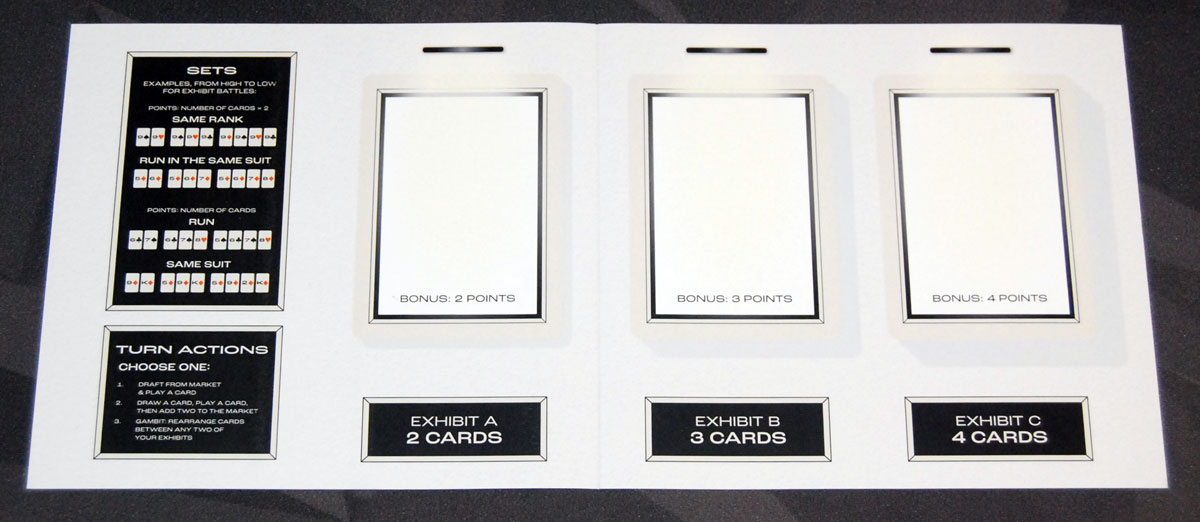
- 5 Player boards
- Player starting chip
- Score pad

How to Play Gallery Gambit
You can download a draft of the rules here.
The Goal
The goal of the game is to score the most point by curating your three exhibits, over the course of 3 rounds.
Setup
Give each player a player board. Depending on the player count, you may remove some cards from the deck. Then shuffle the deck and deal 1 card to each player, which is kept secret.
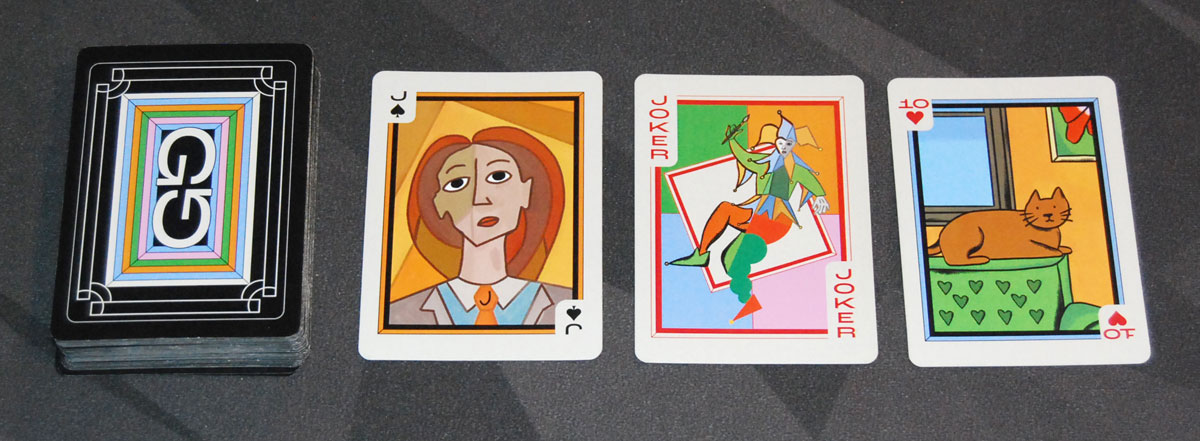
Place the deck near the center of the playing area and flip 3 cards face up to form the market. Choose a player and give them the start player token.
Gameplay
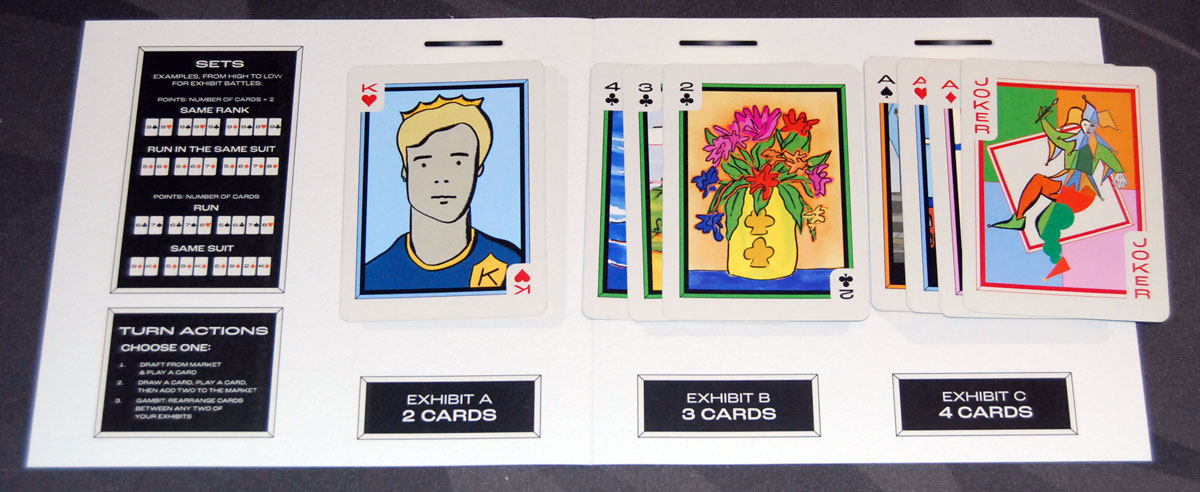
Every player has 3 exhibit spaces. Exhibit A can hold up to 2 cards, Exhibit B can hold up to 3 cards, and Exhibit C can hold up to 4 cards.
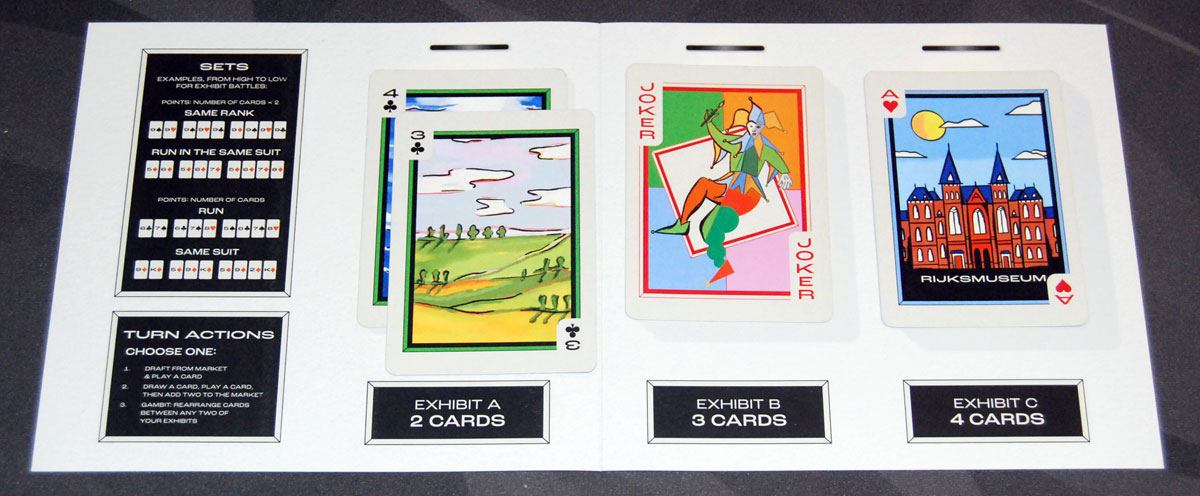
On your turn, you choose one of these options:
- Draft and play: Take a card from the market, and then play a card from your hand into one of your exhibits, If the market is empty add 3 more cards from the deck.
- Draw and play: Draw the top card of the deck, and then play a card from your hand into one of your exhibits, and then add 2 cards from the deck to the market
- Gambit: Pick two of your exhibits and freely rearrange the cards from those two exhibits. (You must move at least one card.)
The round continues, with players taking turns until somebody fills all three of their exhibits. Remaining players take one more turn. Then, reveal cards from the market until there are 8 cards in the market (or the deck runs out). In turn order, players with jokers in their exhibits may exchange each joker with a card from the market.
Scoring
Each exhibit gets points based on its best set of cards. A set must have at least 2 cards to score; any cards in the exhibit that aren’t part of the set are ignored.
The sets are:
- Same rank (pairs, triples, 4 of a kind): 2 points per card
- Run in the same suit (e.g., 2 and 3 of hearts): 2 points per card
- Run (but not all the same suit): 1 point per card
- Same suit: 1 point per card
Then, you have exhibit battles. For each exhibit, you check which gallery has the best set and they get bonus points. To compare exhibits, first check which one has the most cards. If there is a tie, then check which player has a higher ranked set type based on the order above. If it’s still a tie, then check the highest cards in the set, followed by second highest, etc. Finally, if everything is still tied, all the tied players score the bonus points.
Exhibit A is worth 2 bonus points, B is worth 3 bonus points, and C is worth 4 bonus points.
Gather up all the cards and set up for a new round, passing the start player marker to the left.
Game End
The game ends after three rounds. Highest score wins! (There isn’t a tie-breaker.)
Why You Should Play Gallery Gambit
I love that Four Suit Studio is really committed to games that use a traditional poker deck. This is their third title so far, and given their name, I expect that’s probably the plan for future releases as well. It does mean that you can just look up the rules and play the game with any old poker deck you have lying around—and that’s a perfect way to try before you buy—but their custom poker decks are also charming and add to the specific flavor of each game. (As somebody who used to collect poker decks, this also just has a bit of nostalgia for me.) The additional components included in the box sets of their games aren’t strictly necessary, but they do make things a bit easier by organizing the game space, providing score sheets, and so on.
Gallery Gambit is about collecting valuable sets and getting them arranged in your gallery. The best set type is same rank, so you’re always on the lookout for pairs and triples, the higher the better. The next best is runs of the same suit. As you look over the market, you try to gauge what’s going to make the best set, what you’re likely to fill, and whether anyone else is trying to collect cards that will interfere with your own plans.
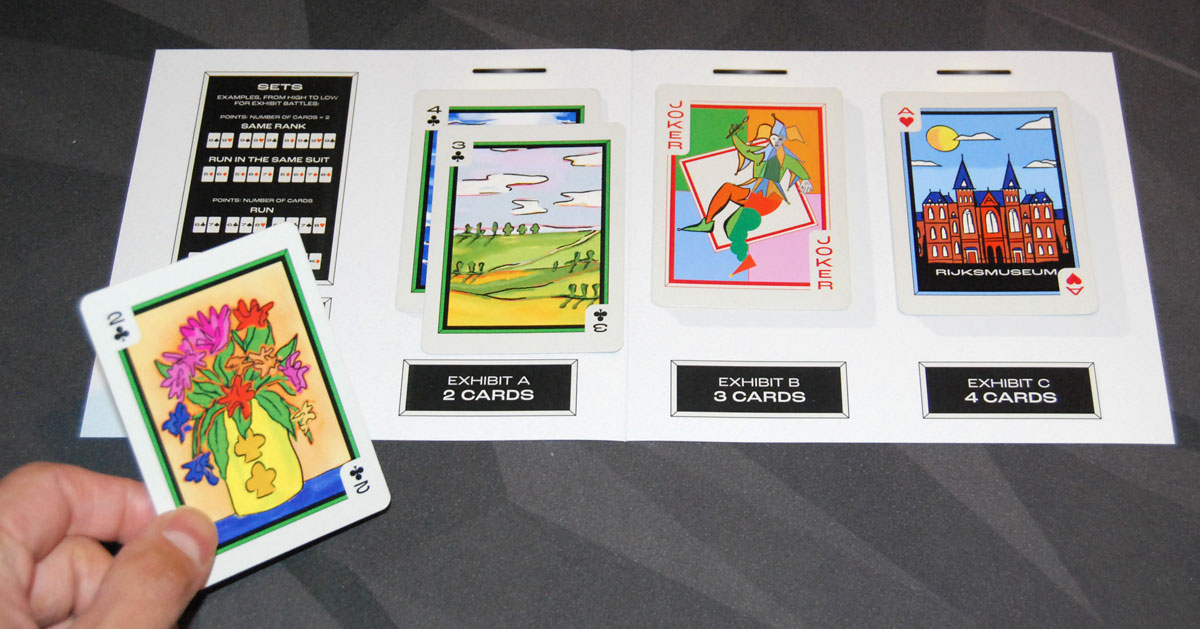
One of the tricky decisions, though, is guessing how many cards you think you’ll get in each set. Let’s say you have an 8 in your hand already and there’s an 8 in the market: great, that’s an obvious choice, so you take it! But now what? Do you put it in Exhibit A, guaranteeing you’ve maxed out your score there? Or do you put it in B or C, hoping that you’ll be able to acquire more 8s later in the round?
If you make the wrong choice, it’s not the end of the world, because you can always take the gambit action to rearrange things. Let’s say you put that 8 in Exhibit A and then another one came up in the market. If you grab that you’ll have to put it in one of the other exhibits, where it’s not helping your set. Then on a future turn, you gambit, moving your 8s over to the other exhibit. No problem! Except on that turn while you were rearranging your cards, your rivals continued to take cards, which means now they have more total cards than you. If you take too many turns shifting cards around in your gallery, you might find yourself left behind simply because you never managed to fill your exhibits. Since the round ends as soon as somebody fills their gallery, you’re only guaranteed nine turns—it’ll only go longer than that if everyone uses the gambit action at least once, so there’s always a risk.
Another dilemma you often face is what to do when you don’t really like the card in your hand and there’s nothing great in the market. Do you draw from the top of the deck? That’s taking a chance—you might get a perfect match, but chances are you get something you didn’t really want, and now you must add one non-optimal card to an exhibit. Not only that, but you also add two more cards to the market, which means maybe you just helped the next player.
Keeping an eye on what other people are collecting in their exhibits is important. If you know somebody has a pair of 10s already, maybe trying to build a 9-10-J run isn’t such a sure thing. On the other hand, sometimes when you’re presented with a few choices in the market that are equally good for you, you can make things just a little harder for one of your opponents, too.
The bonus points may seem small, but in the scheme of things, it’s enough to put you into first place because the scores can be very close. It may be worth using a gambit to move a set around to guarantee that you’ll win that exhibit challenge, even if it means being short a card somewhere else.
All in all, Gallery Gambit is an engaging game—victory depends on watching your rivals and deciding when it’s a good idea to compete over a highly sought-after piece versus picking up the hidden gems that other players are ignoring. And, yes, there’s a bit of luck, too, because the art market can be a bit unpredictable and the card you’re waiting on just might show up too late … or is already hidden in somebody else’s hand.
For more information or to make a pledge, visit the Gallery Gambit Kickstarter page!
Click here to see all our tabletop game reviews.
 To subscribe to GeekDad’s tabletop gaming coverage, please copy this link and add it to your RSS reader.
Disclosure: GeekDad received a prototype of this game for review purposes.


Jonathan H. Liu

Jonathan H. Liu is a stay-at-home dad in Portland, Oregon, who loves to read, is always up for a board game, and has a bit of a Kickstarter habit. I can be reached at jonathan at geekdad dot com.


