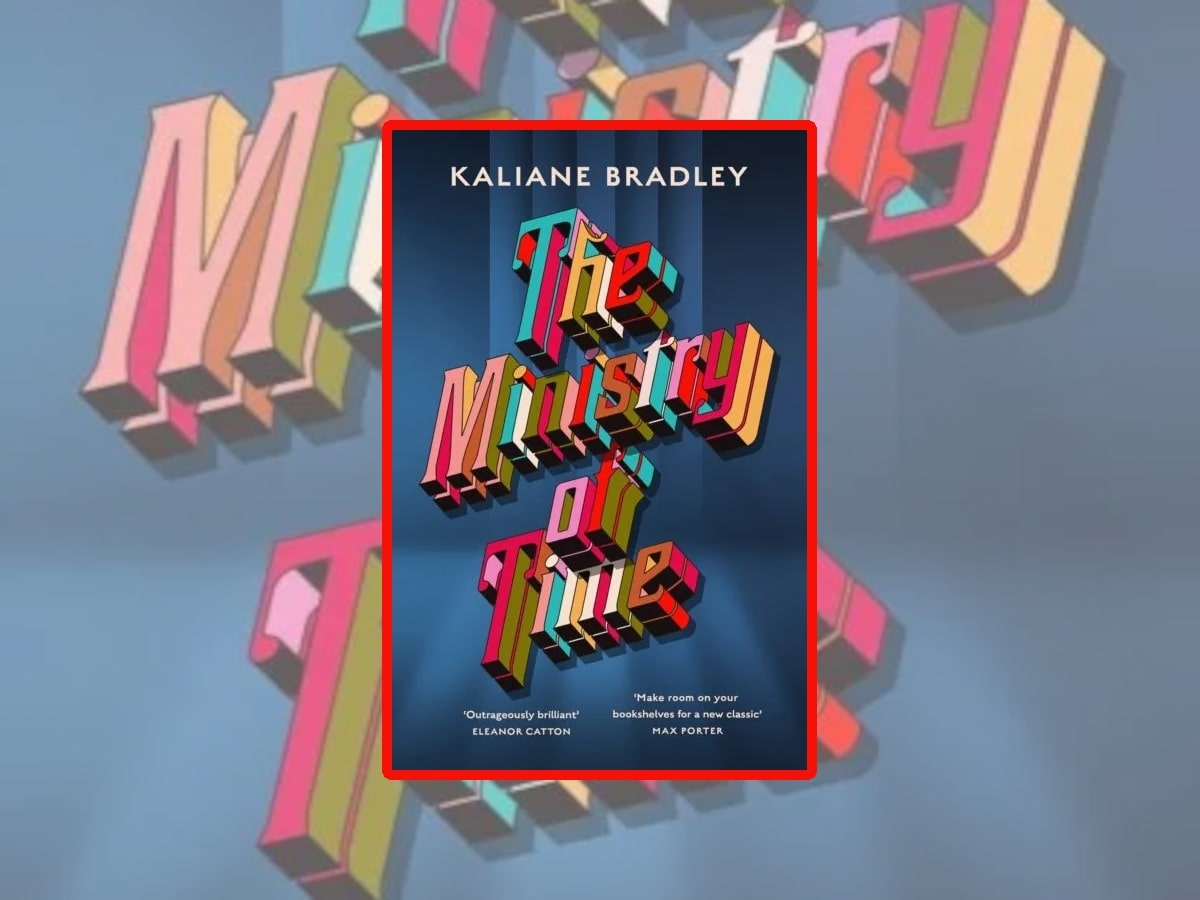
It has been impossible to move on my timeline (if you’ll excuse the pun) for mentions of The Ministry of Time. It’s been on my radar for a while; a novel about state-controlled time travel is dead center of my reading crosshairs. I was tempted to contact the publisher about obtaining a review copy, but experience told me that for a release this big, I probably wasn’t in the running (as the list of blurb authors is prodigious and prestigious). I figured I’d do what I usually do in these circumstances and wait for the paperback to come out.
Then an email from Waterstones—one of my bookstores of choice here in the UK—arrived offering me the chance to buy a signed copy. The last time they did this, and it stuck, they were pushing Tomorrow and Tomorrow and Tomorrow. I succumbed, read it, loved it, and now it’s one of the biggest-selling titles worldwide. (The third thing here may not have a causal relationship to the first two, but it is definitely a very good book.) Not wishing to miss out on The Ministry of Time hype, I dived right in, even though it would seriously upset my already full May 2024 reading schedule.
Anyway, bought it, read it, loved it. And here’s why.
What Is The Ministry of Time?
Nominally, this is a book about time travel. The British government has invented (acquired?) time travel technology and they’re trying to work out what exactly this might mean. To do so they have set up the eponymous government department. For their first foray into chronological experimentation, they retrieve seven people from history—people who history tells us disappeared, presumed dead.
The novel focuses on a new Ministry employee—it was only on starting to write this review, that I realized that she isn’t named in the book—and her relationship with the time traveler she is assigned to help acclimatize to the modern world. She is the “bridge” to Commander Graham Gore, who disappeared on the expedition to find the Northwest Passage in the 1840s, the same expedition depicted in the TV series based on the Dan Simmons novel, The Terror. (As well as all the other great stuff in this book, it serves as an excellent jumping-off point for those interested in learning more about Arctic exploration.)
Much of the novel charts our narrator’s relationship with her charge and his reintegration into the modern world. We also see several of the other time travelers, including a soldier destined to be killed in the trenches. This helps us build up a picture of the attitudes of the Ministry and an examination of historical perspectives from differing periods.
The big unknown in the story is what exactly the Ministry aiming for with this project. It’s investigating the effects of time travel, but what is its end game? The longer the novel continues the more sinister its motives seem to be.
Why Read The Ministry of Time?
As I said to my fellow GeekDad book reviewer, Jonathan Liu, who loves a time travel novel, this is more “time travel adjacent” than a traditional time travel story. There are no grand plans about altering history, no terror of disrupting the timeline, and no fading Polaroid photos. Some of these things do bleed into the novel, but, at its core, this is not what The Ministry of Time is about.
It is no coincidence that the author of the book, Kaliane Bradley, and its narrator are the daughters of Cambodian immigrants. Bradley juxtaposes the geographical immigrant story against the temporal immigrant story, and it’s this friction that gives the novel its power. It’s an immigrant story in science fictional garb, highlighting the pressures and prejudices faced by first- and second-generation immigrants. It elegantly depicts what it is to be defined by something you have no control over.
It’s a novel about attitudes to outsiders, those different from us. It might even be considered a mediation on the idea that “the more things change, the more they stay the same.” The time travelers hail from a time spanning 100-400 years; they all have degrees of difficulty assimilating. Even as 21st-century readers, we recognize something in each of their experiences, making us realize that this century isn’t as enlightened as we’d like to think.
The relationship between our narrator and Graham is excellent. Not far into the novel we want a spark to ignite between them, but we fear the consequences of it doing so. Bradley drip-feeds us her narrative’s skulduggery, and the tension is fierce in the novel’s final third. The time travel elements are unobtrusive yet pivotal to the novel’s central themes. It’s a marvelously constructed whole, and I couldn’t drag myself away from the last 100 pages.
The Ministry of Time feels like a novel cut from the same cloth as Kate Mascharenhas’ Psychology of Time Travel (which you definitely should read, if you haven’t). It’s not a book about the science of time travel but about the emotions of time travel and, in a weirdly compelling way, the bureaucracy of time travel. The book feels positioned in a space similar to Lessons in Chemistry and Tomorrow and Tomorrow and Tomorrow—books that on the face of it, occupy a slightly odd space, but which, in reality, means they appeal to an awfully large number of people. Both those books were smash hits, and The Ministry of Time should be too. If it is, it will be thoroughly deserved.
If you would like to pick up a copy of Ministry of Time you can do so here in the US, and here in the UK. (Affiliate Links)
If you enjoyed this review, check out my other book reviews.
I received a copy of this book in order to write this review.