
Today’s roundup is a bit bigger! Often my roundups are primarily games that looked interesting to me but that I haven’t had a chance to play, so my knowledge is limited to what’s on the campaign page or what I happen to know about prior projects from the same creators. This time, there are a few projects that are new editions of games I’ve played, so I’ll go into a little more detail there, particularly for ones where I haven’t done a full review.
New to crowdfunding? Check out our crowdfunding primer.
Good Dog, Bad Zombie from TESA Collective
We’ll start with one that I’ve reviewed before, when it was first launched on Kickstarter back in 2018. It’s a cooperative zombie game, but the twist is that everything is from the perspective of the dogs—you play as the doggos, investigating interesting scents and looking for the hoomans to bring back to Central Bark. It’s a funny game with a lot of dog-related humor in it, and there are a few difficulty levels for your group to choose from.
While I enjoyed the game, the first edition’s components were on the cheaper side: folded cardstock standees, small cards (without rounded corners), and a fairly thin board. This new edition has the same gameplay but with upgraded components: the zombies and hoomans are meeples now, the cards are larger, and the standees are cardboard. There’s an option for people who have the first edition to get the new game content—all of the playable dogs plus a few new ones—though it doesn’t look like it includes the upgraded components. And, as in the first campaign, there’s a pledge level to get your own doggo as a playable character in the game—it’s only $15, which seems like a pretty good deal to get a custom illustration of your dog. Read my original review here, and check out the Kickstarter campaign for what’s new!
ICE Second Edition from This Way
The first time ICE was launched on Kickstarter back in 2021, I was almost exclusively playing games online instead of in person because of the pandemic, but my old computer simply could not handle the Tabletop Simulator version of ICE because of all of the layered tiles that form the board. As it turns out, that very impressive board also became something of an issue in the physical version, leading to some lengthy delays and extra costs, but This Way finally managed to get it printed and delivered, and later sent me a copy to try out myself.

ICE is a visually stunning game, using the color of the tiles to heighten the sense of depth as you dig through multiple layers of ice, seeking artifacts left behind from an ancient civilization. The board used a large, multi-layer frame that held overlapping hex tiles: when you started the game, everything is covered in a layer of white snow, and by the end of the game you’ll reach the darkest layer at the bottom.
The gameplay itself involves managing your action points each round and some set collection for the different colored artifacts so you can fulfill contracts and decrees. One of the twists is that each type of artifact gives you a special ability you can use while you’re carrying it, but you’ll only score points for the artifacts that you ship back to the city, so throughout the game you have to balance the two. Ship everything back every round, and you may fall behind because you don’t have those extra abilities; hang onto too many, and you’ll run out of time to send them back for scoring.
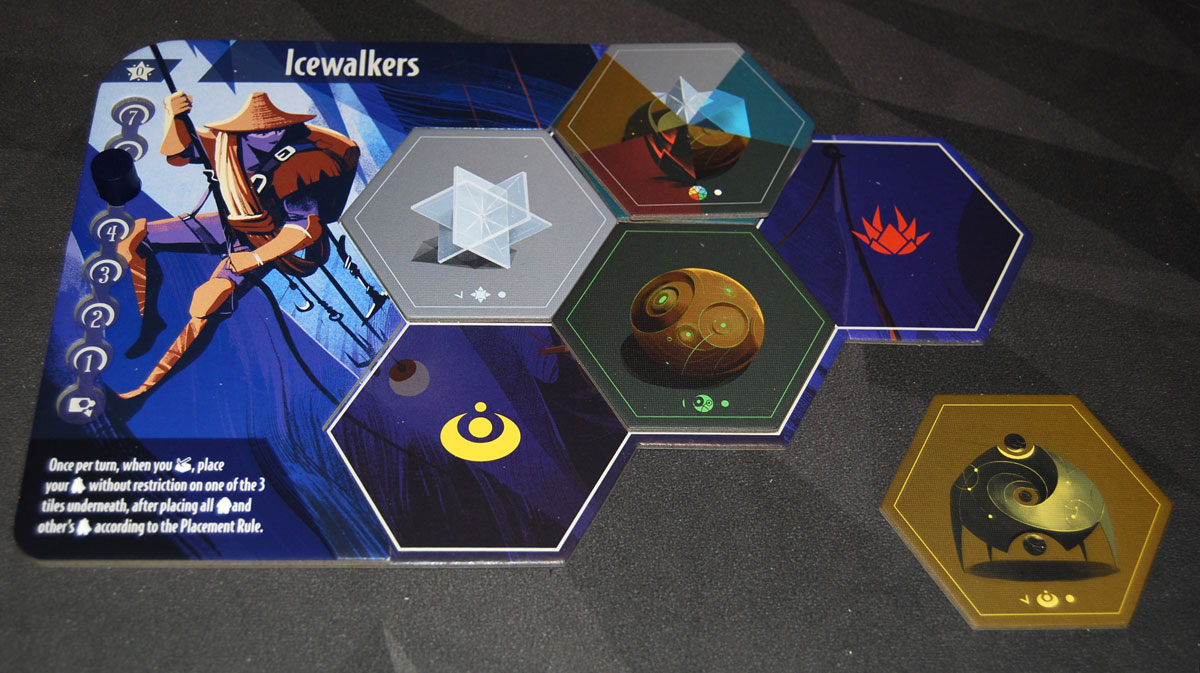
Another interesting aspect is the way you dig: you need to spend action points to dig, but the more people are with you, the less it costs because you all dig together—and you can rely on both the plentiful NPC archaeologists and on other players! It’s like when your friend says “hey, can you come over and help me move?” and you really don’t feel like you can say no. That leads to the tactic of sidling up to another player, digging a hole with their help, and then getting far enough away that when it’s their turn you can say “oh, sorry, I’d love to help but I’m way over here.” (I mean, that’s my tactic, anyway.)

Because of the expense of making the multi-layered board (the deluxe version even included magnets to hold the four pieces together), This Way realized they needed to make some changes to the game for this new edition to keep it more manageable. The new version has one fewer layer, though the game ended when that last layer was revealed so it doesn’t actually end up changing the gameplay that much. They also took the opportunity to make some other tweaks to the game—for instance, the snow tiles on the top have special effects when you remove them, and these have been balanced a little more in the new edition. For backers of the original, there is a kit that lets you play with the second edition rules if you’re so inclined (so you’ll essentially have both versions).
With asymmetric player powers, the forced “cooperation” of the digs, and that tricky balance between keeping artifacts and securing them for scoring, ICE has been an intriguing game to explore, and I’m happy to see it getting a second chance for people who missed it the first time around.
Feudum Septennial Edition from Odd Bird
Feudum was originally funded on Kickstarter back in 2016, and now Odd Bird is running a Gamefound campaign for its Septennial Edition. It’s a sprawling game set in a medieval fantasy world, with artwork that looks more like a psychedelic concert poster than what you’d expect from, well, a medieval fantasy world. I was sent a copy back in 2018 but it’s like my white whale: I just haven’t managed to tackle writing the whole thing up, in part because it’s such a beast, so I’m glad to have the chance to share a bit more about it now for its renaissance.
In Feudum, players will choose from their set of action cards to move around the board, build things, fight, and so on. There are 11 different action cards, and every round you have to choose 4 of them in advance that you’ll use during the round, which takes some careful planning and trying to predict what everyone else is going to be doing. The most complex of these actions is the Guild action, because it triggers an effect in a complex web of six guilds, each of which has systems that take in resources from the previous guild and passes resources to the next guild. The action you take depends on your level of membership in the guild, which means that the Guild action is actually 18 possible actions in itself!

As you can see, the game is not for the faint of heart. I consider myself pretty good at teaching games generally, but I have yet to finish explaining a game of Feudum in under 45 minutes, and even then I made mistakes that I promised to correct next time … and then the next time I made different mistakes. It’s a lot to keep track of.
I’ve had the privilege on occasion of having a few really fancy meals in my life, like a 10-course seafood banquet at a cousin’s wedding. (Stick with me here—I’ve got a point, I promise!) While I may not have loved every single course offered, the meal as a whole was delicious and formed a memorable experience that I enjoyed. It offered a rich tapestry of sights and tastes, each element presented in a way meant to complement what came before and would come after. But a multi-course meal is also something that I haven’t ever paid for myself; it’s extravagant, expensive, and is the sort of thing you reserve for special occasions, not your everyday meal. It’s something I’ll always enjoy when offered, but probably not something I’ll be splurging on any time soon.
Feudum feels a bit like that: it’s a rich, colorful spread that covers the entire table and is almost too much to take in all at once. Whether you’re a fan of the art style or not, there’s no denying that it’s remarkable and out of the ordinary. All of the elements add up to an experience that I’ve enjoyed, even if there are bits here and there that aren’t my favorites. And, lastly, it’s a pricey game (not to mention a long game) that not everyone will want to splurge on, both in terms of the financial cost and the time cost. It’s not an everyday game; it’s an event game, one that I have to plan for ahead of time.

All that is to say that I really do enjoy Feudum. It’s a feast for the eyes and a treat for your brain, and although it takes a long time to play, it didn’t feel like a game that was dragging on past its welcome. If it were shorter, I’d probably be more inclined to play it more often, but I also didn’t see a good way to remove much without breaking the web of interactions between the various guilds. There’s part of me that felt like the game had some complexity for complexity’s sake—the game is fairly fiddly—and there’s part of me that wouldn’t want to remove any of it.
The new edition includes a metal Behemoth (that funny one-horned monster on the cover), plus some tweaks to the game board to accommodate a 6th player and make a few things a little clearer—if you have the game already, you can get an upgrade kit for it. There are also five expansions and lots of additional deluxe bits—I’ve been tempted but have decided to hold off until I feel like I can play the game consistently without forgetting some rules! It’s been a while since I last played Feudum but I’ve just unearthed my copy from the stacks and I’m eyeing it again thanks to this new campaign. Maybe it’s time for another 10-course meal.
Rapid Dungeon from GOTTANI
I received a prototype of Rapid Dungeon recently that I’ve gotten to play a few times so far—I may do a full review soon but wanted to share today just to give it a quick highlight. It’s a cute little set-collection game where you’ll get points for collecting treasures, fighting monsters, and gathering companions for your dungeon-crawling party. But the twist is in how you collect the cards: everyone flips a card at the same time, and then you toss these chunky foam blocks onto the card you want. You need to be fast, but also accurate, using the correct side of your block to match the card, and making sure you don’t miss! (And don’t be too slow, either, or somebody else might get to a card before you do.) Different setup cards mix up the scoring opportunities for the cards, and it goes up to 6 players with an optional cooperative mode. Quick, silly fun that will have you laughing as everyone is flinging their foam blocks around the table!
Glim from Emerald Anvil
Glim is a collaboration between Eduardo Sanchez, the director of The Blair Witch Project, and Twogether Studios: it’s purportedly a strange game discovered at an estate sale, a game played on a fairy world that has made it into ours. If that sounds vaguely familiar, it may be because Twogether Studios were also behind Illimat, a card game made with The Decemberists that also had a “found in the attic” story: Keith Baker and Jenn Ellis showed a knack for bringing to life a game that really did feel like an obscure found artifact, with elements of classic card games, and I’m really intrigued to see what’s in store here. Glim has custom dice, some deck-building, and some push-your-luck elements, and it has a beautiful presentation with a cloth board.
Amsterdam Board Game Design Season 1
Amsterdam Board Game Design is a collective (from Amsterdam, of course) that has been designing and playtesting games together, and this is their first Kickstarter campaign to publish three of the titles from the group, from three different designers. Gratchenpand is a card drafting game about building colorful houses along the canal. Time Zoo is about luring back various prehistoric animals that have escaped just before the zoo’s opening. Bable is about building the Tower of Babel but with a language barrier. I’m particularly interested in Bable because I love playing with language in games: you have to give commands to other players to manipulate cards or place cards into the tower, but you have to use the words that they understand—and everyone’s words are changing throughout the game, too.
CatStronauts from Atlas Games
This cooperative, kid-friendly game is based on the CatStronauts comics series, which I’ve written about before in my Stack Overflow columns. It is designed by the comics creator Drew Brockington, so it has silly humor and cat-based puns that fans of the book will appreciate. Assemble the Fish Finder Satellite before time runs out—and hit the Panic Button if things get tight! (Note: sometimes the Panic Button just makes everyone scream in panic, so … no guarantees there.)
Formosa Tea from Taiwan Boardgame Design
I’ll admit: I backed this one mostly because of the publisher. I met Smoox Chen of TBD Games a few years ago when he attended Gen Con, and was also able to attend a board game festival during a family trip to Taiwan in 2019. Whenever we go to Taiwan (only once every several years), we always try to stock up on some tea, particularly some varieties that Taiwan doesn’t export. We’ve gotten to visit tea plantations to see how it’s made, and so a board game with that setting is really intriguing to me.
Regicide Legacy from Badgers from Mars
Regicide is a cooperative game funded on Kickstarter in 2020, where you work together to battle corrupt Kings. I forget where I first heard about it, but the game uses a standard deck of cards and you can get the rules for free. (The original Kickstarter campaign was for custom decks of cards that had illustrations of all the characters.) I printed out the rules at some point but just never got around to trying it since I’ve had all these other games to review. Regicide Legacy is a new version that takes your party on a 12-game campaign, building onto the original, and it looks like it’ll have a little more story to it as you play. I like the art style and the concept—I’ll probably give the original a try soon before this campaign ends so I can decide if I want to back it.


