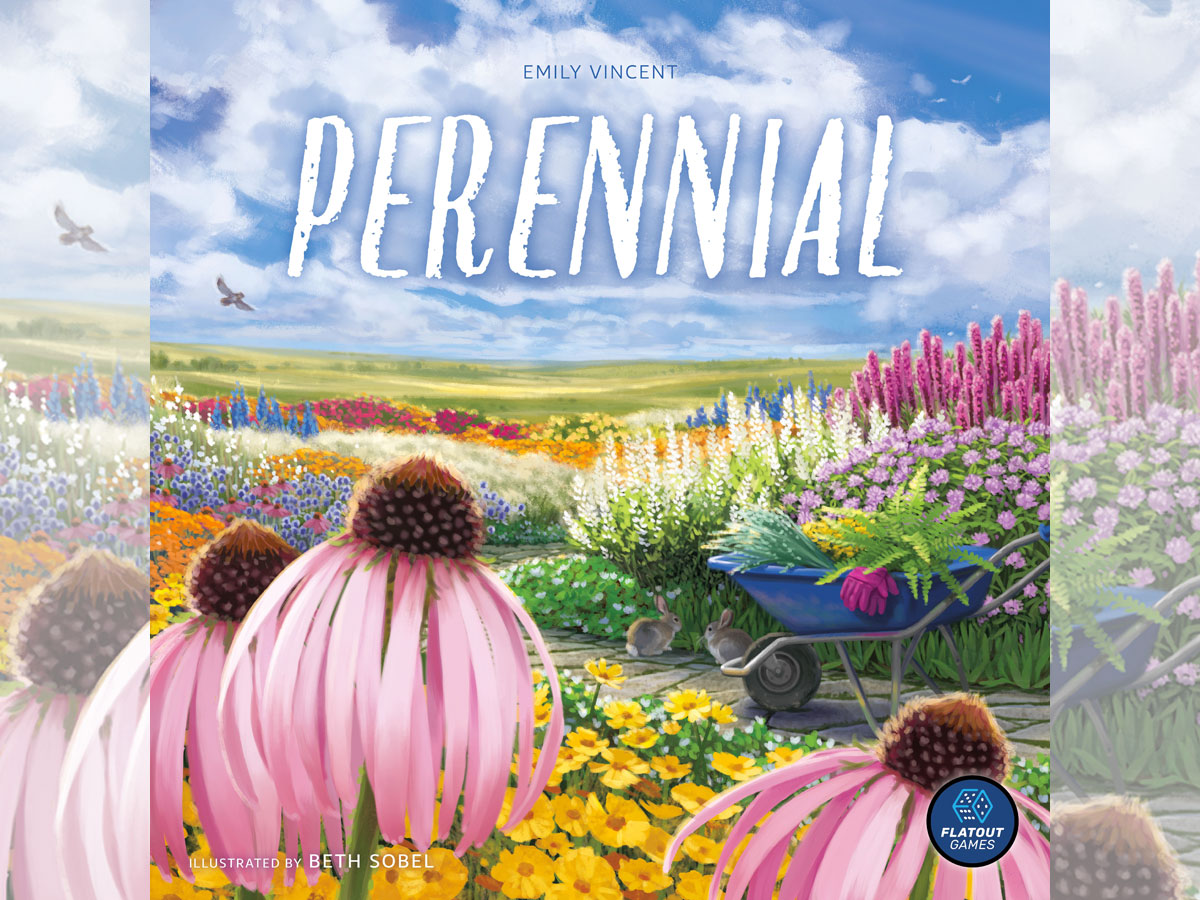
Plot out your perfect flower garden … and then pivot when things don’t go exactly as planned!
What Is Perennial?
Perennial is a tile-placement game for 1 to 4 players, ages 10 and up, and takes about 30–45 minutes to play. It’s currently seeking funding on Kickstarter, with a pledge level of $29 for a copy of the game.
Perennial was designed by Emily Vincent and published by Flatout Games, with illustrations by Beth Sobel. (The solo mode was designed by Shawn Stankewich.)
New to Kickstarter? Check out our crowdfunding primer.
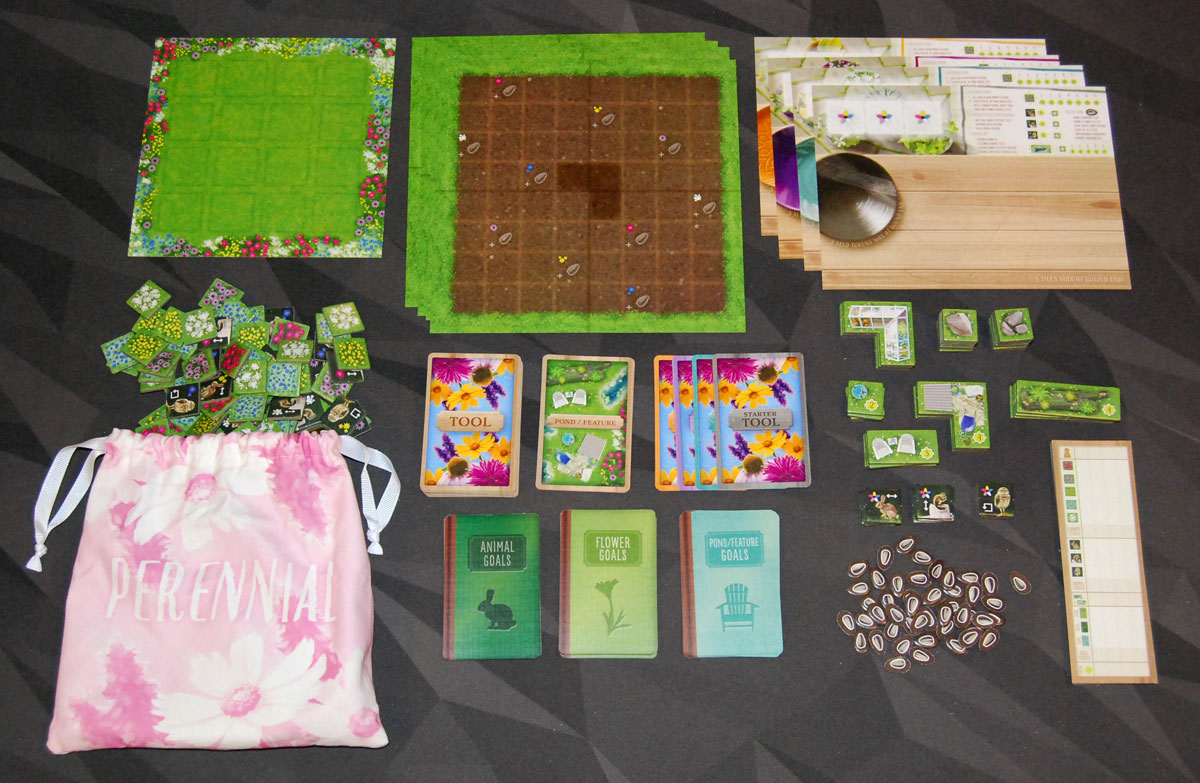
Perennial Components
Note: My review is based on a prototype copy, so it is subject to change and may not reflect final component quality.
Here’s what comes in the box:
- Central Drafting board
- 4 Garden boards
- 4 Workshop boards
- Cloth bag
- 185 Flower tiles (37 each in 5 colors)
- 45 Animal tiles (15 each in 3 types)
- 12 Wild Animal tiles (4 each in 3 types)
- 16 Pond/Feature tiles (4 each in 4 types)
- 16 Boulder tiles
- 4 Greenhouse tiles
- 40 Tool cards
- 8 Starter Tool cards
- 4 Pond/Feature cards
- 27 Goal cards (9 each in 3 types)
- 50 Seed tokens
- Scorepad
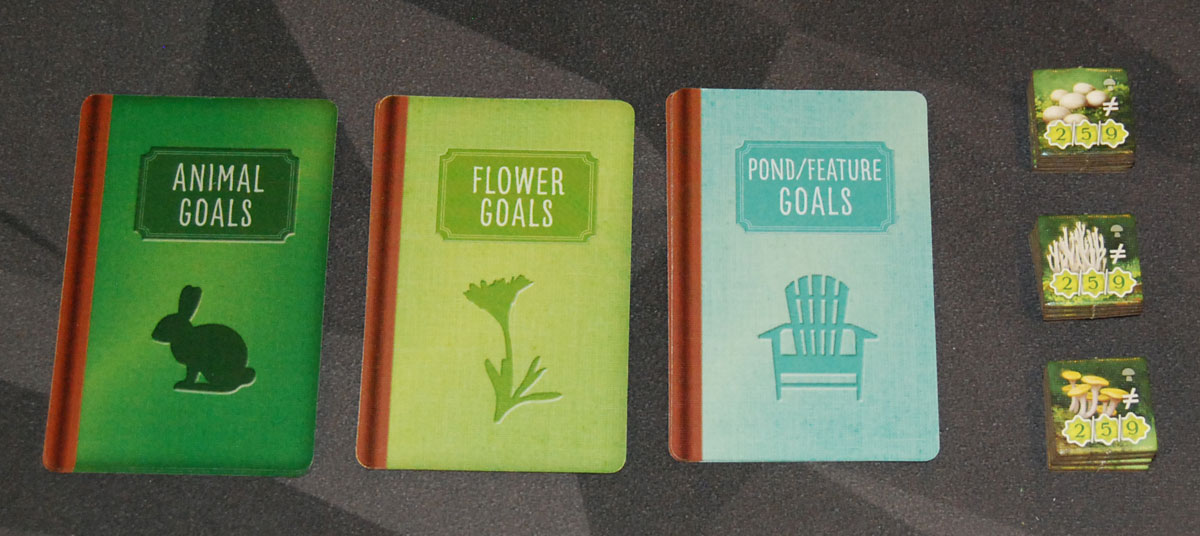
Kickstarter backers will also get a free mini-expansion that includes 9 more goal cards, as well as 12 mushroom tiles to mix into the supply.
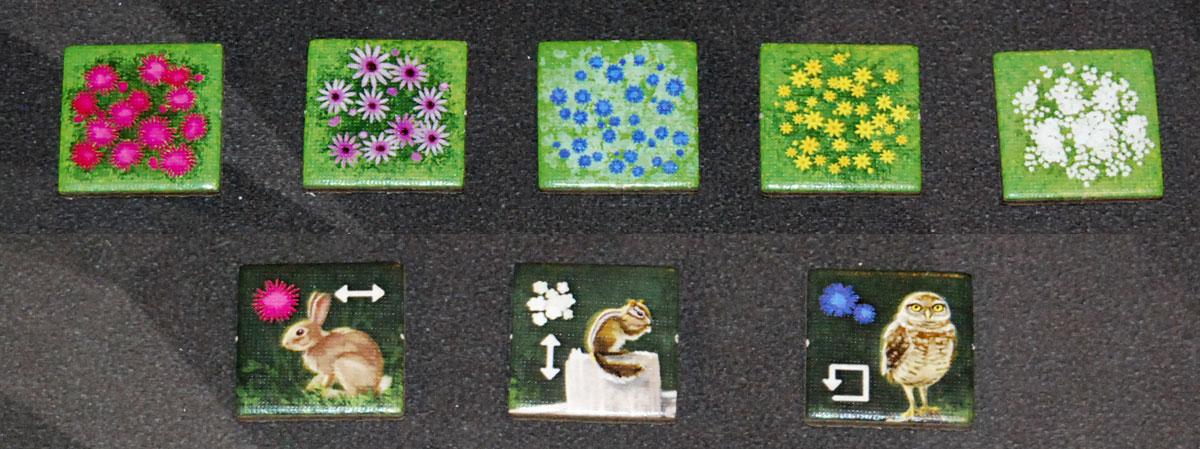
There are 5 flower types, each with a distinct color and shape—each tile depicts a whole clump of one flower. There are three animals—rabbit, chipmunk, and owl—and each one has a little arrow icon indicating its scoring type, as well as a flower icon in the corner. (The wild animals are the same, but have the “wild” icon in the corner instead.)
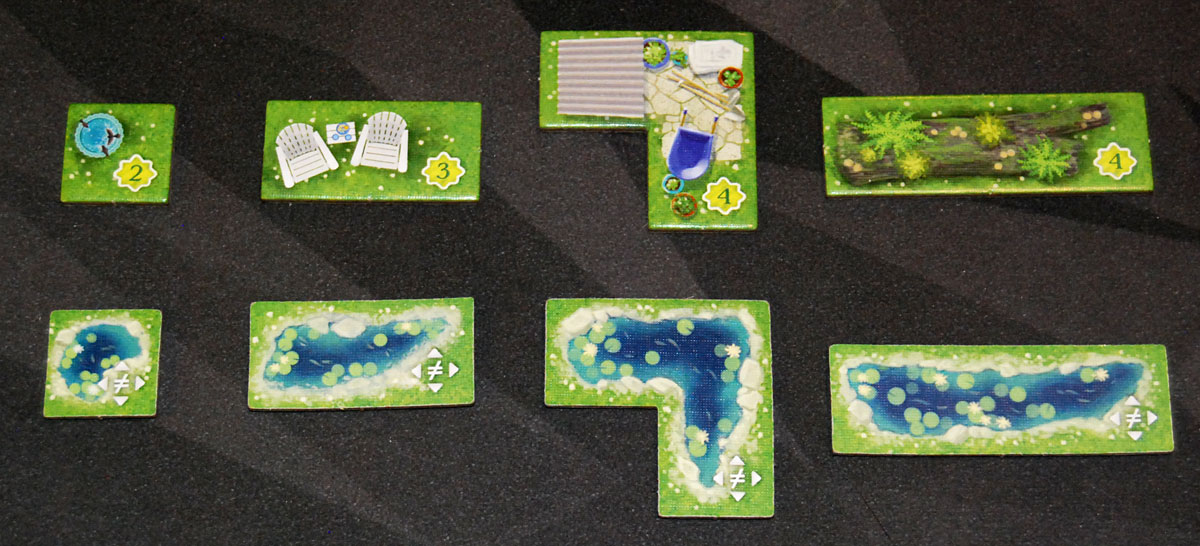
The pond/feature tiles come in four sizes, and each one has a pond on one side and some sort of garden feature on the other, like lawn chairs or a mossy log. The greenhouse tiles are all identical—a top view of an L-shaped greenhouse. Strictly speaking, you don’t really need a tile for the greenhouse because it always starts in the center of the garden and can never be built over, but it definitely feels better to have all of the occupied spaces on your board at the same thickness.
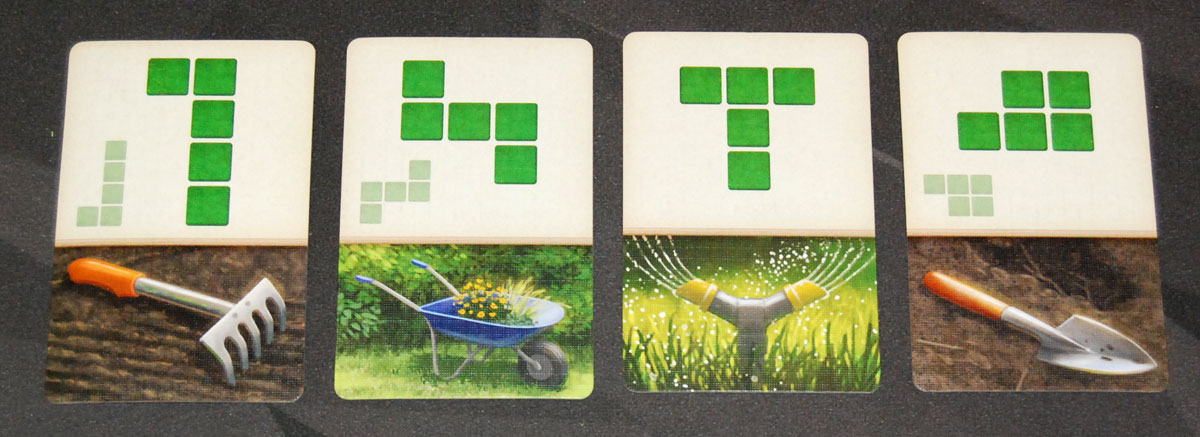
The tool cards each show a gardening tool of some sort, along with a polyomino shape that looks somewhat like the tool. Starting tool cards have polyominos of 4 squares each, but the regular tools have 5 squares each.
All of the “boards” in the game are thick cardstock but not cardboard—sturdy enough but not thick. The central drafting board is a 4×4 grid with a flower border, and just serves as the tile market. The garden boards are larger, an 8×8 grid that starts off looking like dirt, with a spot in the center for your greenhouse. There are also several spaces marked with seeds, and some marked with rocks. The rock icons are extremely small and at first I just thought they were part of the dirt pattern—hopefully in the finished game they’ll be a little more obvious.
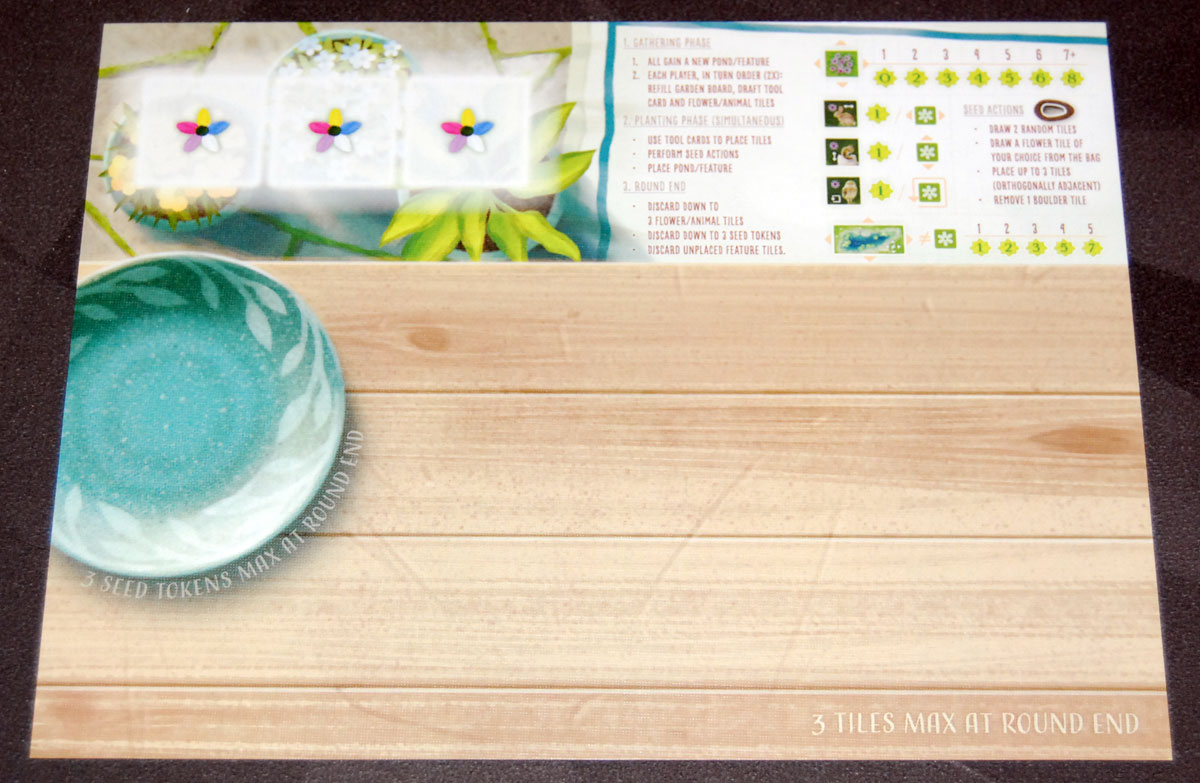
The workshop board is used to store your personal supply—there’s a little bowl for the seeds, three spots reserved for the wild animal tiles that you start with, and a table area where you can put tiles that you’ve drafted. In the top corner, there’s a player aid that explains the turn order, seed abilities, and scoring conditions. My one complaint is that the player aid text is quite tiny. The table area looks lovely, but since you can only store 3 seeds and 3 tiles at the end of your turn, I would appreciate a bigger player aid and smaller storage space.
How to Play Perennial
You can download a draft of the rulebook here.
The Goal
The goal of the game is to score the most points by arranging flowers, animals, ponds, and features over the course of 4 rounds.
Setup
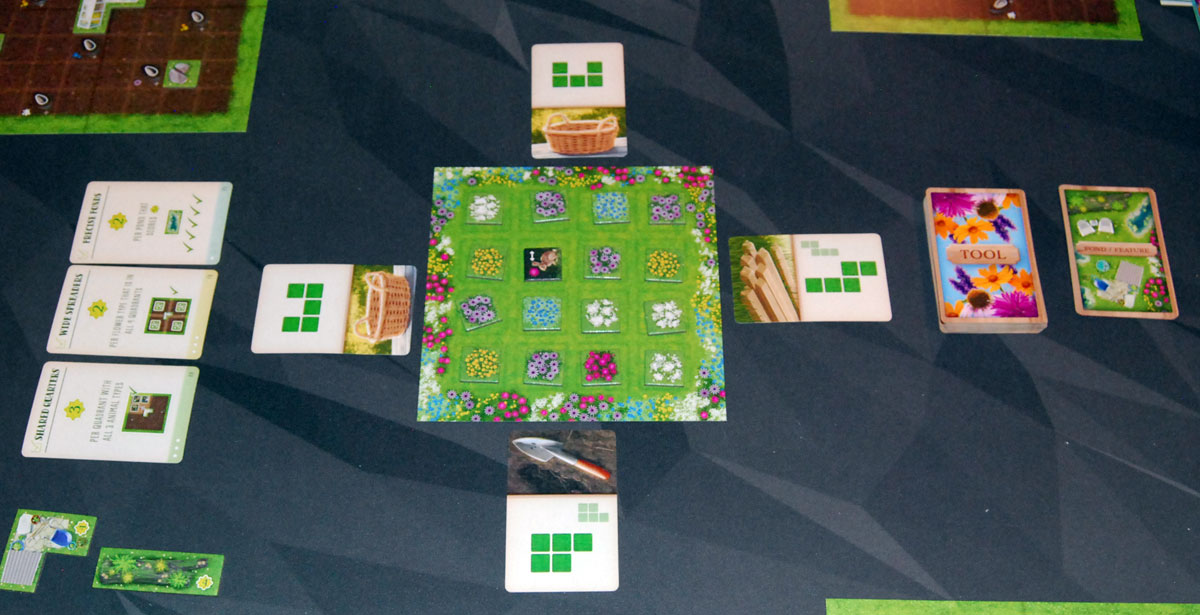
Place the central drafting board in the middle of the table and fill it with random tiles drawn from the bag (which contains the flower tiles and the non-wild animal tiles). Shuffle the tool cards and place one tool on each side of the board, with the deck nearby. Make a supply of seed tiles. Shuffle the four pond/feature cards and place that nearby.
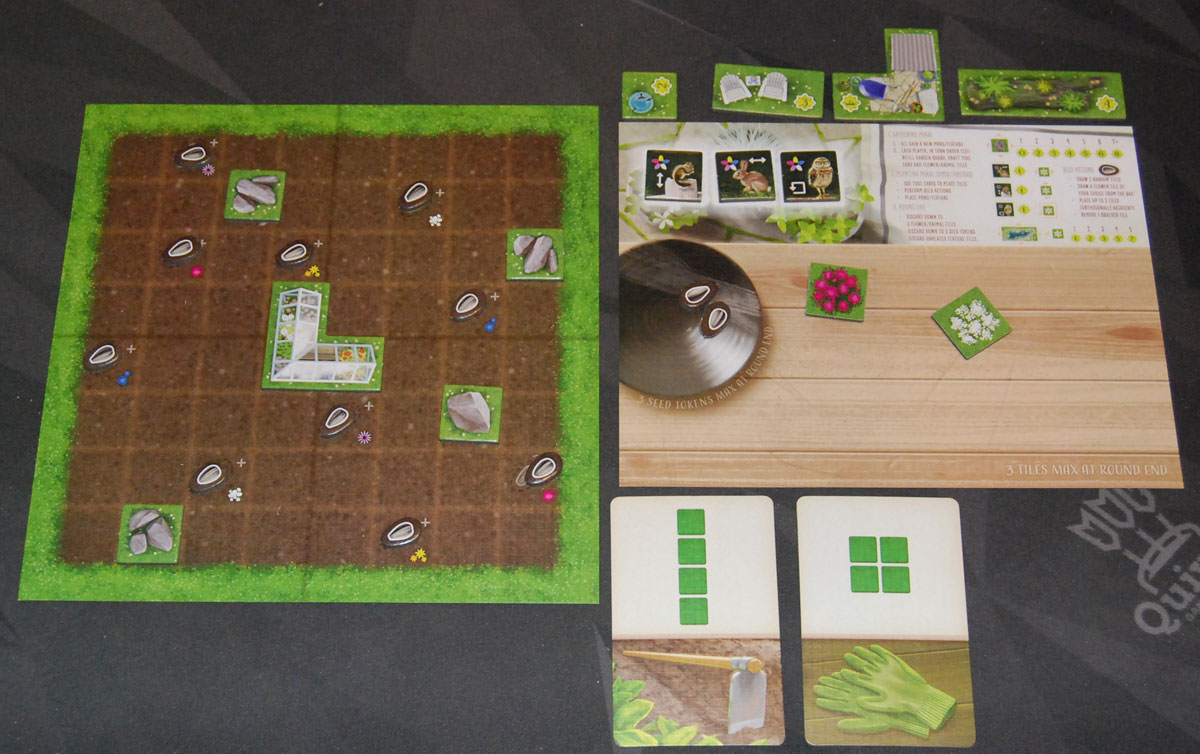
Each player starts with:
- garden board
- workshop board
- 2 starter tools
- greenhouse tile
- 4 boulder tiles – on the boulder spaces on your garden
- 4 pond/feature tiles
- 3 wild animal tiles – on your workshop
- 12 seeds – 2 on your workshop, 10 placed on the seed spaces of your garden
- 2 randomly drawn flower tiles from the bag (not animals) – on your workshop
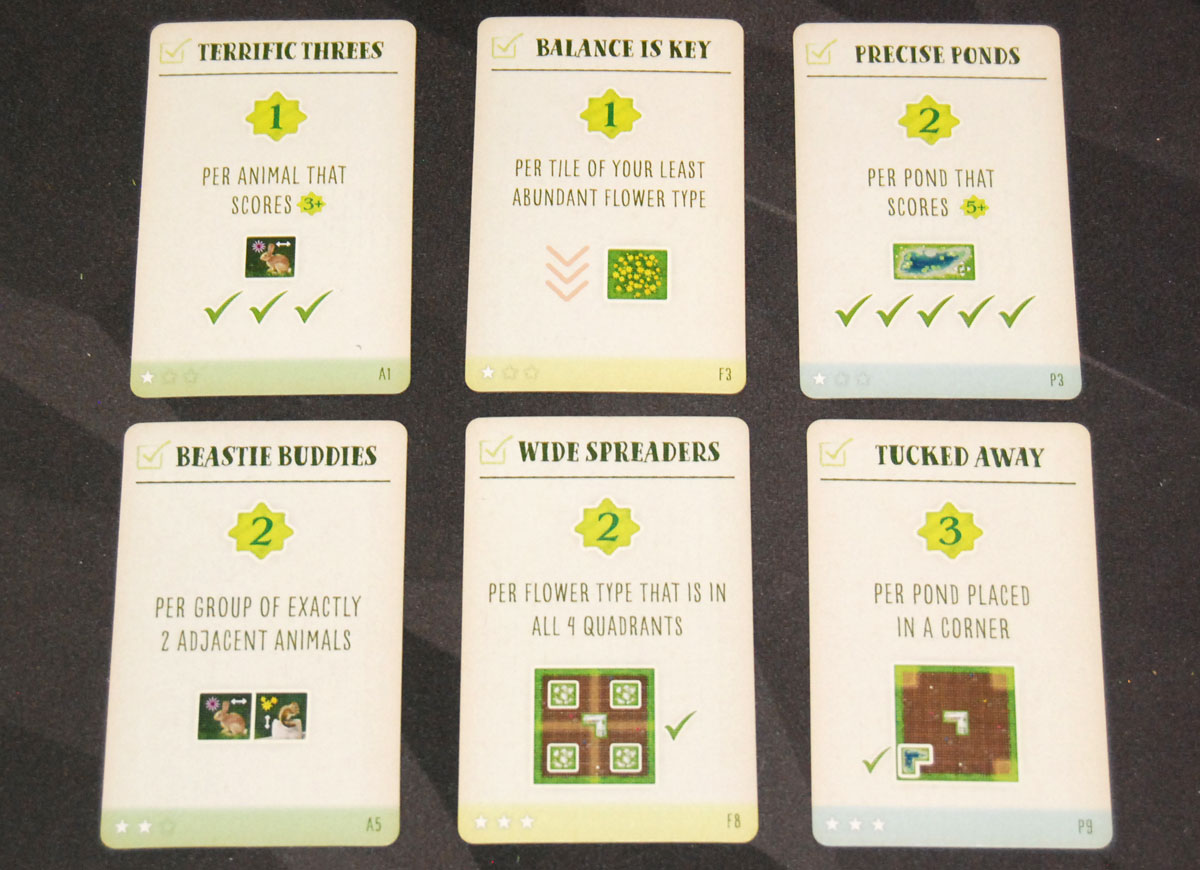
For the advanced mode, shuffle the three goal card decks and draw one of each, placing them face-up where everyone can see them.
Choose a starting player at random.
Gameplay
The game takes place over 4 rounds, and each round has a gathering phase (in turn order) and a planting phase (done simultaneously). At the start of the round, reveal the next pond/feature card. Everyone should find the matching pond/feature tile and place it on their workshop board.
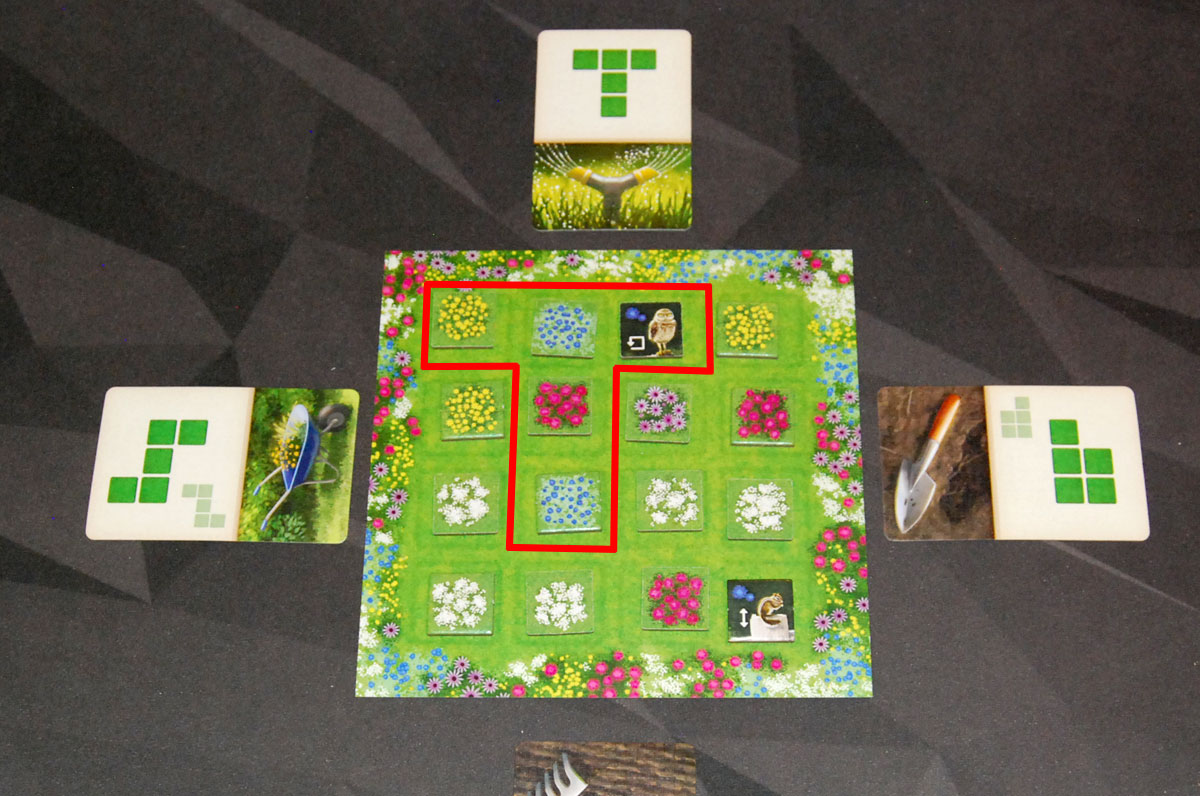
Gathering Phase: Each player, in turn order, will get tiles from the central board. Select one of the tool cards next to the board, and then take 5 tiles from the board in that shape. The shape can be rotated and mirrored, but the one restriction is that at least one tile must be taken from the edge where the tool card was. Place the tiles on your workshop and the tool card near your workshop, and then refill the central board. If there are 2 or more of the same tool card next to the board, you may optionally discard all of them and replace them with tool cards from the deck.
Take turns drafting tools and tiles until everyone has done it twice.
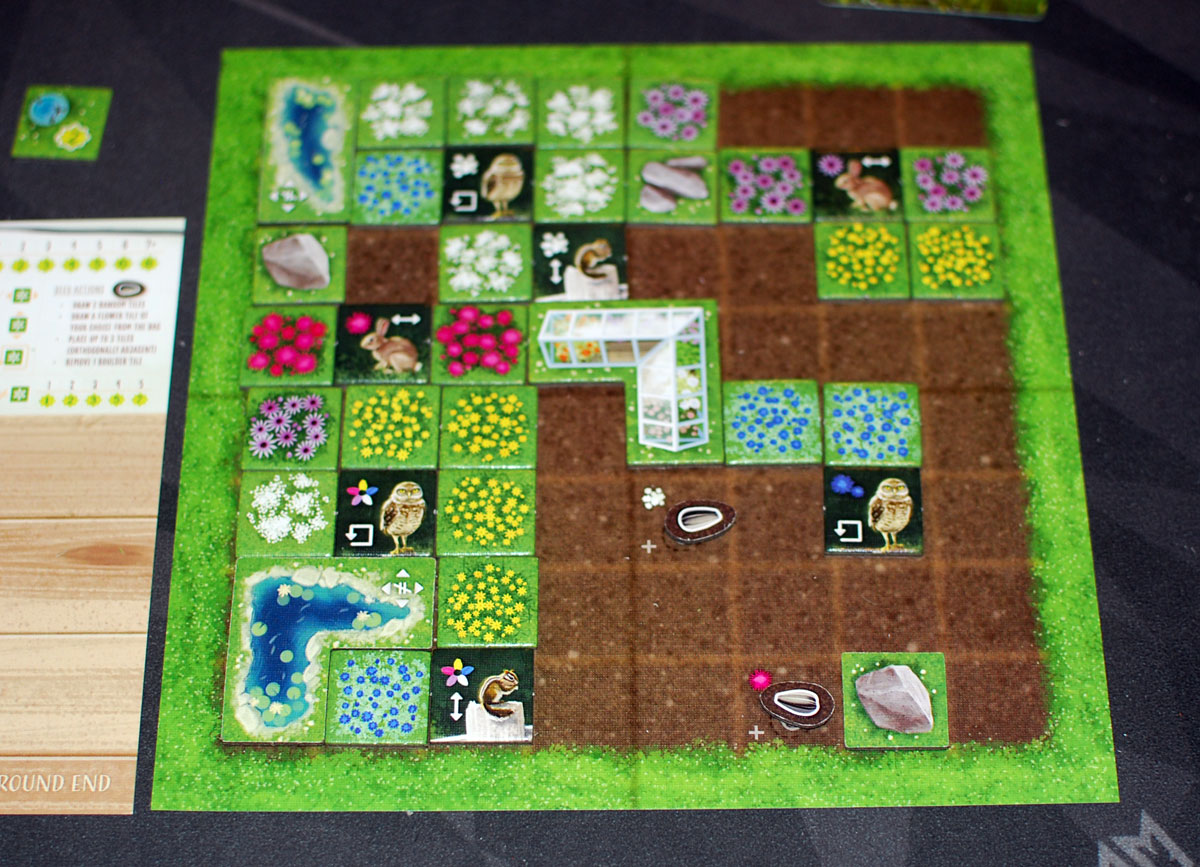
Planting Phase: Simultaneously, players may place tiles into their garden.
To plant, you must spend a tool card, and then you may place tiles into your garden in the shape matching your tool card. Tiles must be placed adjacent to your greenhouse, or adjacent to other tiles you’ve placed (not counting the boulders that start on your board). You may omit squares from the shape, but you must spend tiles from your supply for each square you omit, so you still must spend 5 tiles for regular tools, but some of them may be discarded instead of placed in your garden. After planting, discard the tool card you used.
You may not place tiles over existing tiles (including the boulders). Whenever you cover a seed space on your garden with the matching flower type, you gain one seed.
At any time during planting, you may place the pond/feature tile from this round into your garden for free (it doesn’t cost a tool).
Seed Tokens: Seed tokens may be spent for various abilities during the planting phase:
- Draw 2 tiles from the bag
- Search for 1 flower tile (not animal) of your choice from the bag
- Place up to 3 tiles from your workshop onto your garden board in one connected shape (as if it were a 3-square tool)
- Remove a boulder tile from your board, making it available to plant.
After everyone is done planting, everyone must discard down to 3 tiles in their workshop and 3 seeds in their bowl. If you didn’t place the pond/feature tile, it is discarded.
Pass the starting player clockwise for the next round, and repeat!
Game End
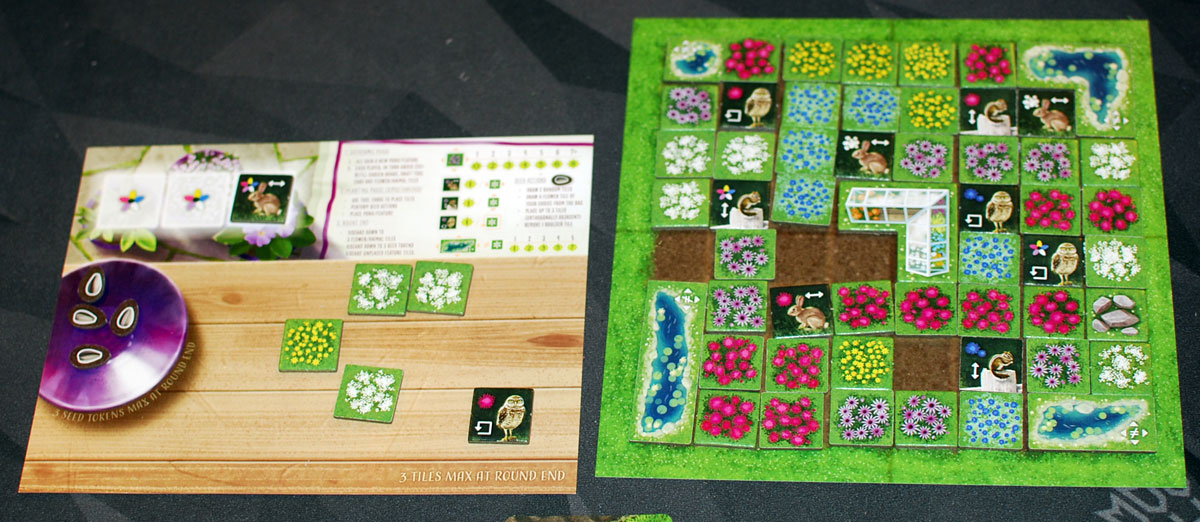
The game ends after the fourth round (all four of the pond/feature cards will be revealed). Time to score your gardens!
- Each flower region—a connected group of the same flower—will score points based on its size (up to 8 points for a group of 7 or more)
- Rabbits score 1 point for each of their flower type in the same row
- Chipmunks score 1 point for each of their flower type in the same column
- Owls score 1 point for each of their flower type in the 8 spaces surrounding them
- Features score the point value printed on them
- Ponds score points based on the number of unique flowers that touch them—up to 7 points if you have all five flower types
- Goal cards score points if you fulfilled their requirements
The highest score wins!
Solo Mode
The solo mode plays very much like a 2-player game; there’s an automated step that removes a tool card and corresponding tiles from the central board, but then they are just discarded. You score your own garden as normal and compare it to the scoring chart.
Achievements
Like many of the other Flatout Games titles, Perennial will also include some scenarios and achievements to track, where you’ll use specific goal cards and try to accomplish different tasks during the game. (The prototype rulebook didn’t have these yet, though you can see them now in the draft rulebook.)
Why You Should Play Perennial
I’m always excited to see what Flatout Games has in store—their puzzly games often hit the sweet spot for me, particularly their games that involve tile-laying. Perennial was designed by Emily Vincent, who previously designed Knitting Circle for Flatout and also Pirates of the High Teas from her own publishing company Pink Hawk Games.
Click here to see all our tabletop game reviews.
 To subscribe to GeekDad’s tabletop gaming coverage, please copy this link and add it to your RSS reader.
Disclosure: GeekDad received a prototype of this game for review purposes.