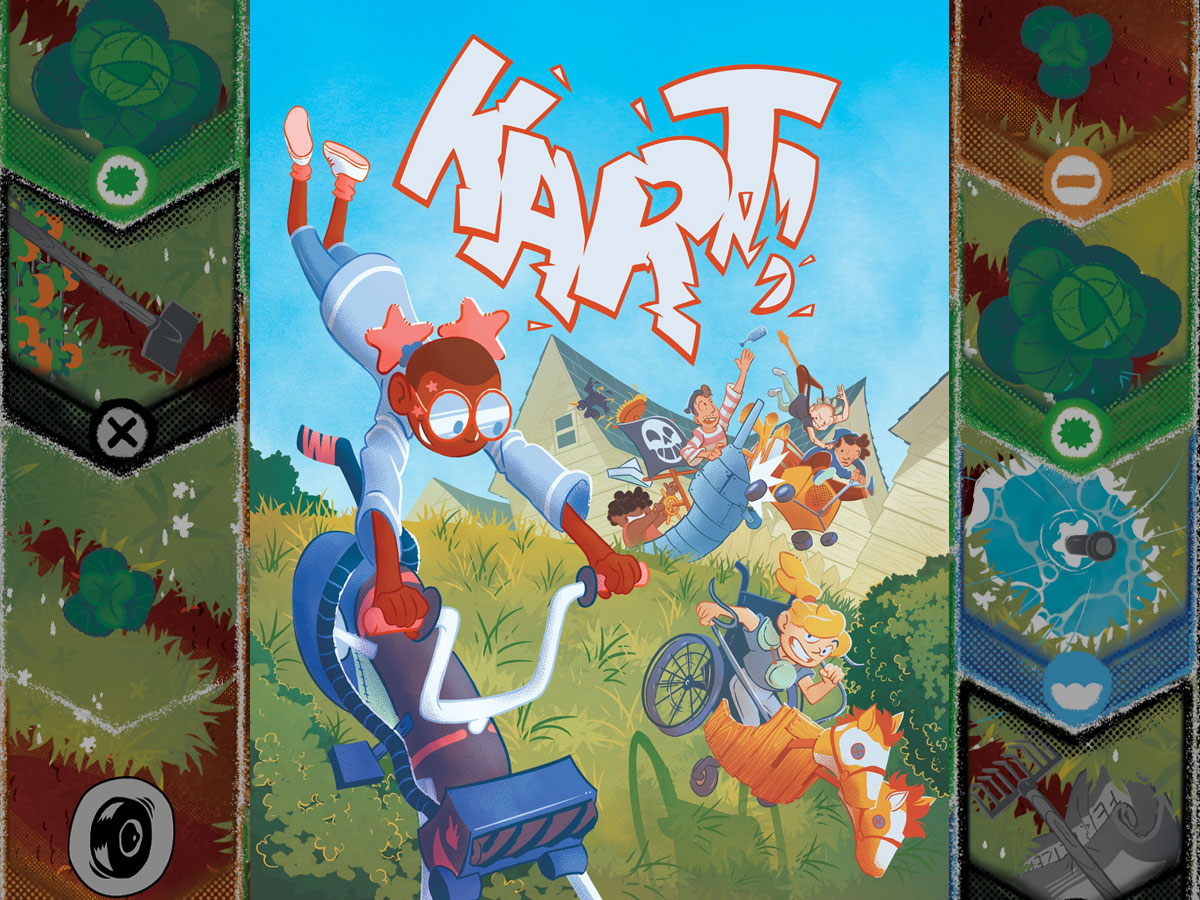
Who needs brakes? Race down the hill and hope most of your kart makes it across the finish line!
What Is Kart?
Kart is a racing game for 2 to 4 players (or 6 with the expansion), ages 10 and up, and takes about 45–75 minutes to play. It’s currently seeking funding on Kickstarter, with a pledge level of $40 for a copy of the base game, or $70 for the base game and 5-6 player expansion.
Kart was designed by Alita Robertson and published by Leder Games, with illustrations by Kyle Armstrong.
New to Kickstarter? Check out our crowdfunding primer.
Kart Components
Note: My review is based on a prototype copy, so it is subject to change and may not reflect final component quality. For instance, much of the artwork on the cards was not completed, and the boards were hand-cut. Also, the trophies and point tokens appear to be wooden in the finished game rather than the cardboard tokens seen in the prototype.
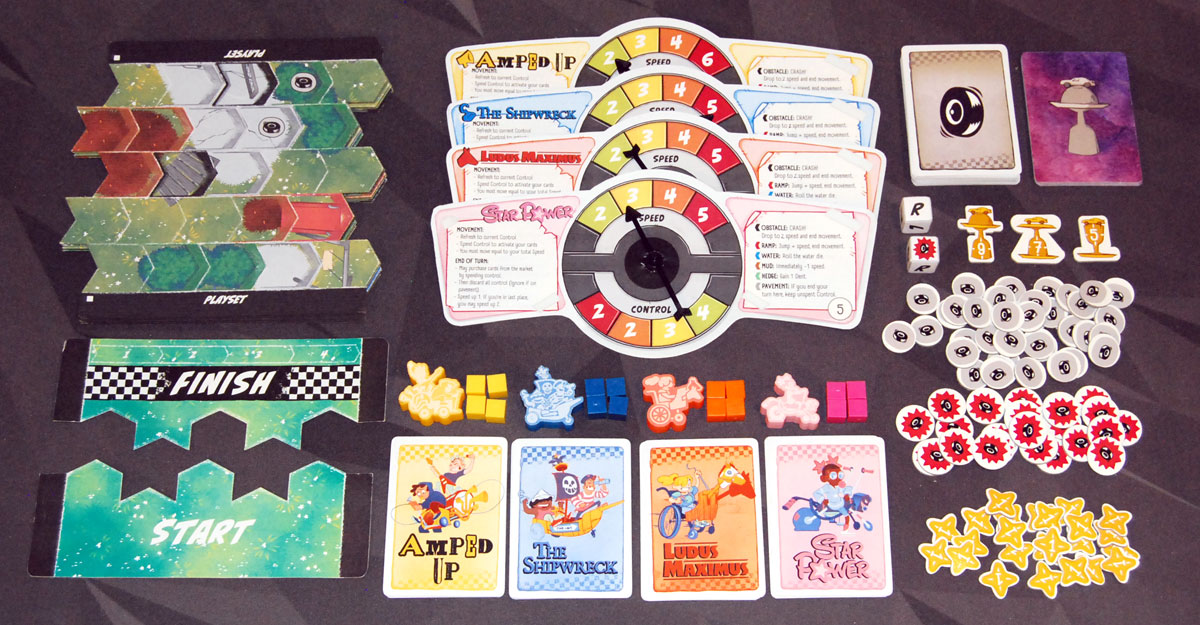
Here’s what comes in the box:
- 12 Map tiles
- Start tile
- Finish tile
- 4 Player boards
- 4 Player meeples
- 12 Player tokens
- 18 Starting cards
- 35 Market cards
- 12 Crowd cards
- 2 Water dice
- 3 Trophies
- 36 Control tokens
- 30 Dent tokens
- 24 Point tokens
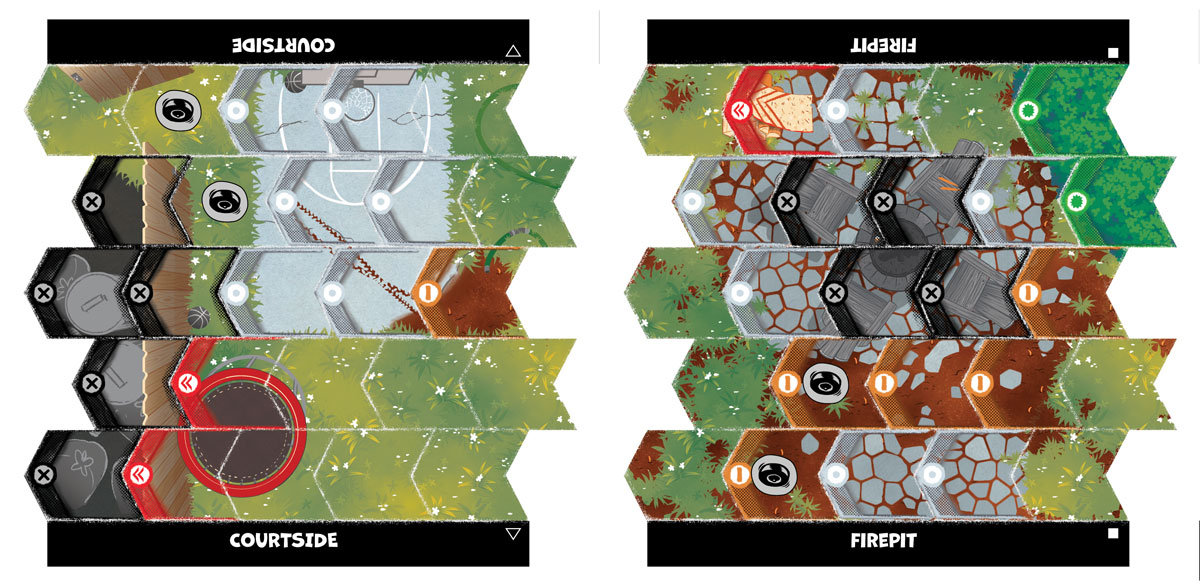
The map tiles remind me a bit of Thunder Road: Vendetta, since they use a similar chevron shape for the spaces to indicate the direction of travel in a hex-based pattern. Each map side is double-sided and has various terrain types; the spaces are illustrated to depict locations like the neighbor’s backyard or a skate ramp, but each space also has a colored edge to indicate the terrain type. (I noticed in the print-and-play version that there are also icons on the edges, which are helpful because sometimes the colors aren’t always as easy to distinguish.)
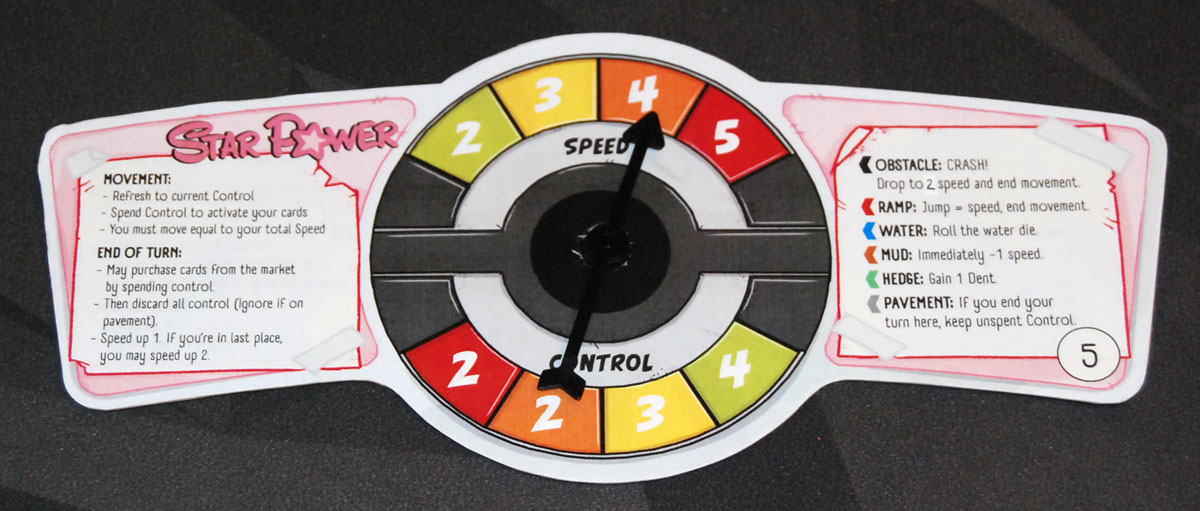
The player boards serve as a player aid, with reminders about your turn order and the various terrain effects, but the main feature is the speed/control dial in the center. As you turn the arrow to increase speed, the other end of the arrow points to your control, which decreases. Each player board has a color and the kart name on it, and a number at the bottom right that indicates how many card stacks you can have. (More on that later.)
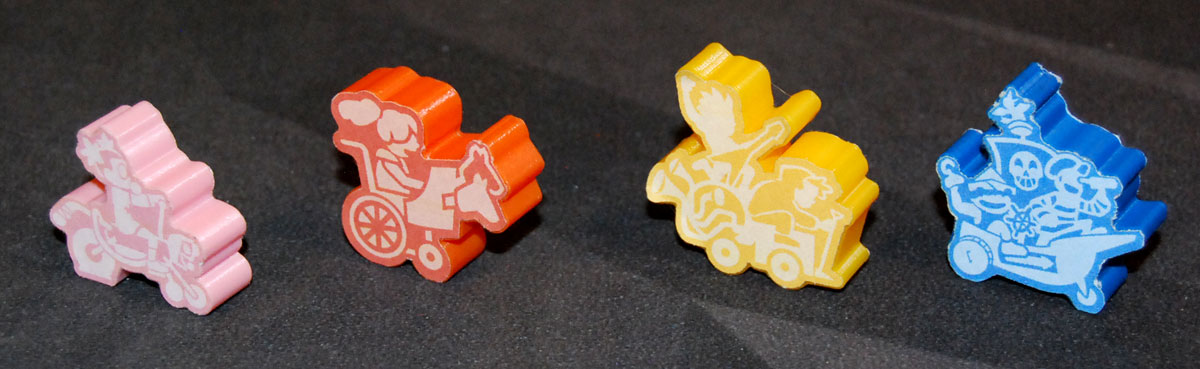
There are four racers included in the base game, and each one has its own unique abilities (based on the starting cards). The illustrations are fun and give the carts a lot of personality, from the chariot-themed wheelchair of Ludus Maximus to the pirate boat Shipwreck.
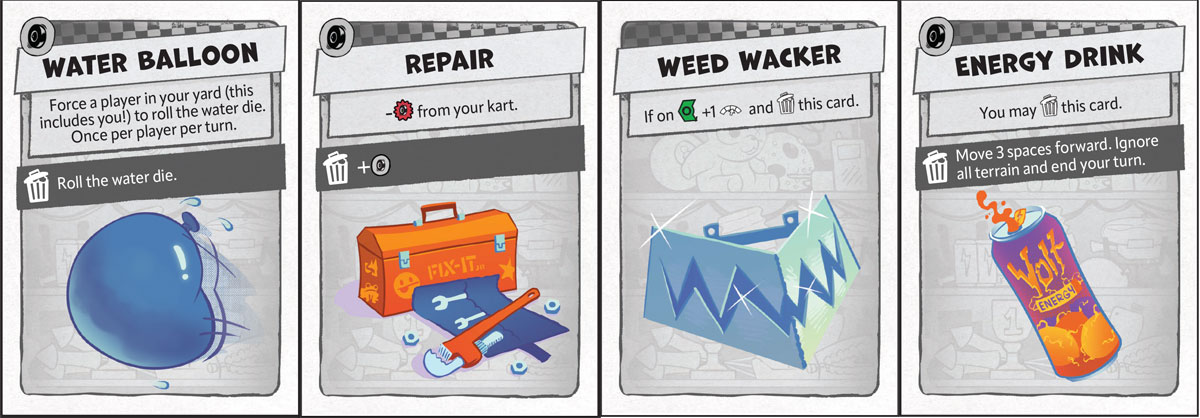
The player cards and market cards are all items and actions that you can use during your turn. The final cards will have illustrations like what you see here, though the prototype cards pictured elsewhere in this review had placeholder art. Player cards have a colored border to match the player board and meeple, and also have the kart name on them.
The expansions (not included in the prototype) add two more karts, 10 more map tiles, and some additional tokens, enough to play with up to 6 players.
How to Play Kart
You can download a draft of the rulebook here, as well as a print-and-play version.
The Goal
The goal of the game is score the most points by winning the race and pleasing the crowds.

Setup
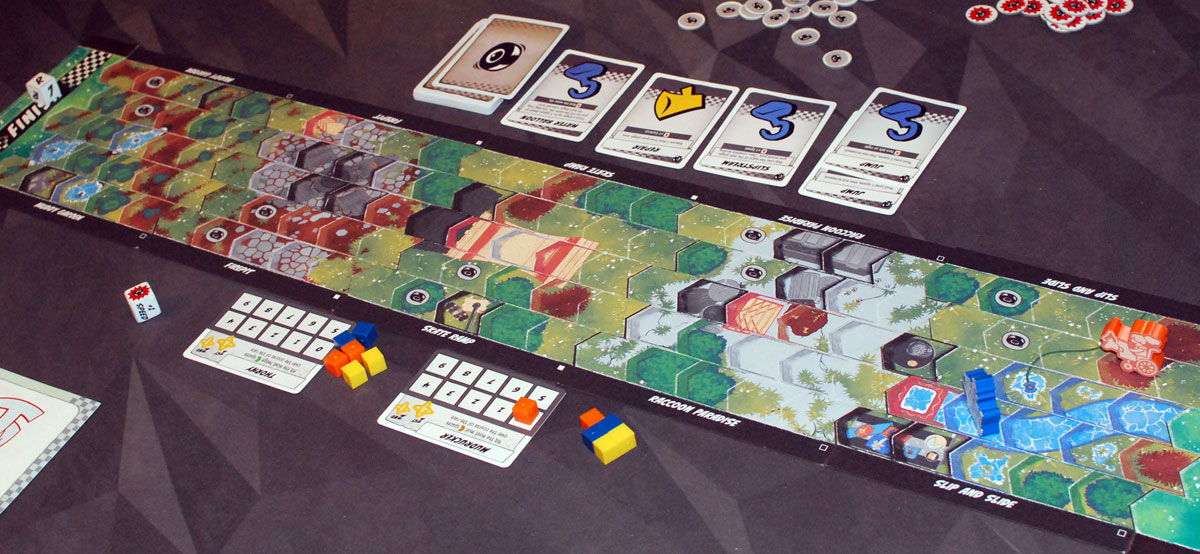
Randomly select 5 of the map boards and line them up, alternating the square and triangle icons (the prototype used solid and outline squares), and then add the start and finish tiles to complete the course.
Shuffle the market cards and reveal cards until you have 4 unique abilities (stacking same abilities). Shuffle the crowd cards and draw two, placing them face-up near the map. Make a supply of control tokens, dent tokens, and point tokens. Place the trophies near the finish line, using one fewer trophy than the number of players.
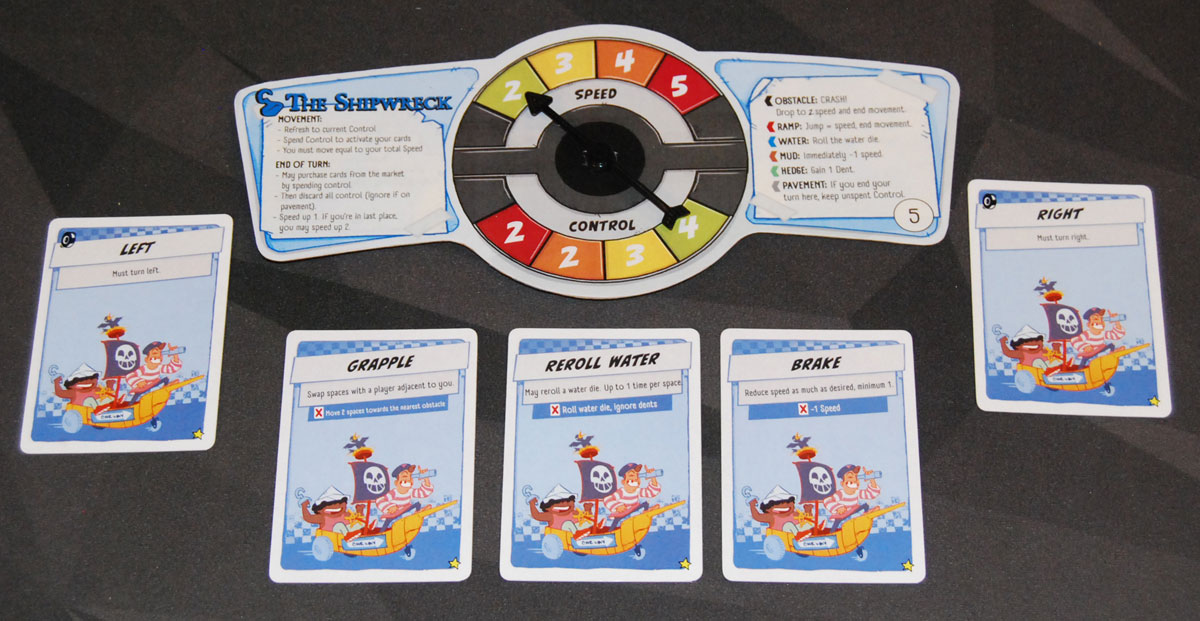
Each player takes a player board, meeple, starting cards, and tokens of their chosen kart. Place your meeple on the start tile, and your tokens at the start of the two crowd cards. Place your board in front of you, with your starting cards spread out—these are your card stacks. Some karts have 4 stacks and some have 5. Set your speed to 2.
Gameplay
On your turn, you check your board and you gain control tokens based on the arrow.
Then you execute your movement phase. You must move as many spaces as your speed indicates (unless you crash or jump, which ends your movement). You always move in whatever direction you’re facing.

You can spend control tokens to activate your card stacks. At the beginning, your card stacks only have one card each, but as you gain cards you may have multiple cards in a stack. You must pay control for an entire stack in order to use it, equal to the tire icons at the top left of each card, and you must use every card in a stack when you activate it if possible. You may activate any number of stacks that you can afford, and you may also activate the same stack multiple times as long as you pay the cost each time.
Everyone starts with a Left, Right, and Brake—you can use these to turn your cart one notch to the left or right, or to decrease your speed by any amount. Note that there are only three directions your cart can face: straight downhill, down and to the left, or down and to the right. You can’t turn more than that to face uphill. If you ever decrease your speed to the point where you’ve already moved the number of spaces, then your movement phase ends.
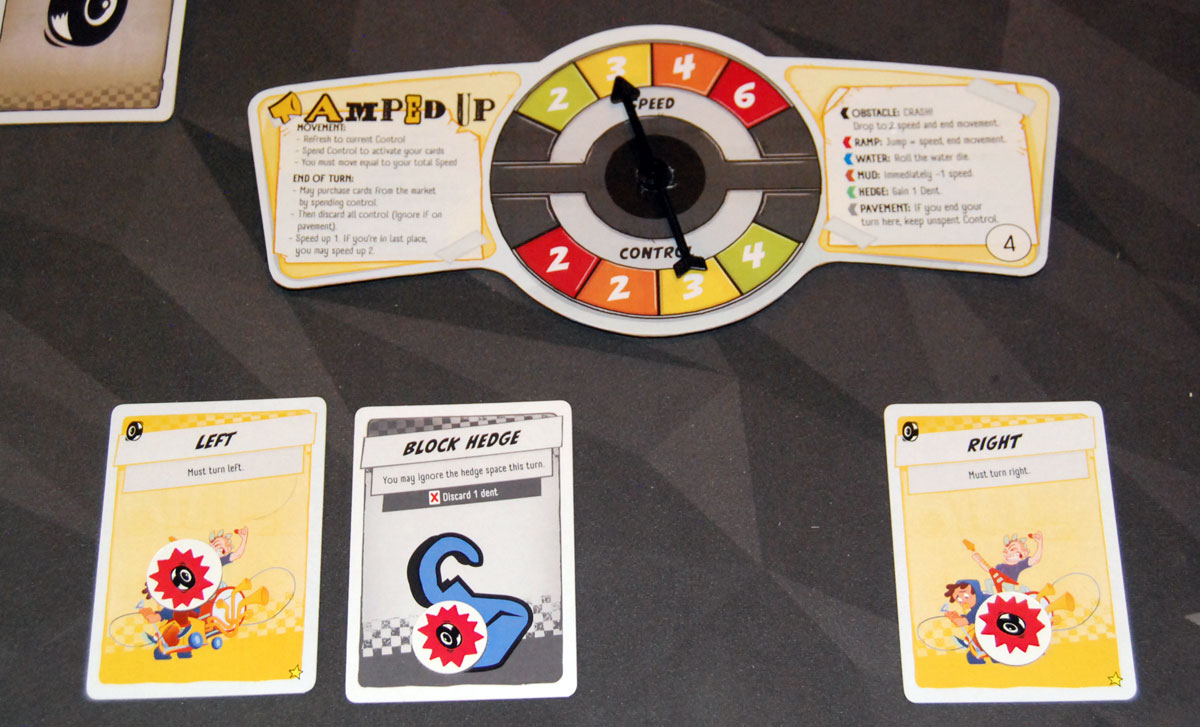
As you enter different terrains, they may have various effects: mud slows you down, hedges give you dents, and water makes you roll the water die, which can have a number of different effects. Whenever you gain a dent, you take a dent token and add it to one of your stacks. This increases the cost to use that stack. If you ever gain 2 dents on the same stack, discard one card from the stack and discard the dents—that part has broken off! Many of the cards have additional effects that trigger when the card is discarded.
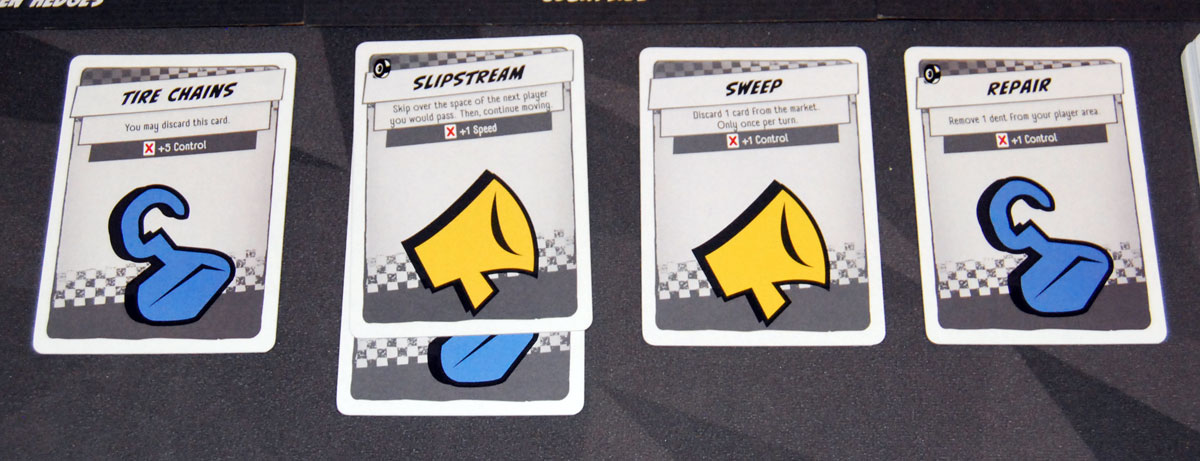
Once you’re done with your movement, you accelerate. You may spend control to purchase cards from the market (if you have any left!) and add it to one of your card stacks. Each card costs 1 control plus 1 control per card already in the stack.
Then, increase your speed by one. If you’re in last place, you may increase by two instead.
Finally, discard any remaining control tokens (unless you ended your turn on pavement).
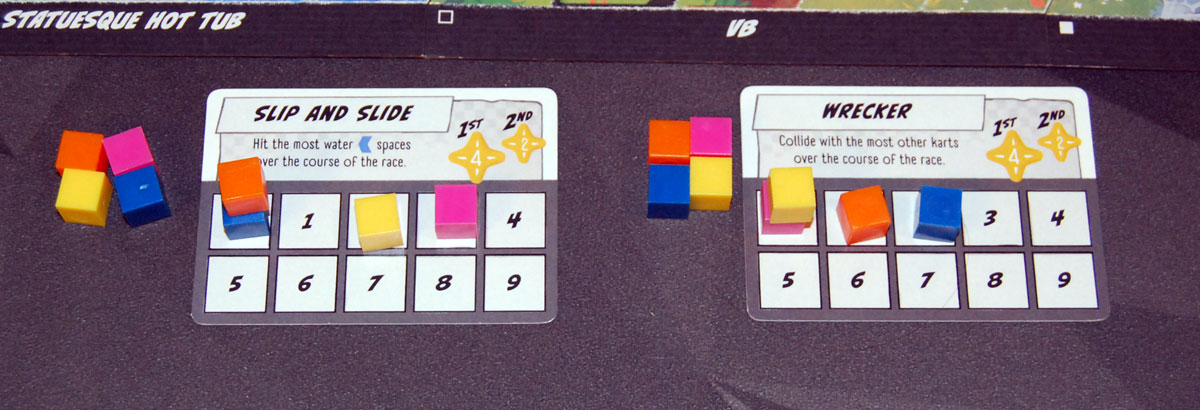
The crowd cards have various requirements like going through hedge spaces or crashing into other karts. Each time you do something matching one of the crowd cards, move your token forward—the winners of each card will earn bonus points at the end of the game.
At the end of each round (after everyone’s had a turn), check to see if anyone has passed the finish line. If so, whoever crossed by the most spaces gets the highest available trophy, and so on, until everyone who has passed has received a trophy or the trophies run out. If all the trophies are gone, anyone else who also crossed the finish line this turn receives 1 point.
Game End
The game ends when no trophies remain at the end of a round. Players score points equal to their trophy value, plus points awarded from the crowd cards. The highest score wins! If there’s a tie, the tied player with the highest trophy wins.
Why You Should Play Kart
Kart sends you flying down the hill in a slapped-together go-kart that just might fall apart along the way. But sometimes that’s a good thing, depending on the part! That’s one of the strange tactics in the game—using your rapid unplanned disassembly to give yourself an advantage.
It’s a race game, with a lot of the things you might expect: a variable racetrack filled with terrain that can help or hinder you, obstacles to crash into, and special items that let you mess with your rivals. But what you usually don’t see is the mandatory acceleration: unlike most racing games, you must accelerate at the end of your turn. And since speed and control are inversely related, it doesn’t take long before you’re just careening down the hill, speed outstripping your ability to steer. Sure, you’ve got brakes (unless they broke), but nobody wins a race by slowing down, right?
The different carts have different stats—Ludus Maximus only has 4 card stacks, but manages to have the most control even at top speed. Amped Up, on the other hand, has a higher max speed than everyone else, though in my first play with them I managed to lose so many parts that by the end of the race I was just ping-ponging back and forth between the two edges of the map! They also have unique abilities—The Shipwreck can re-roll the water die, so they have an incentive to hit spaces that can make other cards spin out of control. Star Power has a valuable repair ability to remove dents, while Ludus Maximus can use spikes to give players dents.
And, of course, there’s plenty of fun upgrades that you can get. (I like the image of kids grabbing stuff off the ground in the middle of the race and slapping it onto their karts, even as other parts are falling off.) They aren’t cheap, though: the more cards you have, the more control it costs to add more—and in some cases the cards themselves will cost extra control to activate. It’s possible to add to a stack, and then be unable to afford to use it once you’ve sped up. (Sure, you can slow down again to earn some more control, but … like I said before, who uses brakes in a downhill kart race?) However, if you plan it right, you can choose cards for their breaking effects instead: slap it on, and then place a few dents on them so they discard and trigger their one-time effects.
The crowd cards are interesting: in many cases, they reward sub-optimal racing. Do you really want to run through the mud (which slows you down) in the hopes that you’ll gain a few extra points at the end? It’s hard to win if you don’t get a trophy—but being first on two of the crowd cards can also bump you up a place or two depending on how your rivals did. That balance between pleasing the crowds and keeping up your breakneck speed is a tricky one to find.
I will say that some of my gaming group found the control economy a little frustrating: once you’re at top speed, most of the karts only earn 2 control per turn. That’s enough to make two turns to dodge an obstacle, but then you have nothing left to buy new cards. Even at maximum control, you generally don’t have enough to put 3 cards in stack (and if you do, good luck activating it!). But slowing down to gain control feels risky, too, because you’ll let other players get ahead.
Some of my other players really loved it, though, because it felt true to the theme. You’re really just zipping down the hill, barely in control of your kart, and it can be quite chaotic. That’s another similarity to Thunder Road: Vendetta—sure, you’d like to win, but a lot of the fun of the game is simply in seeing how things unfold when a bunch of players are doing their best to sabotage each other at high speeds.
If you love wacky racing games, check out Kart! For more information or to make a pledge, visit the Kart Kickstarter page.
Click here to see all our tabletop game reviews.
 To subscribe to GeekDad’s tabletop gaming coverage, please copy this link and add it to your RSS reader.
Disclosure: GeekDad received a prototype of this game for review purposes.