
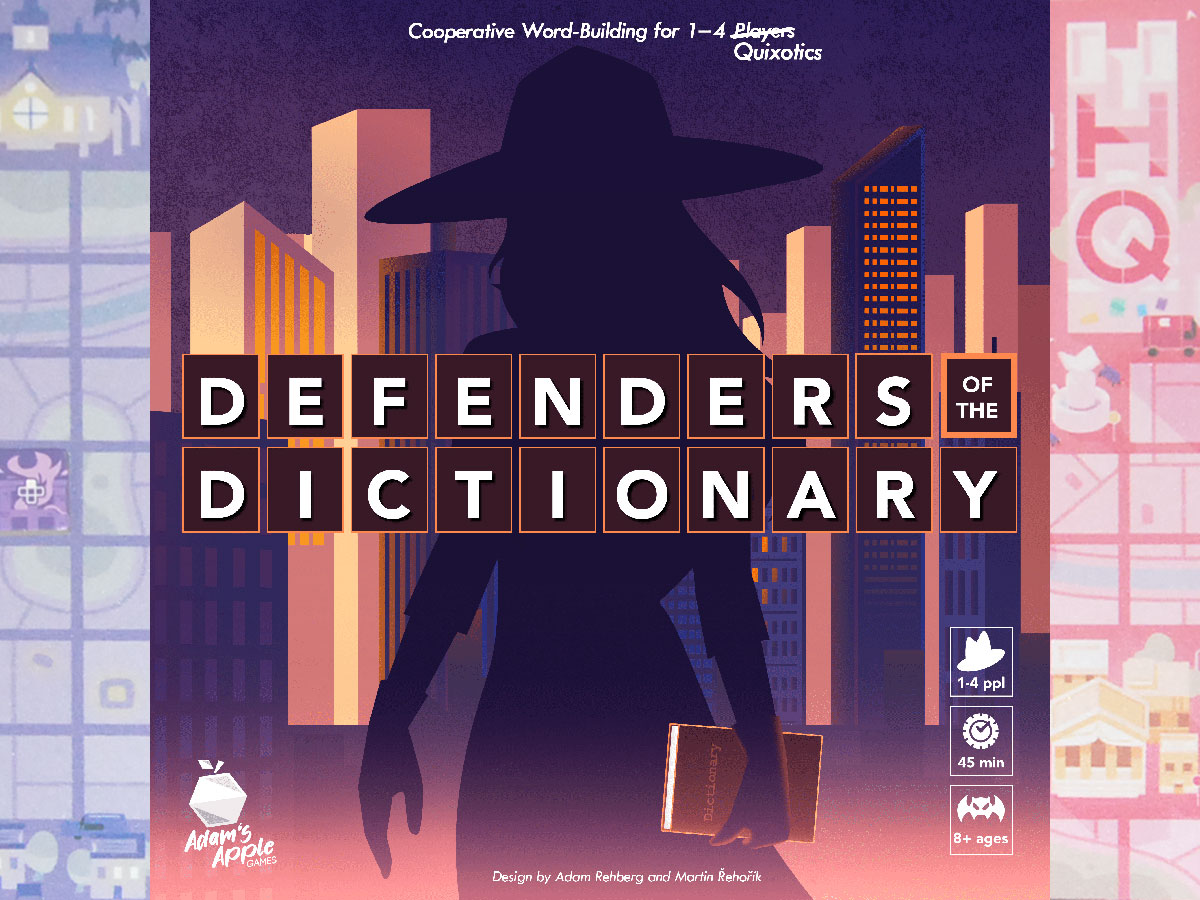
Defend Wordopolis from the nefarious villains making a mess of language!
What Is Defenders of the Dictionary?
Defenders of the Dictionary is a cooperative word game for 1 to 4 players, ages 8 and up, and takes about 45 minutes to play. It’s currently seeking funding on Kickstarter, with a pledge level of $40 for a copy of the standard edition, $60 for the deluxe edition, or $99 for the deluxe edition with 2 expansions included. It’s inspired by Scrabble and players will need to be able to spell words, but since the word-making phase is cooperative, it can work even with younger players who have a limited vocabulary.
Defenders of the Dictionary was designed by Adam Rehberg and Martin Řehořík and published by Adam’s Apple Games, with art by Zak Eidsvoog and Studio KIMP.
New to Kickstarter? Check out our crowdfunding primer.
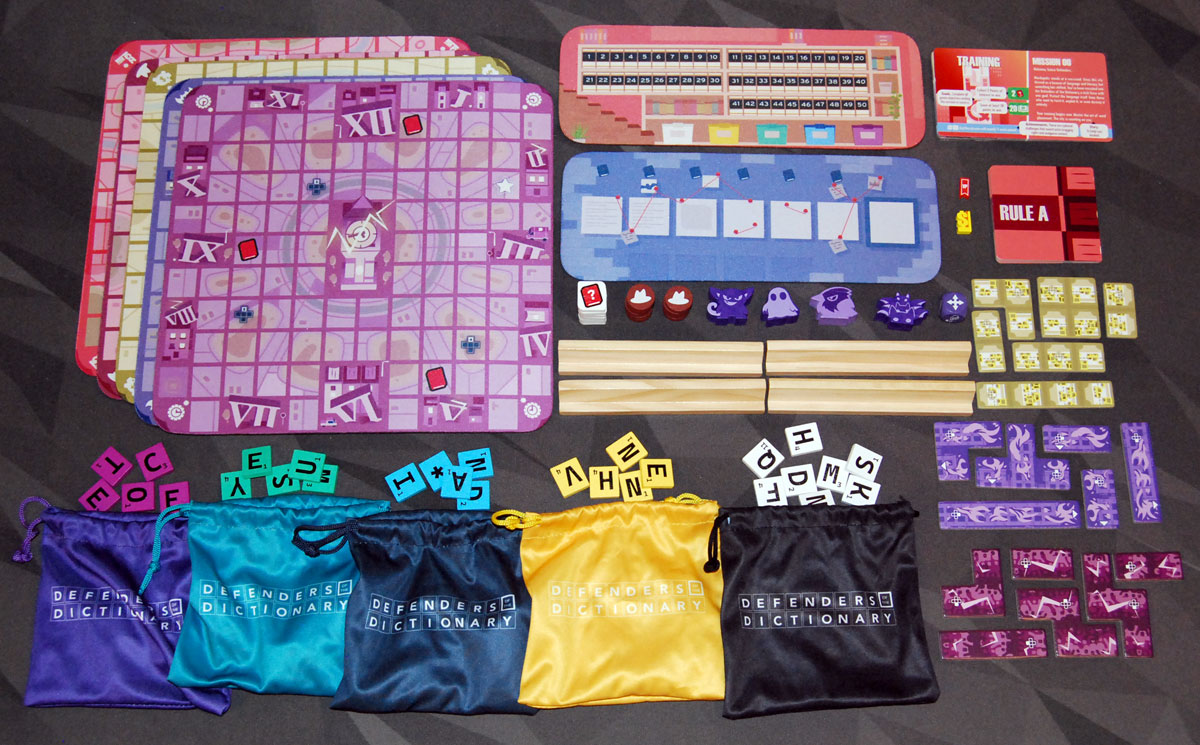
Defenders of the Dictionary Components
Note: My review is based on a prototype copy, so it is subject to change and may not reflect final component quality. The prototype had a mix of standard and deluxe components, but I’ll include a note about the difference between the two versions.
Here’s what comes in the box:
- 5 Map boards (HQ and 4 Villains)
- Scoring board
- Commons board
- Vocabulary Points (VP) tracker
- Corruption tracker
- 17 Mission cards
- 17 Rule cards
- 6 Points of Interest tokens
- 9 Hiding Spot tokens
- 4 Wingding tokens
- Wingdings Movement die
- 4 Letter Tile racks
- 6 Tollbooth tiles
- 6 Urban Distress tiles
- 6 Buzzruption tiles
- 5 Cloth bags (4 Players, 1 Villain)
- 154 Letter tiles (32 per player, 26 Villain)
The deluxe edition upgrades the boards to neoprene mats (as pictured here), and also replaces many of the cardboard tokens with wooden tokens: the wingdings, obstacles, points of interest, and hiding spots are all cardboard in the standard edition, but the VP tracker and corruption tracker are wooden in both editions. The cloth bags are only printed with the game logo in the deluxe edition.
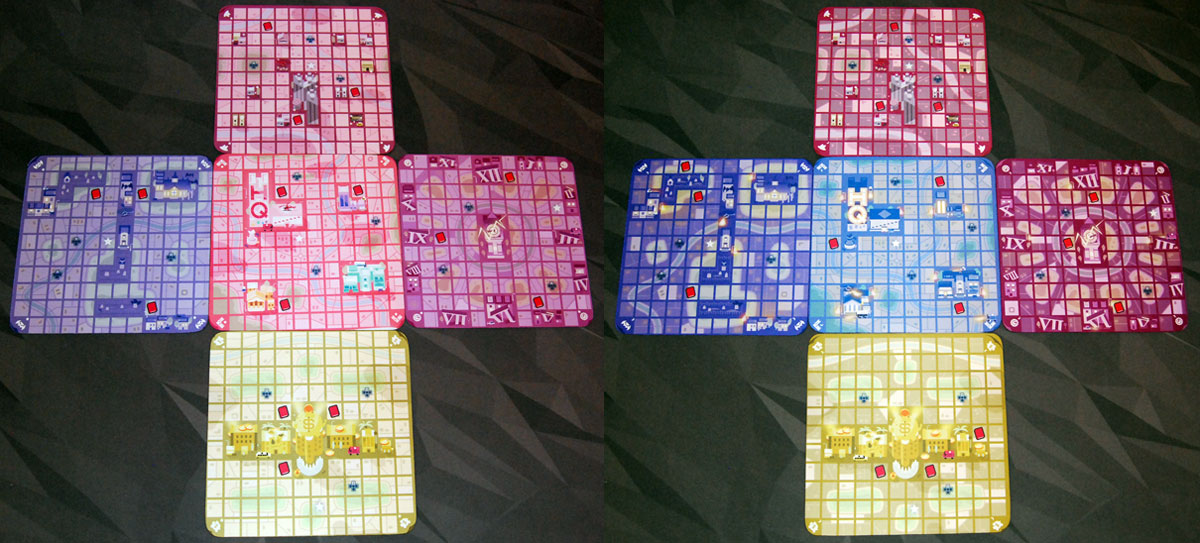
The map boards are a bit like Scrabble boards, though instead of bonus scoring spaces, they’re made to look like city maps; some spaces have large buildings or structures in them instead of spaces for letters, and there are also a few icons like the red books for points of interest and plus-sign shapes where obstacle tiles may appear. Each map is double-sided, with a day and a night side—the buildings are the same, but some of the other icons are in different places. The maps represent the city of Wordopolis, with the HQ map in the center and one map in each cardinal direction that corresponds to a particular villain. You won’t use all five maps at once, but I wanted to show how the city fits together.

The letter tiles are, well, a lot like Scrabble tiles: wooden square tiles with a letter and a point value printed on one side. The main difference is that the tiles come in different colors, one per player; the villain tiles are white.
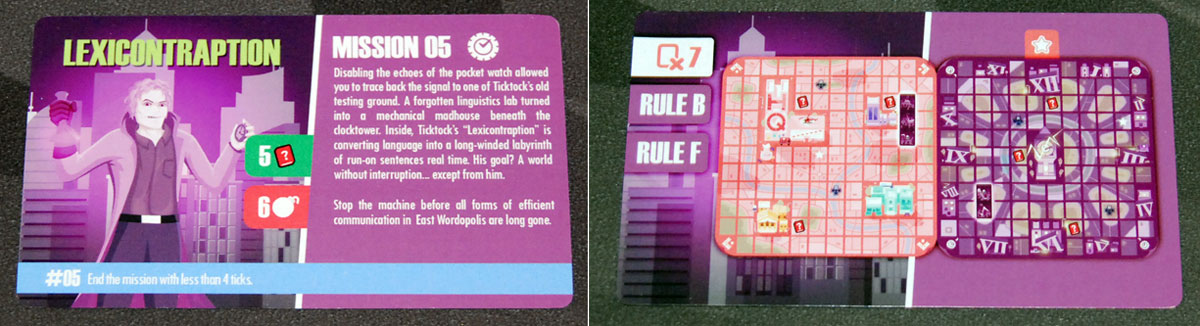
The mission cards are tarot-sized cards: on the front, there’s a portrait of the villain and a bit of story as well as your mission objectives; on the back, there’s a diagram showing the map setup and the rules you’ll need for the mission. My only complaint about these is that, although they’re large cards, the text and diagrams on them are still pretty small and can be a little hard to read for us older players!
How to Play Defenders of the Dictionary
You can download a draft of the rulebook here. Defenders of the Dictionary has 16 missions (plus a training mission), intended to be played in order, and additional rules are gradually introduced as the missions become more and more difficult. There is also a quick-play mode for one-off play sessions.
The Goal
The goal of the game is to fulfill the mission objectives—usually involving reaching a number of points of interest and a specific VP threshold.

Setup
Select your mission and set up the maps as shown on the card. (The training mission only uses the HQ board, but all the others use the HQ with one of the villain maps.) Place the points of interest tokens as indicated, and if needed place obstacle tiles or other items as well. Find the corresponding rules cards indicated on the mission card and place those near the board where everyone can see them.
Place the commons board and scoring board nearby, along with the villain letter bag. (Most missions will have you randomly draw and discard a number of villain letters.)
Give each player a letter rack and bag of letters. Everyone draws 5 letters and places them on their letter racks so nobody else can see them.
Gameplay
Each round has three phases: Contribute a Letter, Form a Word, Prepare for Next Round.
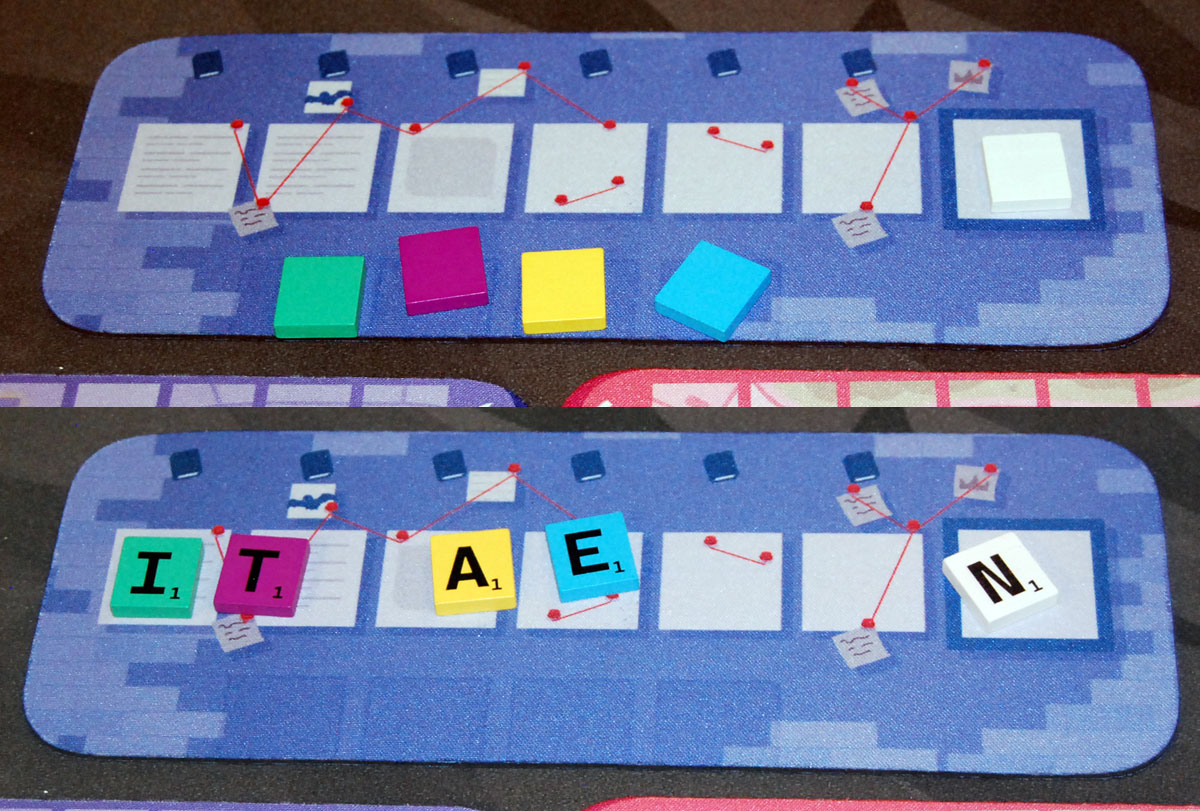
Contribute a Letter: Everyone simultaneously chooses a letter (or 2 each in a 2-player game) from their tile rack and places on the commons board face-down, and then they are all revealed. Draw a letter from the villain bag and place it on the far-right space of the commons board.
Note that while you can talk freely about what is currently on the board or already revealed on the commons board from previous rounds, you cannot talk about what you have on your tile rack or discuss what letter you will contribute. Players may suggest words that might be spelled in future rounds and where to place them, but you may not indicate who has what letters to spell that word.

Form a Word: Together, everyone decides on a word to place onto the map. The first word must cover the star on the starting map, and subsequent words must connect to already-placed tiles (like Scrabble). Once everyone agrees on a word, add up the total points earned and record your VP on the scoring track.
If you place a word that covers a point of interest, then you collect the token and place it near the mission card.
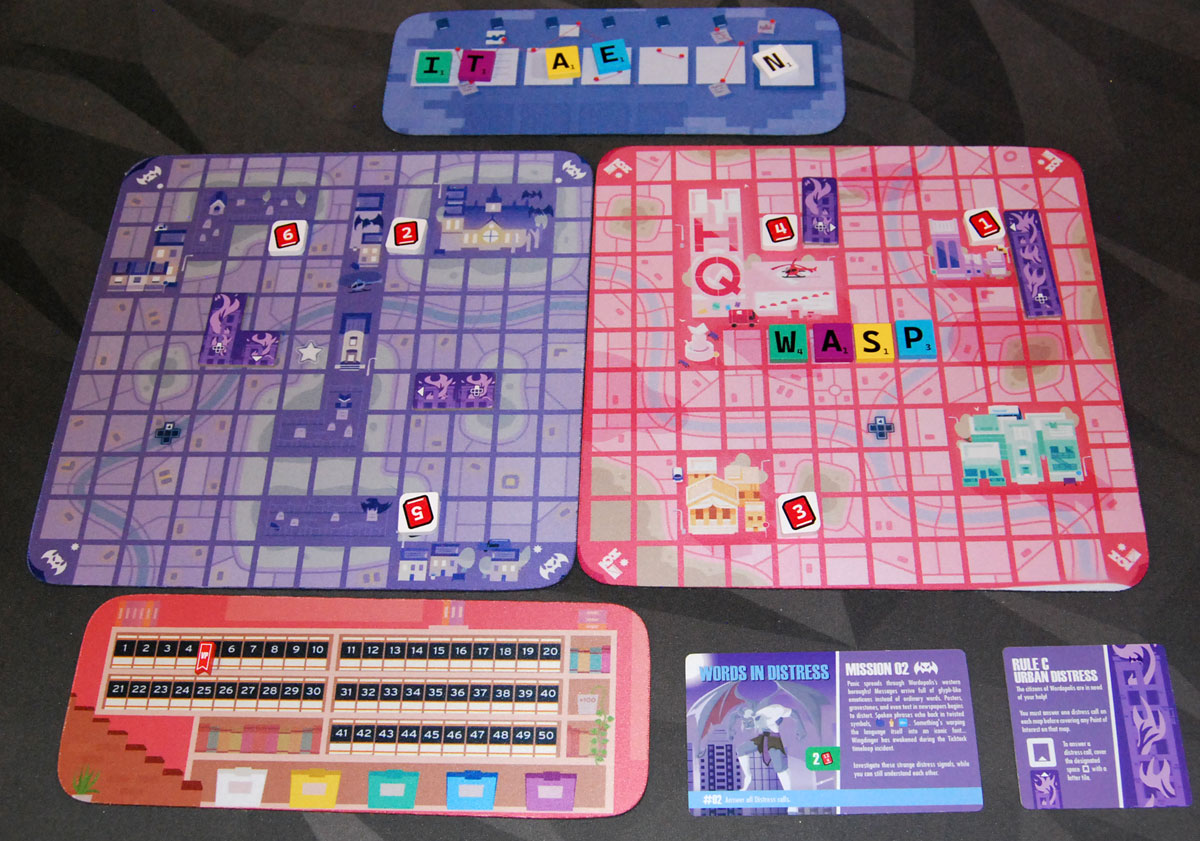
Prepare for Next Round: If you did not use the villain letter, then you immediately lose points equal to its value, and discard the letter. Then, if there are more than 6 letters remaining on the commons board, discard the letter with the highest value and lose its point value as well.
Finally, check if the game has ended—if not, everyone draws back up to 5 letters, and repeat!
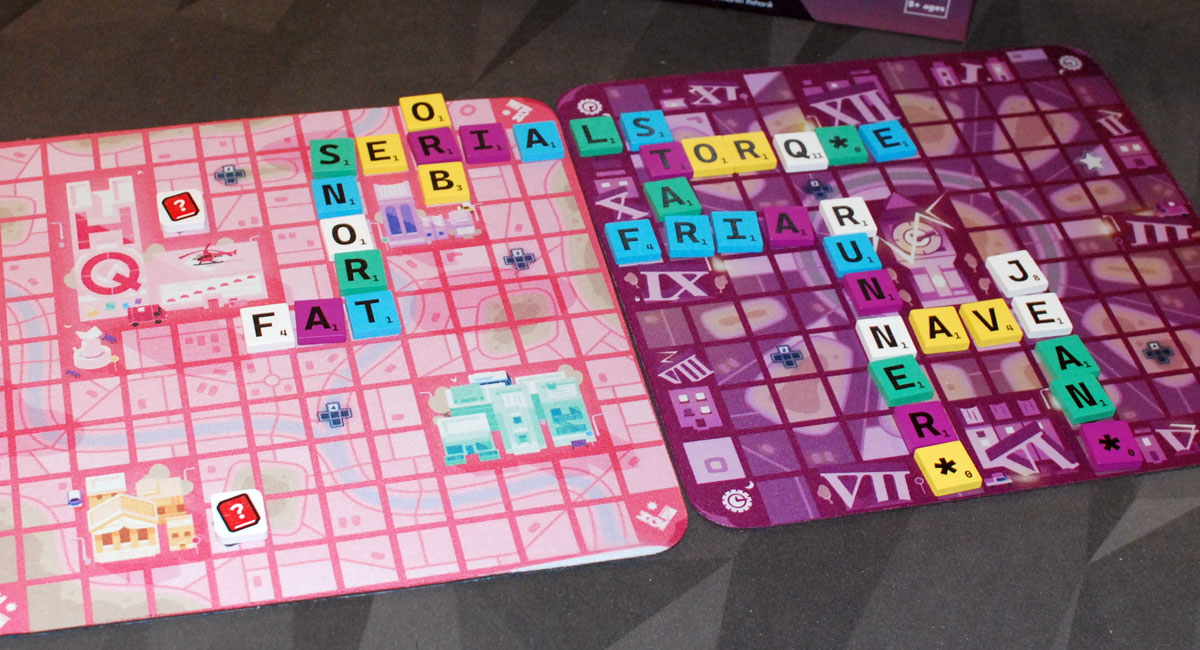
Game End
If you fulfill your mission objectives, then you win—usually this requires collecting a number of point of interest tokens, and scoring a certain number of points.
If you run out of letter tiles in the villain bag, then you lose. The mission may have other lose conditions (for instance, a bomb going off).
Each mission also has an achievement, an extra challenge that you can attempt while playing. For the campaign, you are only allowed to play each mission twice at most, and you must earn the achievement the first time you win. (If you win without getting the achievement, you can’t go back and try again.)
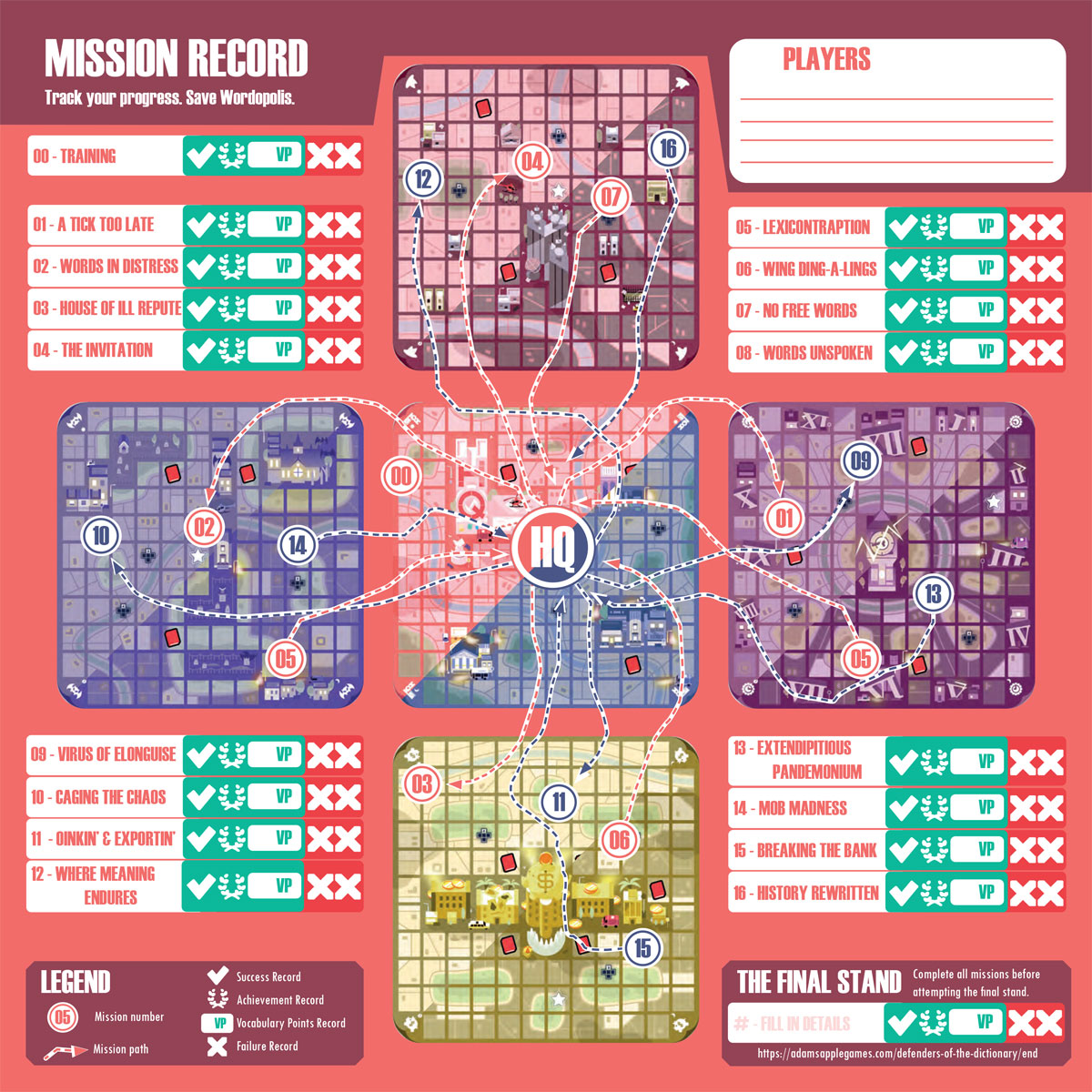
Your wins, losses, and achievements are marked on a campaign sheet, and at the end of Mission 16, you will be able to find out your story ending based on your record.
Quick Play
For a non-campaign session, you can just set up by using the HQ and one of the other maps. The rulebook provides three levels at normal difficulty, and three levels at advanced difficulty. Each has a point of interest requirement and a score threshold. If you want an additional challenge, you may use special rules that correspond to the various villains in the campaign mode.
Why You Should Play Defenders of the Dictionary
The story in Defenders of the Dictionary is about battling things like autocorrect, emojis, and shorthand, those “evil forces threatening our language.” And while, yes, I do have feelings about autocorrect and I’ve certainly been known to lean more toward prescriptive grammar rather than descriptive grammar in the past, I find that I don’t entirely agree with the story’s premise. That said, you don’t actually have to be a grammar stickler to enjoy playing the game (though it does help to have spelling skills, of course).
The core mechanic of the game will be familiar to anyone who’s played Scrabble or even Bananagrams: spell out crisscrossing words using letter tiles. But that’s about where the similarity ends, because Defenders of the Dictionary forces you to work together with the other players instead of against them, and to do so with limited communication. Every round, you each contribute a single letter to the pool that you hope you can use to extend your reach on the board. However, since you can’t discuss what’s on your tile rack, it can be really hard to coordinate so that everyone’s letters work well together. There have been many rounds where we ended up with too many vowels, or multiple copies of the same letter.
Plus, there’s the villain letter: each round you’ll draw a letter from the villain bag, and that letter will cost you points if you don’t manage to include it in your word. Since it’s totally random, sometimes you’ll get lucky and it’s exactly what you need. And sometimes it’ll be the 11-point Q and you’ll be very sad that nobody put a U in the pool.
Once all the letters have been revealed on the commons board, though, that’s when you really get to collaborate, testing out words and trying to decide the best placement for them. Remember, you’re not just trying to score points—you’re building paths to reach the points of interest, and you have to work around the buildings on the map (along with any other obstacles the villains may throw at you).
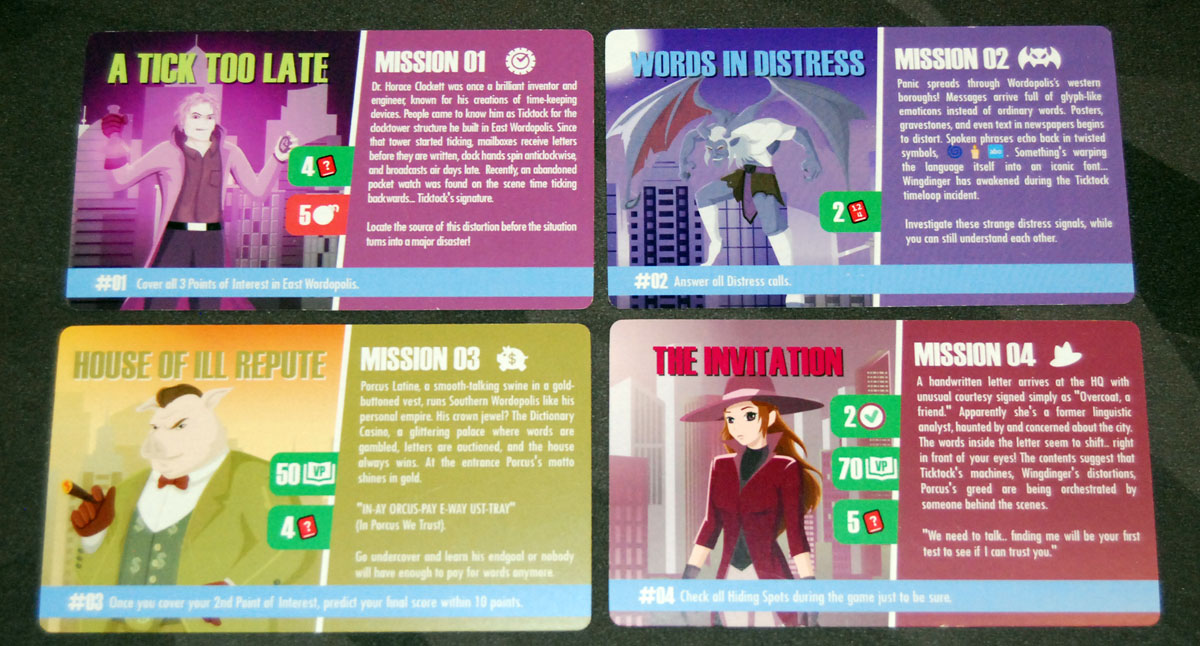
There are four villains in the campaign, each occupying one of the maps adjacent to the HQ board. Dr. Horace “Ticktock” Clockett puts a ticking time bomb into play—each time you fail to spell a longer word than your previous one, the bomb ticks down once! The Wingdinger distracts you with distress calls that must be answered, and sends out its Wingding minions that roam around the board and need to be captured. Porcus Latine imposes a word tax on you, forcing you to strive for ever more valuable words. And the mysterious Overcoat plays hide-and-seek, so you have to distinguish the real hiding spots from the red herrings.
As you play through the missions, more rules are introduced, increasing the difficulty level and the complexity. Defeating the villains takes careful planning and coordination, and a bit of luck! I played through several missions with my gaming group, enough to get to the basics of each villain, but there’s still a lot to explore. The prototype didn’t have the story endings yet, so I’m excited to see what happens when you complete the campaign and check your win/loss record.
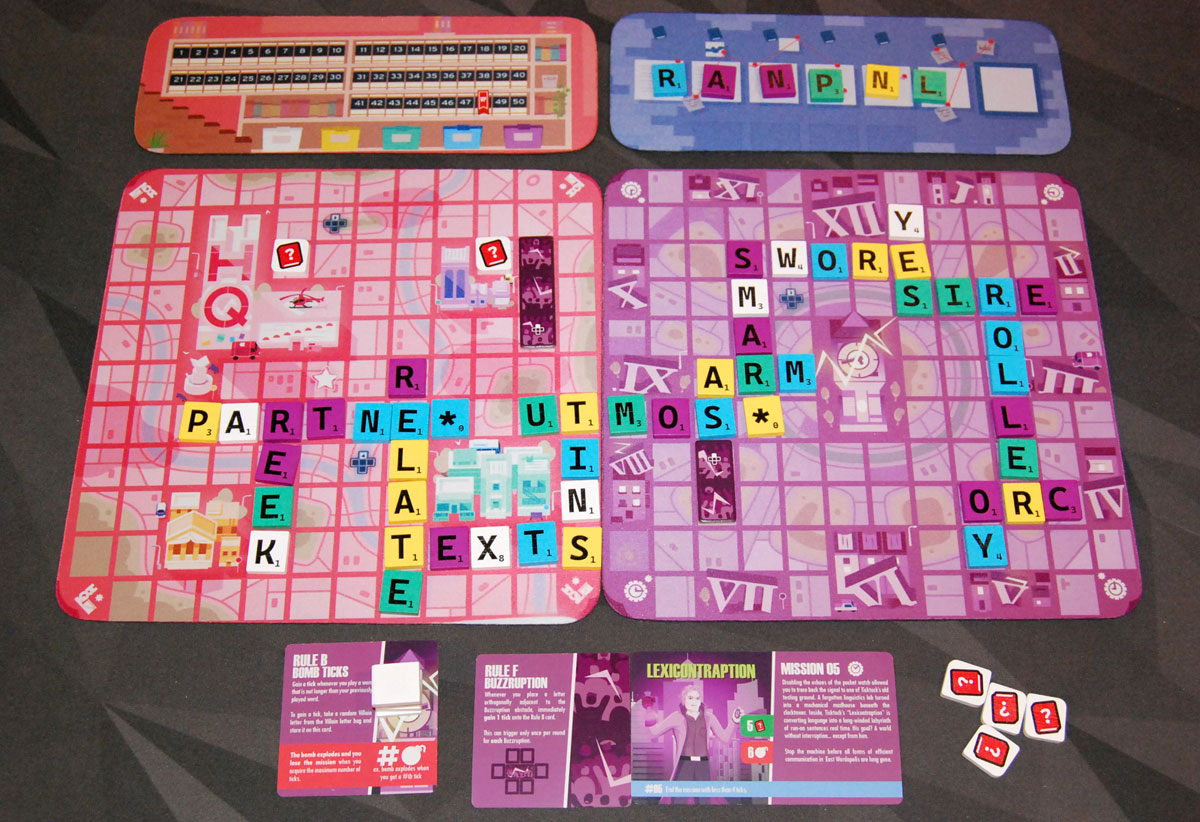
Defenders of the Dictionary is a fantastic mash-up of word games and cooperative games. I really enjoyed the challenge of considering what letter would make the best fit, and then scrambling to use the villain letter each round. The villain abilities are quite tricky—I thought Ticktock’s time bomb was one of the harder ones to work around—and I look forward to playing through the rest of the campaign eventually. And if you love Scrabble but nobody will play with you because you’re always crushing them, this might let you scratch that word-making itch in a way that doesn’t leave everyone else demoralized. At least, if anyone loses, you all lose together, right?
For more information or to make a pledge, visit the Defenders of the Dictionary Kickstarter page!
Click here to see all our tabletop game reviews.
 To subscribe to GeekDad’s tabletop gaming coverage, please copy this link and add it to your RSS reader.
Disclosure: GeekDad received a prototype of this game for review purposes.


Jonathan H. Liu

Jonathan H. Liu is a stay-at-home dad in Portland, Oregon, who loves to read, is always up for a board game, and has a bit of a Kickstarter habit. I can be reached at jonathan at geekdad dot com.


