Lake of Darkness is the most challenging novel that I’ve finished in a very long time. The key word in that sentence is “finished,” because whilst I often struggled with deriving meaning from Adam Roberts’s sentences, regularly finding myself looping back to make sure I hadn’t missed some deeper meaning, I always wanted to reach the bottom of the mystery. I wanted to understand what Roberts was driving at.
This is not an easy novel to read. It will not be to everyone’s taste. It is probably not for those addled from looking after small children. 10-years-ago-me would definitely have put Lake of Darkness down. The book is a space opera in setting, but it’s the hardest of hard science fiction, drawing on complex ideas from the latest black hole theories, as well as some abstruse philosophical musings.
If you want a measure of the novel’s ambition, try this partial sentence from Roberts’s author’s note at the end of the book.
“As my Thing Itself was a Kantian novel, and my The This a Hegelian novel, so this, in curious and perverse ways (curiosity and perversity being eminently Deleuzian virtues) is a Deleuzian one, written under this ordnance from The Fold…”
It goes on.
What Is Lake of Darkness?
On the face of it, our setup is simple. We’re several thousand years in the future. Humans are spacefarers. Technologically advanced but still alone in the universe. Two ships the Sα Niro and the Sβ Oubliette are investigating a black hole – “QV Tel.” Essentially, they’re both parked up, hoping to do some research.
One of the crew members, Captain Alpha Raine an intelligent military man, goes rogue and kills the crew of both ships. Why? Because a voice, the voice of “The Gentleman,” told him to do it.
Raine is not executed for his crimes, civilization has gone beyond that. Instead, he is kept imprisoned, while being treated therapeutically. Nevertheless, his affliction is transferrable. A historian who interviews Raine also starts behaving strangely, and from there, the virus, if that is what it is, spreads.
The tale continues – with various factions wanting to return to QV-Tel, some to destroy the black hole, some to liberate its prisoner. But how can anything escape a black hole? What does it even mean to be trapped inside one? Lake of Darkness poses many difficult questions.
Why Read Lake of Darkness?
What do black holes and Lake of Darkness have in common? – They’re both dense and absorbing!
In his author’s note, Roberts says that the starting point for his novel was “a notional solution to the paradox of information associated with a black hole. Gravity is a one-way street into black holes, such that nothing can return, no data can come back up across the event horizon back into our universe. If these black holes eventually evaporate through Hawking radiation then all the information they have captured will simply disappear. But such a hypothesis violates the idea of information conservation.”
He then cites this Scientific American article, which contains some of the background and foundation for the ideas in Lake of Darkness.
If pushing at the limits of our understanding of physics wasn’t enough. Roberts also turns his gaze to the evolution of humanity and our possible deskilling with the advent of AI. Humanity in the story is hyper-advanced compared with society today, yet almost nobody can read or write. Why bother, when we have AIs to do it for us?
It’s long been decried that technology stops us thinking; makes us worse at spelling or mental arithmetic, for example. Does this mean Adam Roberts is an old man shaking his fists at clouds? I don’t think so, but then I’m an old man too. He is a man worried about the infantilization of our culture and I think he has good reason.
Being an Adam Roberts novel, Lake of Darkness is gently satirical too. There are some swipes at influencer and celebrity culture and there are lots of references to modern pop culture, clever puns, and plays on words that anybody who has followed Roberts on social media for any length of time will be well aware of.
One of the novel’s characters, Guuanarsonsdottir, is possibly one of the most infuriating characters in modern times, forever morphing their opinions and claiming they were right all along. Professing to be an expert whilst obfuscating, lying or just claiming credit for things they had no control over. Perhaps, because when reading Lake of Darkness, I was continually looking for connections and references but Guuanarson and Johnson don’t seem that far apart.
There is a lot of science in this book. Not only lots of musing on the maths, geometry, and physics of black holes, but also a project to allow a daredevil celebrity to walk on the molten core of a planet. Beyond the science, there is the novel’s central meditation on the nature of good and evil. Is “The Gentleman” the Devil and is he trapped in the black hole? One of the novel’s characters is a committed Christian, making the possibility that Satan is trapped at the heart of the story all the more interesting.
There are a lot of metaphysical and philosophical musings in the book, coupled with our use of AI, and the idea that humanity is opting out from making the big decisions. Roberts is an author of ideas, whether they be Hegelian, Kantian, or Deleuzian. This book is brimming with them, and while they may sometimes feel a little overwhelming, take your time and try to soak in this hot-tub ideas machine. I read the Lake of Darkness in small chunks, often only 10 pages. It was thoroughly worth the effort.
Good fiction makes you see the world in a whole new way. Lake of Darkness does this on three fronts – The dangers of society subcontracting difficult thinking to AI, the nature of evil, and the complex science of black holes. An ambitious, difficult novel, but one that reaps reward for those who persevere.
If you would like to pick up a copy of Lake of Darkness here, in the UK. (Affiliate Link). I struggled to find any useful links based on the US – indeed Adams himself has mentioned that there are issues with US Amazon. If I hear any more I’ll try to update these links then. In the meantime I did find a link to the audiobook.
If you enjoyed this review, check out my other book reviews, here.
I received a copy of this book in order to write this review.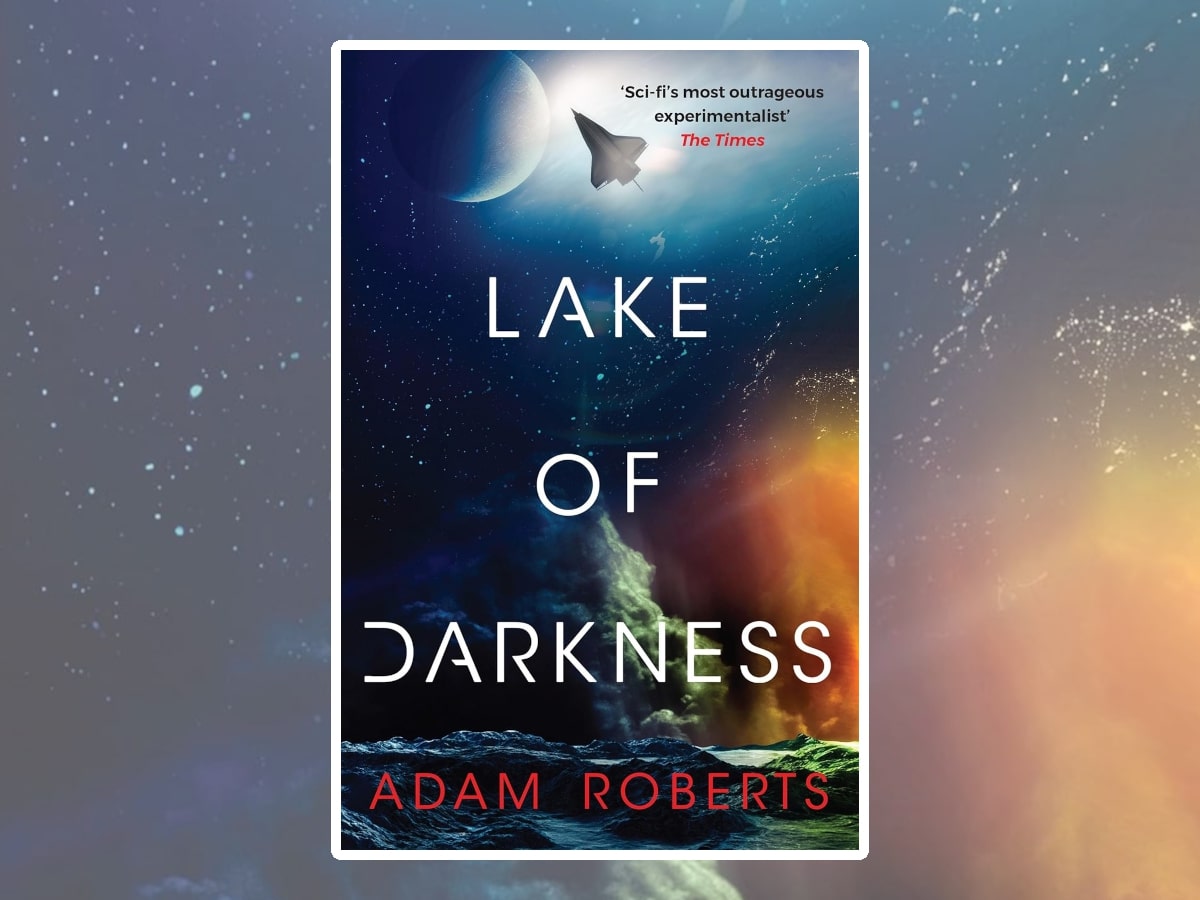
Robin Brooks

Dad of boys, player of games, and reader of books. GeekDad and one half of Agents of Sigmar. Prone to starting things I can't fin