The end of the year is looming—I always feel like the last couple months of the year just sweep past me, and I remember all these things I’d been thinking I’d get done. For example, one of my family’s holiday traditions is to go out for dim sum on Christmas morning with some friends. We’d done it for several years but had to put it on hold for a while because of the pandemic (during which time our favorite restaurant shut down and we had to find a different option). Every time we went, we’d say “wow, that was great—we should go more often!” And then … it would be December again and we hadn’t gone for a whole year. Starting next week we’ll have the first of our traditional year-end Stack Overflow posts: reflecting on our reading resolutions from the beginning of the year, making new resolutions for 2026, and sharing some of our favorite reads from 2025.
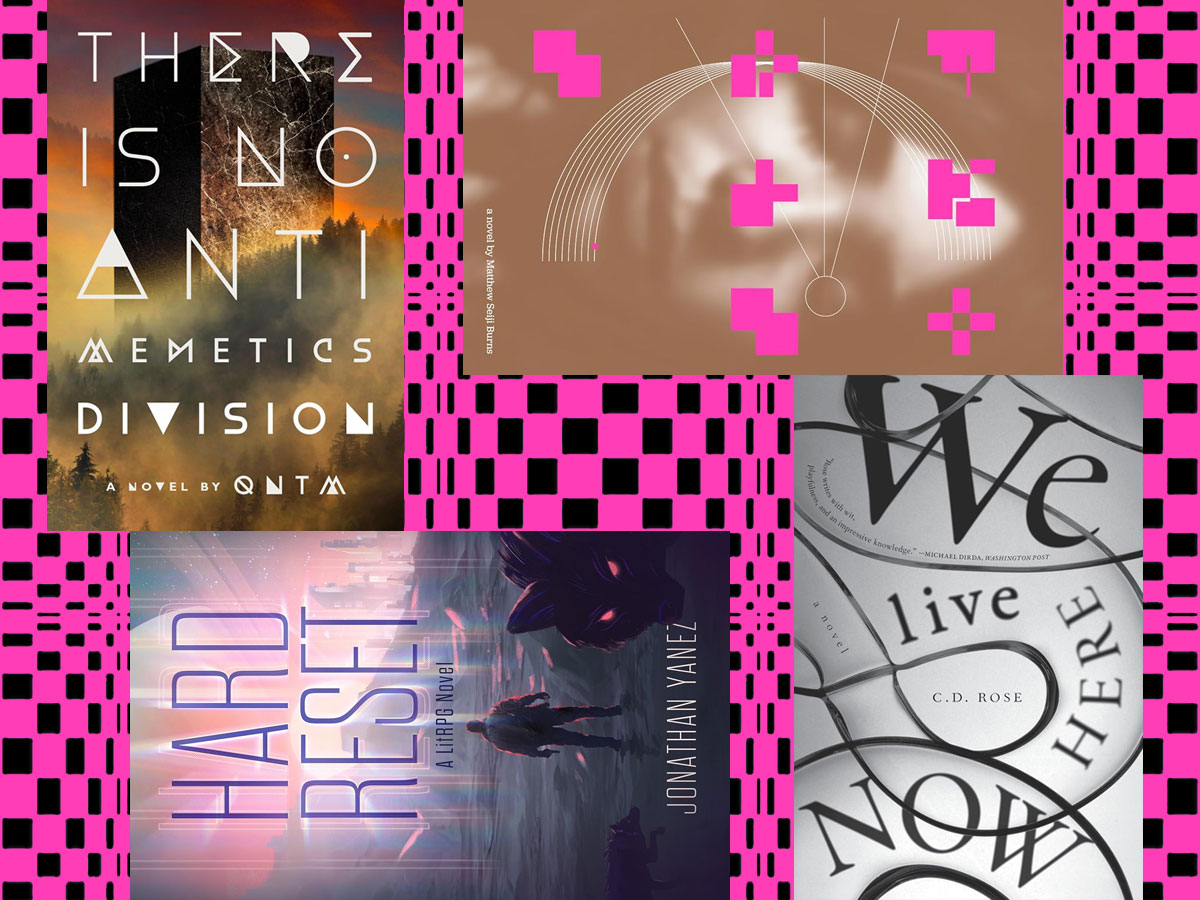
For now, though, I find myself in the middle of a couple stacks of books that I haven’t quite finished yet. I’ve got four novels today: two that I finished reading and two that I’m still reading. Though they’re all quite different from each other, the one thing they share is that they’re all a little unsettling in one way or another. So if you like your fiction just a little bit (or a lot) freaky, here are a few books that might fit the bill.
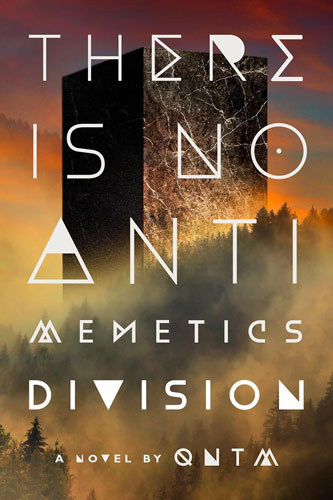
There Is No Antimemetics Division by QNTM
This book was originally serialized online between 2015 and 2020, and has been reworked to make it flow better as a novel. The story centers on the Unknown Organization, a sort of “Men in Black” secret organization that handles all the weird and unexplainable things in the world so that the rest of us can stay ignorant and go to sleep at night. Among the things that are studied, tracked, and sometimes contained by the UO are memetic phenomena: things that lodge themselves in your mind, things you can’t ignore, ideas that literally spread virally.
And, of course, the opposite: antimemetic things defy memory. Giant obelisks that you can look at but just don’t see because your brain glides past them. Creatures that eat specific memories from your mind. Things that you forget as soon as you leave their presence. These are things handled by the Antimemetics Division, headed by Marie Quinn.
The start of the book finds Marie trying to convince her boss that there is, in fact, an Antimemetics Division and that she has worked there for years—because one of the hazards of working in a division dealing with memory-eating phenomena is that people tend to forget about you entirely. The book consists of various vignettes surrounding the Antimemetics Division, and it has a sort of existential horror that I feel like Lovecraftian stories were supposed to evoke but never actually did for me. The book includes various case files from the UO that purport to explain various things that have been discovered, and they’re things that make your brain crawl a bit. The idea of erasing memories—sometimes intentionally—makes for some fascinating plot points, and I liked the thought experiments about a whole department trying to study things that by their very nature resist understanding.
I don’t want to give away too much of the story, but I thoroughly enjoyed being freaked out by this book. In case you’re familiar with the SCP Foundation (a collection of fiction that is very much in the same sort of shared universe, about the weird things that normies don’t know about), the stories in this book were originally serialized there, so that gives you a sense of the type of things you might find here. Suffice to say, this is probably one of my favorite books of the year and one that I’ll be thinking about for a while.

Hard Reset by Jonathan Yanez
When Tom Dexter wakes up in a coffin-like box with a weird computer screen in it, he has no idea what’s happening and has no memory of who he was before or where he is now… but it doesn’t take long for you to understand that he’s in some sort of Matrix-like videogame. Although most of the game focuses on Tom’s escapades in this sort of futuristic Wild West alien planet, we do get the occasional scene set in the real world, following some of folks running the program.
The idea is that Earth is in trouble, and the game has been designed to identify the people who would have the skills to lead an expedition to a faraway planet to establish a new home for humanity. Whoever can complete the game—which involves figuring out the goal of the game—will prove themselves capable. But the problem is that when people die in the game and respawn, they lose a little bit of themselves each time—and eventually become zombie-like figures, stuck in the game with no hope of finishing.
Hard Reset is billed as a “LitRPG novel,” a genre in which characters are playing a game and the story itself includes things about stats, game rules, and so on. Compared to Dungeon Crawler Carl, another notable example of the genre, Hard Reset actually focuses a lot less on specific game mechanics. Occasionally Tom checks his stats and spends skill points, but for the most part the reader is left in the dark about the specifics of how the game works, and there aren’t enough actual hard numbers that you really care about those much. Instead, it’s much more about the corporation behind the game, run by a mysterious Chairman, and one woman in particular who is in charge of selecting the people who get wired into the game.
This one wasn’t entirely satisfying to me, in part because there was just so much that I found implausible—and I say that as somebody who has really been enjoying Dungeon Crawler Carl, which features a talking cat. The general premise, that the game was designed to find people who could spearhead a space colonization effort, doesn’t feel like it fits with what actually happens in the game: trying to take down a corrupt mayor, which involves lots of shootouts and some hand-to-hand combat. The company’s stated aim to benefit humanity is also at odds with the way it is literally destroying people, and when I eventually heard the planned timeline for saving the world, it felt absurdly brief.
There’s certainly some potential for the “stuck in a videogame” premise, as well as for the conflicted employee who is working to make up for the damage they’ve done, but this is a game I probably won’t continue to the next level.

Process by Matthew Seiji Burns
Lucas Adderson, the narrator of this story, is not really somebody you’d probably want to hang out with. He’s singularly obsessed with success, narrowly defined in terms of recognition and monetary gain. He doesn’t understand why other people he has worked with in the tech industry have succeeded, gotten promotions, made millions, but he—with a similar background and intellect (by his own evaluation)—has been passed over time and time again. Maybe it’s because he’s just too nice a guy, he thinks to himself.
Reading between the lines, you get the impression that he doesn’t actually have the same skills as his successful friends. He’s the idea guy, who feels like somebody else should be doing the actual work of coding whatever grand vision is in his head, and calls that an equal partnership. When he strikes out on his own after losing his job, determined to make this thing that will change the world, it’s not even his own software that he starts pitching to interested parties—it’s something somebody else wrote that he doesn’t even quite understand. He’s just been fiddling with it and adding to it without really knowing how any of it works.
This is one of those books that I’m not sure I would say I’m enjoying, because of what a miserable person Lucas is, but it’s also a pretty sharp portrayal of the tech industry in the past couple of decades. Burns was himself a videogame designer, and he sets the story in a world that he is personally familiar with: Lucas is in Redmond, the land of Microsoft (and also its would-be competitors). The story is populated with tech bros who have grand visions of changing the world with their tech, but no concept of how real people would actually use it.
I’m about three quarters of the way through the book, and the whole story is written as something that Lucas is telling another character, Megan, somebody who was apparently quite successful back when the two of them worked at the same company. You get little glimpses of Megan here and there, but Lucas spends most of his attention on himself, so she is still little more than a cipher, a symbol of what Lucas could have been. And there’s a lot of foreshadowing: you get the sense of something ominous, something big that has happened, and Lucas’s whole story is a roundabout way of explaining what has happened. But I haven’t yet gotten to what exactly happened. Though the plot of the story (so far) has been firmly in the real world—no memory-eating monsters, no digitized people—there is this feeling of unease that I’m sure will come to a head in the final quarter, and I’m curious to see where it goes.
While the story itself is mildly unsettling, the presentation of the book has its own disorienting effect. The physical book is quite a production: the page edges are hot pink with various symbols on them, and the cover is a combination of a metallic copper and hot pink, with a pixellated font that is occasionally used for pull quotes within the book as well. The interior of the book also often uses the copper and hot pink, along with photographs that are blurred or oddly cropped or strangely digitized. The text is strangely justified so that there are often diagonal stripes of blank space cutting across the page. It is a book that plays around with the typography, not in a way that makes it difficult to read, but gives the impression that every line of the book was laid out with some intent that you can’t quite grasp.
I’m very curious to see where this story is going, but I’ll admit that it took me a while to get going because Lucas is just not somebody I’ve really enjoyed spending time with. We’ll see if the payoff was worth the setup.
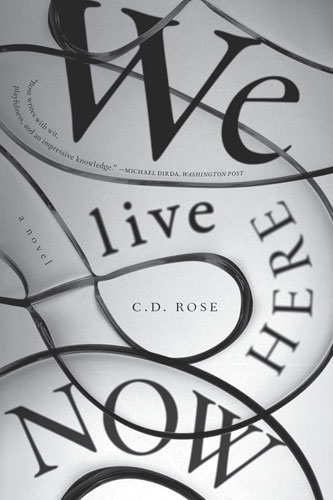
We Live Here Now by C.D. Rose
Here’s one I’ve just started, but already it feels like a story that would fit in the world of There Is No Antimemetics Division. It’s about the art world, and appears to be a series of stories that have some connection to an artist named Sigismunda Conrad. Her conceptual art installations have challenged notions of interior and exterior, of where the piece ends and the real world begins. She herself is enigmatic, elusive, and has even known to be frequently absent while her team of hired hands works on an installation. Several people who visited one of her pieces have gone missing, though it isn’t clear whether it has any connection to her art.
The opening chapter is a sort of retrospective article about Conrad, and feels like the sort of thing you’d read in The New Yorker, with impressions of her earlier work, interviews with people who knew her or worked with her, and lots of name-dropping of other artists (mostly real, I think?). It feels grounded in reality, even while the writer has trouble remembering certain details about Conrad’s exhibits, as if her artwork has antimemetic properties of its own. Then there’s a chapter about a woman who facilitates art sales, though she would probably never use a term as crass as “sale.” These are the rarefied heights where conversations hint and imply, and vast amounts of money somehow change hands without actual numbers ever being discussed. A potential buyer leads Kasha to a Conrad piece, which then results in a strange wild goose chase. And then the next chapter is about somebody else entirely.
Even in the first chapter, presented as a somewhat drily academic essay, I was hooked. What is going on here? I’m definitely intrigued, and will report back in the new year after I’ve finished the book.
My Current Stack
I’ve got a big stack of comics (mostly for kids) that are sequels, plus another stack that has the first two books in a series, so I figured that might make a good topic for an upcoming column—though not until mid-January at the earliest. I’ve started reading those, and perhaps if I get through those I’ll finally tackle this (now-overflowing) box of comic book biographies that I think I first mentioned over a year ago. Oops!
Hope you have a happy holiday season!
Disclosure: I received review copies of the books covered in today’s column. Click on the book titles for affiliate links to Bookshop.org, which help support my writing and independent booksellers.