

One of the biggest obstacles to overcome in the tabletop gaming hobby is what you face when you first bring that shiny new game home: learning to play. Is somebody going to sit down and study the rulebook? Or maybe they’ll watch a video instead… but that still leaves the issue of communicating all of that information to everyone else who’s going to play the game, too. There are a host of resources for learning games—YouTube channels, tutorial apps, fan-made rulebooks or player aids—but the fact that there’s a whole side industry based on learning to play games just highlights the core problem: most people can’t or won’t learn a game by reading the rulebook themselves.
Last weekend I saw a post on Bluesky from user Dzee Szed (Dean Ray Johnson) about board game rulebooks. He said that he had rewritten a few rulebooks as a hobby, but then after taking some grad school classes in technical writing, he “started to hate all rulebooks” and eventually wrote a 90-page paper on the subject. Titled “Every Board Game Rulebook Is Awful,” the paper is a deep dive into how rulebooks are structured, who they’re written for, and how they are used. And, as the title says, why they’re all awful.
Johnson examines the rulebook for one game in particular: On Mars, designed by Vital Lacerda and published by Eagle-Gryphon Games. The rulebook was written by Paul Grogan of Gaming Rules! In addition to writing rulebooks, Grogan also has a popular YouTube channel with how-to-play videos, so he’s no slouch when it comes to teaching games. In fact, his rulebook has been praised for the way it handles such a complex game with so much information. Johnson doesn’t critique it because he feels it’s particularly egregious, but because it does illustrate a lot of issues that are present in many other rulebooks.
I’m not going to repeat everything the paper says—it’s entirely worth a read if you have any interest in board game rulebooks and technical writing (admittedly this is for a small niche, but if you’re here reading tabletop articles on GeekDad then maybe it’s your niche too)—but I’ll touch on a few of the things Johnson brings up.
One is an issue that I’ve often thought about myself: a rulebook that works well for learning a game isn’t necessarily one that works well as a rules reference later. When you’re learning a game, you want information presented in a way that teaches the flow of the game and helps connect your actions to their outcomes, explaining how that will lead to victory. But when you need to look up a specific rule, it helps to have information organized in a way that makes it easy to find, and a rulebook with a lot of explanatory text doesn’t make for a good reference document.
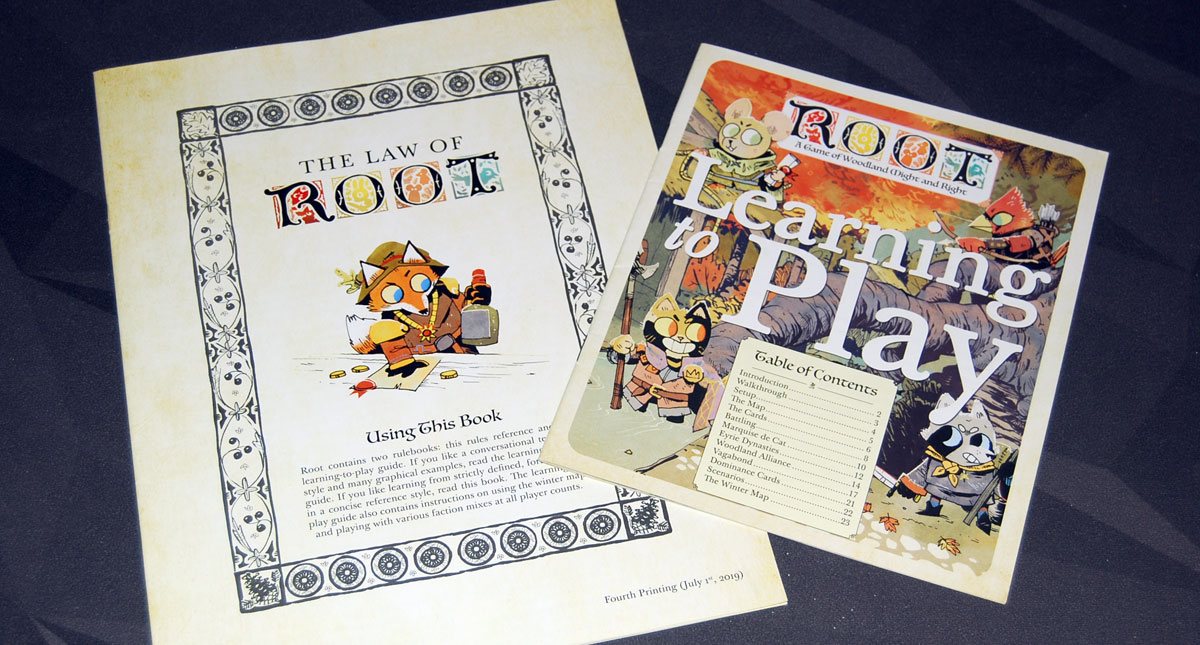
Publishers have tried different solutions to this. Fantasy Flight Games had separate books for learning to play and reference. Root from Leder Games had a rulebook that was organized like a giant outline with sections and subsections—that was used for reference—and a separate document for learning the game. I felt that the reference was excellent: any time I needed to look up a rule, I was able to find it easily. But for actually learning how to play the game from start to finish, that reference book was impossible to navigate, so you needed the other document instead, as well as a walkthrough guide (which sometimes worked but then you didn’t want to use it again if you had a new mix of players). Most of the time, though, you end up with something that’s just kind of a mix of both, which makes it not great as either. Maybe it’s a how to play book but with an index—better than nothing.
Another big issue is the fact that rulebooks don’t have a clear target audience. You need to provide different information to a novice than an expert. If you’ve never heard the terms “worker placement” or “trick-taking” or “deck-building,” then it’s not helpful to you if I use those as shortcuts to describe a game’s mechanics. On the other hand, if you are familiar with those game genres, then I can cut out a lot of explanation and skip to how this specific game uses those mechanics and how it might differ. Since publishers generally can’t make any assumptions about what the reader may have played before, I feel like most rulebooks are written as if they’re for novices, starting from scratch and not relying on the players to rely on knowledge of other games.
But does that make sense? Johnson did some informal polls and found that the majority of people who play a game have usually not read the rulebook. Think about your own experiences with games. Most likely one person reads the rulebook and then teaches the game to the other players, who might look at the rulebook to look up a question but won’t read the whole thing. I’m sure there are often situations where somebody learns a game from the person who read the rules, and then subsequently teaches somebody else to play without reading it themselves. It’s not a stretch to say that although Monopoly remains one of the best-selling games, most people haven’t read the rules and just learned from somebody else. If it is the case that most rulebooks are read by that one person in the group who always reads the rulebooks, then wouldn’t it make sense to take their experience into account?
Of course, it’s not so simple: there are always new people entering the hobby, so you can never count on somebody having a dedicated rulebook reader in their group already. Any game might be the first game somebody tries to learn on their own, and nobody wants to be the game that made somebody give up on the hobby altogether, right?
These are just some of the issues that I’ve encountered as the rulebook guy for my own group. As a game reviewer, I’m generally the one responsible for introducing people to a new game, so I do my best to read the rulebook ahead of time when possible, and I’d say that 15 years of writing for GeekDad has given me a lot of practice. I feel like I’m pretty good now at learning a game from the rulebook and then relaying that info to other players—though sometimes that makes me impatient when somebody else is teaching me and I don’t get to read the rules myself!
But there are lots of additional considerations from a technical writing perspective, and I really appreciated Johnson’s insight into things like cognitive load, working memory, and even how formatting can be used to make instructions easier to grasp at a glance. Numbered lists and flowcharts may feel dry or technical, but they work and they’re easier to follow than a wall of text. There are a lot of good lessons to be learned from the paper, though my biggest takeaway is probably that it’s impossible to create a document that can be everything for everyone.
It’s made me think a bit about how we write about board games here at GeekDad, too. We always include a “how to play” section that tries to explain the game’s rules, so that the reader has some context for when we write about what it feels like, what we like and dislike about the experience. But that “how to play” section can be a lot like these fan-made rulebooks that Johnson describes, and after reading his paper I wondered how effective they actually are, and what I might change about them in the future. Stay tuned, I guess!
In the meantime, if this sort of thing fascinates you, take a look at “Every Board Game Rulebook Is Awful.” As a bonus, if you happen to have Stardew Valley: The Board Game, Johnson has written a sample rulebook for it as an exercise, included at the end of the paper. Happy gaming!
Note: The photo at top is from the rulebook for Hegemony, a game I’ve just recently received for review and it may not be entirely fair to use it as an illustration of difficult rulebooks. I’ll admit that I haven’t actually sat down to read the rulebook so I can’t say whether I consider it’s good or not, other than that it was daunting because there’s a lot of small text and not a lot of graphics after the setup pages, so I set it aside for later.


