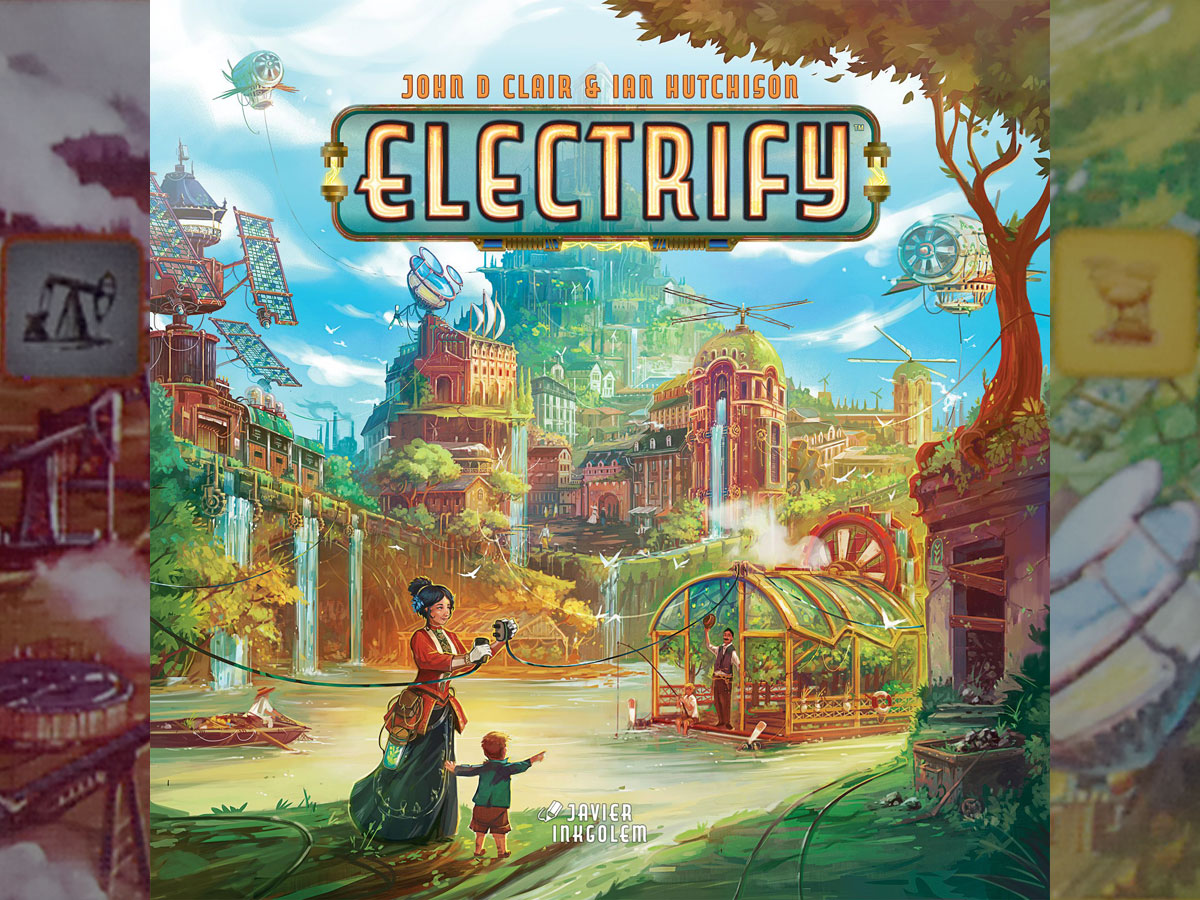
At the turn of the century, build your energy infrastructure to electrify your city!
What Is Electrify?
Electrify is an engine-building game for 1 to 4 players, ages 10 and up, and takes about 60 minutes to play. It’s currently seeking funding on Kickstarter, with a pledge level of $39 for a copy of the game; there’s also a $69 tier for the “visionary” edition. The game does have a bit of complexity to it, and since much of the game is played simultaneously with all the players, it can be a little tricky to make sure everyone is playing it correctly; if you are playing with less experienced players, you probably want to allow for a longer play time to make sure everyone knows what they’re doing.
Electrify was designed by John D. Clair and Ian Hutchison and published by Alderac Entertainment Group, with illustrations by Javier González Cava.
New to Kickstarter? Check out our crowdfunding primer.
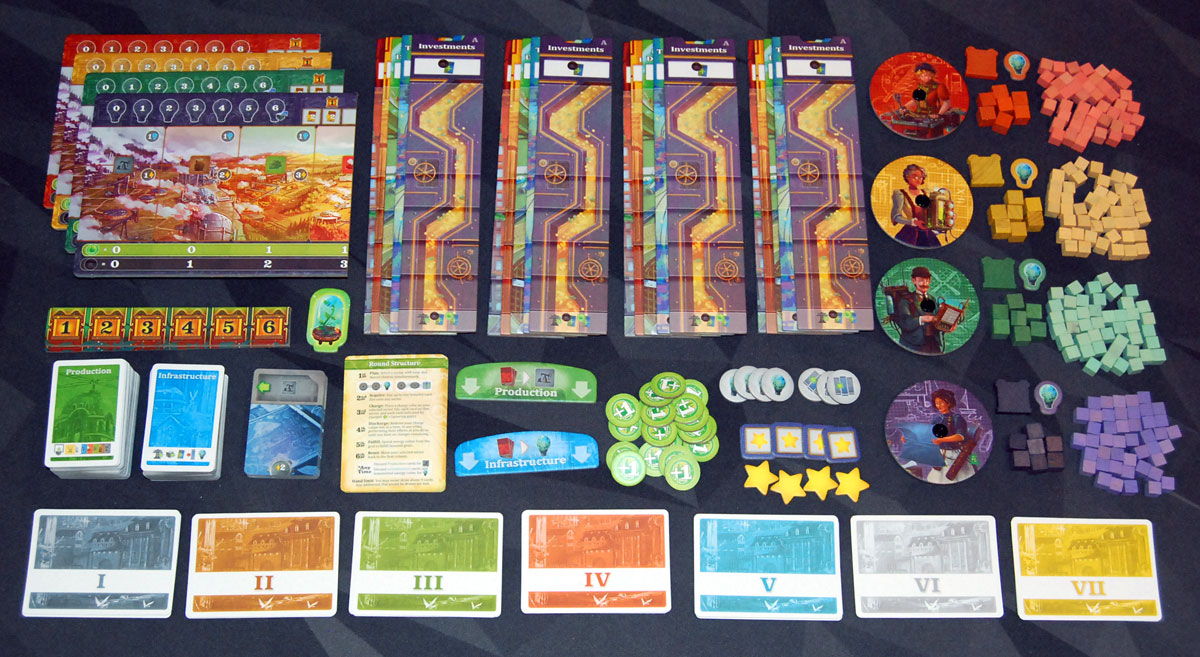
Electrify Components
Note: My review is based on a prototype copy, so it is subject to change and may not reflect final component quality, though the prototype did look nearly complete.
Here’s what comes in the box:
- 4 Sets of player components, each containing:
- Player board
- 5 Industry Sector tiles
- Sector Selection dial
- Score marker
- Research marker
- 7 5-value cubes
- 45 1-value cubes
- Score/Round track
- Round Marker
- 52 Production Industry cards
- 52 Infrastructure Industry cards
- 24 Basic Industry cards
- 8 Reference cards
- 2 Discard tiles
- 20 Clean Breakthrough tokens
- Solo components:
- 7 Sector Boost tokens (for solo game)
- 4 Bonus Reward tokens
- 4 Bonus Star tokens
- 4 Scenario cards (not pictured)
- 28 Demand cards (4 each in 7 levels)
- Lead Visionary token (not pictured)
- 4 Jumpstart Guides (not pictured)
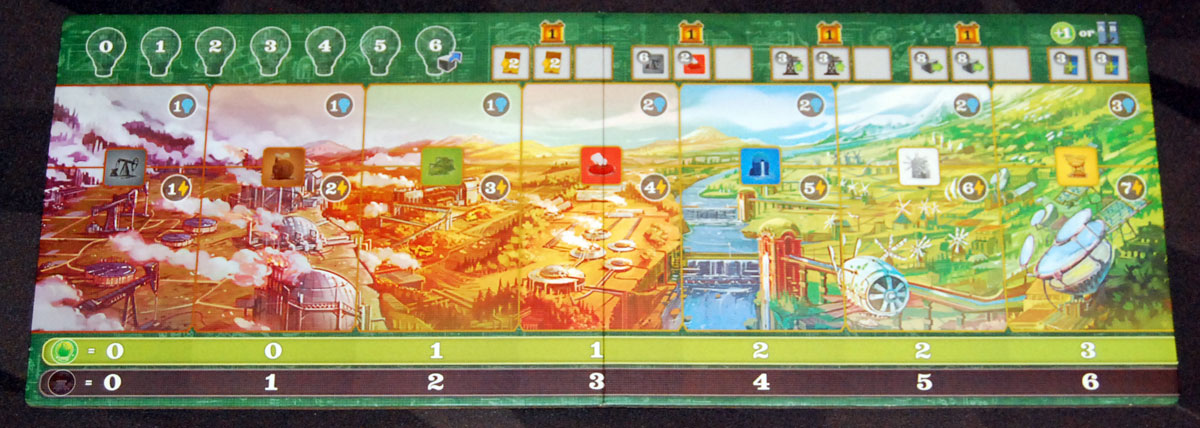
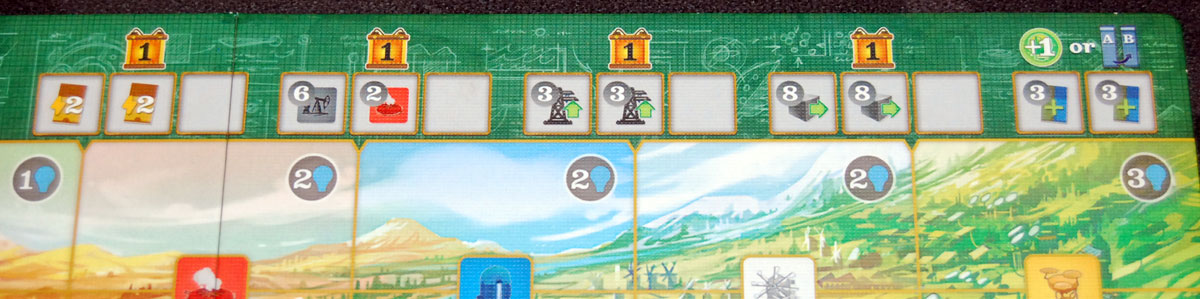
The player boards are identical except for the player color on the background. There’s a large panoramic view depicting various types of energy production, from fossil fuels to hydropower to solar power. Each of the 7 types of energy has its own icon, and the board is split between a bottom and top sections, where you store cubes representing produced energy and transmitted energy. (There’s a very thin line between the bottom and the top sections at the level of the energy icons.)

Along with the player board are industry sector boards, long vertical cardboard tiles that are lined up side by side below the player board. Each one can have up to 5 overlapping cards on it, and there’s a small notch at the top to make it easier to pick up a tile, since you will be moving and rearranging these tiles constantly during the game.

Each player gets a dial, which allows you to choose one of the five industry sectors to activate each round. The backs of the dials have character illustrations on them (seen in the full components photo above), though I’ll admit I spent most of the game just looking at the selection side.
The player components also include two sizes of cubes—the larger ones are worth 5 each and the smaller ones are worth 1 each. I did notice that the colors of the cubes are not entirely consistent in the prototype, but that did help distinguish the large and small cubes at a glance. I’m not sure if that’s intentional or if the colors will match more closely in the finished game.
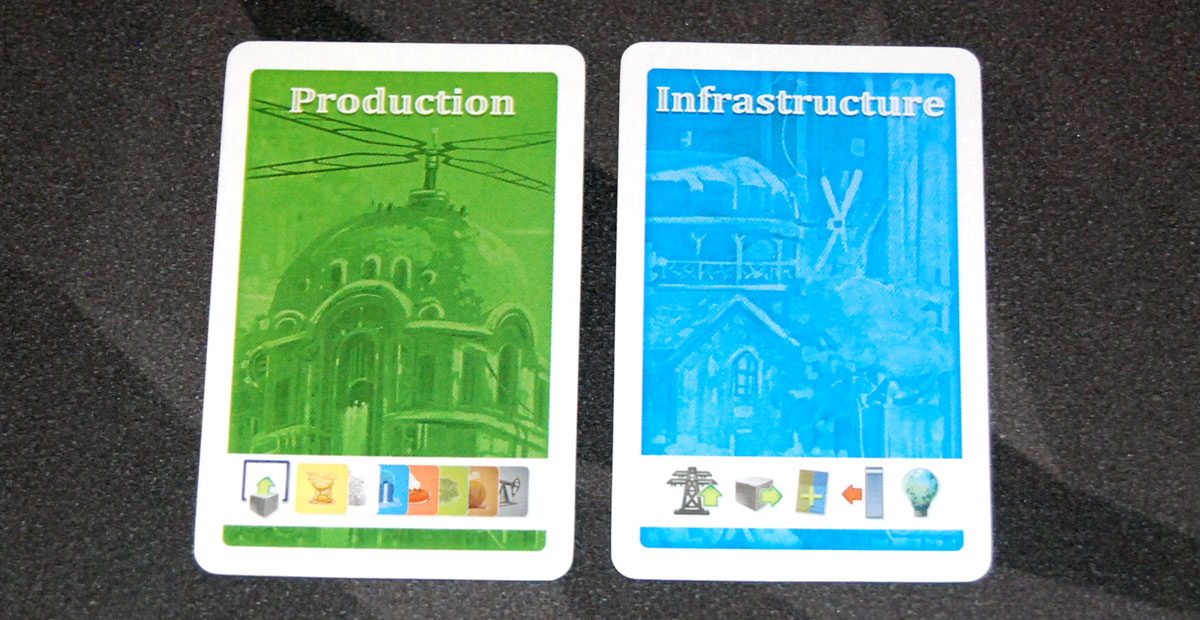
The two main types of industry cards are production(green) and infrastructure (blue). The backs of the cards have icons that indicate the types of actions that are included in that deck: production cards let you produce different types of energy; infrastructure cards have a wide range of actions that include transmitting energy, moving industry sectors, and gaining research.
The “visionary” edition of the game includes a second box with some original concept artwork, as well as two “tech packs” of 20 cards each that introduce some more complex actions and effects. (The prototype included at least some of these cards to try out.) It will also include the Fusion microexpansion and components for a 5th player. Finally, it adds an upgrade pack that has cloth bags for the player components and unique meeples for the scoring markers.
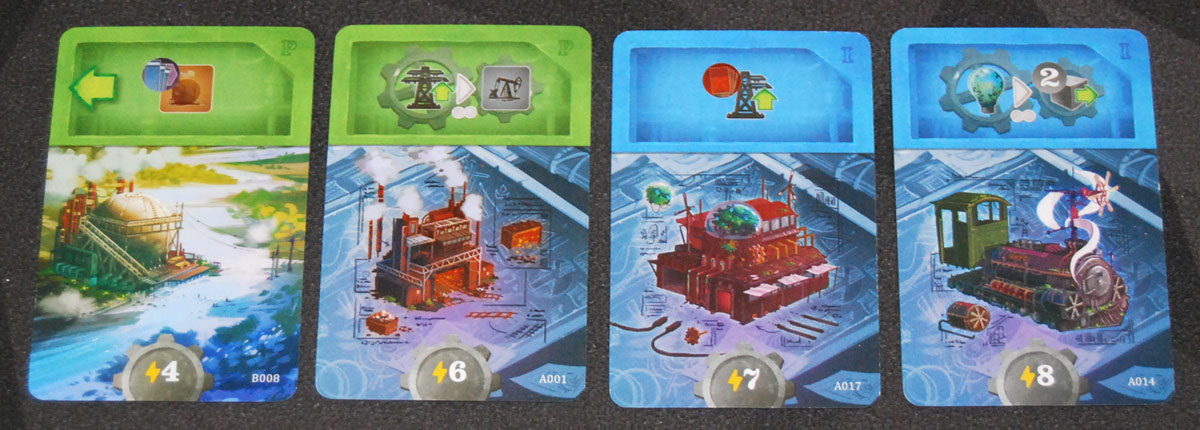
The “tech packs” are a set of 40 cards (20 per type) with more complex actions and are meant to be mixed in once you’re familiar with the game. However, in the prototype rulebook there were not any instructions indicating how to identify them, so they were all mixed together. Apparently the tech pack cards were labeled in the bottom corner with an “A” number and what appears to be a blueprint, though I wasn’t sure if the “B” card was a basic card or a tech pack card. Hopefully in the finished version it will be easier to distinguish these so you can sort them out.
How to Play Electrify
You can download a draft of the rulebook here.
The Goal
The goal of the game is to score the most points, primarily by producing energy to fulfill demand.
Setup
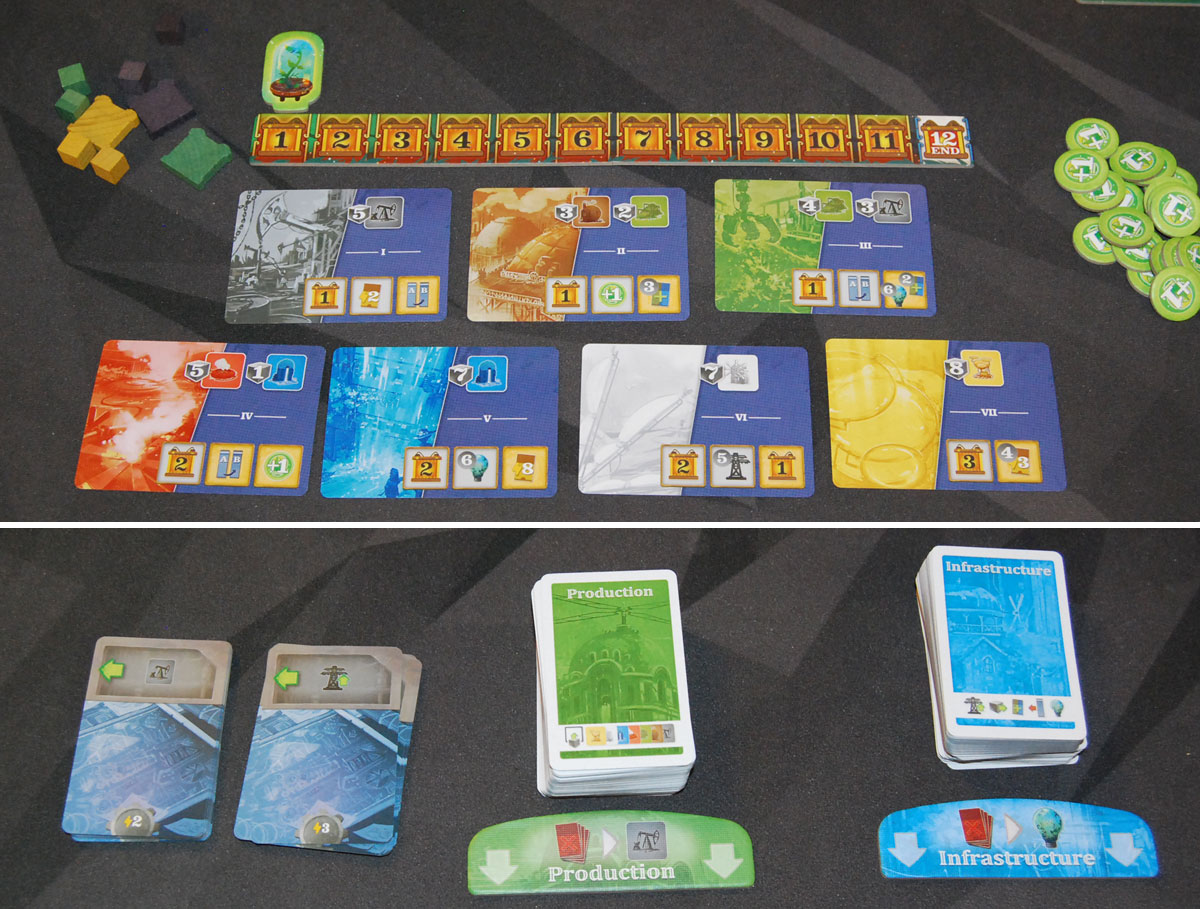
For the main setup, place the score/round tracker in the center of the play area, with the round marker above the “1.” All players should place their score marker and 2 large cubes next to this. Below the track, place 1 random demand card from each level face-up. Make a supply of clean breakthrough tokens nearby.
Shuffle the production cards and infrastructure cards separately to form two decks, with the discard indicator tiles near them. Place the basic industry cards nearby. (The basic cards are all identical, with a production side and an infrastructure side—you can split the deck and turn one over just to make it easier to see both options.)

Each player gets a player board, a set of 5 industry sector tiles, a selection dial, a research marker, and all of the cubes of their color. The research marker is placed on the first space of the research track (top left of your player board). One player arranges the 5 industry sectors in order, starting at the bottom left edge of their player board, and everyone else places theirs in the same order. Everyone draws 3 production cards and 3 infrastructure cards.
Place 6 small cubes in the fossil fuels space at the bottom left of your player board.
Gameplay
Most of the gameplay is done simultaneously each round. You choose what sector to activate, and then everyone charges and activates their actions on their own, resolving all of their actions as desired.

Each turn, players will simultaneously select an industry sector using their dial, and then reveal. If you chose the same industry sector as somebody else, you get a collaboration boost—everyone who matched moves their research token up one space. If you’re the only person who chose your sector, you get an innovation boost: slide your chosen sector one space to the right, pushing any sectors to its right to make room. (If it’s already as far as it can go, then it does not move.)

Then, everyone may play one industry card from their hand (or a basic one from the supply). The cost is shown at the bottom of the card, and is paid using energy from your player board. Each of the sectors has an energy value—fossil fuels are worth 1 energy per cube, but solar energy is worth 7 energy per cube. (You don’t get change if you overspend.)

The card you play may be placed on any of the 5 industry sectors, not just the one you selected this turn. You may place the card in any order on it sector (inserting it before or after any existing cards), but then all of the cards should be shifted toward the top of the tile so open spaces are below the cards.
Next, you charge your actions. Place a small cube on each action that is charged: the action at the top of the industry sector you selected, as well as any cards on that sector. In addition, many industry cards also have green arrows pointing to the left (and sometimes diagonally up or down). If there is a card to the left (skipping over spaces that have no sector tiles at all), then those get charged as well, chaining across until there isn’t an arrow or the arrow doesn’t point to anything.

Then, you may discharge those actions in any order (though you must complete using one action before you begin another, since many actions have more than one effect). All actions are optional. Production cards allow you to produce energy, placing cubes in the corresponding location of the player board. Developing lets you move energy cubes to the right so that they’re cleaner, more efficient energy. Transmitting is used to move cubes from the bottom section of your board to the top, where they can be used to fulfill demand.
Some of the actions have a small circle next to them, which indicates how many times you can do the action. If it’s a numeral, you just get to do the action that many times. If it’s a green or grey icon, then you get to do the action according to the clean or dirty track directly above that action on your player board. For instance, in the photo above, the Investments sector has a “draw cards” effect with a grey icon—I will get to draw 5 cards based on its currently location. If it had been on the far left, the action would draw 0 cards. The “+1” clean breakthrough tokens are placed next to the track when you earn them, and they each add 1 to all of the values in the clean track.
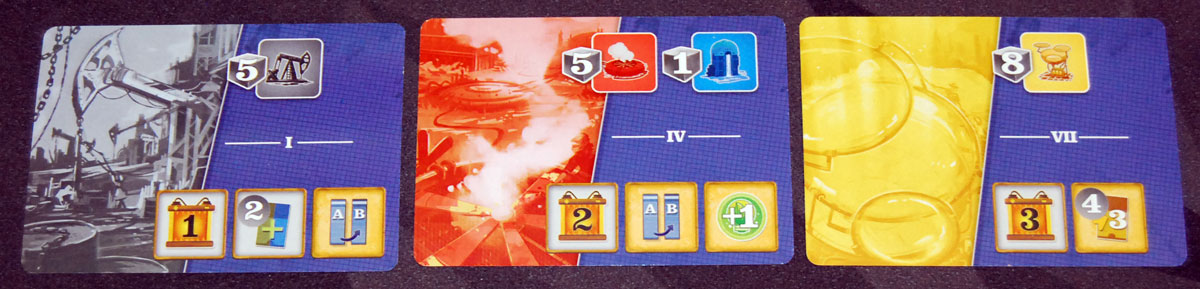
After you’re done discharging all your actions, remove any remaining charge cubes—they do not carry over to the next round. Then, you may fulfill any number of demand cards that you can afford. Each demand card shows a number of energy cubes that must be spent from your transmitted section (top of the board) to fulfill that card. For instance, the center card shown above requires 5 geothermal and 1 hydropower. If it’s one of your first two demand cards fulfilled, use one of your large cubes from next to the score track, and you gain all of the rewards on the bottom of that card. Otherwise, place a small cube from your supply on the card and gain just the rewards in the silver boxes. Note that you can only fulfill each demand card once. Also, it does not matter whether other players have fulfilled it before you or not—it only matters if it is one of your first two.
You may always discard cards from your hand for a bonus effect: discarding a production card lets you produce 1 fossil fuel, and discarding an infrastructure card lets you gain 1 research. (The discard indicator tiles have reminder icons about this.)
At the top of your player board, there is a research track with a light bulb marker. There are three ways to gain increase research: the collaboration bonus when you select the same sector as another player, a research action on a card or sector tile, or you can spend transmitted energy to increase your research—cleaner energy gives you more research points than dirty energy.
Every time your marker reaches “6” on your track, you place a cube on your research rewards and then reset your marker. There are several groups of rewards (pictured above); you may place the cube in any group, but fill from left to right within the group to get the reward shown. If you fill an entire group, you get the reward shown above the group.
At the end of the round, you reset: take the industry sector that you selected this round and move it to the far left, pushing other sectors to the right to make room as needed. When everyone is done, move the round marker to the right and start the next round.
Game End
The game ends at the end of 12 rounds. The highest score wins, with ties going to the player who performed the most research, and then the player with the highest total value of remaining energy on their player board.
Why You Should Play Electrify
The setting of Electrify is the turn of the 20th century, and you are all visionary leaders bringing the power of electricity to the masses. Ramp up your production to generate more energy, and build out your infrastructure so you can transmit the electricity and and develop cleaner sources of energy. You win the game by earning the most energy points—primarily by fulfilling demand, but also by pursuing research (which also has its own benefits).
The gameplay is very much about engine-building. Each round, you’ll get to add one card to your tableau, improving one of the five industry sectors—now, each time you choose that sector, you’ll get additional effects. But after a sector is used, it moves all the way to the left, where it is least effective, which encourages you to cycle your choices rather than always choosing the same thing.
There’s an interesting balance between loading a lot of cards onto the same sector versus spreading out your cards across multiple sectors. If you power up one action, then each time you take it, it could be extremely powerful (though perhaps limited by the sector’s current position). If you spread cards out, you may be able to build chains so that you activate several effects across your whole tableau. The chaining reminds me a little bit of another John D. Clair game, Space Base—there are some ship abilities that will activate adjacent cards; in this case, though, the card has its own effect and activates an adjacent power. The constant rearranging and shifting of the industry sectors makes it a good puzzle, and it’s extremely satisfying when you can line everything up to pull off a big turn.
It does take a bit of time to build up, though. Even if you’re really good at arranging things, using research bonuses, and so on, you are still typically limited to adding one card to the tableau per round, same as everyone else. There are only so many actions you can do in a single turn in round 3. But by the late game, it’s possible to have huge chains of actions, as well as upgraded industry sectors, sometimes allowing you to fulfill multiple demand cards in a single turn.
One of the things that stands out about Electrify is that there’s almost no direct player interaction. Other than the innovation/collaboration bonuses (based on whether you selected the same action as another player or not), nothing that you do actually has any effect on another player’s game. It really fits the definition of “multiplayer solitaire,” and John D. Clair explained in a design diary that this was intentional: it’s about building the best engine, not about sabotaging your rivals. Thematically, that fits the story of several people introducing electricity to their own cities: you all want to build the best city, but you aren’t actively destroying what anyone else builds.

In many games with shared goals, there is a race element, where the first person to meet a goal gets a bonus and everyone else gets a lesser reward. In this one, the only person you’re racing against is yourself: your first two demand cards give you a bigger bonus, and the rest of them score the lesser amount. One of the important strategic decisions is choosing which demands to fulfill first for their added bonuses. In my first game, I made the mistake of pursuing the Level 7 demand card first—it cost a lot of solar power, which is the most difficult to produce. I had some tools to help me produce solar quickly, and I liked the bonus reward (playing some extra industry cards) but since I’d had to discard a bunch of my cards for extra transmission, I no longer had the cards in hand to take advantage of the bonus.
Bonus rewards might let you flip one of your industry sectors over to the upgraded side, making that action more powerful for the rest of the game. You might get to play additional cards for free, gain research points, or just draw more cards. The clean breakthrough tokens are particularly useful if you have a lot of actions that have the green icon, because each breakthrough will boost all of those actions across the board.
And, of course, demand cards are the primary way to score points. Some have additional points as bonus rewards, but generally speaking this is a low-scoring game. The scoring track only goes up to 12 (your score marker flips over to the “12+” side if you happen to exceed that). The only other way to score points is by filling out the groups on your research track, but that can come at the expense of fulfilling demands, another point of balance to figure out.
There’s enough going on in my own personal puzzle that the solitaire feel of the gameplay didn’t bother me at all. Multiplayer solitaire isn’t the same thing as solo play—you are still playing with other players, and you can see their progress as the demand cards fill up with everyone’s cubes and the score markers start climbing. It’s more like parallel play, where you all get to participate in the same activity, but everyone is kind of doing their own thing. The collaboration/innovation bonuses are a little nod to the fact that there are other people at the table with you, and if you’re really hoping for one or the other, you can look at their boards and try to guess what they’re going to do when you make your own selection. But if you prefer games with a little more head-to-head conflict or interaction, Electrify might be a bit dry.
Overall, I really enjoyed the challenge of building up my energy-production engine and sequencing my actions to rearrange the industry sectors for maximum effect. If you enjoy this sort of efficiency puzzle, you should check out Electrify! For more information or to make a pledge, visit the Electrify Kickstarter page.
Click here to see all our tabletop game reviews.
 To subscribe to GeekDad’s tabletop gaming coverage, please copy this link and add it to your RSS reader.
Disclosure: GeekDad received a prototype of this game for review purposes.