

So, our nation celebrated its 250th birthday this weekend—a pretty big deal, and yet we’re still a fairly young nation in the scheme of things, and it seems like we’re still figuring things out and making a lot of mistakes. The occasion has led to a lot of reflecting (not to mention all that hubbub about a certain reflecting pool) about patriotism and nationalism and, well, politics. While a lot of people still had a great time celebrating the holiday, there was also a lot of dissatisfaction and dissent, including some real “rain on the parade” weather in DC.
Today’s stack includes two books that I felt were relevant reading for the weekend, things to ponder as we consider two and a half centuries of this Great American Experiment.

Declaration/Emancipation Illustrated by R. Sikoryak
A few years back, I wrote about Sikoryak’s Constitution Illustrated, which includes the text of the Constitution, juxtaposed with a variety of comics. This two-in-one book does the same thing, but with the Declaration of Independence, the Emancipation Proclamation, and the Gettysburg Address (which doesn’t get a mention in the title). The book is printed back-to-back, so you read the Declaration starting from one cover, and then flip the book over and read the Emancipation Proclamation and the Gettysburg Address from the other cover.
The images aren’t usually literal illustrations of the passage they’re paired with, though in many cases there is at least some connection. Instead, each page is a single panel featuring various characters—the Avengers, the Wizard of Id, Ziggy, Family Guy—but dressed in colonial garb, picking up the Declaration where the previous page left off. The Emancipation Proclamation gives prominence to Black comics characters in its illustrations.
Of course, I’ve read the Declaration of Independence before, though it’s been a long time since I’ve read the whole thing beyond the often quoted sections about “life, liberty, and the pursuit of happiness.” In particular, the charges brought against King George that serve as justification for instituting a new form of government struck me as distressingly familiar—an observation that I’m certainly not the first to make in recent years. Imposing taxes, standing armies, obstructing immigration, cutting off trade, depriving people of trial by jury… these aren’t just complaints from 250 years ago—they’re things we see on social media today. (Granted, there are also parts that are different; the language about “merciless Indian Savages” feels backwards and racist, and calls to “British brethren” for their support is not as relevant to our situation now.)
Reading the Emancipation Proclamation, what I noticed most was how much more it read like a legal document, with provisions and technicalities, rather than something like the Declaration that has some poetic flair. We were taught in school that the Emancipation Proclamation is how Lincoln freed enslaved people, but we often gloss over the part where it only applied to the Confederate States and didn’t apply to several slave-holding States that weren’t in rebellion. The Gettysburg Address, on the other hand, is a speech meant to inspire and encourage, praising the soldiers who died in battle and setting forth a vision of what the nation might become. It’s remarkably brief, but maybe that’s also what made it so memorable.
As before, Sikoryak offers very little in the way of commentary. There’s an index that lists the comics that the characters are taken from, and some timelines of events leading up to the Declaration and to the Civil War, but outside of that the book is largely just the text of these documents themselves. The illustrations themselves carry some weight and sometimes feel like they shed a bit of light on the author’s opinions of the text in question, but for the most part Sikoryak lets the text speak for itself and it’s up to you to interpret it.
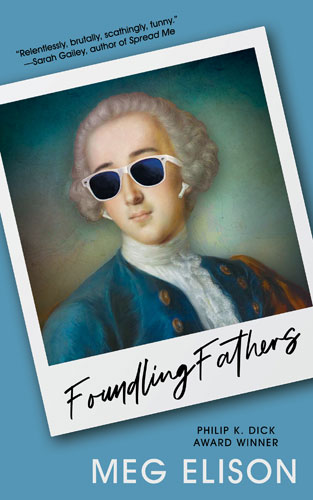
Foundling Fathers by Meg Elison
Foundling Fathers is a political satire, and unlike Declaration Illustrated there is no question which side of the fence the author is on. The year is 1750—or so the four young men living on an island plantation have been told. Ben Franklin, Thomas Jefferson, John Adams, and George Washington have been raised as brothers by their mother, Mary Libertas, who tells them stories about their heroic deceased father. Their teacher and father figure, Jeff Hancock, has given them an education that will prepare them for statecraft so that one day they will be ready to lead the nation.
And that’s when Ben finds his mom’s iPhone in the privy, and everything begins to fall apart.
It is actually the year 2026, and the four young men—now in their late teens and early adulthood—are part of an experiment by the Antediluvian Society, a shadowy organization that wants to make America great again by bringing back its founding fathers. They’ve secretly cloned them and raised them in an 18th-century setting, cut off from all modern technology (well, except for the airplanes that occasionally pass over in the sky) and outside society, in the hopes that they’ll grow up to be the inspiring figures they were the first time around. (And if Thomas Jefferson keeps impregnating the servant girls, or John Adams turned out to be a bit whiny … well, they’ll work with that.)
It’s a pretty short novel so I don’t want to give too much away, but the discovery of the iPhone opens their eyes to the truth, and forces the hand of the Antediluvian Society to move up their timetable for their planned reveal. Things hardly go according to plan, though, and there’s a lot of humor and pointed observations about what it would be like if young clones of the founding fathers suddenly turned up in our modern world. The society includes an old true believer who really thinks that the best solution is a re-run of our past; a colonel who can’t wait to have Washington on his side; a tech billionaire who really doesn’t care about history at all but thinks he’s the smartest guy in the room.
The book is a critique of those who have nostalgia for a whitewashed version of our history—the one in which our founding fathers were mythic figures and not flawed men who often held contradictory views. It’s Elison’s birthday present to America, a country that she loves despite its flaws and lies, and it’s worth a read.
Disclosure: I received copies of these books for review purposes. Affiliate links to Bookshop.org help support my writing and independent, non-billionaire booksellers!
My Current Stack
I’ve been trying to get through my stacks of comics (as usual), and in particular catching up on some of Ben Katchor’s books, both old and new. I also just finished a truly fascinating book called Sublimation by Isabel J. Kim that deals with topics like immigration and Asian diaspora and identity, by imagining a world in which people sometimes split into two when crossing a border. I’ll definitely have more on that soon. And I’ve just started reading Wildwood by Colin Meloy, which I never actually read despite it sitting on my shelf for about 14 years now. (I barely started it once but got distracted by several other books I needed to read and then … just didn’t finish.) But now, with LAIKA making a stop-motion film of it, I think it’s finally time to explore this weird version of Portland.


