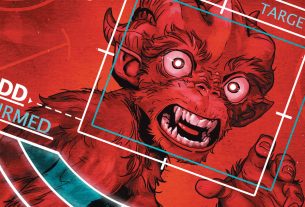
Sometimes you just don’t really feel like yourself, whether because you woke up on the wrong side of the bed or because you’ve been subsumed by sentient alien fungus. Today’s stack includes several books about alternate selves and strange realities.
Disclosure: I received review copies of the titles covered in this column. Affiliate links to Bookshop.org help support independent booksellers and my writing!

Of Swamp and Sea by Mia Jay Boulton and Laurel Boulton
I recently read the first three volumes of this graphic novel series (the latest will be released in early July, and Book 4 is coming in November), which was originally serialized on Webtoon. Mercy Gray Harding has a monster problem: her father was killed by a strange misty wolf in the swamplands, and she has hired the monster hunter Jonah to track it down. But something goes wrong in the process, and the wolf ends up possessing her, with her human and wolf natures clashing and merging. Jonah warns that the wolf will eventually take over entirely, but there is a way to cure her, so they set off together.
If it weren’t clear from the cover, this is a romance story, but one that builds up gradually. Jonah has his own secrets and a somewhat shady past, and is slow to open up to Mercy about himself. Meanwhile, Mercy has never really traveled much and is both excited and overwhelmed to leave home in search of the cure. But as they encounters dangers along the way, she discovers that her inner wolf (which is sometimes an outer wolf?) also has some valuable abilities, and she starts to wonder whether she really wants to be free of it.
I’m enjoying the story so far, even if the characters do play into some tropes: Jonah is stoic and suppresses his feelings for Mercy, instead trying to “protect” her by leaving her behind—which of course infuriates her. (He does look a bit like Mr. Incredible—remember how that worked out?) Meanwhile, Mercy gets to be a damsel in distress who also turns into a powerful beast when threatened; she falls for Jonah but he seems to be the only eligible bachelor she’s ever encountered. I liked finding out more about Jonah’s past as the series unfolds, particularly meeting some of his former, uh, colleagues, and it’s interesting to see how Mercy deals with her own dual nature.
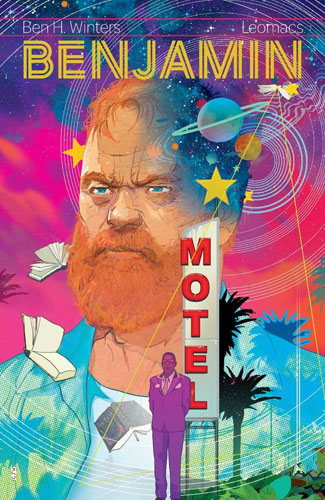
Benjamin written by Ben Winters, illustrated by Leomacs
A man wakes up in a hotel room with no idea of how he got there—but then Marcus, who works at the hotel, recognizes him as Benjamin J. Carp, a cult classic sci-fi writer. The only problem? Benjamin died in 1982. He realizes that this plot is vaguely familiar, like something out of one of his own books, so he starts to investigate, searching his old books for the answer.
I was pretty intrigued by the premise of this comic book and wondered where it was going, but Benjamin is an obnoxious character. He describes himself as a “man of consequence” and apparently believes that gives him the right to do whatever he wants, regardless of how it affects any of the (presumably inconsequential) people around him. He goes on long rambling rants and he’s certain that he has been brought back for some significant purpose—and Marcus has been sucked into his orbit.
I wasn’t entirely satisfied with the answers once they finally came, though there was at least one amusing part that made me laugh. Overall, though, it felt like it’s intended to show how Benjamin learns that he’s not the center of the universe, but because the discovery only comes at the end of the story, he’s just kind of unbearable for the whole book, the epitome of the overconfident white man.
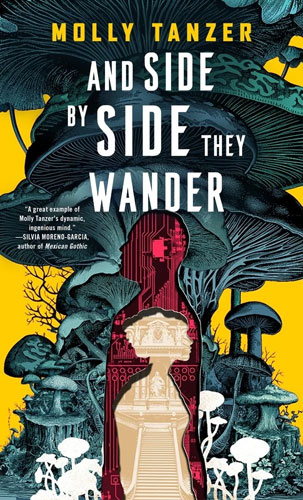
And Side by Side They Wander by Molly Tanzer
Three hundred years ago, the Celerians made contact with Earth, which was on the brink of destroying itself. In exchange for their advanced technology that helped battle both diseases and climate change, they asked only one thing: to take our artwork and keep it safe in their Greenwood Museum until Earth was ready for its return. They even made synthetic reproductions of everything they borrowed so we wouldn’t go without.
Now, the climate crisis has been averted, poverty is a distant memory, and Earth is ready to receive the originals back … but the Celerians don’t have any plans to visit our neck of the galaxy anytime soon. So that’s why a ragtag group of misfits has set out to fly across the galaxy, break into the Greenwood, and stage an intergalactic art heist to steal Earth’s artifacts back. They’ve got a pilot (an insectoid alien named Tchik-tchik), muscle (Misora, who can unfold herself into six separate people), hacker (a synthetic being named Jack), and the mastermind (Tarquin, who maybe didn’t tell the crew all the specifics before they set out). And then there’s Fennel Tycho, who narrates the story—she’s an art historian, but is mostly there because of her unusual relationship with Jack.
As you may expect, no heist story is complete without plenty of twists and setbacks, conflicts between crew members and “this seems too easy” moments, and even though this slim novella weighs in at under 100 pages, it satisfies those requirements. It’s also a reflection on colonialism and repatriation of artwork. And it’s a philosophical question: would a perfect reproduction of a work of art be, in any ineffable sense, different from the original? Is it worth flying all the way across the galaxy to steal something that is compositionally identical to the replica you already have? (What do the Celerians value about the original, instead of creating replicas and storing those instead?)
Oh, and I haven’t even gotten to the sentient fungus—but that’s from this story, too. If you like weird, thought-provoking sci-fi, put this one on your list!
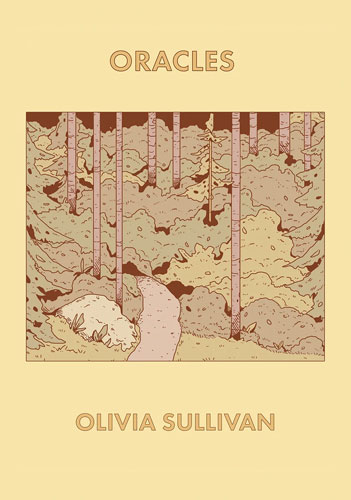
Oracles by Olivia Sullivan
This comic book is about grief and loss, with text that is more like poetry than prose. The nameless narrator, mourning the loss of their mum, goes into the wilderness and has strange encounters: branches grow out of their skin, but is it real or just a hallucination brought on by the plants they consumed? Some of the text and images has a narrative structure, but a lot of it is more abstract: a series of internal organs, a collection of foraged plants, a list of sensations. The character goes on a journey, imagines a life in the woods, and processes a lot of different emotions. Instead of reading a story, it’s a bit more like having somebody’s thoughts wash over you and you’re left with an impression, something to contemplate.
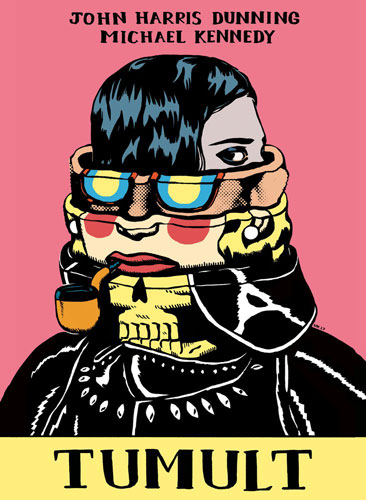
Tumult written by John Harris Dunning, illustrated by Michael Kennedy
Tumult is an older graphic novel that I just never got around to reading until recently, but it’s a doozy. Adam, a small-time director, is kind of burning his life down: he has a fling with a girl way too young for him, breaks up with his girlfriend, and then blows off a directing opportunity. But then at a friend’s party, Morgan appears, gives him the night of his life, and then leaves just as abruptly. When he runs into her in town a while later, she doesn’t recognize him and says her name is Leila, though she does use him as an excuse to get away from a strange man who’s spouting nonsense at her.
As they start over and start getting to know each other, Adam learns that various people from Leila’s life are dying under strange circumstances, and he’s scared that Leila might be next. But maybe Leila isn’t the one who’s in danger…
Tumult is a psychological thriller and a murder mystery, and there were some parts of it that reminded me of Mind MGMT: secret government projects doing weird experimental things to people’s brains, and the fallout when things go wrong. The book makes you work at it a bit: there are interludes where the drawing style changes and suddenly it’s a whole different set of characters at play, and you don’t know how that fits into the main storyline until later, as you slowly see how these other plots overlap with each other.

All That We See or Seem by Ken Liu
Nearly a decade ago, I read The Three-Body Problem by Cixin Liu, which was translated into English by Ken Liu. Ken Liu has written a few novels and books of short stories of his own, but this is the first book of his that I’ve read. Julia Z. was once famous both because of her activist mother and for her role as the “orphan hacker” in the underground organization Cartographers Obscura, though she has since tried to reduce her online presence and seek anonymity. But then Piers Neri, an attorney, shows up at her apartment, asking for her help finding his missing wife, Elli.
Elli was a famous oneirofex, an artist who “conducted” mass dreams for her audiences using special technology. Now she is gone, and a criminal kingpin who calls himself the Prince has sent Piers video of Elli, saying that he has kidnapped her. His demand? Something that Elli took from him—but he won’t say what, and Piers has no idea where to start.
“Egolets” are AI models trained on a particular aspect of them so that they learn not just the output but the processes—and then people can license their egolets to create things in their style, whether that’s an acting performance or a digital painting. Julia has to rely on Elli’s egolet for information as she tries to piece together what the Prince might be looking for, and what Elli’s connection to him could be. Meanwhile, the Prince has various hired goons keeping an eye on Piers, and Julia has to rely on her past experience to hide from the modern-day panopticon of security cameras and online tracking in a world where it’s very difficult to get off the grid.
The book is set in the near future, and it has perhaps one of the more nuanced depictions of future technology (particularly AI) that I’ve read recently. In this world, there isn’t a single dominant company that runs it all and AI is neither superintelligent nor obsolete, but there are all sorts of AI-driven agents that are now mundane. They’re used for scheduling and banking, searching and compiling information, and so on. Liu has coined various terms referring to social media that show up throughout the book, and while they’re not currently in use, they feel familiar and you usually can understand what he’s referring to. The Prince has gained power and wealth by becoming a broker of secrets, but he also has created content farm sweatshops that are a horrific prediction of where we could be headed, when the AI-creation and AI-detection arms race necessitates actual human interaction.
The book can feel a bit over-the-top at times in the way of action thrillers: the bad guy has seemingly unlimited resources and a near-endless supply of minions; the hero can hack just about anything and can make up a secret message based on pi on the spot. But it still managed to surprise me a lot of the times by going off in directions I wasn’t expecting, and I really liked Julia’s resourcefulness. It looks like this is just the first Julia Z. book, so I look forward to seeing what she takes on next.

Jonathan H. Liu

Jonathan H. Liu is a stay-at-home dad in Portland, Oregon, who loves to read, is always up for a board game, and has a bit of a Kickstarter habit. I can be reached at jonathan at geekdad dot com.