Build the epic tale of your hero!
What Is Questline?
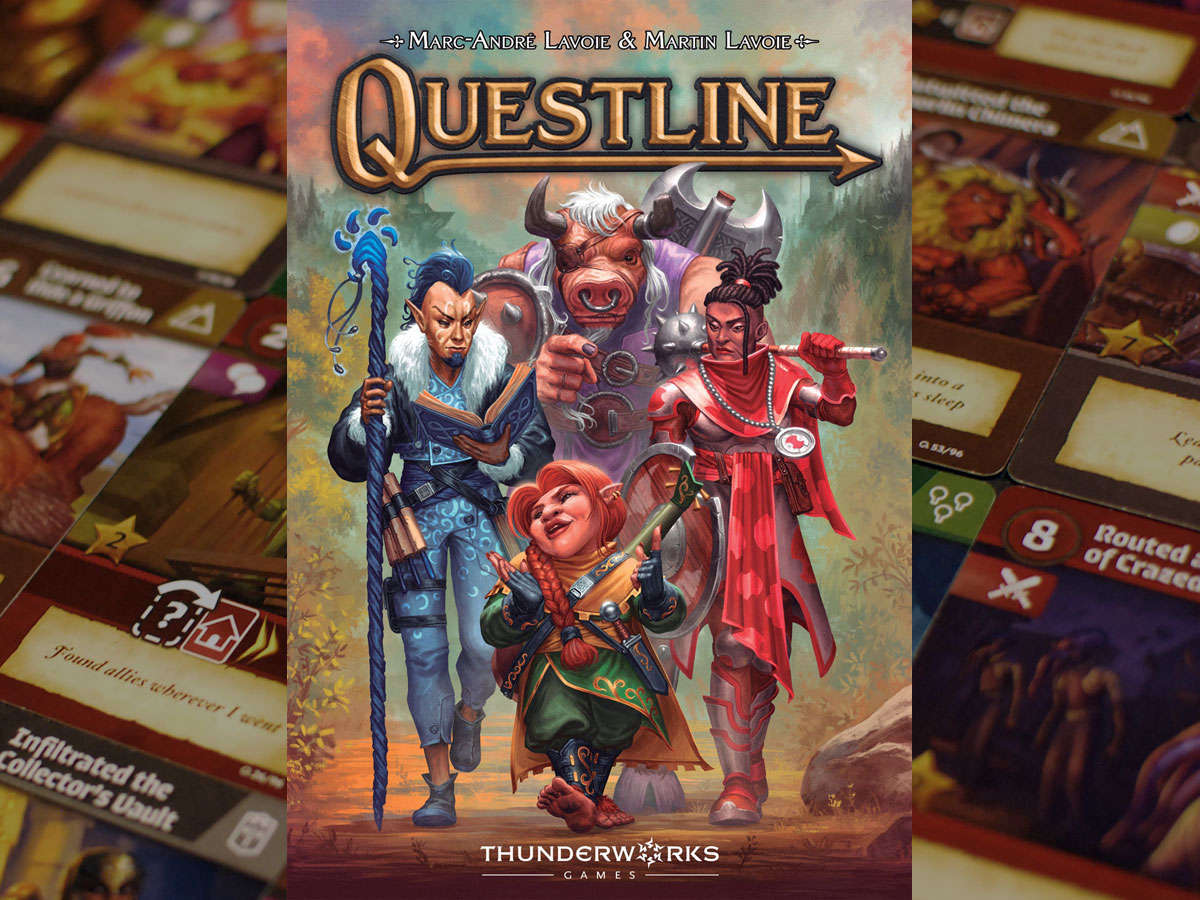
Questline is a tableau-building game for 1 to 6 players, ages 14 and up, and takes about 15 minutes to play. It retails for $19.95 and is currently available for pre-orders from Thunderworks Games, expected to ship before August 2026. (You can also arrange for pickup at Gen Con.) Although the game box says 14+, I think you could play this with kids as young as 10, as long as they’re okay with some simple arithmetic for scoring. (The game has a fantasy setting so that comes along with various creatures, but the style of artwork isn’t too scary.)
Questline was designed by Marc-André Lavoie and Martin Lavoie and published by Thunderworks Games, with illustrations by Diego Sá, Lucas Ribeiro, Megan Graham, Damien Mammoliti, and JJ Ariosa.

Questline Components
The components are pretty simple:
- 18 Class cards
- 72 Adventure cards
- 6 Epilogue cards
- 6 Reference cards
- Score pad

The different card types are very easily distinguished by the backs. If you’ve played other games by Thunderworks Games (particularly those set in the world of Ulos, like Roll Player, Cartographers, or Stonespine Architects), then you’ll find a lot of the iconography familiar. Gold stars for victory points, silver stars for negative points, and icons for villages, forests, mountains, and so on that have been seen in their other games.

The illustrations on the cards are also in a familiar style to those games, depicting a rich world with lots of different classes and fantasy races. The adventure cards all have titles that are brief descriptions of what your hero did, usually with some additional flavor text at the bottom tied to bonus scores.

I only have two complaints about the icons: first, that on some cards, the gold star blends into the background illustration a little bit, making it harder to see. Second, on some cards there’s an icon that indicates two cards of a particular terrain—but it’s very easy to miss the second card outline and just see the terrain type.
The whole game comes in a small box, similar to Fliptoons: basically the width of two card decks but taller. It’s a little too big for a pocket, but still small enough to be easily portable for on-the-go gaming.
How to Play Questline
You can download a copy of the rulebook here.
The Goal
The goal of the game is to score the most points across your line of 8 cards.

Setup
Shuffle the class deck and the adventure deck. Deal 2 classes to each player and 6 adventure cards to each player.
Make a face-up stack of the epilogue cards based on the player count, with the highest valued card at the top of the stack.
Each player chooses one of the two class cards to discard face-down in front of them. When everyone has chosen, the discards are turned face-up and the game begins!
Gameplay
Play is simultaneous—there are no turns, and everyone plays at the same time.
At your own pace, you draw a card and then discard a card. You may draw from either the class deck or the adventure deck, but you may also draw from a neighbor’s discard area or your own. What cards are you looking for? We’ll get to that in a minute.

Your discard area has a limit of 7 cards. If you ever hit 7 cards, you may only draw from your own discard area until somebody else draws from it and reduces it below 7. (Cards should be discarded in front of you, turned so that other players can easily read them, and spread out rather than in a stack.)
If you’re happy with your hand of cards, then you draw the top epilogue card, set your hand down, and then remove your discard area from play so nobody can draw from it anymore. (Note: in a 2-player game, you leave your discard area there.)

Game End
The game ends when everyone has taken an epilogue card, and then the stories are scored.
Lay out your cards in a row from left to right, starting with your class card and ending with the epilogue card. Cards should be arranged so that the levels increase from left to right. Class cards are all level 1, and the adventure cards range from 2 to 10. Each card needs all of the numbers lower than it somewhere to its left as a prerequisite, or else there will be a penalty.

Some cards provide shortcuts—this will allow you to skip over a number somewhere in your questline (not just immediately after this card), as long as the next card after the gap matches the shortcut.

Most of the cards have a point value, shown on the star, but many have quests and masteries as well. Quests have boxes pointing to the right, and will score points based on the number of times the matching icon appears to the right of the card. Masteries have boxes pointing to the left, and will score the indicated points if the requirement is met by cards to its left. (Masteries only score once even if the requirement is met multiple times.)
Players share their epic tales, and then calculate their scores using the score pad. The highest score wins, with ties going to the player with the highest epilogue card.
Why You Should Play Questline
Questline is a quick game in a small box that gives you a little taste of the world of Ulos, the fantasy setting for several of Thunderworks Games’ titles. Your hero might battle creatures and outwit villains, or you might take a more nefarious route yourself, stealing artifacts or leading a group of bandits. However your story plays out, though, your goal is to hit the important story beats on each card so that you can score the most glory.
The card-combo nature of the game reminds me a little of Fantasy Realms, another game in which you have a limited number of cards and you’re just trying to make sure that each card you include in your hand is increasing your score and not costing you points. Each card has various tags and terrain types and so on, and you’re looking for combinations that key off each other. One of the big differences in Questline, though, is that your hand of cards is ordered: the sequence of cards matters because of the way some requirements check what’s to the left or or right, and also because the levels of the cards themselves need to increase from left to right.
The other major difference is the simultaneous play. Now, most of the time when I think of real-time games, I imagine games that are frantic, with people slapping down cards or rushing to complete a task. Questline is probably the most chill real-time game I’ve played. You can draw and discard at your own speed, but if you’re outpacing the other players, you’ll reach your 7-card discard limit quickly, and then you’re stuck unless somebody draws cards from your discard. Instead, a lot of of the time people will pause and wait a little for their neighbors to discard some cards to see if there’s anything they want. After all, it’s better to pick up a card you know you will work than to draw a random card from the top of the deck, which might just clog up your discard area.
The theme reminds me a little of Call to Adventure, a much bigger game from several years ago that also involved building out the story of a character. That one had a lot of other things going on, though—casting runes, overcoming challenges, whereas Questline is really focused on piecing together a chain of story cards.

The game throws a bit of humor in here and there, which I appreciate. One of my favorite examples: on the adventure card “Found a Relic for the Chrono Mage,” you get bonus points if you have magic, which means you “completed the quest before it began.” When we complete the game, we always make sure to read out our story instead of just adding up points, because that flavor adds a lot to the experience. There have been some stories that turned out remarkably cohesive, and some where it seemed the player was pretty easily distracted by any shiny object.
There’s a good mix of card types and effects in the deck, so there’s some flexibility in how to build your story. I had one high-scoring story with low-level cards, using a combination of a Monk class that gave me bonus points for having duplicate levels and a story card that awarded bonus points for having no cards above level 5. But I’ve also played games in which somebody has managed to use a combination of shortcuts and multi-level cards to play multiple level 9 or even 10 cards, which tend to have big scores on them (as long as you didn’t suffer too many penalties to get there!).
The main racing aspect to Questline is in claiming the epilogue card: the sooner you finalize your story and quit, the more points you’ll get for the epilogue. (And, as a side bonus, you remove your discard area so nobody else can shop for cards there anymore.) The epilogue usually isn’t the only factor in determining who wins, but it can mean the difference of a few points, so it gives just a little bit of tension so that players aren’t sitting around too long trying to decide on cards. The hard limit of 7 discards also keeps the game tight, because once there’s only one player left, there’s a countdown before they can’t do anything else and have to stop.
In short: Questline is a small box game that accommodates up to 6 players and lets you weave stories about fantasy heroes in about 15 minutes! It could make for a fun pairing with any of the other Ulos games, or give you a just a little bit of a puzzle to solve when you’ve only got a little bit of time to play.
For more information, visit the Thunderworks Games website!
Click here to see all our tabletop game reviews.
 To subscribe to GeekDad’s tabletop gaming coverage, please copy this link and add it to your RSS reader.
Disclosure: GeekDad received a copy of this game for review purposes.