Plan your dream vacation in France! See the sights of Paris and make a side trip to a unique region.
What Is Let’s Go! To France?
Let’s Go! To France is a trip-planning game for 1 to 4* players, ages 10 and up, and takes about 45 minutes to play. It’s currently seeking funding on Kickstarter, with a pledge level of $49 for a copy of the standard edition, or $79 for the “Bon Voyage” edition. It’s a stand-alone sequel to the GeekDad Approved Let’s Go! To Japan and is also family-friendly, though with a slightly higher complexity level than the original.
*There is a 5th player expansion available as a $10 add-on, or free if you sign up for AEG’s newsletter. See the “Add-Ons” section of the campaign for more.
Let’s Go! To France was designed by Josh Wood and published by AEG, with artwork by Nicole Barriere, Akihito Horigome, Timo Bechert, David Wuatier, Katariina Purru, and Erica Ward.
New to Kickstarter? Check out our crowdfunding primer.
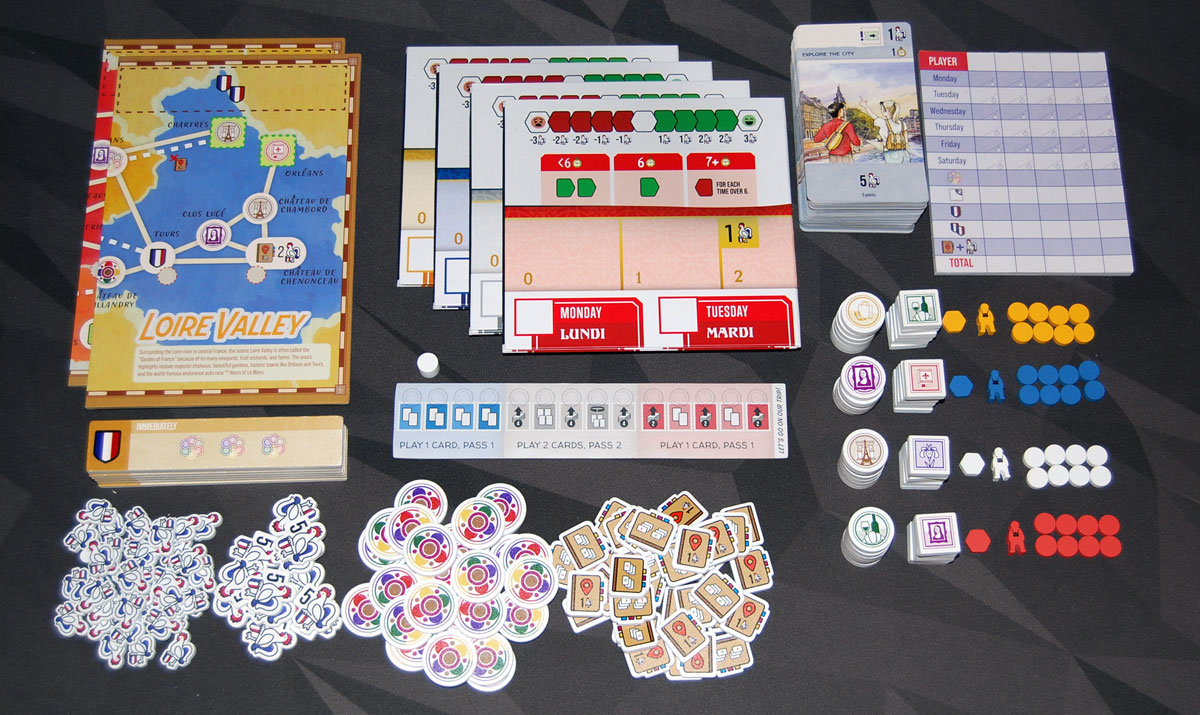
Let’s Go! To France Components
Note: My review was based on a pre-production prototype and components are subject to change. However, most of it looks pretty close to the finished version of Let’s Go! To Japan, so I would guess most of this is fairly finalized.
Here’s what’s included:
- 124 Activity cards
- Round tracker board
- Round tracker token
- 30 Wild tokens
- 36 Research tokens
- 40 1-Point tokens
- 12 5-Point tokens
- 2 Regional Map boards (double-sided)
- 7 Goal tiles (double-sided)
- Scorepad
- 4 sets of player components, each including:
- Player board
- 6 Experience tokens
- 6 Favorable Condition tokens
- 6 Exploration tokens
- Energy token
- Traveler meeple
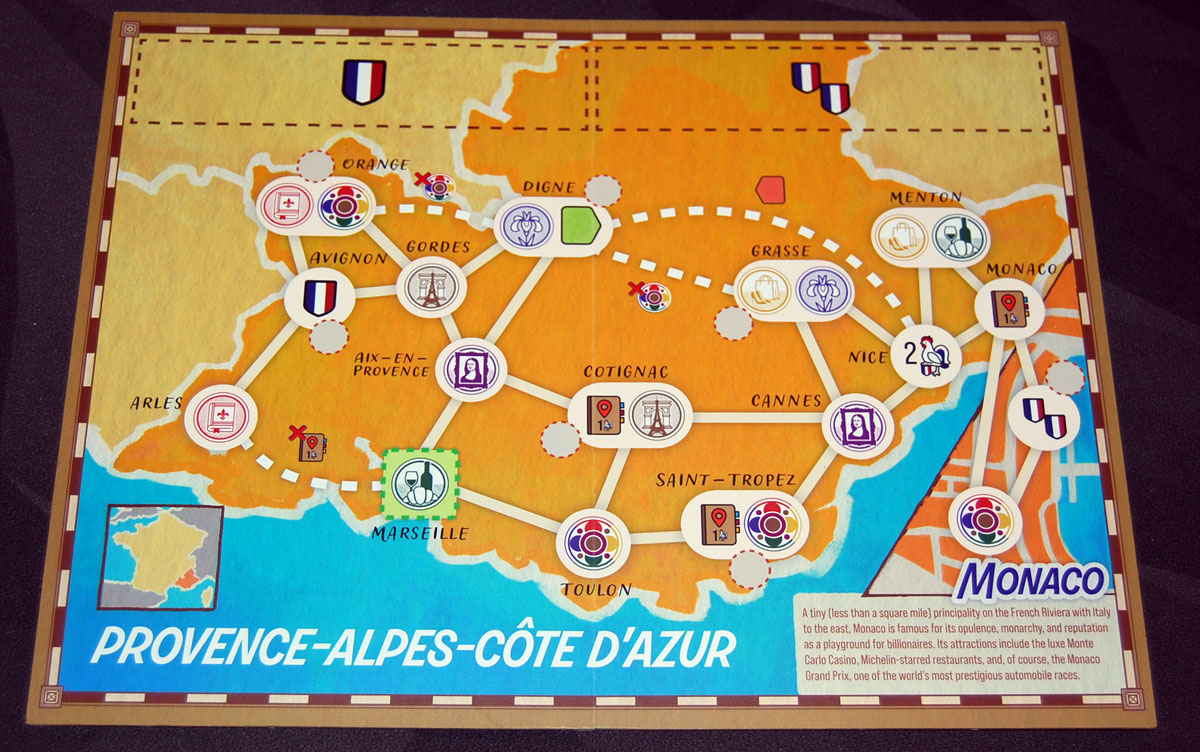
If you’re familiar with Let’s Go! To Japan, you’ll notice that most of the components are pretty similar, so my descriptions below are the same. However, there are also some new components specific to this version. The most notable are the regional maps. There are two double-sided boards, making four different regions you can visit: Loire Valley, Brittany & Normandy, Sud-Ouest, and Provence-Alpes-Côte d’Azur. Each time you play you’ll use one of these. Each player has a small traveler meeple that moves around on the maps.

The cards are all extra-large, making for plenty of room for the illustrations and a bit of text that wouldn’t be out of place in a travel guide. The game-specific parts of the card are at the top and bottom; when the cards are overlapped, only the top part of the covered card is relevant so it’s a nice way to remember that. The large cards do mean that each player needs a good amount of space on the table, though.
The player boards are tri-fold boards, with various tracks and a space for cards that you’ve been passed by other players. You will be playing cards below the board, so a large portion of your playing area will actually be off the board.
The prototype included wooden tiles and tokens instead of cardboard, which would be included in the deluxe edition but not the standard. The wooden tokens are chunky and fun, but I did find it a little harder to pick up handfuls of them for putting the game away compared to the cardboard versions. The deluxe edition also includes one more double-sided map, a cloth-covered scoring journal, and 4 ceramic ramekins for storing the tokens.
How to Play Let’s Go! To France
You can download a draft of the rulebook here.
The Goal
The goal of the game is to score the most points by planning activities for your week in Paris, as well as making a side trip into the other regions.

Setup
Shuffle the deck of activity cards and place it within reach of all players. Place the round tracker board in the center and place the marker on the first round. Make a supply of the other tokens: point tokens, wild tokens, research tokens.

Choose the regional map you’ll be using and place that near the round tracker. Randomly select a 1-shield goal tile and place it in the space at the top of the map. For the 2-shield goal, find the tile corresponding to your regional map, and randomly select a side to use and place it in its space.

Give each player a set of player components: a player board and all of the various tokens. The energy token (wooden hexagon) goes on the center of the energy track. The six (round) experience tokens are placed at the 0 space of your board. Each player mixes up the six (square) favorable condition tokens and place one on each day at the bottom of their board, with the “2” side face-down. Set your exploration tokens (the small discs) nearby. Be sure to leave room to play cards below your player board. The traveler meeples should be placed near the regional map.
Gameplay
Let’s Go! To France takes place over 14 rounds, with players creating a trip itinerary by placing activity cards below their player boards from Monday to Saturday. The cards may be placed anywhere in your itinerary (up to 5 cards per day), but once placed cannot be moved later. At the end of the 14 rounds, players then take their trips as planned, accumulating experiences and scoring points.

Planning Trips
Each round, players will simultaneously draw cards and then play and pass cards as indicated by the round tracker board. For instance, in the first four rounds, players draw two cards, and they will play one card into their itinerary and pass the other card clockwise, placing it face-down at the top of that player’s board. Some rounds indicate that you pick up the passed cards instead of drawing from the decks, and in the middle five rounds you play two and pass two. Starting in round 8, you will pass counterclockwise instead. Cards are placed overlapping so that the top section of each card is visible; only the last card of the day is fully visible, showing the highlight at the bottom.
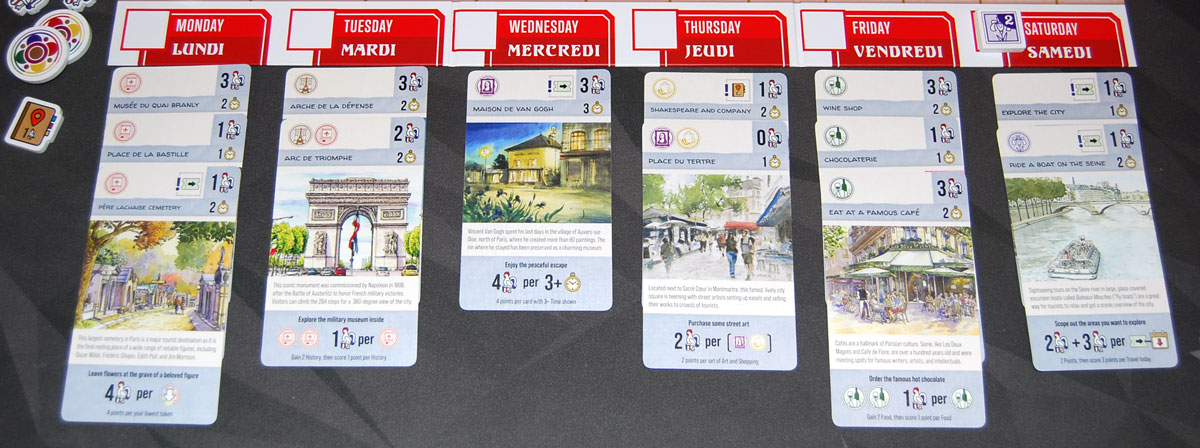
Each day may have up to 5 cards on it, and you’ll want to pay attention to the time costs of each card (shown at the top right below the point value). When you score your trip, spending more than 6 time in one day will decrease your energy, while spending 6 or less time on a day will increase your energy.
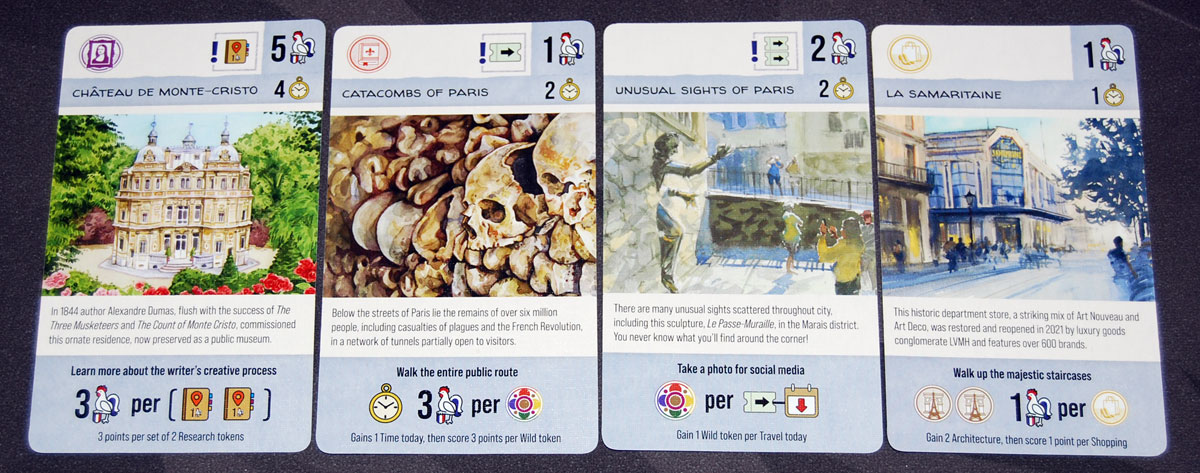
Some cards have bonus icons on them with exclamation points. The research icon lets you immediately take a research token, and the ticket icons let you travel on the regional map. Research tokens are worth 1 point at the end of the game, but you may also discard one at any time to draw 3 cards, then discard 3 cards.
Whenever you earn a ticket, you get to move your traveler on the regional map. The first time you travel, you place your traveler meeple onto the map on a green square (some maps have more than one), and immediately earn the bonus shown there. From then on, each ticket lets you move along a solid line on the map and earn the bonus you land on. Bonuses may include moving your experience tokens on your player board, earning points, getting wild tokens or research tokens, and so on.
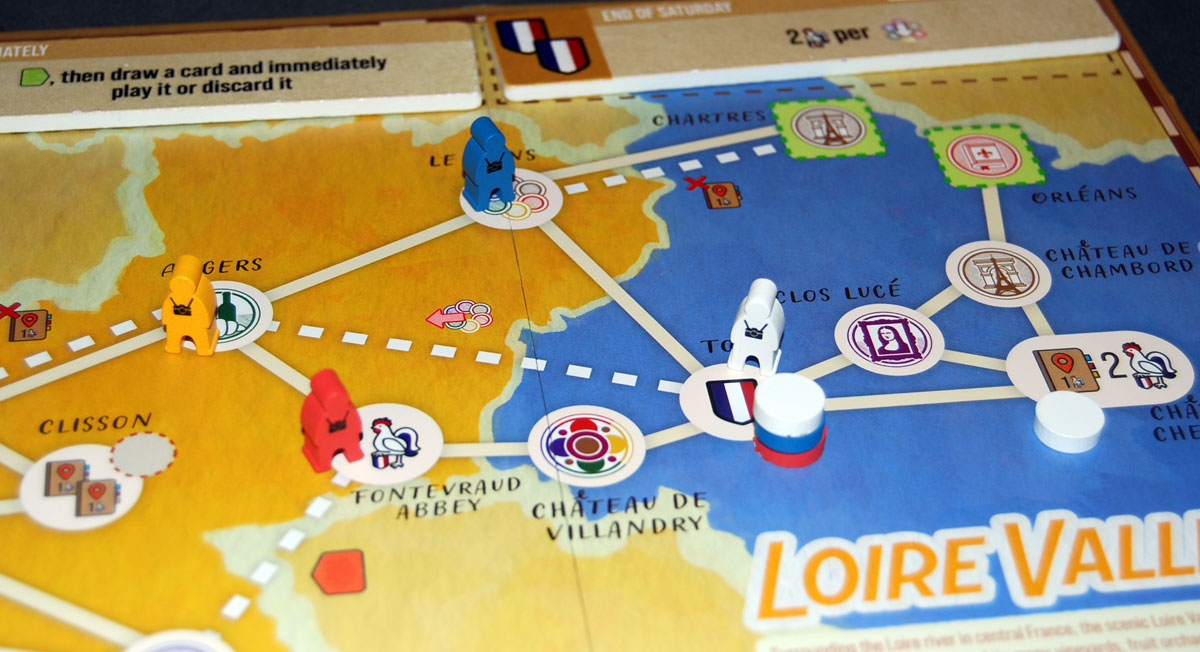
Some paths have a dotted line with a cost—you may travel along those paths without a ticket, just by spending the required cost. Some of the bonus spaces have a small dotted circle next to them. When you enter one of these spaces, you earn the bonus but then mark it with an exploration token—this indicates that you cannot receive this bonus again (each player may enter the space and earn the bonus once). The two goal tiles at the top of the map have unique rewards that you earn if you have marked the corresponding reward space on the map.

There are incentives for placing cards on the days that match the icons. When you place a card that has at least one icon matching the square favorable condition token for that day, you get one of two bonuses:
- You may flip the token over so the “2” side is showing—it will be worth bonus points at the end of the game if it is moved to a bonus track.
- You may move the token to the leftmost available space on one of the three bonus tracks in the center of your player board and immediately get its reward.
Note that once you have taken the second option, moving it to a bonus track, you may no longer flip that token over to the “2” side because it will no longer be associated with a particular day.

If you don’t like any of your options, you may also “explore the city.” Just place any of your cards face-down in your itinerary. You immediately gain a travel ticket, and the card will be worth 1 point during scoring (with a Highlight of the Day bonus of 5 points).
Going on Trips
After the final round of planning, it’s time for everyone to take their trips and see how well they scored!

Each player goes through their itinerary one day at a time, scoring the cards from top to bottom. For each card, if there are experience icons on the top of the card, move the appropriate experience tokens to keep track. The rooster symbol on the top right corner is points for that card.

The last card of each day has a highlight of the day bonus at the bottom. Some highlights give you bonuses, like earning more experience, taking wild tokens, etc. Others may also give you bonus points or bonus experience if you have met the requirements already. If you earned wild tokens as bonuses during the planning phase, you may spend them at any time to get any 1 experience per token spent, which can help you fulfill those requirements. There are some requirements that refer to cards played on that particular day. Generally speaking, requirements that include other cards only consider cards leading up to that day, and not anything that happens later in the trip.

At the end of each day, count up the amount of time spent on that day, and move your energy tracker accordingly. Your energy level may give or deduct points from your score for that day. (Note: the energy tracker does not reset from day to day, so if you spend a lot of energy on Monday, you will start off with a deficit on Tuesday!)

Game End
Your score is as follows:
- Scores for each individual day’s activities (including time bonus/penalty)
- Points for each of your experience tokens on your experience track
- Bonus points for goals achieved on regional board, if applicable
- 1 point per unspent research token
- Point tokens collected from travel or other bonuses
- 2 points per favorable condition token that has been flipped to the “2” side and moved to a reward track
The highest score wins! The rulebook says ties are shared, though if you really want a tiebreaker you can count up the total earned experience.

Why You Should Play Let’s Go! To France
Let’s Go! To Japan was one of our Game of the Year finalists for 2024, and it remains one of my favorites. I like the mix of card drafting, trying to fit activities to their optimal days, and then seeing how everyone’s trip plays out at the end for scoring.
Let’s Go! To France builds on the successful formula from the original game so that it still feels familiar, but with enough changes to the gameplay that it really stands out as its own thing, too. Although both games are still what I’d consider “casual” games—not too complex or long—Let’s Go! To France has a little bit more going on, which adds to the puzzle in new ways.
Gone are the two cities with the train requirements to shuttle back and forth, and the two separate decks of activity cards. Gone too is the stress level that was affected by spending too much money or energy. Instead, the biggest new system in the game is the regional map, where you’ll be making a side trip to gain bonuses during the planning phase. Thematically, I’m not entirely sure what’s happening here: are you traveling around these other regions while you’re still planning your itinerary? I wouldn’t worry too much about that.
There are multiple ways to get tickets to travel—some cards have them as an immediate bonus when played, and every card can be played as an “Explore the City” to gain a ticket. But there are also tickets to be found on the bonus reward tracks, earned by playing cards that match your favorable conditions. However, there’s only so many of those to be had, and the opportunity cost is that you won’t be collecting as many wild tokens, research tokens, or victory points. But since travel is the new thing, I’m always tempted to do that the most, filling out the reward track that gives tickets before starting on any of the others.

Aside from letting you bump up some experience tokens or gain a few wild and research tokens during the planning phase, travel also gets you access to the two goals, which are randomized each time you play. These can be quite powerful, though you still have to consider whether they’re worth the cost of the travel.
The favorable condition tokens have also changed: you only need to match the condition twice to get the maximum benefit, flipping the token over and gaining a reward from the tracks, and then you can put whatever else you want on that day. Or, if you move the token to the reward on the first card played, then there’s no reason to match any more after that. (But, again, I always try to flip and move each one if I can.) That does mean there’s a bit more flexibility in where you play your cards than in Japan.
The other difference with the favorable conditions is that everyone has their own randomized order. In Japan, everyone had the same randomized order, so you knew that if the best day for shopping was Friday, then everyone was looking for shopping cards for that day, and that could affect what you wanted to pass to your neighbors. In France, everyone has a different order—so a card that isn’t great for me because it matches too early in the week might still be advantageous to somebody else.
The time aspect of France is also new. Each card has a time requirement, and your total time spent per day moves your energy level up or down. With the new expanded limit of five cards per day, it’s really easy to overdo it on a day. You’re also playing a total of 19 cards, which means at least one day will have at least 4 cards in it. It can be easy to load up on time-heavy cards early in the game because they have high point values or fantastic highlights … and then realize that you’ve already exceeded 6 time on every day but have 5 more cards to squeeze into your itinerary! Also, since your energy doesn’t reset from day to day, it means that having a blowout Monday might cost you points for the entire rest of the week! But if you take it easy at the beginning of the week and save up energy, it can let you afford to have a big day and still stay in the green.
As I said with Let’s Go! To Japan, the flavor text and illustrations elevate the game from a programming, card-combo game to one that feels like you’re plotting out a trip. These are all real places, with little descriptions like what you’d see in a guide book, and they’ll make you want to plan a real trip. I haven’t been to Japan or France myself, so playing these games gives me a little peek at what I could experience someday. (I also don’t speak Japanese or French, but I did find it a lot easier to pronounce the Japanese locations than the French locations!)
In short: Let’s Go! To France is another fantastic title from Josh Wood and AEG. If you love travel and trip planning, it’s worth buying a ticket!
For more information or to make a pledge, visit the Let’s Go! To France Kickstarter page!
Click here to see all our tabletop game reviews.
 To subscribe to GeekDad’s tabletop gaming coverage, please copy this link and add it to your RSS reader.
Disclosure: GeekDad received a prototype of this game for review purposes.