Build and beautify your hummingbird nest, attract a mate, and demolish your rivals.
What Is Hover?
Hover is an aggressive game for 2 to 4 players, ages 10 and up, and takes about 30–60 minutes to play. It’s currently seeking funding on Kickstarter, with a pledge level of $39 for a copy of the base game, $69 for the base game with expansion, or $89 for the collector’s set that includes some upgraded components. The game is family-friendly in that kids around 10 and up could learn the rules, but it is decidedly not friendly! The tagline is “a brutal game of hummingbirds” and they aren’t kidding—there’s lots of direct confrontation, so make sure everyone’s comfortable with that before you dive in.
Hover was designed by Victor Shiu and published by Ibis Tea, with illustrations by Shawna Shiu.
New to Kickstarter? Check out our crowdfunding primer.

Hover Components
Note: My review is based on a prototype copy, so it is subject to change and may not reflect final component quality.
Here’s what comes in the box:
- Game board
- 1 Feeder Flower tile
- 4 Garden Flower tiles
- 4 Hummingbirds
- 4 Beauty cubes
- Performance die
- 4 Nests
- 8 Hummingbird cards
- 4 Player Aid cards
- 45 Field cards
- 40 Energy cubes
- 20 Lichen tokens
- 10 Twigs
- 10 Spider Silks
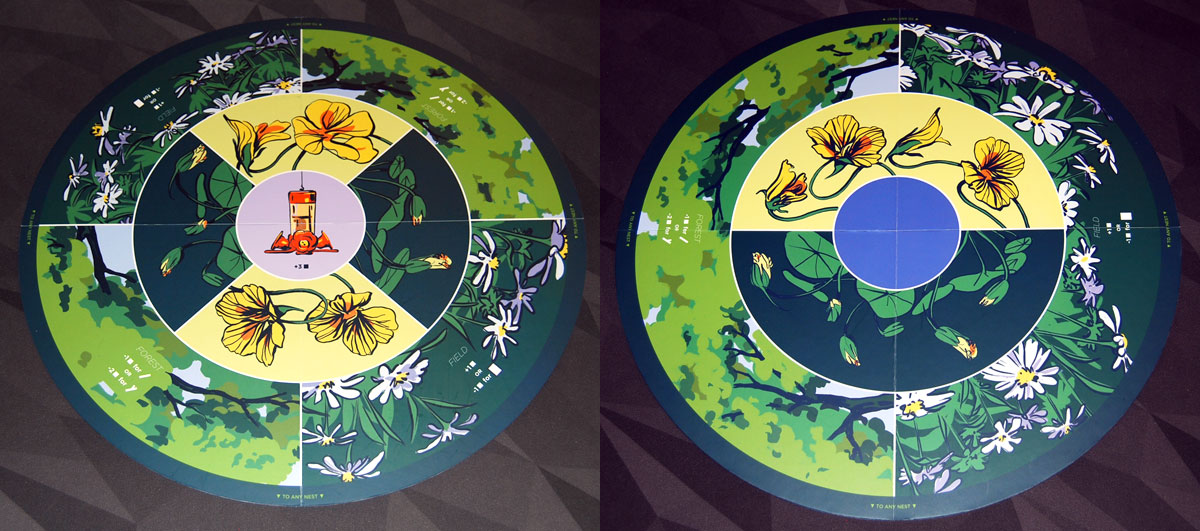
The main board is a large circle; it’s double-sided, with one side used for the 2-player game and the other for 3/4 players. (The blank space in the center of the 2-player version has a large flower tile that goes there.) The board is fairly simple, with only a few different types of spaces. It is a little larger than what’s absolutely necessary, but it gives the lovely illustrations a bit of room to breathe, and feels more like hummingbirds flying around in fields and forests instead of cooped up in small worker placement spaces.
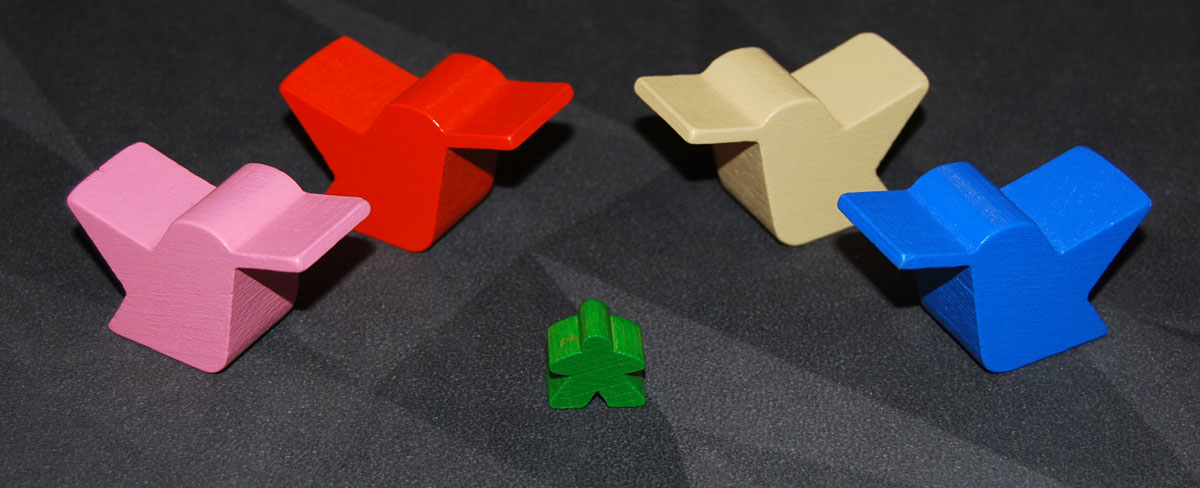
The hummingbird meeples are substantial—close to the size of an actual hummingbird, actually! You can see them compared to a standard Carcassonne meeple here. They are pretty impressive, though I did notice that because they’re slightly angled forward, they can tip over sometimes—the wing is just enough to counterbalance usually.
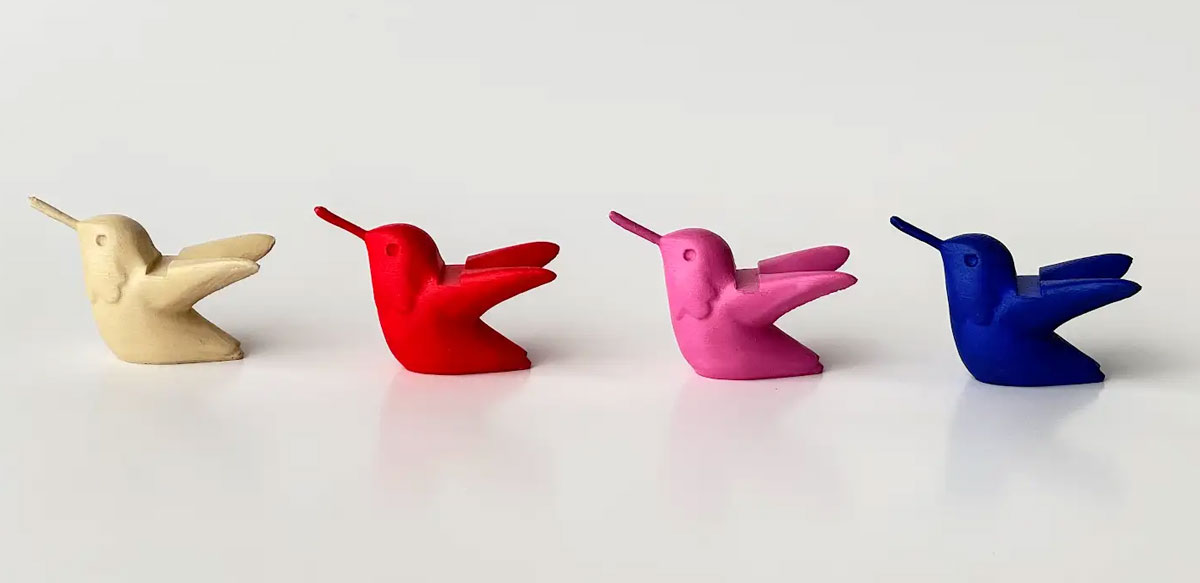
If you spring for the deluxe edition, you’ll get these fancy hummingbird models, which are made of Re-wood, a combination of recycled wood and resin. (The notch above the wings is for carrying the spider silk and twigs; when using the meeples you can just balance it across the wings or the beak.)
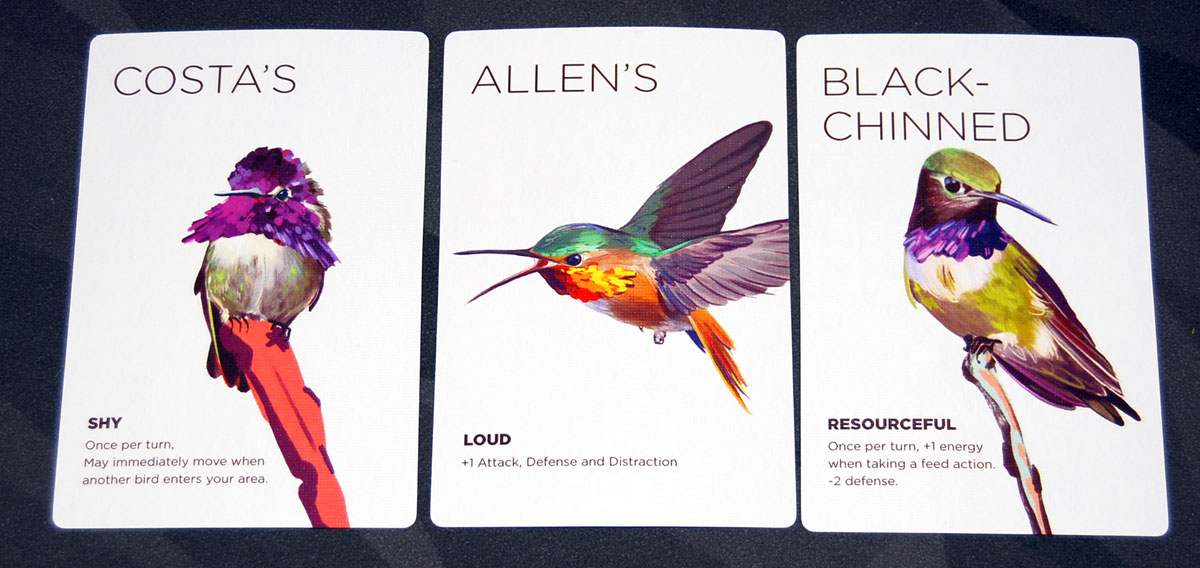
The hummingbird cards feature illustrations from Shawna Shiu, and depict various species. (With over 350 hummingbird species, I guess that leaves plenty of room for expansions!) The illustrations are gorgeous, and the cards are oversized so the birds are just about actual size, too. Each bird has a special ability printed on the card, but most of the card is for showing off that spectacular art.
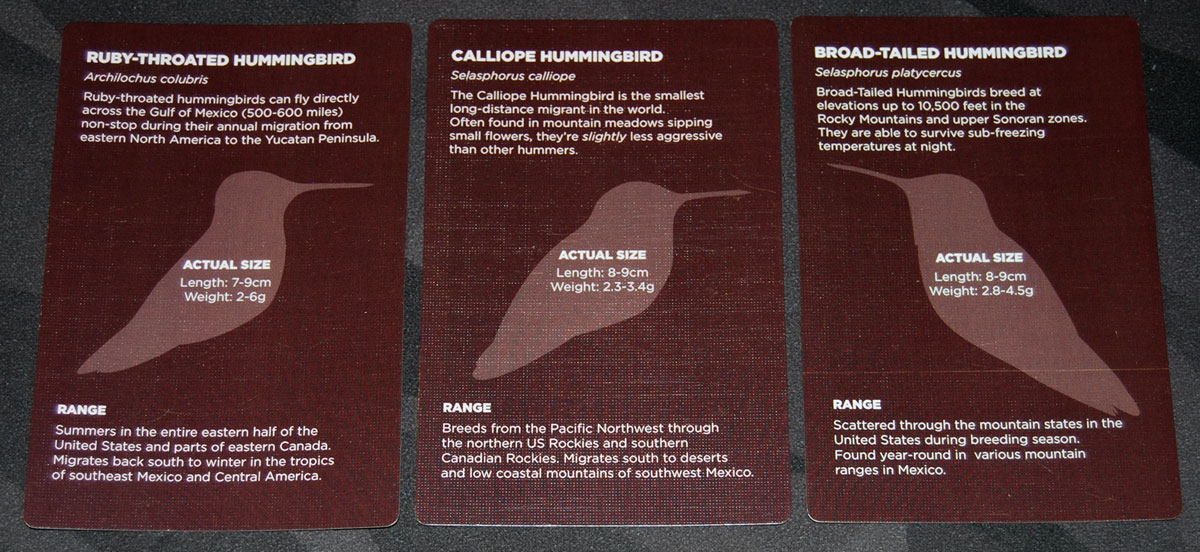
On the back of the cards there are facts about the hummingbirds, plus an actual size silhouette of the bird.
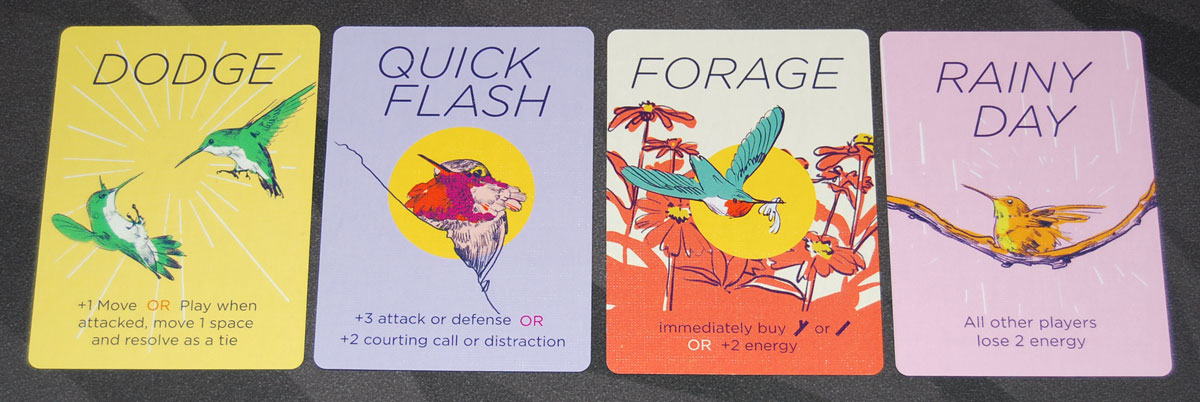
The field cards are regular-sized cards, and also feature delightful illustrations of hummingbirds in action.
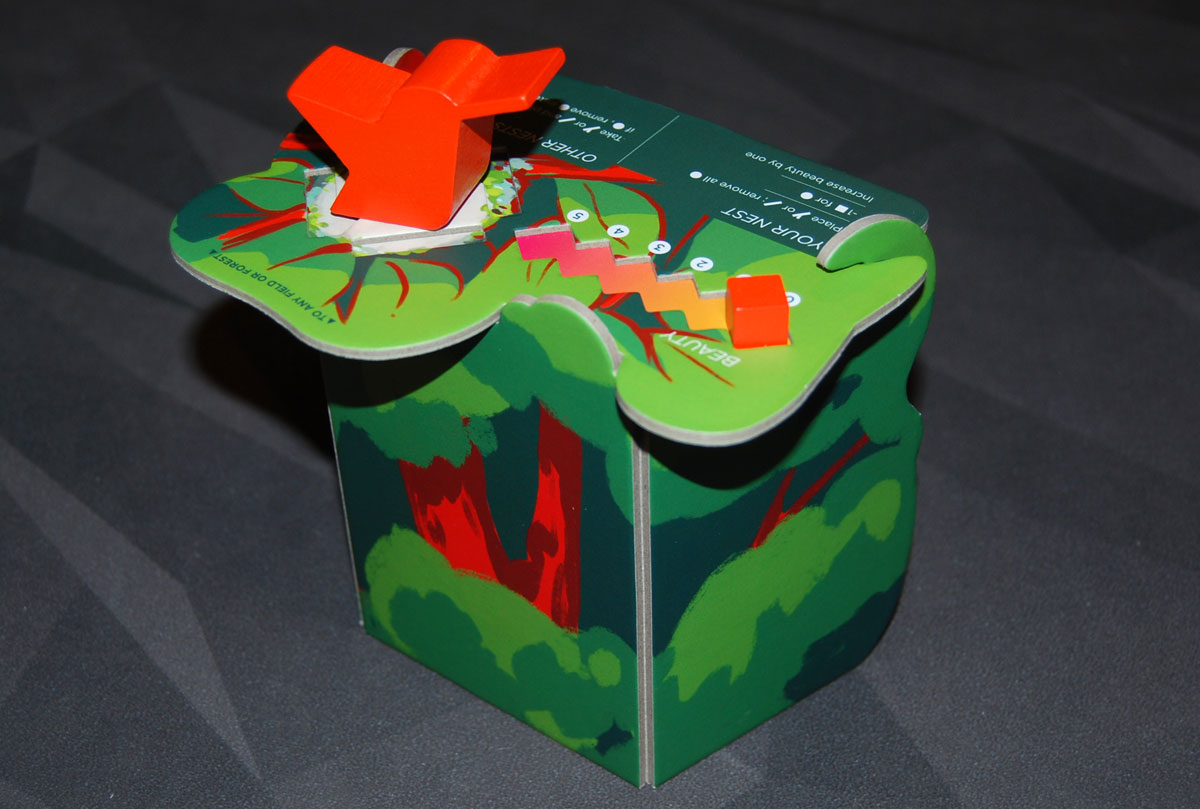
Each player has a nest, made of a tri-fold tree trunk and then a flat, dual-layered platform that slots into the top. The nest serves two purposes—it’s a screen to conceal how many energy cubes you have, and it’s a small board that holds your nest and your beauty track. They’re also spaces that can be moved to—by you and other players—and the elevation makes a nice visual distinction between the board and the nests. However, we did notice that because the nests are so tall but not very deep, they had a tendency to tip over (especially if multiple hummingbirds were occupying them at once). I think they might work better at a lower height and would still keep the nice visual, but it may be too late to change that.

The box insert is made of cardstock, with little matchbox-style containers for the smaller tokens and wooden components, and a larger one that holds the sleeves. It has a clever removable insert so that if you sleeve your cards, the space is expandable. All of the components will be made of FSC-certified wood and paper.
Kickstarter backers will also get a bonus pack of 6 more hummingbird cards featuring endangered hummingbirds. The expansion included in the higher tiers (but not covered in this review) includes two modules, the Desert Expansion and the Migration Expansion. The Desert Expansion adds more complex birds and some light engine-building as you develop more skills. The Migration Expansion gives you more modes of play: solo, cooperative, and a different competitive mode.
Finally, if you back the deluxe edition, you’ll get those fancier hummingbird models, a 12-sided die (instead of the regular 6-sided die), and wooden tokens to replace most of the cardboard tokens, including the large flower tiles.
How to Play Hover
You can download a draft of the rulebook here.
The Goal
The goal of the game is to successfully build your nest and attract a mate with your courting call—whoever does that first wins the game.
Setup
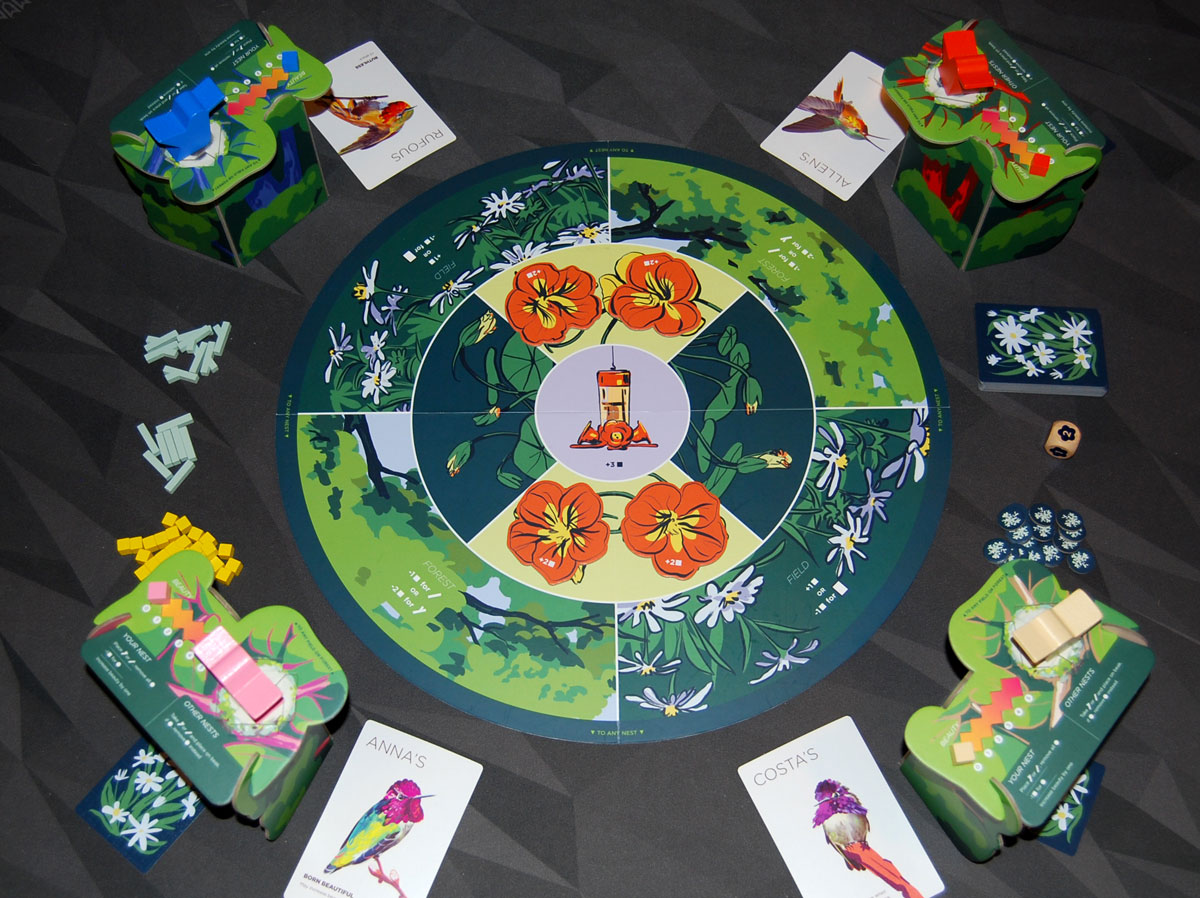
Use the side of the main board for your player count, placing 2 flower tiles on each flower space. (For a 2-player game, the large flower goes in the center in place of the feeder.) Give each player a nest, a hummingbird, and a cube set at the “0” beauty space on the nest. Each player gets 1 energy, 1 field card, and 2 random hummingbird cards; everyone chooses one hummingbird card to use and discards the other. Set the rest of the field cards, energy, spider silk, twigs, and lichen nearby, along with the performance die.

The player who most recently saw a hummingbird goes first.
Gameplay
On your turn, you get 2 actions, which you may spend on movement, area actions, and attacking. (You may do the same action twice.)
Movement is pretty simple: just move from one space to any adjacent space. Note that the nests are adjacent to any of the outer ring spaces.
Each of the board spaces has its own area actions.
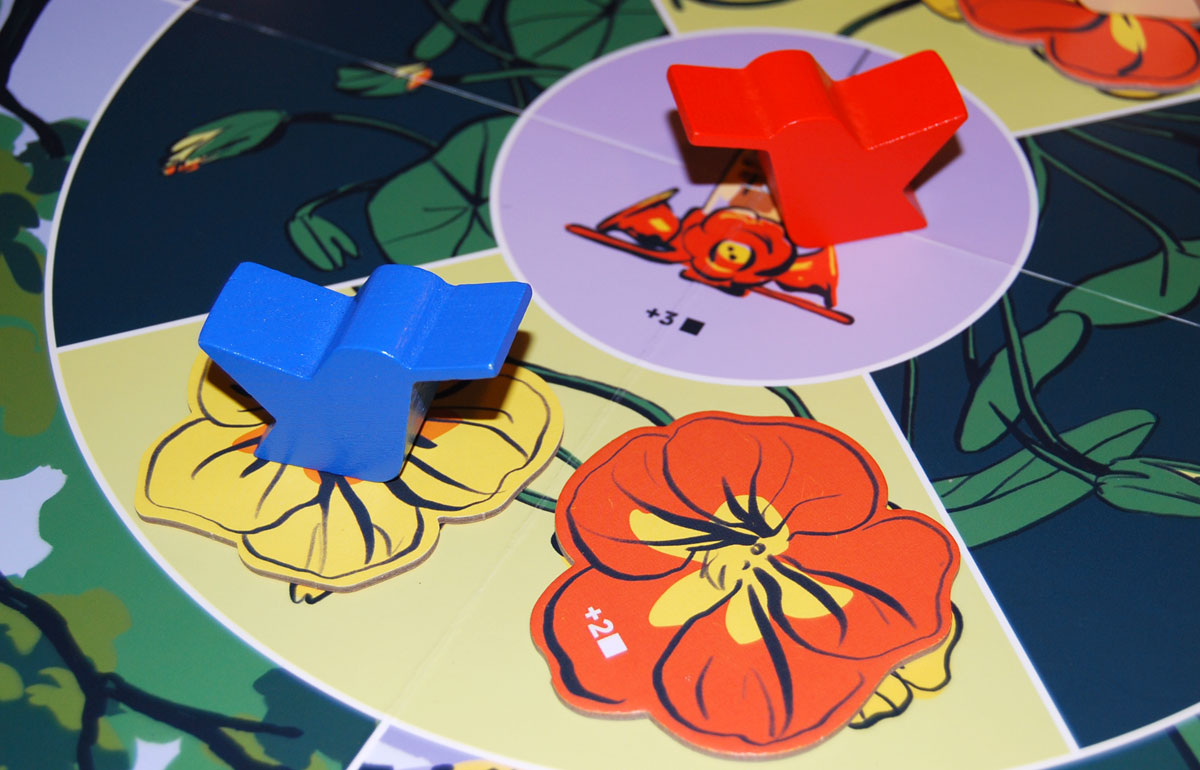
In the center and the middle ring, there are spaces to feed. Gain the energy shown (up to a maximum of 10 energy in your storage). If you feed at a flower, flip it face-down. Flowers only refresh when both flowers have been flipped face-down and a turn ends with nobody in that space.
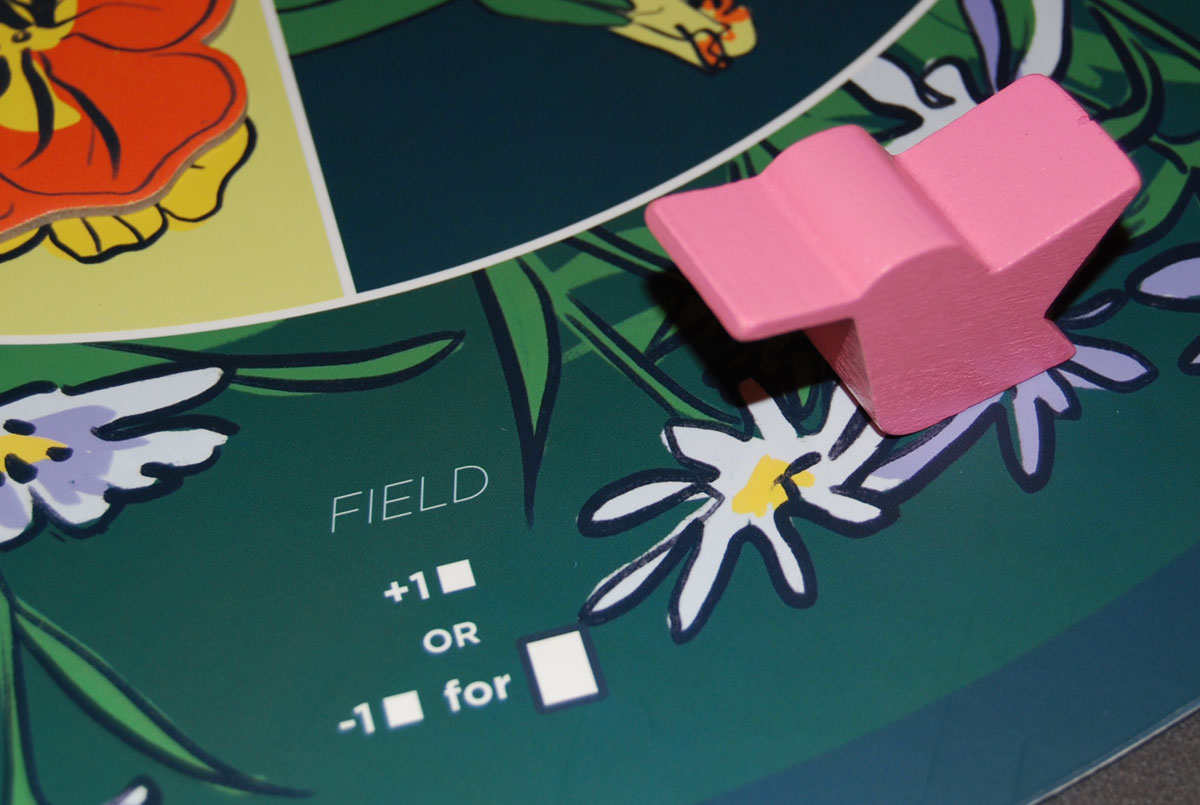
Fields let you gain 1 energy or spend an energy to draw a field card. Field cards may be played at any time (as appropriate) and have a wide variety of effects—more on those later.
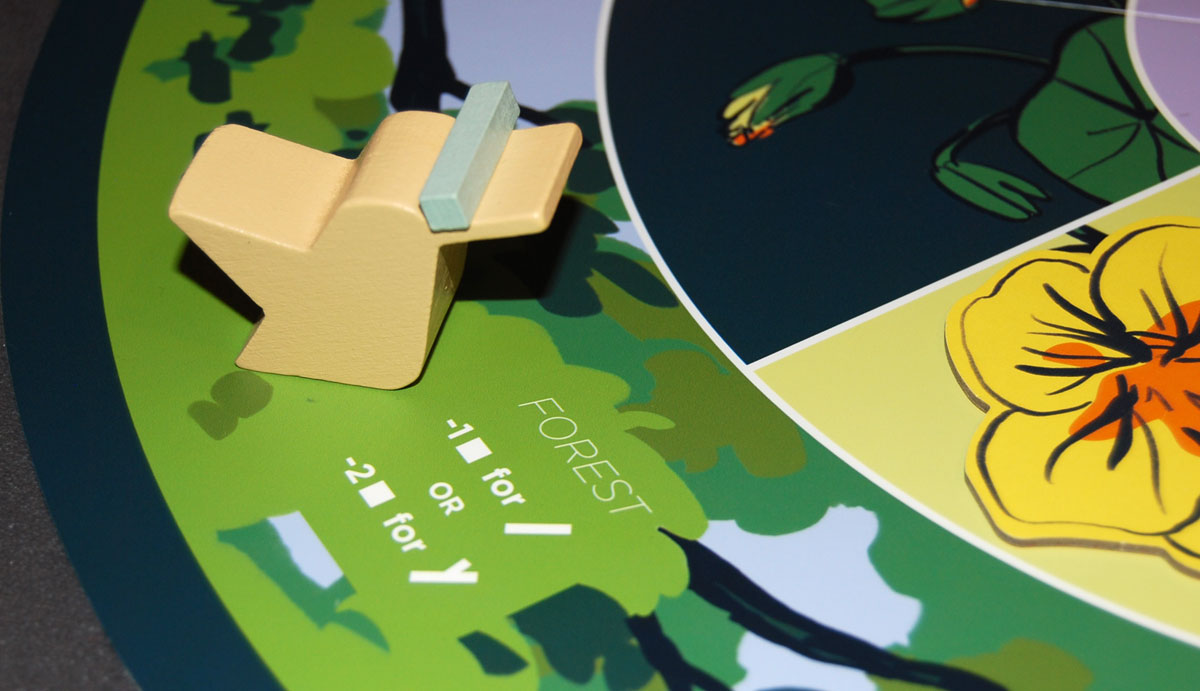
The forest is where you gather supplies to build your nest. Spend 1 energy to pick up a spider silk or 2 to pick up a twig, and place it on your hummingbird. You can only carry one thing at a time. You also cannot take more than you need—the nest requires 2 silk and 2 twigs, so if you already have 2 twigs you cannot pick up any more.
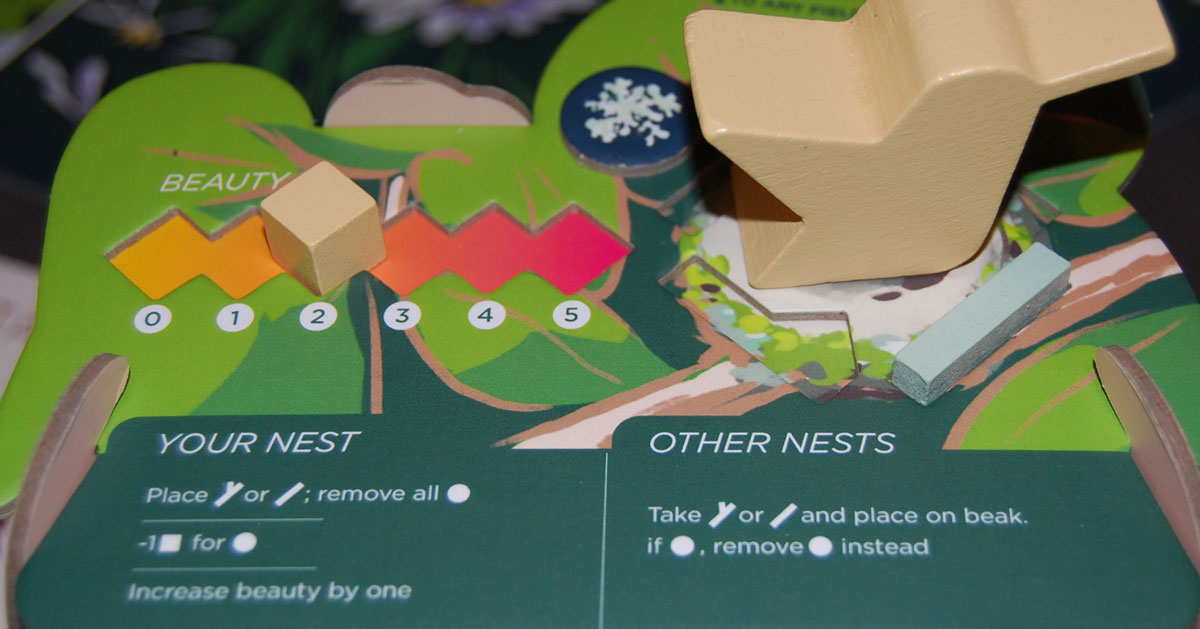
The nests have a couple of options for area actions. If you’re at somebody else’s nest, you may spend an action to take a bit of their nest! But if there’s lichen on the nest, first you have to spend actions to remove lichen.
At your own nest, you may spend an action to place a silk or twig that you’re carrying, but this clears any lichen currently on your nest. You may also spend actions and energy to add more lichen.
To increase your beauty by one level, spend energy equal to the level that you are moving to (for instance, moving from 3 beauty to 4 beauty would cost 4 energy).
Your nest is also where you perform your courting call, but I’ll explain that a little later. You cannot be attacked at your own nest.
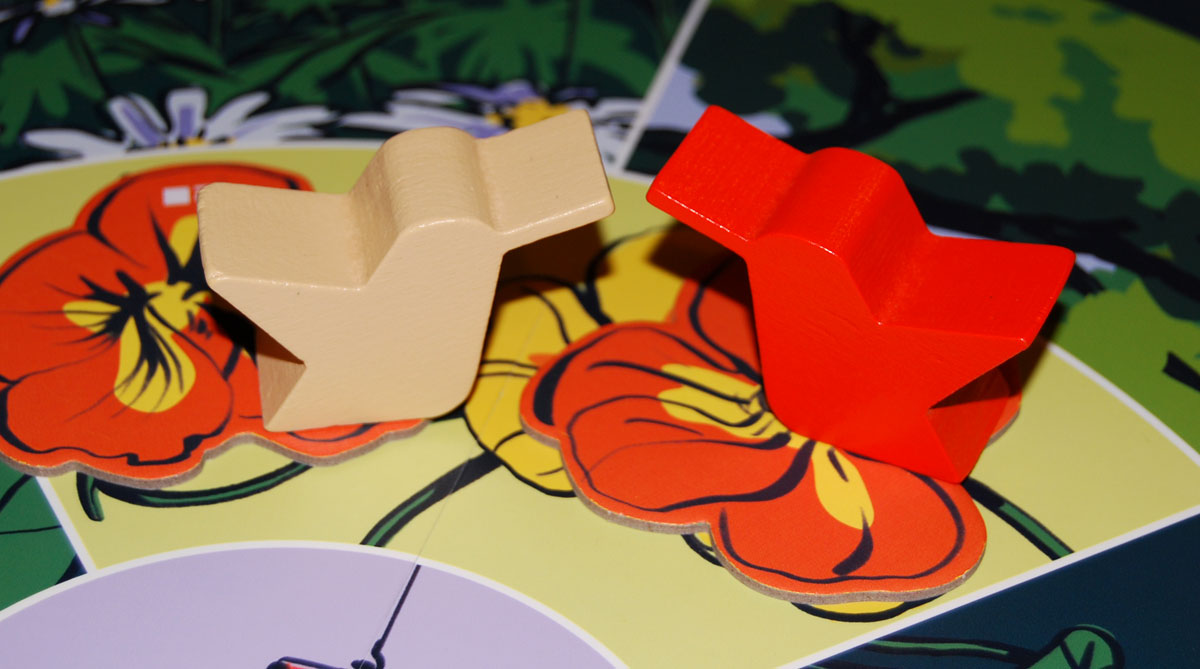
One important rule is that you cannot perform area actions if another hummingbird is present—and that’s where the attacks come in! You may spend an action to attack another hummingbird in your space. Both players secretly pick a number of energy cubes to spend (including 0), and then they reveal simultaneously and spend that energy. Add your beauty level to the result. The higher total wins the fight; in case of a tie, nothing else happens.

The winner gets to draw a field card and move the loser to an adjacent space. The winner can also steal an item that the loser was carrying. If you win a fight as an attacker (i.e. during your turn) you get an additional action this turn—so it’s possible to enter a space, fight off a hummingbird there, and then take the area action.
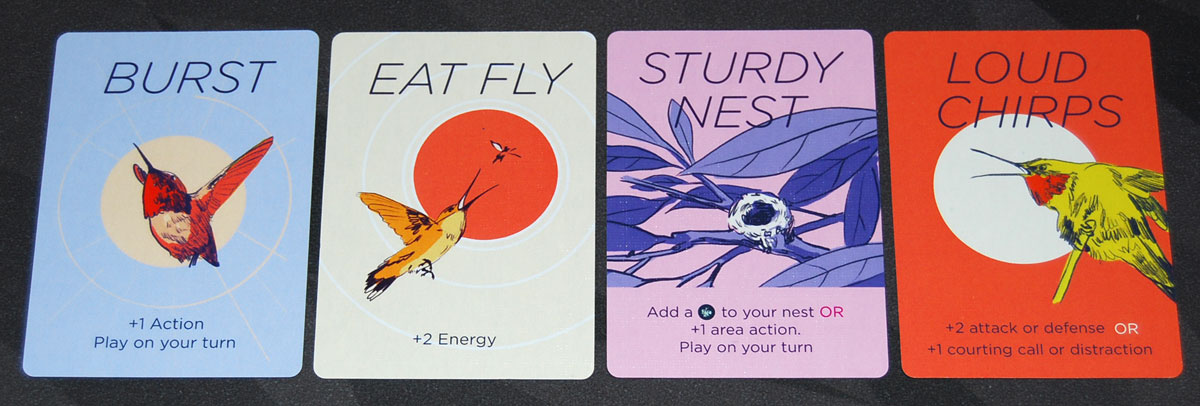
Many of the field cards can be played at any time, even when it’s not your turn, unless they say otherwise. They can give you extra actions, boost your attack or defense in a fight, or let you run away when somebody enters your space. Your maximum hand size is 3 field cards.
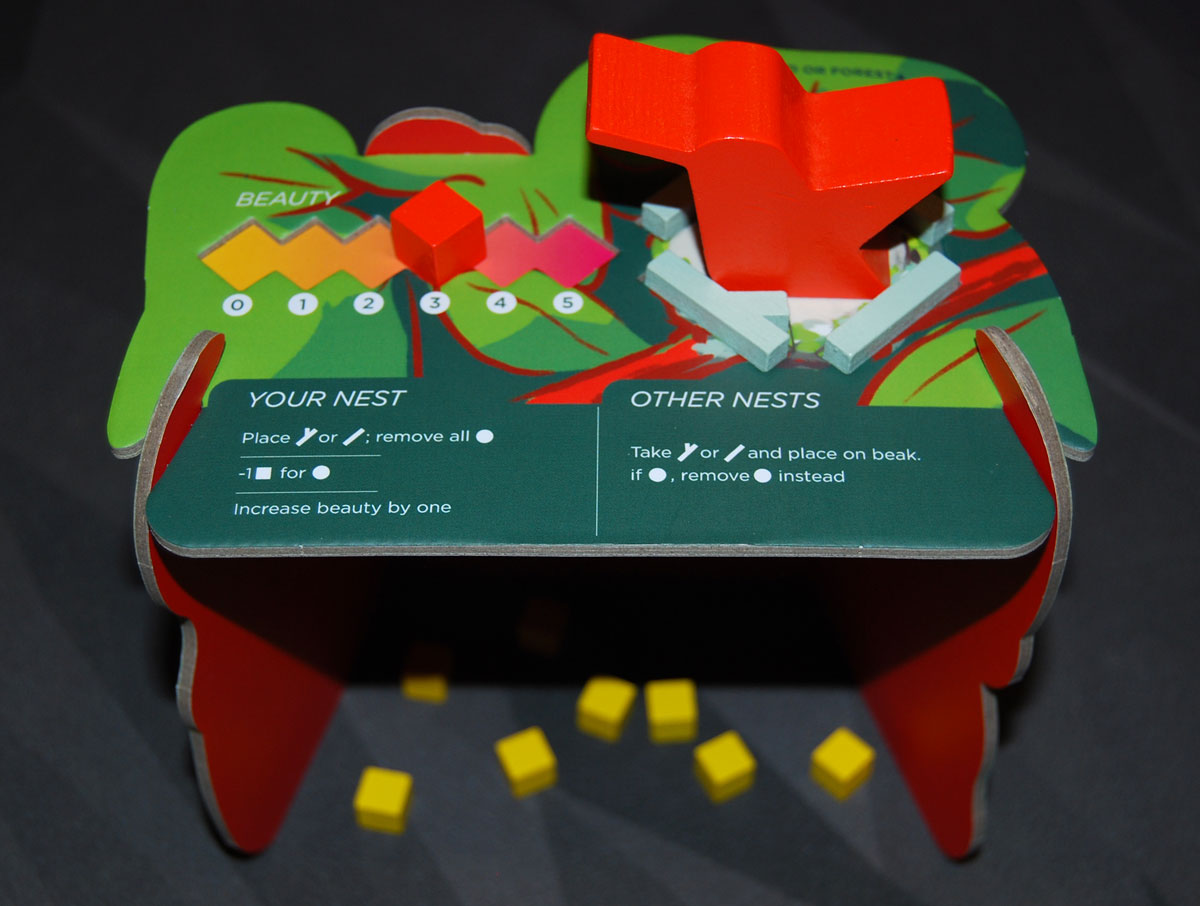
Okay, so you’ve built your nest (with 2 twigs and 2 spider silk), and you’ve raised your beauty level up—but is it enough? You can do a special courting call action while at your nest. It uses 2 of your actions, so typically you can’t do anything else on that turn.
Secretly bid 1 to 5 energy, hiding it in your hand. Everyone else may also secretly bid any amount of energy. Once everyone reveals, total up your energy plus your beauty, compared to everyone else’s total energy, the distraction value. (In a 2-player game, the opponent also includes their beauty.) Then, you also roll the performance die.
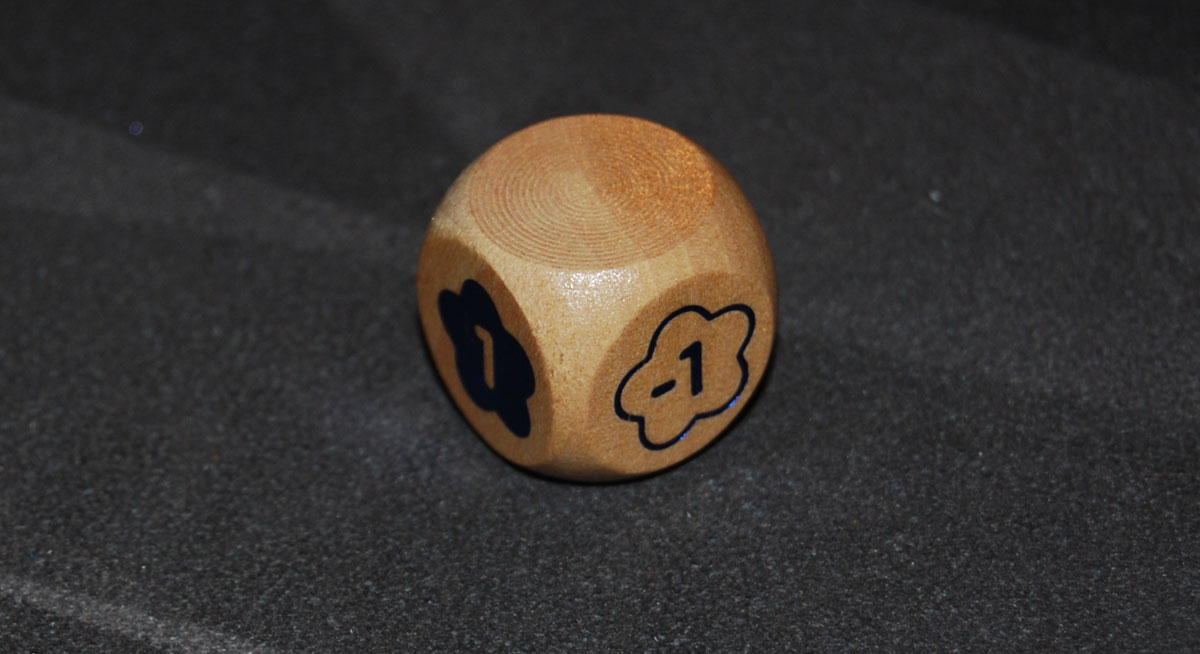
The performance die has values from -1 to 2, with a couple of blank faces as well. Add the die’s value to your total. If your courting value is higher than the distraction value, you’ve successfully outsung your opponents and attracted a mate! Otherwise, everyone spends the energy they bid and the game continues.
Game End
The game ends when a player successfully courts a mate.
Why You Should Play Hover
Hover is a lot like the hummingbirds it depicts: fast, beautiful, and brutal. Victor Shiu, the designer, explained that he was inspired by watching the hummingbirds near his home. In case you weren’t aware, hummingbirds are fiercely territorial and they don’t just use those pointy beaks for sipping nectar! In Hover, you have to move quickly to get your nest done, but don’t be afraid to start a fight if somebody’s in your way.
While the overall game time can go up to an hour with the full four players, it feels fast because turns are zippy. You only have two actions each turn (barring field cards), and most of those actions are extremely brief. Move twice. Feed and move. Pick up a twig and fly away. Drop a twig in your nest and increase beauty. It’s only when an attack occurs that there’s a pause as the two birds involved size each other up, wondering how much energy to commit to the fight.
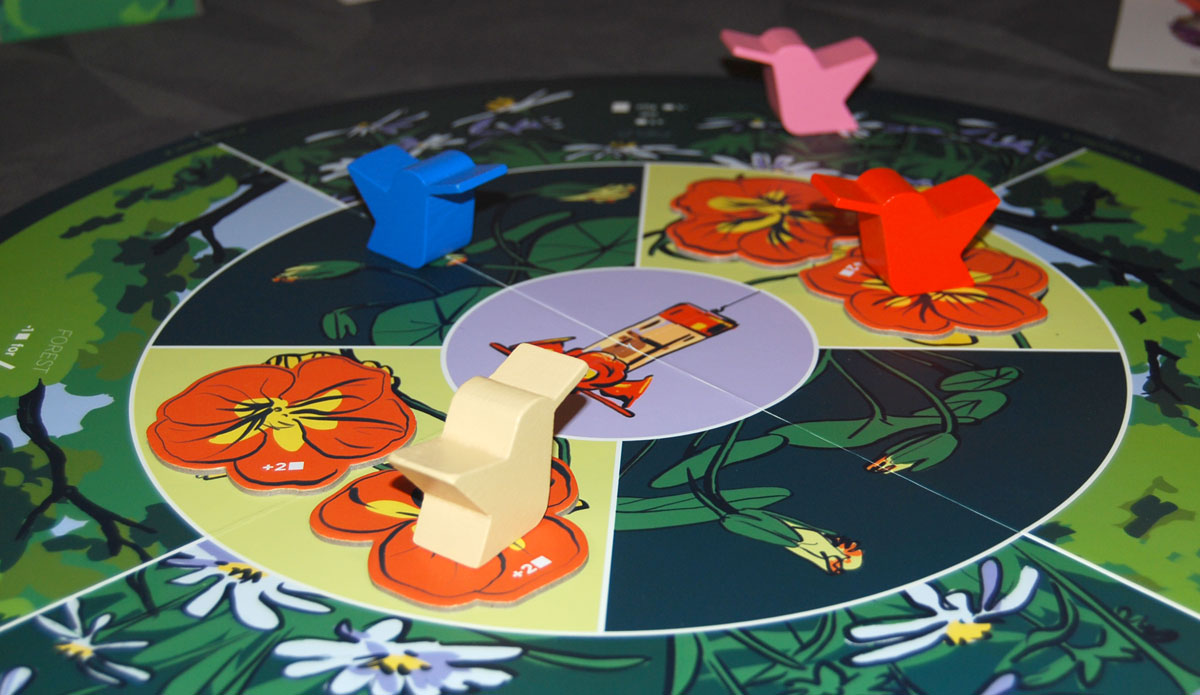
Losing a fight isn’t the end of the world: it just means the winner gets to push you around a bit, and most of the time they’re probably going to shove you into that space that has no special actions. If it means you get to keep your stash of energy, maybe it’s worth it. However, the winner also gets a field card—and that could come back to bite you later. The more important piece of a fight is whether the active player is going to win and get to take another action—is it worth spending a bunch of energy to prevent that?
Energy is fuel. You need it to pick up those nest materials, to surround your nest with lichen, and to increase your beauty (in addition to the aforementioned fights). Oh, and you can spend it to get field cards. But with a maximum capacity of 10 energy, you’re constantly burning through it and needing to go back for more. Is it worth flying all the way to the center, where you can get 3 energy per action from the feeder? Or do you just go for the flowers—they’re closer and still provide 2 energy, but sometimes the timing is off and you have to wait for them to refill.

Of course, there’s another way to get your twigs without spending so much energy … stealing them from somebody else! If somebody’s far away, gorging on that feeder, maybe you can sneak in and disassemble their nest before they get back home again. Hey, if they didn’t want you to take it they should’ve added some lichen, right?
The courting call is a tricky business indeed. How much energy do you collect before you attempt it? Do you max out your beauty, or hope that nobody wants to spend a lot of energy to stop you? Since it takes your entire turn to sing, ideally you want to have enough energy stored up that you could attempt it again on your next turn without having to make another trip to the feeder. We’ve had players sing but bluff, bidding only 1 energy, to drain the other players of their resources. But if one of your opponents is camped out on the feeder, you might just have to switch tactics.
Hover—at least the base game—is fairly simple, with a limited number of actions you have access to. That keeps the game moving for the most part, though even then there can be some agonizing decisions to make. I particularly like it with more than 2 players because then it starts to become a negotiation game: if somebody is attempting a courting call, I have to work with my opponent to stop them—but that doesn’t mean I’m their friend now! The 2-player version is a real head-to-head battle.
I like the variety of hummingbird abilities and I’ve seen all of the base game abilities in play, and it’s hard to pick a favorite. The broad-tailed hummingbird can carry two nest components at a time—great for reducing the number of trips you have to take, but it makes you a target. Costa’s hummingbird can fly away when somebody enters its space, so it’s hard to pick a fight. You’re just helping it move faster! Anna’s hummingbird is “born beautiful,” and can increase beauty from anywhere. If you let that player camp out on the bird feeder in the center, they can ramp up their attack and defense and become a menace while you’re still just getting started.
I’m excited to see what the expansions have in store, too, because I like the core concept of the game but also enjoy playing games with a little more complexity, too. The skill-building of the Desert Expansion sounds particularly appealing.
If you love beautiful games with a bite, take a look at Hover! For more information or to make a pledge, visit the Hover Kickstarter page.
Click here to see all our tabletop game reviews.
 To subscribe to GeekDad’s tabletop gaming coverage, please copy this link and add it to your RSS reader.
Disclosure: GeekDad received a prototype of this game for review purposes.