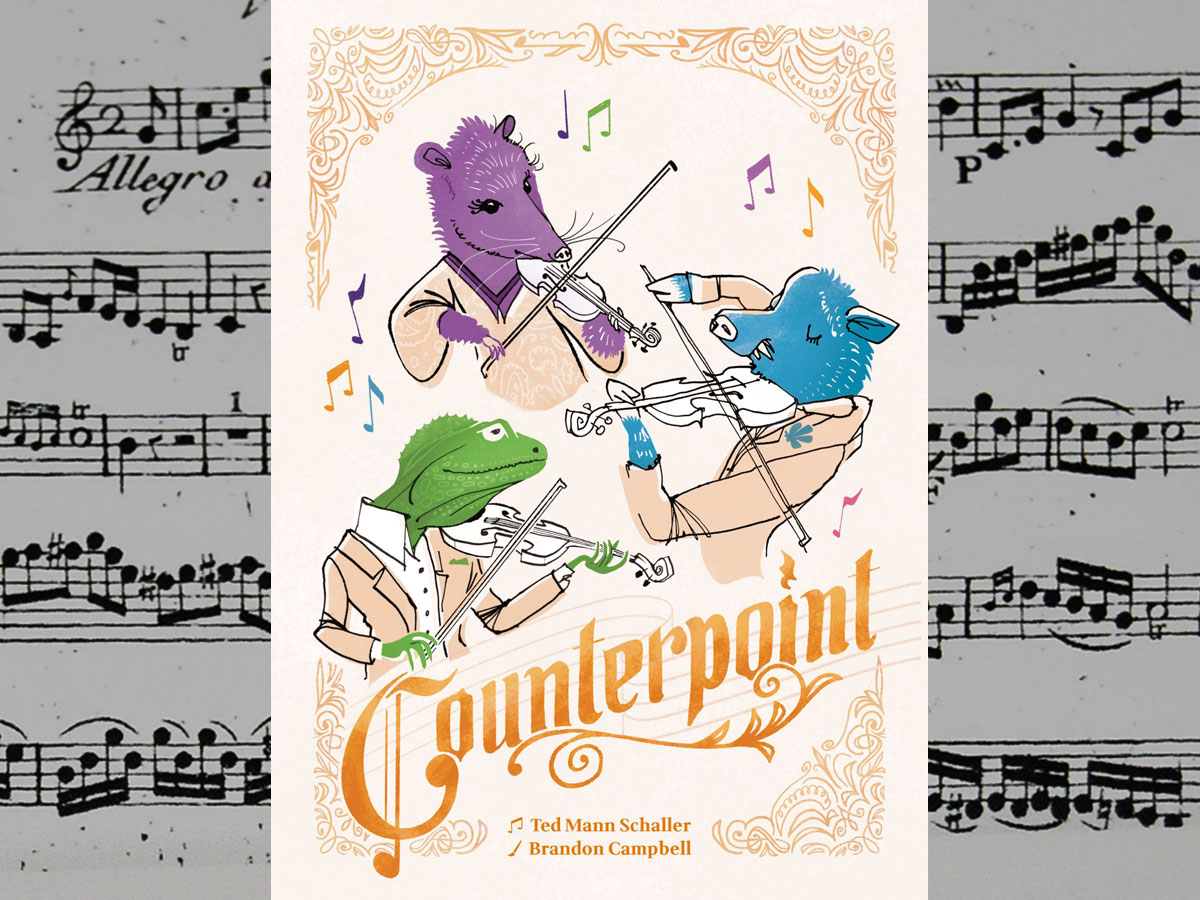
Work in concert with your fellow performers in this musical trick-taking game!
What Is Counterpoint?
Counterpoint is a cooperative trick-taking game for 3 to 5 players, ages 14 and up, and takes about 15 minutes per scenario to play. It’s currently seeking funding on Kickstarter, with a pledge level of $25 for a copy of the game. The game is family-friendly and I think could be played by kids younger than 14; familiarity with trick-taking games isn’t required but is certainly helpful, especially for the more difficult scenarios.
Counterpoint was designed by Ted Mann Schaller and published by Square Cactus Games, with illustrations by Brandon Campbell.
New to Kickstarter? Check out our crowdfunding primer.

Counterpoint Components
Note: My review is based on a prototype copy, so it is subject to change and may not reflect final component quality.
Here’s what comes in the box:
- Music Book
- 5 Music Stand cards
- 5 Musician cards
- 5 Rest cards
- 6 Technique cards
- 50 Playing cards
- 3 Clef tokens
- 35 Note tokens

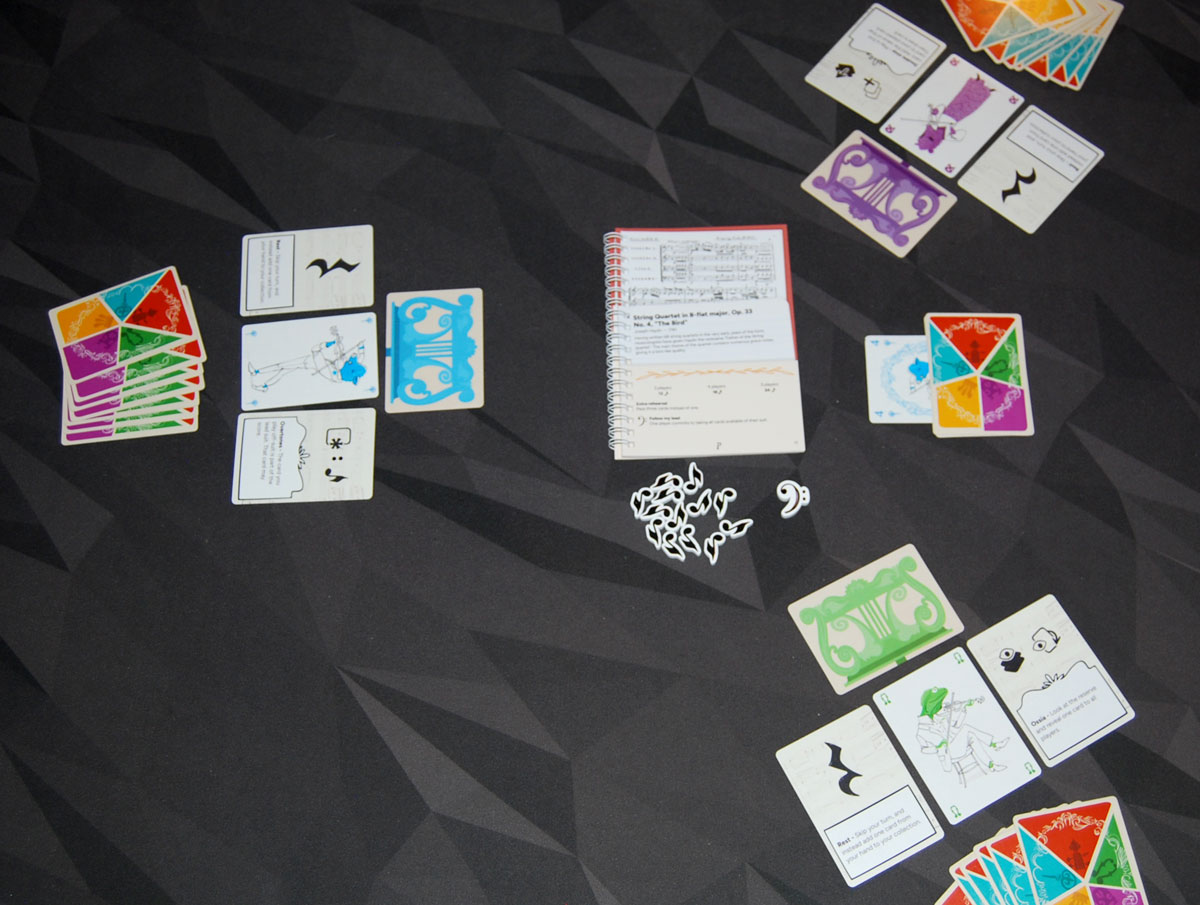
The cards are all standard-sized cards. The illustrations of the animal musicians—four string instruments and the piano—are really delightful, from the iguana violinist to the armadillo pianist. (How does it reach the foot pedals? I suppose we’ll never know.) The numbered playing cards have a few other nice accessibility features, too. Aside from the prominent animal portrait, each suit has its own little instrument-themed icon in the corners, making it easy to distinguish the cards even in the case of color-blindness. The cards also have the number and suit index in all four corners, so you can read them no matter which direction you fan your cards in your hand.

The music book is a small spiral-bound notebook that includes 50 different classical pieces to play, each one representing a different scenario. The top half of the page has an excerpt of actual sheet music of the composition, along with a short blurb about it—this portion is all flavor and isn’t necessary for gameplay, but it really helps establish the setting so I really like that it’s included. (If you want to dig in even further, Schaller has created a playlist of all the music in the book so you can listen along as you play the game!) The bottom of the page shows the rules and objectives for that piece. The difficulty level is marked at the bottom of the page, with p (piano) being the easiest and f (forte) being the hardest.
The note and clef tokens are simple wooden tokens—cute and effective. (As a viola player myself, I appreciate the inclusion of the C-clef!)
How to Play Counterpoint
You can download a draft of the rulebook here.
The Goal
The goal of the game is to successfully complete the objectives for each song—usually playing a required number of notes, along with additional rules.
Setup
Each player chooses a musician and takes the musician card, music stand, and a rest card. Shuffle the technique cards and deal one to each player—everyone can choose which side to place face-up.
Build the deck of playing cards using only the suits that match the players and set the rest aside. Depending on the player count, you may need to remove 9s and/or 10s as well. Shuffle the deck and deal a hand to each player (the number of cards depends on the player count).
Place the remaining cards to the side as the reserve, and flip the top card face-up so it is visible to everyone. The suit revealed is the “melody” suit (or trump suit, if you’re familiar with trick-taking games), and the player matching that suit is the melody player. The first player is the player to the left of the melody player.

Open the music book to your chosen composition. Make a supply of note and clef tokens according to the instructions. (Not all compositions include clefs.) Be sure to read any special instructions to all players.
Gameplay
Everyone secretly passes one card to the player to their left.
Then, players will bid by taking notes and clefs from the center. Starting with the first player, players take 1–3 notes from the center and place them on their music stand, or else pass—in which case they will skip their turns for the rest of the bidding. Your bid represents how many cards of your own color you will collect during the performance.

The bidding continues turn by turn until all the notes have been taken. You may not pass on your first turn, and the last player to pass must take the remaining notes—you have to finish playing the piece, after all!
If there are any clefs included, they must be taken by players while bidding (maximum 1 clef per player). Clefs include additional requirements for the players who take them, as specified by the music book.
Once bidding has concluded, the trick-taking (and the performance) begins!
Starting with the first player, each player must play one card into a trick. The first card played is the lead suit, and everyone else must follow suit (by playing the same suit) if possible. If you have no cards of that suit, you may play off-suit. If any melody cards were played, the highest melody card wins. Otherwise, the highest card of the lead suit wins.
The player who won the trick takes all of the cards and puts them in their collection. Any cards that match their suit are turned face-up and the rest are face-down, and then they move one note token from their music stand for each card they collected of their own suit to the face-up pile. Then they become the lead player of the next trick.

Each player also has a rest card—you may use this once during the performance, and then turn it face-down. Resting lets you skip your turn, and instead of playing a card to the trick, you just add a card from your hand directly into your collection. If it matches your suit, then you get to move a note to it just as if you collected it by winning a trick. (You can’t rest if it’s your turn to lead a trick, though!)
You may also use your technique card for its ability once during the performance—just follow its instructions and then discard it.
Performance End
The performance ends when all cards have been played (though in some of the earlier pieces you may be able to accomplish all of the requirements before all the cards are played). If all of the goals have been met and everyone has played enough of their own notes, then you win! (Playing more notes than your bid is fine.)
If anyone fails to meet their bid, or the goals have not been met, then the group loses. Critics pan your performance and the reviews are harsh.

Concert Variant
If you want to play a full concert, play four compositions in a row, one from each difficulty level. You may play the four pieces in any order, and there is an intermission between the second and third performances—you only reset rests and techniques during intermission!
Also, when setting up the note tokens for a piece, players may optionally increase the number of total notes. If so, then you may subtract that number of notes from other pieces later in the concert.
If you fail a performance, you may try again. You win the game after successfully playing all four pieces!
Why You Should Play Counterpoint
I played piano and viola through high school, and though it’s been a long time since I’ve played in an orchestra, I still have a fondness for classical music. In order to play a musical piece well, the musicians have to be attentive to each other, listening for their cues, adjusting their volume to bring out the melody, and—of course–knowing when not to play. If everyone just played their own part at full volume and at their own pace, you get cacophony instead of a concert! Counterpoint does a great job of capturing this cooperation and interaction, because you’ll need to pay attention to what everyone else is doing in order to succeed.
Trick-taking games have made huge strides in the hobby gaming world in the past few years. One of the games that I think really introduced players to new possibilities was The Crew, which was one of our 2020 Game of the Year finalists. While it used mostly traditional trick-taking rules in terms of following suit and trump cards, the cooperative aspect was something that many people had not seen before. Each of its missions set different objectives for the players to accomplish while playing through a hand of cards, with a limited amount of communication allowed between players.

Counterpoint is in a similar vein, but the musical setting gives it a different feel—instead of a high-stakes space mission to an unknown planet, you’re playing a piece together and trying to hit the right notes. Maybe a little less stressful, but it doesn’t make the game itself easier! What’s interesting about this one is that the notes that you bid aren’t a number of tricks you need to win, but cards of your own color that you will collect. If you only have low cards of your own color, can you win any tricks at all with them? Maybe you have some cards of the melody suit—those could help you win tricks … but of course the melody player is also trying to collect those cards, too. Conversely, if you have too many of your own color, that also makes it hard to collect a lot of your color because it would require winning too many tricks, one note per trick.
And then you throw in the clefs and other requirements for the pieces. For instance, the piece shown above requires one player to take only odd-numbered cards in their collection. You may have a player who needs to bid 0 and take no cards of their own suit. One (easy) piece that we got stuck on for a while had a requirement that the lead player could never win a trick, so we had to figure out how to lead so that somebody else would take the trick. You could never win two tricks in a row. (And each of these requirements and objectives has a musical term associated with it, so if you’re a music nerd you can really geek out over these details!)

The special abilities—the technique cards—give you a one-time effect that might get you out of a sticky situation. Some of them let you interact with the reserve, because the cards that aren’t included in the player’s hands can still affect what everyone’s doing. Or they break the rules of the game a little bit so that you can get somebody a much-needed note. And the rest card is crucial, too—it can let you collect a note on your own, or avoid ruining a trick that somebody really needs to take.
All in all, Counterpoint is a delightful trick-taking game that really hits all the right notes. The variety of scenarios gives you a lot of options, but just like actual music you can get better at a particular piece if you keep practicing!
For more information or to make a pledge, visit the Counterpoint Kickstarter page!
Click here to see all our tabletop game reviews.
 To subscribe to GeekDad’s tabletop gaming coverage, please copy this link and add it to your RSS reader.
Disclosure: GeekDad received a prototype of this game for review purposes.