Okay, so the headline may be a little bit of an exaggeration, because trick-taking games have never really gone away. Traditional card games like Spades and Hearts and Bridge are still around and it’s quite possible that the number of people who play them may outnumber, say, the people across the world who play even the most well-known tabletop games. But it does feel like the hobby gaming world has been waking up to this classic genre of games, and—of course—putting their own weird twists on them.
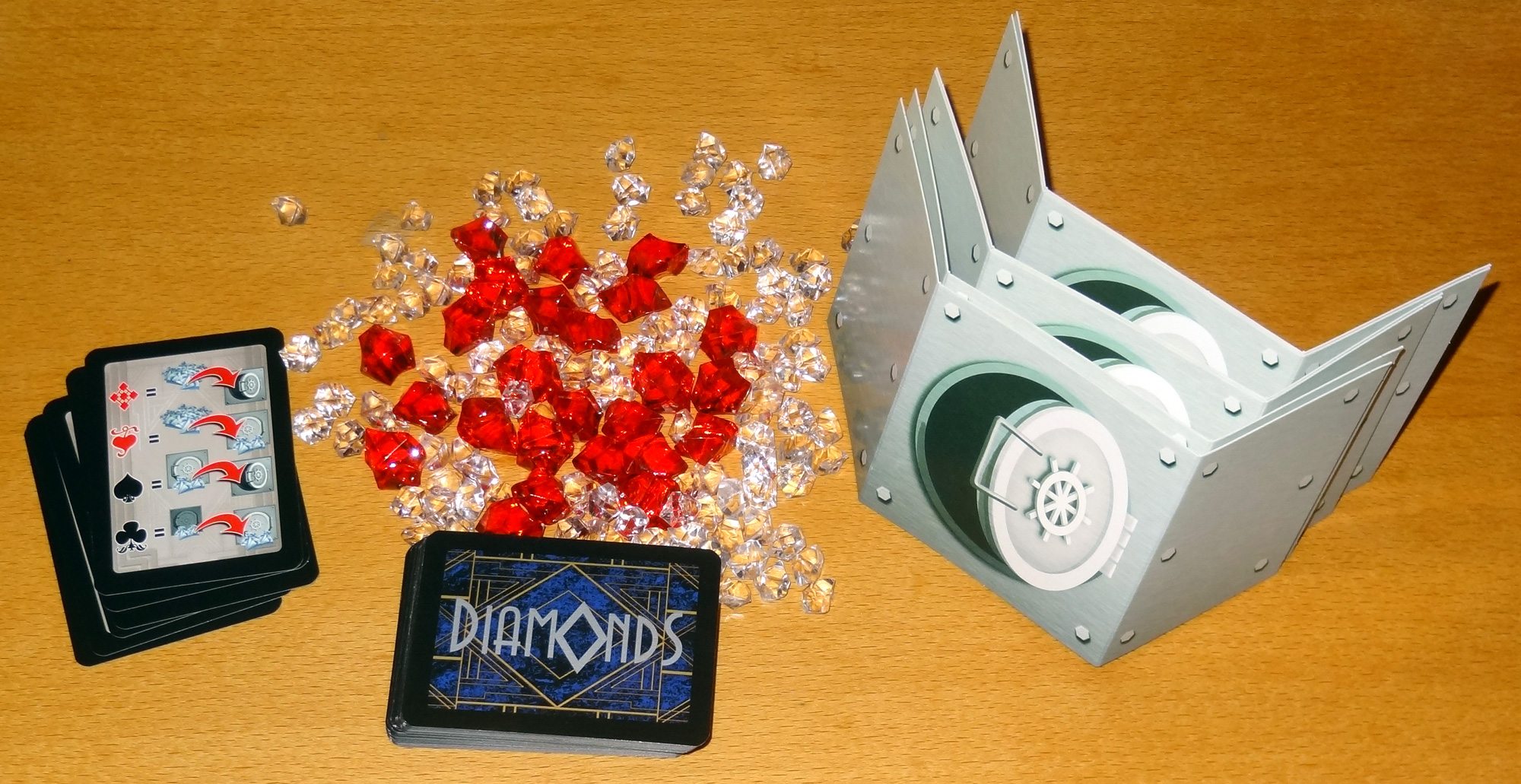
This also isn’t a totally new phenomenon. I wrote about Diamonds back in 2014, probably one of the first new trick-taking games I’d come across, and there were some others released over the following years to varying degrees of success, but it feels like the past several years has seen an explosion that shows no signs of stopping. I figured it was high time to take a tour of the genre!
First, a quick overview of trick-taking itself. Generally, players will be dealt a hand of cards, and a “trick” consists of every player playing one card. Some typical rules are:
- For each trick, each player will play one card from their hand in turn order.
- Usually, you must play a card of the suit (the “lead suit”) that started the trick if possible—this is called “following suit.”
- If you have no card of the starting suit, you may play any card “off-suit.”
- In some games, there is a “trump suit,” a suit that is considered higher than the others. The winner is the hand that played the highest trump card; if no trumps were played, the winner is the hand that played the highest card of the starting suit.
- If you don’t follow suit and don’t play a trump card, then you will not win the trick, regardless of how high your card is.
Of course, these rules can be tweaked from game to game—some games involve bidding on how many tricks you think you’ll win, for instance. Some games don’t require you to follow suit, or even require you not to follow suit. The objectives and scoring also vary depending on the game. The main thing that makes it a trick-taking game is that everyone plays cards, and there’s some way to evaluate the “highest” card in the trick.

Diamonds was one of the earlier modern games I’ve played, and it uses mostly standard trick-taking rules, but gives each suit a specific power, involving moving gems around. You get to use those powers when you win a trick, when you play a card off-suit, and at the end of the hand if you’ve collected the most cards of a suit. You use these powers to steal gems from other players and get them into your vault so that they can’t be stolen back. Six of VIII is a more recent title that uses standard rules, but the trump suit changes over the course of the game, to reflect the reigns of the six wives of King Henry VIII.

A couple of other favorites that use mostly traditional rules are Time Chase and Cat in the Box, both of which earned our GeekDad Approved seal. The big twist in Time Chase is that in between each trick, players may use their time machines to travel back in time, allowing them to replay previous tricks in an attempt to change the outcome. Cat in the Box, inspired by the Schrodinger’s Cat thought experiment, uses cards that are all colorless until they’re “observed”: you mark the color that you’re playing on a board, but it’s possible to create paradoxes when somebody must play a number and that particular number is no longer available in any color they have access to.
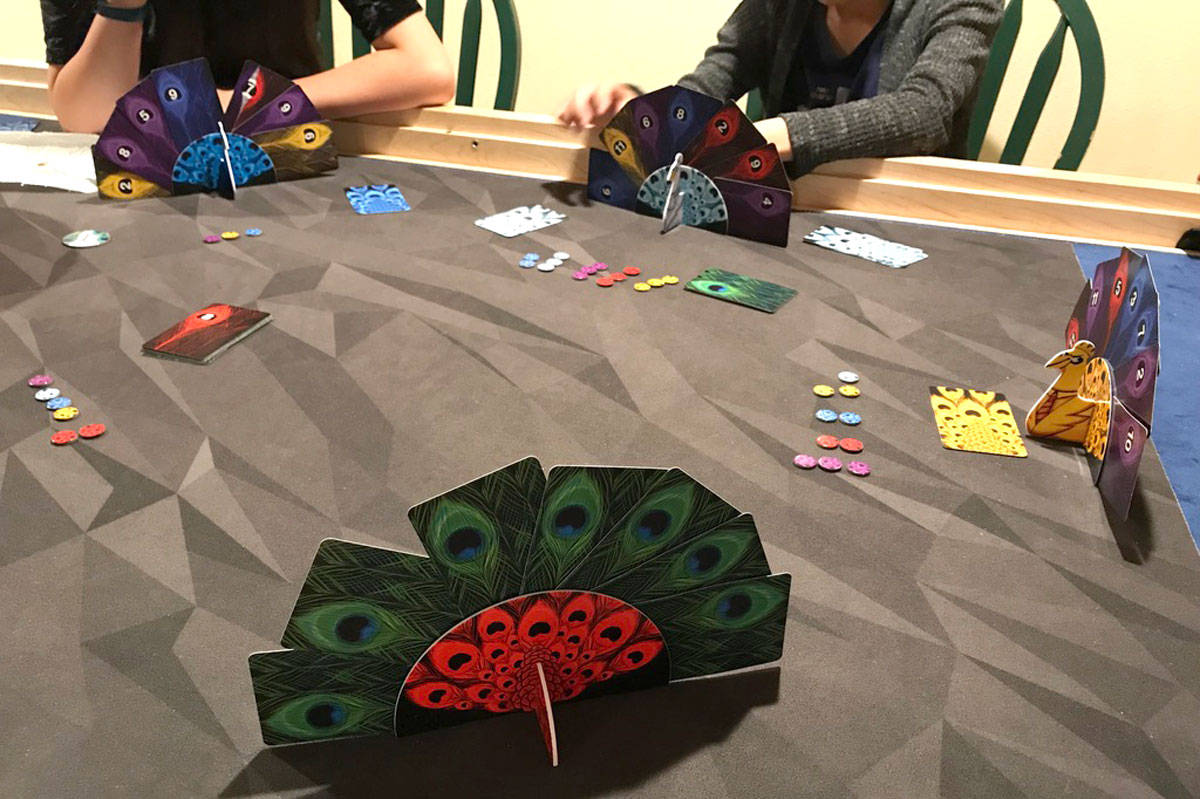
Vamp on the Batwalk has a theme of vampires putting on a fashion show—but of course vampires can’t see their own reflections, so your hand of cards is held backwards. Everyone else can see your hand, but you can’t see your own. Pikoko is another one where you can’t see your own hand of cards—but you also pick cards for your neighbors to play. Heroes & Tricks uses a different sort of limited visibility—the cards are all played into a special tuckbox so that you can only see the card played just before your own. If you aren’t the first or second player, you don’t know for sure what the lead suit even was, though there are some hints—and you can also use items, tucked behind your own card, to manipulate the outcome.
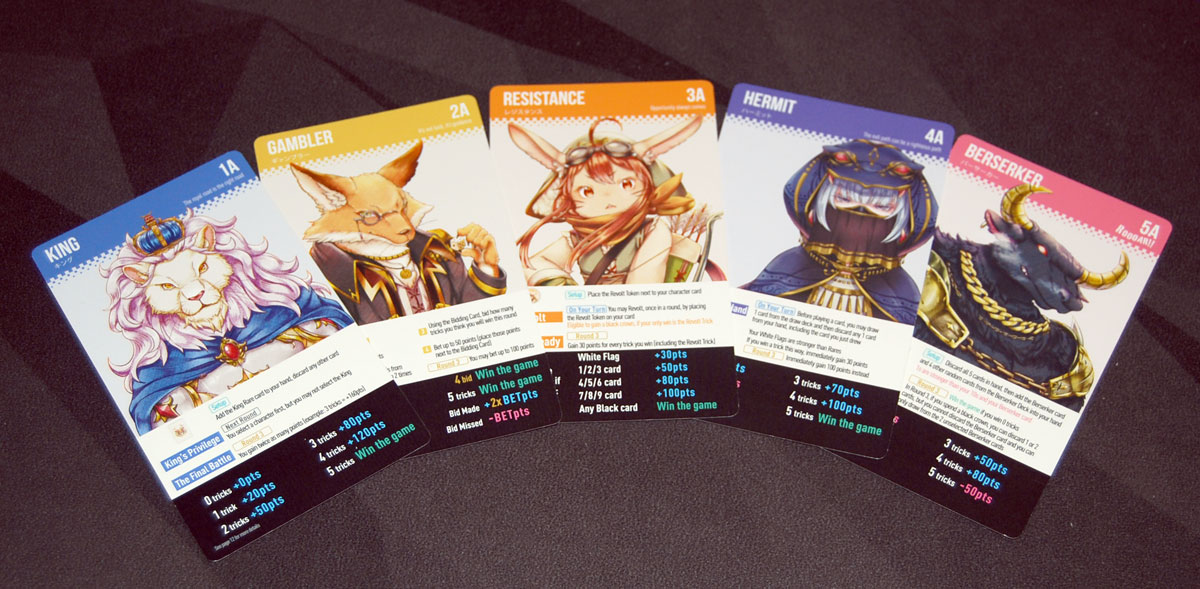
TRICKTAKERs (yes, that’s how it’s capitalized for some reason) is a wacky game where players get to choose characters each round, and each character has different abilities and ways to score or win. Supposedly the designer, Hiroken, had played Root and wondered how to make an asymmetric trick-taking game. One character can draw and discard before each play. One can revolt and flip the strength of the cards upside-down for one trick. The English edition is available from Portland Game Collective, which has a lot of other trick-taking games in their catalog. Later this year they’ll have a Kickstarter campaign for the English edition of the expansion, and I’m looking forward to it!

Trick-taking games usually require at least 3 players, because a 2-card trick almost feels like playing War. Still, there are some games that have taken on that challenge. One that I just learned last weekend is Sumo, which simulates a wrestling match. Each time you win a trick, you shove your opponent back—if you can push them out, you win the match! However, there are a number of special moves that let you immediately win the match: for instance, if you play a 1 against a 5 of the same color, you use your opponent’s strength against them. It’s a quirky little game that can end after a single trick, but it’s all about trying to gauge what cards your opponent may have in their hand. (And usually we ended up playing several matches in a row.)

Cooperative trick-taking games were also an unusual concept up until a few years ago with the release of The Crew, which now has two versions: The Quest for Planet Nine and Mission Deep Sea. Both games will have players taking on tasks for each hand: you may be required to win specific cards during the hand, or take a certain number of tricks. Communication is limited, and the goal is to play through a book of scenarios, each with its own ways to assign tasks. More recently, The Fellowship of the Ring: The Trick-Taking Game casts the players as the hobbits (and many others) tasked with taking the One Ring to Mordor. Divided into chapters that follow the plot, you will choose characters each hand, and the specific tasks are tied to the characters themselves. A lot of the chapters introduce new cards to the mix. Inside Job takes the team-task aspect of The Crew but adds a new wrinkle: the potential of hidden traitors!

With increased familiarity with the genre, you can enjoy even stranger takes, where trick-taking is the underlying mechanism but is used to drive something else. Torchlit is one that I recently purchased from New Mill Industries (though unfortunately it’s currently sold out): the results of the trick let players advance through rooms of a dungeon, with the ultimate goal of stopping in a room that has the most defeated monsters in it. However, the loser of the trick has the most control over which cards get put into the dungeon.

Arcs is a space-based wargame, with battles and area control and council cards with special abilities. But what drives it all is trick-taking: the suit played determines what types of actions you can take on your turn, but the value of the card played will affect how many actions you get. It’s a game where you have to decide carefully which tricks to win and which to lose, because ultimately it’s about using your actions to accomplish certain goals on the board. It’s a hard one to wrap your head around, even with experience in trick-taking games, but one that I find really fascinating.
I’m sure we will continue to see more games in the coming years that take trick-taking in weird and unexpected directions, and I’m excited to go along for the ride. It also makes me wonder: what other classic game mechanics might we see revived and remixed next: poker, perhaps?