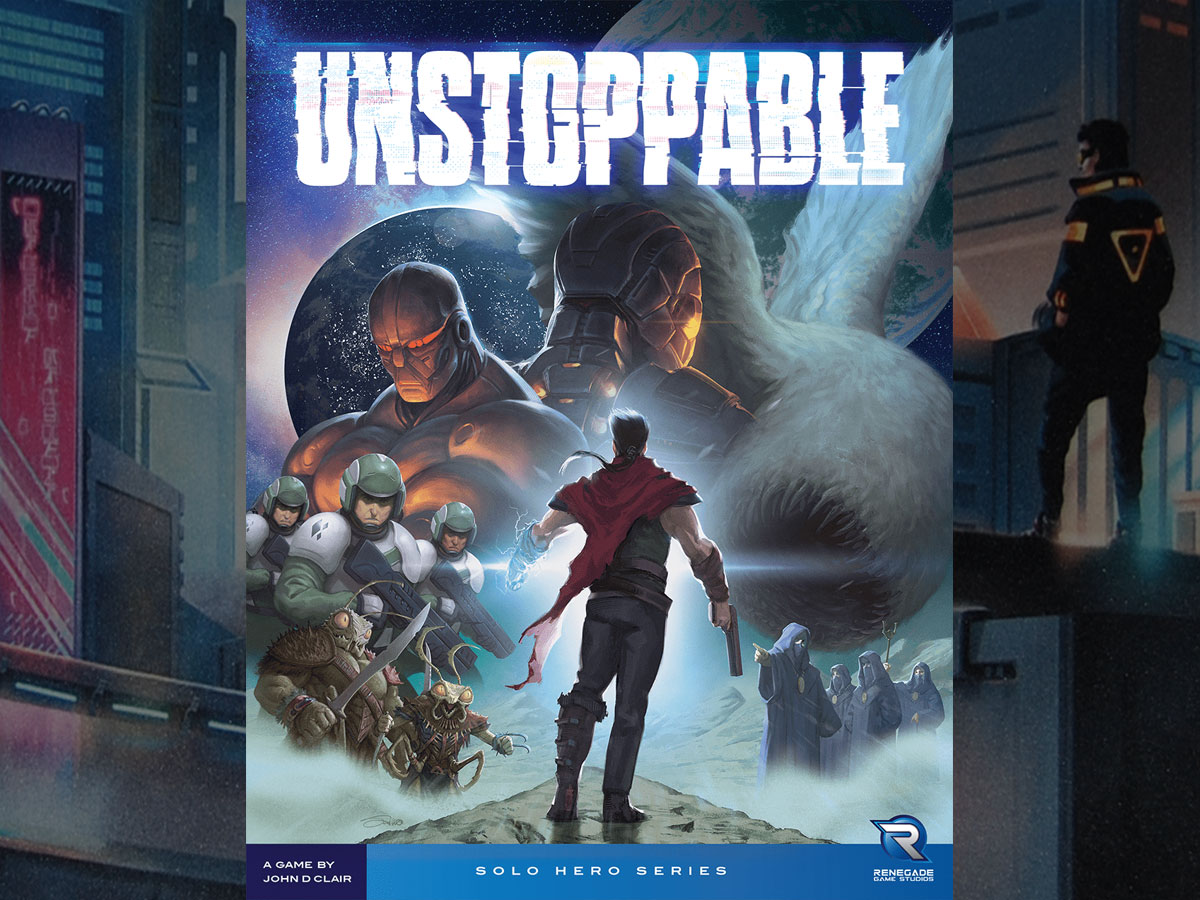
The world is ending—but maybe you can save it. You’ll have to train and upgrade, but the enemies also grow stronger as you do.
What Is Unstoppable?
Unstoppable is a card-crafting, deck-building game for 1 or 2 players, ages 14 and up, and takes about 45–75 minutes to play. It retails for $60 and is available in stores or directly from Renegade Games. There is also an expansion, Tyrant’s End, and an optional playmat.
Unstoppable was designed by John D. Clair and published by Renegade Games. Illustrators include Jacopo Schiavo, Cold Castle Studios, Stephanie Dziezyk, Bryant Grizzle, Giuseppe De Iure, Damien Mammoliti, Fabian Parente with Ana Maza, Darko Stojanovic, and Gunship Revolution: Kriss Sison, Rafael Cal-Ortiz, Arvin Albo, Jenno Diaz, and Luisa Odulio.

Unstoppable Components
Here’s what you get in the box:
- 3 Boss Mats
- 1 Danger Marker
- 46 Boss Cards
- 14 Starting Core Cards (7 per player)
- 4 Portrait Cards
- 12 Character Cards (3 per character)
- 2 Player Mats
- 2 Armor Markers
- 2 Health Markers
- 12 Action Point Discs (6 per player)
- 4 Level Discs (2 per player)
- 26 Starting Threat Cards
- 39 Threat Cards (13 per planet)
- 100 Core Cards (in 6 levels)
- 36 Upgrade Cards
- 16 Credit Tokens (in 1 and 5 denominations)
- 30 Damage Tokens (in 1 and 5 denominations)
- 121 Card Sleeves
- 20 Card Dividers

As you can see from the photo at top and the components list, the majority of the components are cards: a few large cards for the player mats and boss mats, and then a whole lot of other cards of different types. Most of the game fits in less than half of the box, which has plenty of room for future expansion, and the rest of the components (wooden discs and cubes, cardboard tokens) fit easily in one of the two other wells. The one thing about this long well for the cards is that when you set up the game, you use enough cards that the dividers and other cards tend to fall flat and slide around, so some foam block spacers are really handy.

The cards aren’t just normal cards: they have some odd cut-outs on the sides, and the upgrade cards have a little tab on the top. These unusually shaped cards are for the card-crafting aspect of the game. The first time you play, you’ll need to sleeve the starting card combos, as well as all of the threat cards. As you play the game, the cards will get paired up: one side (oriented vertically) is what you use for your actions, and the other side (oriented horizontally) is a threat that you have to face. Upgrade cards are inserted between the two cards, with a little “tab” that will be visible on both the front and the back; there’s room for two tabs on each card.
The cards are sized so that the action card is taller than the threat card and sticks out a little from the top of the card sleeve, while the threat card is the size of the sleeve, so you can see a little bit of info about your card when it’s on the threat side. The upgrade card tab also extends outside of the sleeve (seen at the bottom right photo above)—this makes it easier to unsleeve all of the actions and upgrades when you’re done playing the game. It does mean putting away the game takes a bit of time as you have to unsleeve everything (see also: Mystic Vale). The shape of the cards does make shuffling them a little odd, particularly the upgrade cards.

I was sent an optional playmat ($20) along with the game. The playmat is double-sided: one side has the main area setup with the card market, boss area, and areas for resources. The other side is the player area and holds your player mat, active threats, and discard pile, along with plenty of room for your “in play” cards. Of course, with only one playmat, you’ll have to decide which side to use when you play the game—or else get two of them. (And for a 2-player game, you’d want three playmats if you want everything on mats.)
The Tyrant’s End expansion ($15) adds two more characters, along with 36 core cards and 10 upgrade cards—these all fit easily into the existing box, and since it only introduces one new keyword, it’s fine to mix it into the base game right away. (The cards are marked with a small crown icon at the lower left in case you want to sort them out.)
How to Play Unstoppable
You can download a copy of the rulebook here. I’ll explain the solo rules first, and then note some of the changes for the 2-player game.
The Goal
The goal of the game is to defeat the boss before any player is reduced to 0 health, or the boss reaches the end of its danger track.

Setup
In the main area (shown above on the play mat), you will lay out all of the core cards, separated into their 6 levels (indicated by the hex icon on the lower right corner). Below that is the upgrade deck: six face-up cards form the market, and the rest are placed in a deck face-down. Resource tokens (credits and damage) are placed in a supply nearby.

For your player setup, take a player mat, and set your armor at 0 and your health at 10 using the tracker cubes. Choose a character and place their portrait on your player mat. Take a set of starting cards—1 Spare Credits and 6 Strikes—and shuffle them together with your three character cards, and place the deck threat-side-up on your player mat. Draw three for your starting hand, and then draw the next three threats and place them next to your player mat—these are active threats.
Place three action point discs on your player mat, and set the other three aside. Stack your level discs above the Level 1 cards in the market. Take 3 credits from the supply.
Finally, set up the boss. Place the boss mat with its associated boss cards next to the market, and check the back of the boss mat for additional setup instructions. It will tell you which threat cards to use, placed in a stack to the left of the core cards. (In the photo above, the Harbinger boss uses a mix of Ceres II and Viren cards.) Place the danger token on the first spot of the boss mat.
Gameplay
Each round has several phases: Upkeep, Draft, Main, Threat, Cleanup.
Upkeep: Reset to 3 action points on your player mat, refresh all exhausted ally cards, and resolve any effects that trigger during the upkeep phase.

Draft: Check where your small level disc is, and draw the top three cards from that core deck. Choose one to keep, and put the other two at the bottom of the deck. Draw the top threat card, and sleeve the core card with the threat card, and then add it to your hand. (Note that you aren’t supposed to look at the threat side of cards in your hand or discard.) Then, stack your small level disc onto the larger level disc if it had been moved.
Main: The main phase is where you’ll use your action points to play cards, spend credits to upgrade cards, and exhaust allies to use their effects.
Each card has an action point cost at the top right—to play a card from your hand, you must spend that many action points, and then you resolve all of its effects. Upgraded cards may have additional effects on the visible tabs.

There are two types of cards: tactics and allies. Tactics cards are resolved, and then left in the play area until the cleanup phase. Ally cards stay in play, and then can be exhausted (rotate 90 degrees) once per turn to use their effects.
To buy an upgrade from the market, spend the credits indicated on the top corner of the card and then slot the upgrade into a card that’s in your hand or in play. Note that upgrades are marked for tactics, allies, or both. Refill the upgrade market immediately.

Many of your cards will let you do damage, which you mark by placing damage markers on threat cards. You may attack active threats, or the “on-deck” threat that is visible at the top of your deck. Some threats have keywords that may affect you—for instance, the “taunt” keyword means that you have to defeat that threat before you can attack anything else.
Each threat has a number of orange and grey icons on it, either numbered or with a skull icon. The value of the skull icon is based on where the danger token is on the boss mat, so it starts low but will increase over the course of the game. A threat’s health is the total of all of the orange and grey icons. If you do enough damage to meet its health, the threat is defeated, and you flip it over and add it to your hand.

There are, of course, ways that various cards work together. Your cards come in four different factions, and there are some effects (Focus, Conspire) that require you to have other cards of the same faction, and another (Unite) that is based on having cards of different factions. Some effects let you refresh allies so that you can use them again in the same turn; some give you more action points to spend. “Bargain” lets you spend credits for an additional effect.
Threat: Once you’re done with your main phase, the threats will attack. Any threats in your active area that you have not defeated will attack you based on their orange icons. First you lose shields, if any, and then you lose health.
Cleanup: Discard all tactics cards in play. Remove all of your remaining action points. Reset your armor to zero—it only protects you the turn that you gain it! Draw new threats until you have 3 threats in your active threats area. Advance the danger marker on the boss mat.
Leveling Up
You level up when you need to draw new threats to refill but there are none, or because you’ve defeated everything in your active area when the deck is empty. (There’s a handy reference on your player mat that is revealed when your deck runs out.)
First, you move both of your level discs forward one space.
Then, you discard all tactics and allies in play and discard down to 3 cards in your hand. You may optionally eliminate one card from your hand or discard pile (which removes it from the game).
Resolve any boss-specific effects for leveling up.
Reshuffle the deck and place it, threat-side-up, back on your player mat.

Game End
If you run out of health, or the danger token reaches the skull on the boss mat, then you lose the game. If you defeat the boss, then you win.
There are ways to score the game based on the difficulty level and how many rounds you had left on the boss mat and how much health you had when you won. (You score 0 points if you lose.) There are also additional points for certain achievements, like having 15 or more credits at the end of the game, or owning at least 2 cards of each faction.
2-Player Rules
The 2-player game is very much like the solo game, with each player setting up their own player area, and working cooperatively to defeat the boss. Your active threats only damage you and not the other player, but you are also allowed to attack the other player’s threats. One note is that the “Taunt” effect only applies to its own battlefield, so even if you have a Taunt threat in play, you may still attack the other player’s threats, and if they attack your threats they must attack the Taunt threat.
Players lose if either player is reduced to 0 health.

Why You Should Play Unstoppable
Unstoppable is, in some sense, a deck-building game: you start with a deck of basic cards, and over the course of the game you acquire stronger cards to add to your deck. Whenever your deck runs out, you reshuffle your discard pile and make a new deck. But it’s also a card-crafting game, a specialty of John D. Clair (see also Mystic Vale, for instance): each card can be upgraded twice, adding effects or making it more powerful, so even when your deck doesn’t grow in number, it can grow in strength.
One of the new twists of Unstoppable is that, unlike typical deck-building games, you do not draw back up to a certain hand size at the end of each turn. Sure, at the start of each turn you draft a card from the market for free, so you’re always guaranteed to have one card when you start your turn. But after that—the only way you get more cards into your hand is by defeating the threats in front of you, which are then drawn into your hand. I remember Clair describing it as a “momentum” game—you do get a sense of building up momentum as you defeat threats to draw cards to do more damage.
It’s also very easy to lose momentum if your timing is off: for instance, if you spend all of your actions and cards to place some damage on a threat (but don’t defeat it), you’re starting your next turn with just the one card in hand. If that single card you draft isn’t enough to finish off the threat so you can draw it, then you’re in for a world of hurt because those three threats in your active area will all hit you—and later in the game that may be enough to kill you even from full health!
Leveling up happens every time you burn through your entire deck, and the primary benefit of leveling up is that you get access to stronger core cards. You can get to them earlier by using the “training” effect, which moves your small level disc temporarily, but then it snaps back to your actual level each turn. Moving the larger disc bumps your starting position up to the next core deck. The risk of leveling up is that when you do, all of your allies go into the deck, where you’ll have to fight your way through some threats to get them back into play. Figuring out the timing of when to defeat enough threats to level up, and when to wait until the next turn so you can set up some card combos, is part of the strategy and takes some experience to get used to.

The other feature that I really love is the way that the upgrades affect both your cards and the threats on the back. You want to boost the damage on this card? Great! Now the threat on the back also hits harder. Here’s an upgrade that gives me an action point when I play it so I can play more cards in a turn. But now the threat is “Fast,” which means it doesn’t count toward the three active threats and I have more enemies attacking me. It’s easy to go all out on some great upgrades, and then having severe buyer’s remorse when that card comes back as a beefed-up threat.
The game works well as a 2-player game, even though it seems to be marketed primarily as a solo game. It’s even part of Renegade’s “Solo Hero Series” line of games. I was worried that the 2-player variant would just feel like two people playing solo games next to each other, but the fact that you can attack each other’s threats means that there’s a lot of coordination and assisting that can happen, particularly in trying to get around those Taunt threats. It also means that the two players can focus on different types of effects, because each faction tends to have its own unique strengths, and it helps to know if you’re leaning into the focus/conspire effects or the unite effects.
Unstoppable comes with a small storybook (written by Banana Chan), giving you more background than you would normally get from the rulebook blurb. It’s about three planets inhabited by humans—one with the current official government, one where a royal family holds an uneasy alliance with the bug-like Virens, and one that has been mostly trashed by war, where junkers sort through the planet’s garbage for valuable tech to sell. Several of the characters have a strange ability to manipulate reality, and there’s a strange doomsday cult that seeks to unleash a world-ending monster that could very well destroy the planet. You don’t have to read the story to enjoy the game, but it does help to put some theme to the four factions and their effects.
So far I’ve only played against the introductory boss, the Harbinger—it’s a simpler one where you just have to do a whole lot of damage to it before time runs out, and its cards are special threats that are added to your deck. The two other bosses are more complex, with both threat cards and event-type cards that will trigger as you play. It’s been challenging enough—my win/loss ratio isn’t great—but I’m looking forward to tackling the other bosses once I get a better handle on that whole momentum thing.
I mentioned in my crowdfunding roundup last week that there’s a new version of Unstoppable in the works: Dungeon Crawler Carl! My understanding is that it will be cross-compatible with this base game, but it has some of its own twists that tie into the theme. For instance, the boss mats are the dungeon floors, and you can play either a one-off session or play a campaign mode where you retain your character and play through multiple floors. After you hit Floor 3, you’ll also be able to play with some class/character combinations, just like in the book series. I’m a big fan of the books, so I’m especially excited to see how this new version will play out!
For more about Unstoppable, visit the Renegade Games website. To check out Dungeon Crawler Carl: Unstoppable, visit the Backerkit campaign. (Note that the campaign is also for a DCC role-playing game.)
Click here to see all our tabletop game reviews.
 To subscribe to GeekDad’s tabletop gaming coverage, please copy this link and add it to your RSS reader.
Disclosure: GeekDad received a copy of this game for review purposes.