

Build your own ecosystem of flora and terrain, but in a fraction of the time it takes to play Earth.
What Is Earth Express?
Earth Express is a tableau-building game for 1 to 8 players, ages 14 and up, and takes about 20 minutes to play. It’s a standalone spinoff of Earth, which was one of our Game of the Year Finalists for 2023. Earth Express currently seeking funding on Kickstarter, with a pledge level of $39CAD (about $29USD) for a copy of the game. (The campaign is for two standalone Earth-inspired titles; I’ll cover Behind the Lens: Photographing Earth in a separate review.) Although the recommended age is 14+, I think younger kids with some tabletop experience should be able to pick this one up as well.
Earth Express was designed by Maxime Tardif and published by Inside Up Games. Graphic design is by David Shaw, Riley Lem, Katie Hoang, M81 Studio, and Yulia Sozonik.
New to Kickstarter? Check out our crowdfunding primer.

Earth Express Components
Note: My review is based on a prototype copy, so it is subject to change and may not reflect final component quality.
Here’s what comes in the box:
- Fauna board
- Ecosystem board
- 3 Action tiles
- Demeter Score board (for solo game)
- 306 Earth cards (224 Flora, 82 Terrain)
- 33 Ecosystem cards (double-sided)
- 21 Fauna cards (double-sided)
- 8 Player Aid cards (not pictured)
- 24 Sprout tracks
- 16 VP Leaf tokens (2 per player color)
- 98 Seeds (in 1, 5, and 10 denominations)
- 140 Growth pieces (86 trunks, 54 canopies)
- 72 Sprouts
- Scorepad (not pictured)
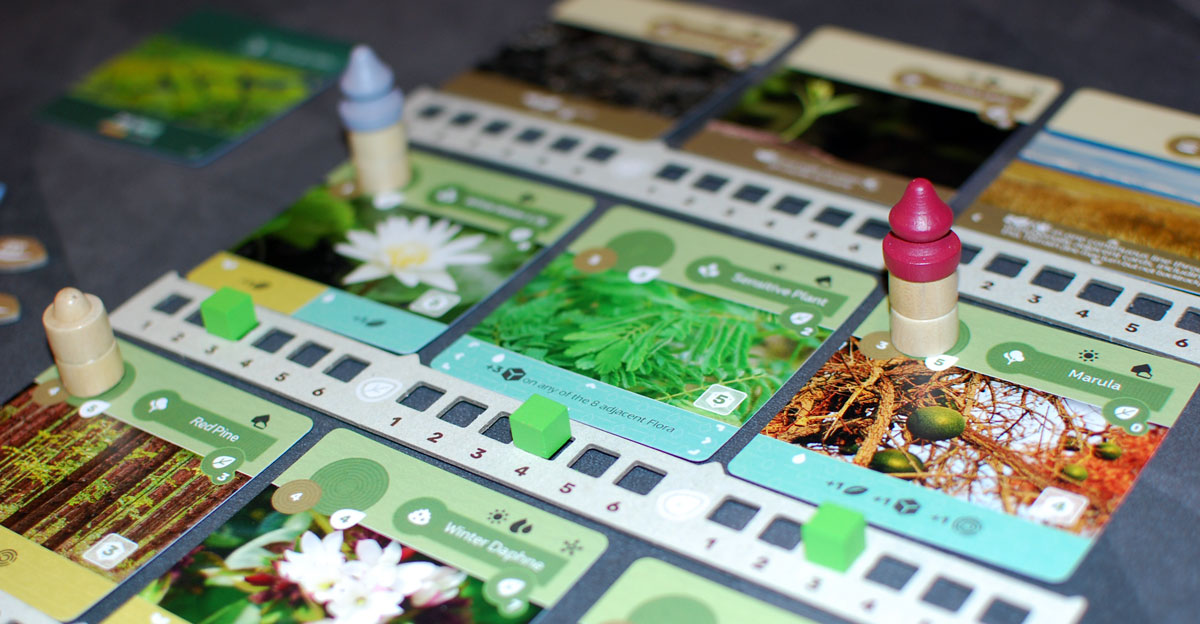
If you’ve played Earth, you’ll see some familiar components and component types here. The growth pieces are little wooden tree trunks that stack up, and then you top them off with a colored canopy piece. The sprouts are simple bright green cubes.
The sprout tracks are placed in between rows or columns of your card grid, and they’re used to track how many sprouts each card has. It’s a clever system that requires fewer wooden cubes, since some cards can hold as many as 6 sprouts. Now, each card just uses one cube, placed in a numbered space.

Earth Express uses square cards instead of standard rectangular cards—perhaps in part to give the two games a bit more of a visual distinction, but the shape works well for the 3×3 grid that each player will be building. Each card has a bunch of information on it like flora type, spaces for growth, point value, and card abilities.
Every card has photography on it. Conor McGoey of Inside Up Games had told me that for Earth they purchased all of their photos from stock photography sites, selecting for the various plants, animals, and terrain represented in the game. (The rulebook does include a disclaimer that, although they tried to be accurate, they aren’t botanists and you shouldn’t use these cards as a field guide!)

The three action tiles are pretty simple, since they each show two of the three potential actions: red, yellow, and blue. The tiles are large, I suppose to make them easily visible, but the icons on them are pretty tiny and can be hard to read from across the table, so I hope they make these icons a bit bigger in the finished version.
How to Play Earth Express
You can download a draft of the rulebook here. Earth Express is also available to play on Tabletop Simulator.
The Goal
The goal of the game is to score the most points with your 3×3 card tableau.
Setup
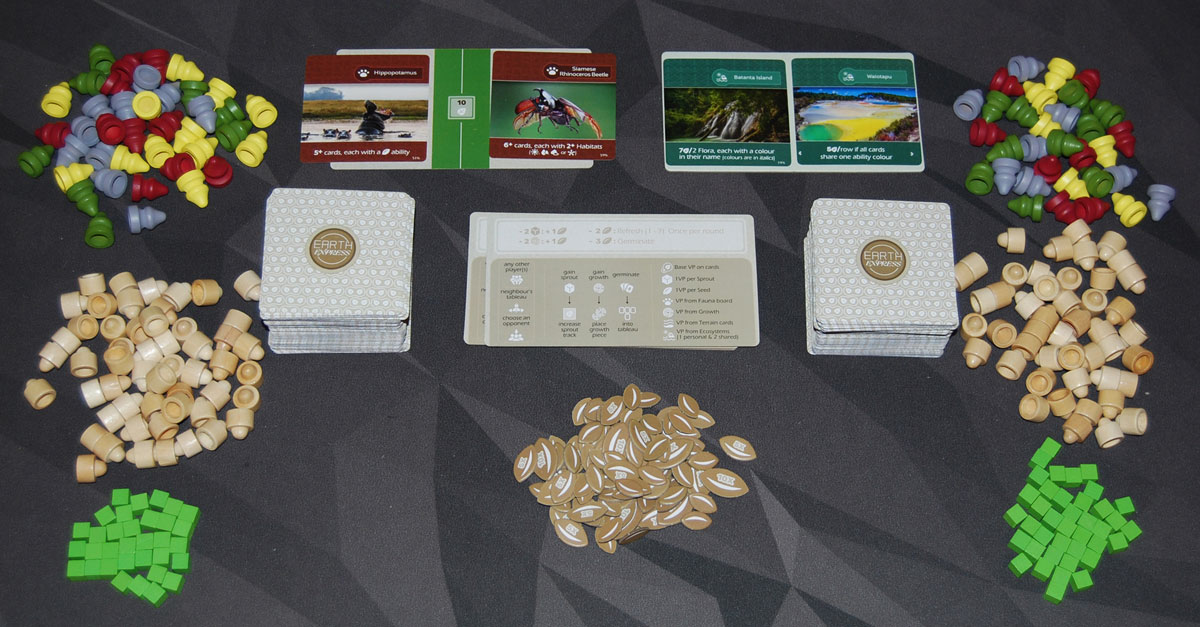
Shuffle all of the Earth cards and make a deck (or several decks so everyone can reach). Place the Fauna board in the center of the play area with two randomly drawn fauna cards on it. (If using the optional Ecosystems, place its board in the center as well with two ecosystem cards on it, and also deal 2 ecosystem cards to each player. Each player chooses one to keep and decides which side to use face-up.)
Shuffle the three action tiles and place them face-down. Make a supply of seeds, growth pieces, and sprouts.
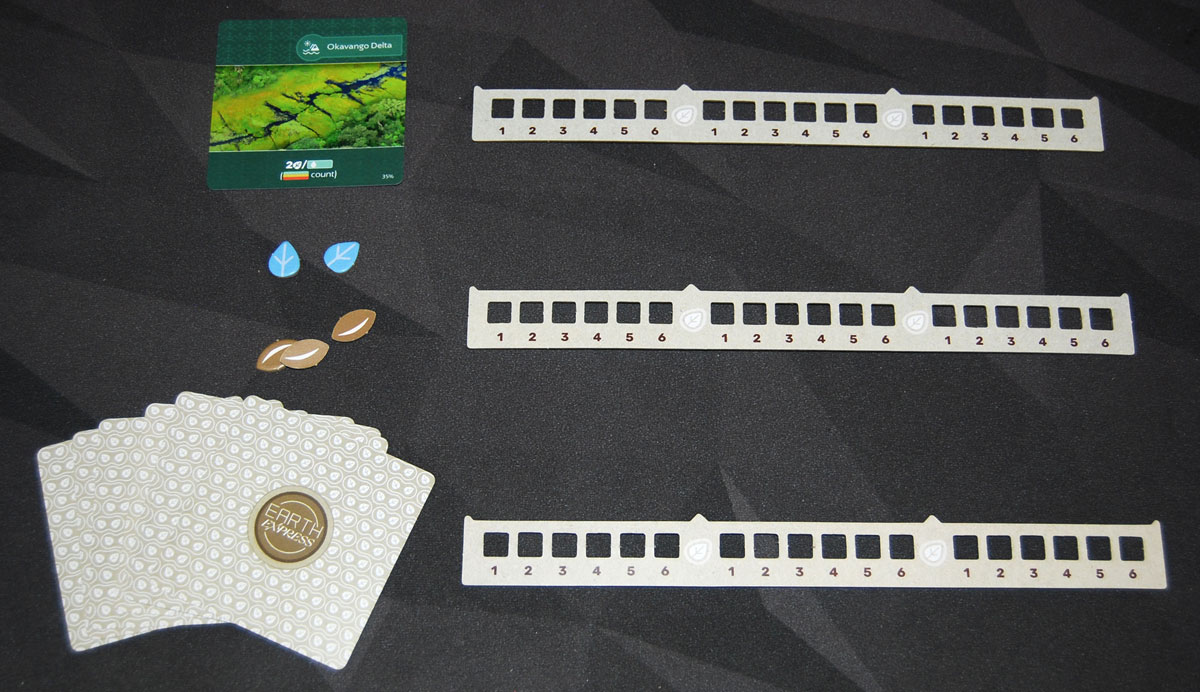
Give every player 2 leaf tokens of their color, 3 sprout tracks, and 3 seeds. Place the sprout tracks so there is room for cards in between them.
Every player draws a hand of 7 Earth cards.
Gameplay
The game lasts 5 rounds. Each round, you will plant cards, choose an action, and then activate your tableau.
First, reveal the top action tile. (If all three have been revealed, reshuffle them and form a new stack.)

Then, everyone plants 2 cards into their tableau, and then passes the rest of their hand to the left. (In the last round, you will only place 1.) Cards may be placed in any empty space in your 3×3 grid, but once placed they may not be moved later. Cards that have a black ability at the bottom trigger once when you plant the card.

Then, choose one of the two actions shown on the action tiles:
- Red: Gain 2 seeds
- Blue: Gain 3 sprouts
- Yellow: Gain 2 growth
Seeds are just placed in your own supply. Sprouts are added to existing flora cards: each card has an icon in the lower right area of the photo that shows how many sprouts it can hold. (If there’s no icon, then that card cannot take sprouts.) Growth is added to the growth ring spot at the top left of the flora cards. The number on the left side of the growth ring indicates how many growth pieces the card can hold—use trunks to build up, and then use a canopy for the last piece.

Finally, you activate your tableau. Based on the action that you chose in the previous step, you may activate any cards in your tableau with a matching color ability. (Rainbow abilities count as all three colors.) While you can skip over abilities, cards must be activated in order from left to right, top to bottom.
There are a few bonus actions you can do at any time during your turn:
- Spend 2 sprouts to get 1 seed
- Spend 2 growth to get 1 seed
- Spend 2 seeds to refresh your hand: discard any number of cards, and then draw back up to 7.
- Spend 3 seeds to germinate: name a particular scoring feature, and then flip cards from the bottom of the deck until you find one. You must take the first card that matches the named feature and add it to your hand, and then discard the rest.

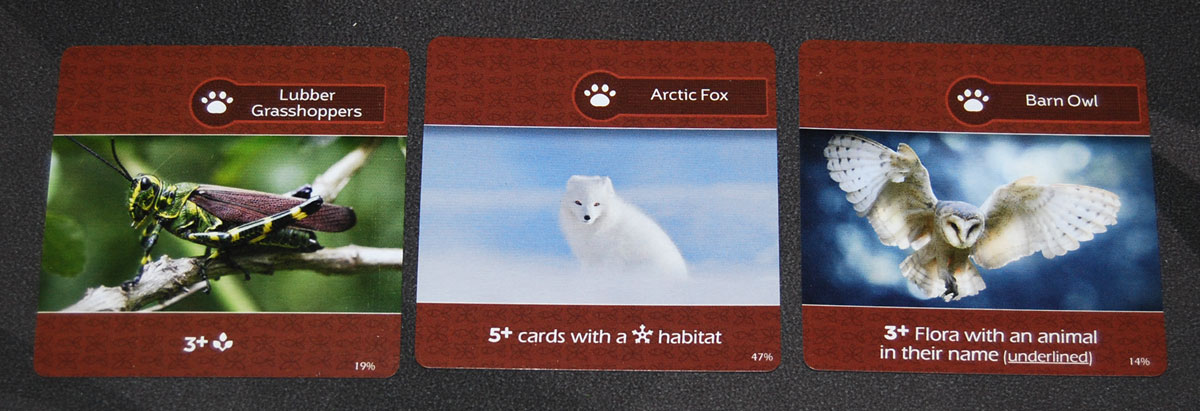
At the end of the round, once everyone has activated their tableaus, you check for the fauna objectives. If anyone has achieved either of the fauna objectives, then they place a leaf token on the board. (On the basic side, each objective is worth 10 points; on the advanced side of the board, objectives are worth more points if you achieve them earlier than other players.)
Finally, players pick up the cards passed to them, and draw back up to a hand size of 7 if needed.

Game End
The game ends after 5 rounds. Everyone will have a completed 3×3 grid.
Score points as follows:
- Point values for each card in the tableau (in the top right)
- Remaining seeds in your supply are 1 VP each
- Sprout cubes are worth 1 VP each
- Growth spaces with a canopy are worth the completion value (the leaf icon on the right side of the growth space). Incomplete growth spaces are worth 1 VP per trunk piece
- Terrain cards score VP if you achieved their objectives
- Leaf tokens on the Fauna board score points as shown
- Ecosystems (if in play) score points if you meet their objectives. Everyone can score for the two public ecosystem, and each player can score their own ecosystem card.

The highest score wins! There is a whole string of tiebreakers:
- Most seeds remaining
- Most growth pieces
- Highest sprout cube value
- Most VP from terrain cards
- Most VP from fauna cards
- Most VP from ecosystem cards
Solo Mode
In the solo game, you play against an automated player, Demeter. Instead of playing cards from a hand of 7, you actually deal out a 3×3 grid for Demeter, and each turn you will choose cards from her tableau to play into yours, and then refill her tableau. She will gain points based on the action you choose, and will trigger abilities in her tableau in a slightly different way. Your goal is to score more points than Demeter.

Why You Should Play Earth Express
As I mentioned earlier, Earth was one of our top ten games of 2023: it’s a game of finding combos and chaining together card abilities and maximizing your score. There’s a huge number of cards in the game, so unlike some games you can’t just build your “favorite” tableau each time; you have to work with what you’ve got.
Earth Express takes a lot of the core concepts of Earth and distills them into a compact version. Maxime Tardif explained in his designer diary that he and his girlfriend love thinky games—but they don’t always have much time to play, so he wanted to pack a lot of the complexity of Earth into a much shorter game. I’d say that he has succeeded! Earth Express still has a lot of the puzzly aspect of building your tableau and maximizing your points for sprouts and growth and terrain objectives, but it really does play in around 15 to 20 minutes!
There’s a more detailed comparison of the two here, but I’ll note a few things that stand out. Earth used an action-follow mechanic, where the active player chose an action, and everyone else got a weaker version of that action. This could lead to some tactics like choosing a particular action because you knew your opponents didn’t have a lot of abilities in the matching color. Planting cards into your tableau was one of the action options, so you only added cards to your tableau when using that action; it also cost soil to plant them, so there were times where you could have taken the action to plant but couldn’t afford to.
In Earth Express, both the planting and the action selection have been simplified. You always add two cards to your tableau every round, and there’s no additional cost to keep track of. For the actions, there are always two of the three possible actions on the current tile, and each player gets to choose for themselves which of the two to do. While both games are primarily about building your own tableau and there isn’t a lot of direct interaction between players, Earth Express is a little more insular still—the primary source of interaction is that you’ll be passing cards to the next player, and that in the advanced game there is a race to complete the fauna objectives.
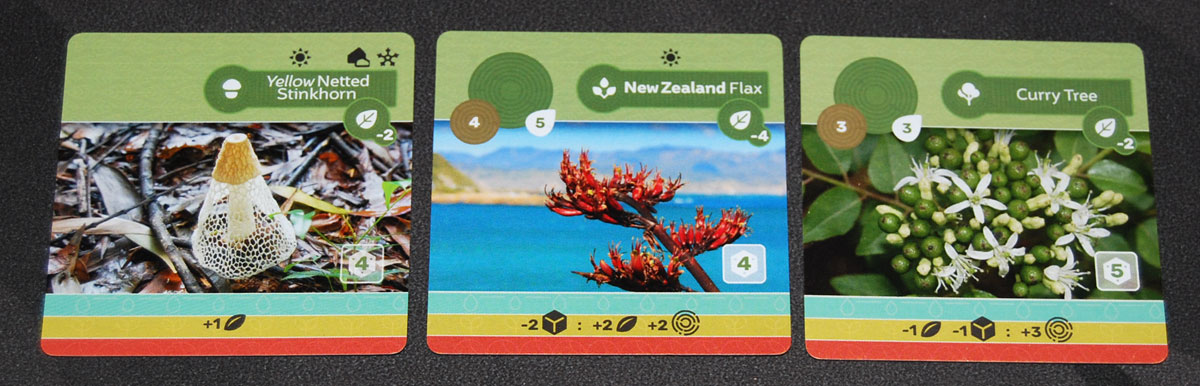
But even in this short game, there’s still plenty to think about, including a lot of trade-offs. When is it worth spending sprouts (which are worth points) to gain growth (also worth points)? When do you spend seeds (points again!) to dig for cards that help you fulfill your terrain objectives (you guessed it—for points)? One other trade-off I noticed was that there are a lot of cards with negative point values, particularly the ones with rainbow-colored abilities. These are wild so no matter what action you choose, you can trigger their effects—powerful, but you’ll need to make sure they’ll generate enough points to be worth it.
In my review of the original Earth, I described it as a game for people who like spreadsheets. I count myself as one of those, but I understand that it’s not for everyone! It can be a little dry, and although there are cool photos of flora and fauna, there isn’t any narrative to tie things together. If you enjoy mathy puzzles or you’re looking for a speedier Earth, this is definitely worth checking out. If you prefer games to have a bit of a story, fun characters, or dramatic tension, this is probably not the one for you.

Overall, I feel like Earth Express captures a lot of the same feel as Earth, but it’s impressive that it can do so in a much quicker timeframe. And since it’s a drafting, simultaneous-action game, it also means that you could go up to 8 players without dramatically increasing the play time, too. It’s rare to find games for 6 or more players that don’t lean more into the party game genre, so this will make a cool addition to my library for those situations.
For more information or to make a pledge, visit the Earth Express Kickstarter page!
Click here to see all our tabletop game reviews.
 To subscribe to GeekDad’s tabletop gaming coverage, please copy this link and add it to your RSS reader.
Disclosure: GeekDad received a prototype of this game for review purposes.


Jonathan H. Liu

Jonathan H. Liu is a stay-at-home dad in Portland, Oregon, who loves to read, is always up for a board game, and has a bit of a Kickstarter habit. I can be reached at jonathan at geekdad dot com.


