Deep underground, monsters are roaming in an abandoned mineshaft. Unfortunately, it is lonely and quite boring down there. What better thing is there to do but build a ghost train to given their existence meaning once again. It is up to you to lay down track to include as many monsters as possible along your routes in Ghosts Galore.
What Is Ghosts Galore?
Ghosts Galore is a tile laying game with drafting for 2-5 players, ages 10 and up, and takes about 20 minutes to play. Players claim tiles and then place them to create their own paths of track to connect monsters in combinations to ear the most points. It’s currently available from your local game store or from online retailers such as Amazon for around $29.99 for a copy of the game.
Ghosts Galore was designed by Michael Luu and published by asmodee and Lookout Games, with illustrations by Nele Diel.
Ghosts Galore Components
Here is what you get in the box:
- 5 two-sided player boards
- 5 overview cards
- 78 track tiles
- 1 lamp token (start marker)
- 5 minecarts
- 1 scoring pad

Each player will take one of the player boards and pick a side. The board consists of nine spaces in a 3×3 grid with 12 tunnels along the edge. Each side of the board has the three types of tunnels in different locations. The spaces are used to place the tiles.

The overview cards have two sides. On one side the number of each type of monster is listed as well as the numbers of each type of track tiles. The opposite side explains how each of the nine types of monsters as well as scoring for gems and connecting tunnels. Each monster scores in a different way and requires different strategies to get better scores.

There are 78 track tiles divided into four different types. These include 31 straight sections of track, 31 curved sections of track, 8 sections with two curves each, and 8 sections where the perpendicular tracks cross over one another. Players place the tiles they draft onto any open space of their player board and can rotate them in any direction. Along with the track, each tile has one or more monsters and/or gems. These monsters are used for scoring at the end of the game.

The lamp token indicates the first player at the start of each round. Each player has their own minecart which they use to claim their tile during the open draft at the start of each round.
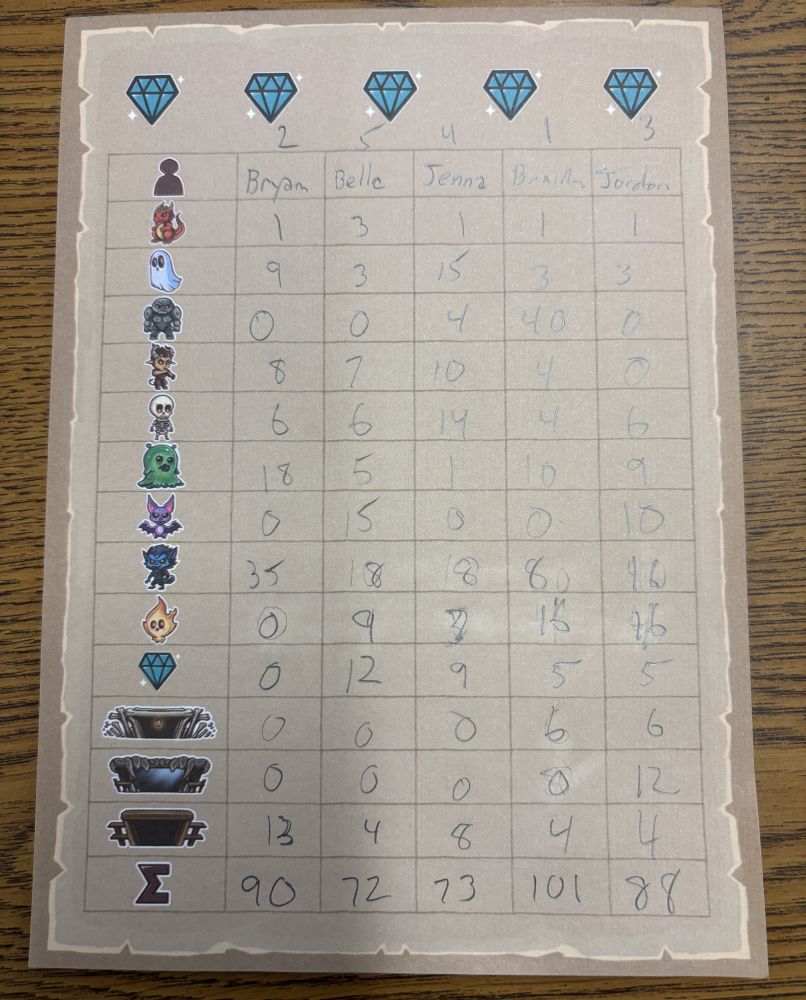
The scoring pad is used to calculate the scores for each type of monster in each player’s gameboard and to determine the winner. There are spaces for each monster, gem, and tunnel.
How to Play Ghosts Galore
The Goal
The goal of the game is to create the highest scoring ghost train in your abandoned mineshaft.

Setup
Start off by having each player take a random player board and place it with either side face up in front of them. Then each player takes an overview card and a minecart and places these next to their player board. Turn over all of the track tiles so the back side is up and shuffle them around. Each player selects one tile randomly and places it face down next to their player board. While they can look at it at any time, it stays hidden from the other players.
Now create eight stacks of tiles, each with a number of tiles equal to the number of players plus four. For example, in a two-player game, each stack would have six tiles while a five-player game would have 9 tile stacks. Return any leftover tiles to the gamebox. Finally, determine a starting player and give them the lamp token. You are now ready to play Ghosts Galore.
Gameplay
Ghosts Galore is played over eight rounds. During each round players will claim a trick tile from the current stack and then place it on their player board. After eight rounds, players must then place their hidden tile on their final open space to complete their board in preparation for scoring. Let’s take a look at each of the two parts of a round.
Claiming Track
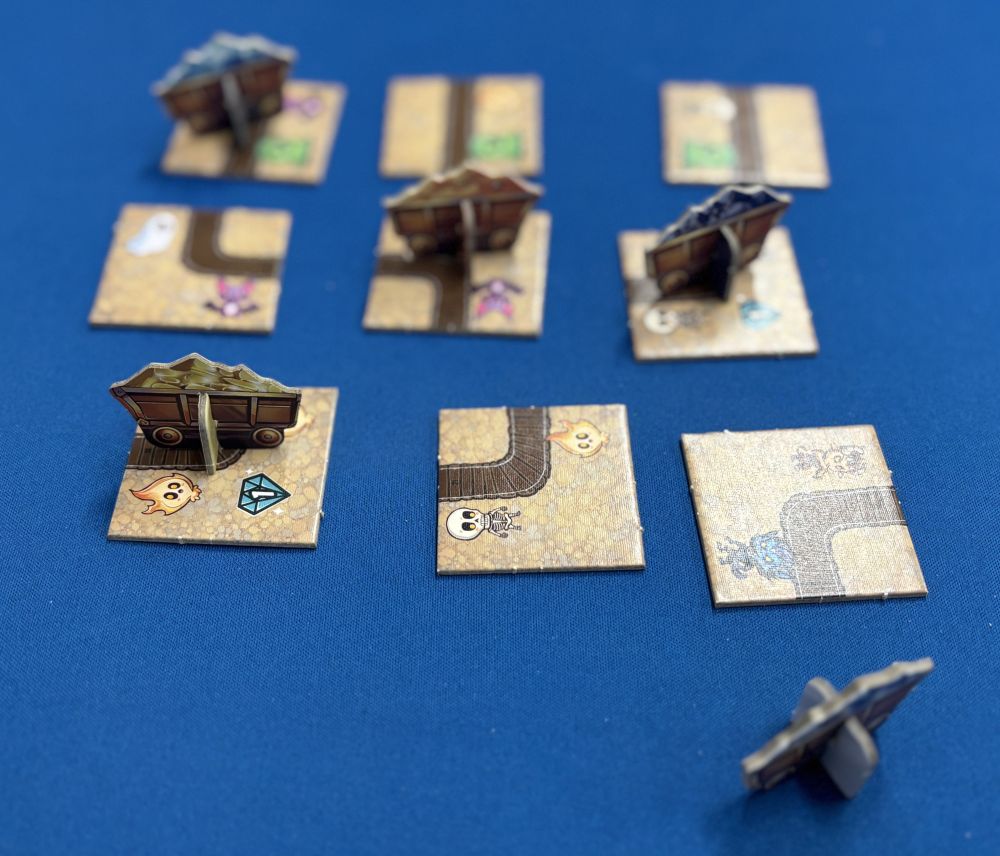
Track is claimed through a drafting mechanism. Beginning with the first player, select a stack and then turn over the top tile. The active player can choose to claim that tile by placing their minecart on it. Or they can pass. The next player can then either claim a face-up tile that has not been claimed or they can turn over the next tile from the stack. Once they reveal a new tile, they can either claim that tile or pass. They cannot go back and select any of the other face up tiles. Continue going around the table until all but one player has claimed a tile. Then reveal the remaining tiles and the last player must claim one of the non-claimed tiles.
Placing Track
After all players have claimed a tile, players take their tile and must place it on their player board. When placing a tile, they may rotate it freely. It does not have to be placed touching an existing tile. Dead ends are allowed–you don’t need to have continuous track, but you should avoid this for scoring. Finally, you may not move or cover a tile that has already been placed on a previous turn. Once you have placed a tile, it cannot be moved after that round. Now return the four remaining tiles to the game box and pass the lamp to the next player to the left and continue the next round.

Game End
At the end of the eight round, when all players have placed their eighth tile, the players then take their hidden tile, reveal it, and place it in the final open space on their gameboard to complete their railway. Now calculate each players score using the rulebook and the scoring pad. Each monster scores differently. Players also get points for diamonds and connecting tunnels. Let’s take a look at the 13 scoring categories.
- Dragons: Count the number of dragons a player has and then square that number. For example, 1 dragon is worth 1 pooint, 2 draons 4 points, and 8 dragons 64 points. If a player does not have any dragons, then get -5 points.
- Ghosts: On paths with at least 3 ghosts along them, those ghosts score 6 points each. All other ghosts are 3 points.
- Golems: Count up the golems that are not orthogonally adjacent to another golem. Then consult the table in the rule book for the points that depend on the number of such golems.
- Satyrs: Each satyr scores a number of points equal to the number of different types of monsters along its path, including the satyr.
- Skeletons: Each skeleton is worth the number of diamond symbols (disregard their printed value) on your board.
- Slimes: Slimes are each worth the number of curves you have on your tiles. Double curve tiles count as two curves.
- Bats: Bats score 5 points each only if they are orthogonally adjacent to another bat. Isolated bats are worth no points.
- Werewolves: Each werewolf is worth 4 points. If you have the most werewolves on your board, you score an additional 10 points.
- Wisps: Count the number of wisps you have on your board. If you have 0-3 wisps, they are worth 3 points each. For 4-6 wisps, the are each worth 4 points and 7 or more wisps are 5 points each.
- Diamonds: Add up the printed values of all diamonds on your tiles.
- Bone Doors: If there is an uninterrupted path from one bone door to another bone door, score 2 points for each tiles along that path.
- Tooth Doors: If there is an uninterrupted path from one tooth door to another tooth door, score 2 points for each tiles along that path.
- Other Paths: All other paths from one door to another score 1 point per tile along that path.
The winner is the player with the highest score. In case of a tie, the player with the fewest dead ends is the winner and if still a tie, players enjoy a shared victory. Here is an example of scoring a board.
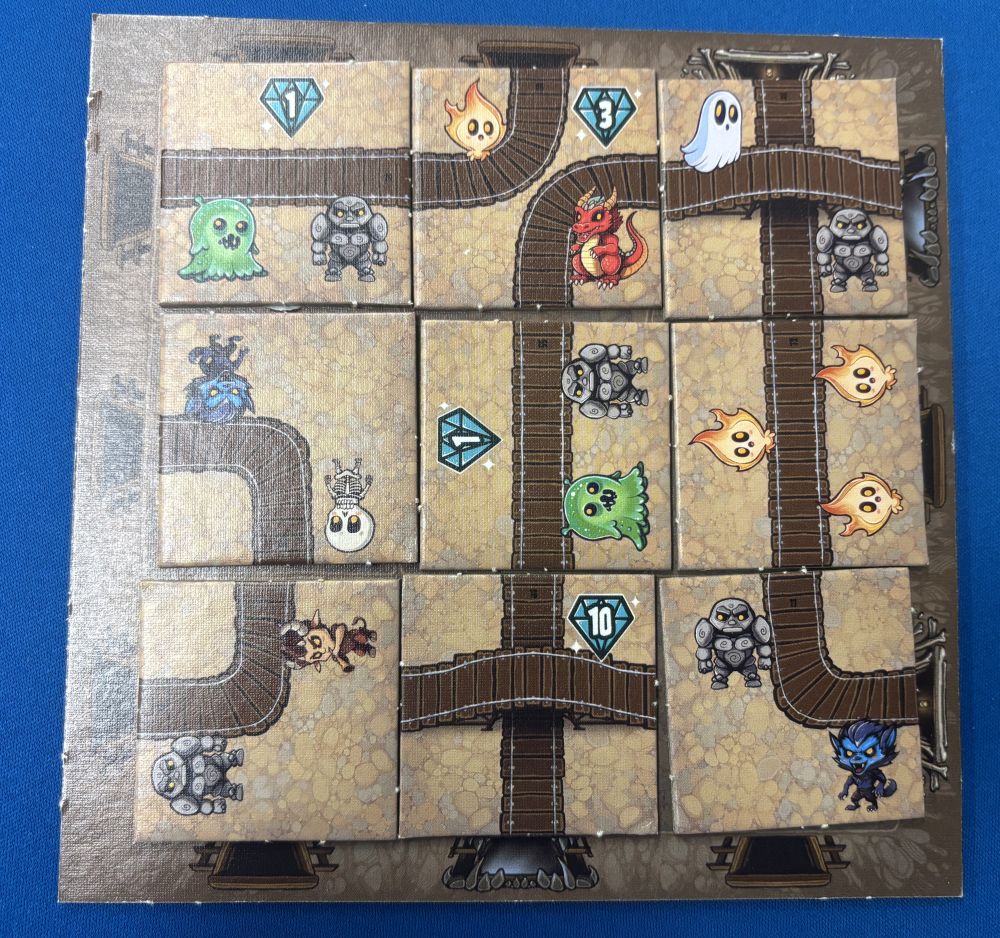
This player has 1 dragon for 1 point, only 1 ghost for 3 points, 5 golems that are not adjacent for 40 points, 1 satyr with four different monsters on its path for 4 points, 1 skeleton for 4 points, 2 slimes with 5 curves for 10 points, no bats for 0 points, 2 werewolves for 8 points, 4 wisps for 16 points, 5 points for diamonds, 6 points for 3 tiles connecting bone doors, 8 points for connecting teeth doors, and 4 points for connecting other doors. This comes to a total of 109 points.
Why You Should Play Ghosts Galore
I have been looking for some quick, fun games to play with my tabletop game club at the high school where I teach. When I learned of Ghosts Galore, I thought it might be a good tile placement game to introduce them to that type of game. Since we have about 30 minutes during our intervention/enrichment period, I was pleasantly surprised that I could teach and have the students play the game in that amount of time. Once they learned the game, they could play and score it in about 20 minutes. The first time I tried it, we had four players who enjoyed the game. I forgot the game at home the next time we met and they were disappointed because the wanted to play it again. So I made sure to bring it for the following time and we had 5 players, two who were new. They all really enjoyed it and said they want to play it again.
While some high school students liked the game, I also am impressed with Ghosts Galore. First, it is very quick to setup, especially with all the players helping create the stacks of tiles. It is also very easy to teach. I really like the open drafting when players claim their tiles. You have to decide whether you want a tile already visible, to reveal a tile, and then to decide if you want the revealed tile or wait for something better which might come later. If you are the last player, all of the rest of the tiles are revealed. However, they may not be as good as what was already claimed by other players. This gives the game a bit of a push your luck to see if you can get something better later.
I also enjoy the strategy in the game. As you begin to collect tiles and place them, it is important to keep in mind the scoring so you can claim tiles and place them so as to maximize your score. It seems players all want to get at least one dragon so they don’t lose points. I have also seen players focus on golems or werewolves as a strategy or skeletons combined with diamonds. Since players don’t immediately take their tiles after claiming them, but instead wait until all players have claimed a tile, you can see what your opponents are going after as well. Players also have to be flexible. You may start on one strategy and have to change if you can’t get the monsters you need.
Ghosts Galore looks great. The art is cute and colorful with each monster having different colors. I am impressed that the scoring sheets are also in full color rather than just black and white. The tiles are of a decent thickness so they are study but not so thick that stacks get too high. I did notice that the overview cards had a couple errors. For example, the side with the numbers of different tiles shows single curves twice and no straight sections. On the other side, the scoring for dragons is different from the rule book. As long as you refer to the rule book for scoring, these errors are not much of a problem and will probably be fixed in future printings of the game.
I am impressed with Ghosts Galore. l like the simplicity of the game as well as the strategy of determining how to create a high scoring system of tracks when you have to do it one tile at a time. The hidden tile may help provide an initial strategy, but you may have to change it depending on the tiles you are able to claim. I appreciate how quickly the game can play as well. The box is small and can easily be taken on trips or out camping since you don’t need a large area to play, especially if only playing with 2-3 players. Since it is easy to teach, you can get new players right into the game and they can learn as they play. The game has cute and colorful artwork that makes it attractive to new and experienced gamers. Finally, I have always had fun whenever I have played it and so have the other players. If any of these reasons appeal to you, I recommend adding Ghosts Galore to your game collection. It will hit the table frequently either on its own or as a warm up for an extended game night.
For more information, visit the Ghosts Galore page!
Click here to see all our tabletop game reviews.
 To subscribe to GeekDad’s tabletop gaming coverage, please copy this link and add it to your RSS reader.
Disclosure: GeekDad received a copy of this game for review purposes.