You’ve crash-landed your flying saucer on Earth—find your crew and get off the planet!
What Is Crash & Grab?
Crash & Grab is a quick programmed-movement game for 2 to 6 players, ages 13 and up, and takes about 25–45 minutes to play. It’s currently seeking funding on Kickstarter, with a pledge level of $34 for a copy of the game or $49 for the deluxe edition with upgraded components. (There are also slight discounts for the early bird tiers.) The game is not too complex and I think you could play with younger kids, since the subject matter is also kid-friendly.
Crash & Grab was designed by Clayton Skancke and Brian Henk and published by Pull the Pin Games, with illustrations by Loic Billiau.
New to Kickstarter? Check out our crowdfunding primer.

Crash & Grab Components
Note: My review is based on a prototype copy, so it is subject to change and may not reflect final component quality. This prototype is the standard edition; the deluxe edition includes some metal tokens, custom dice, and card sleeves—see the Kickstarter page for specifics.
Here’s what comes in the box:
- 14 Board tiles
- Placement die
- Rotation die
- 23 Upgrade cards
- Probe token
- 4 Directional Marker cards
- 14 Energy cubes
- 10 Booster discs
- 2 Override tokens
- 6 sets of player components, each containing:
- Escape pod box
- Saucer token
- 4 Crewmember tokens
- Saucer mat
- 3 Movement cards
- Reference card

There are four main board tiles that are each a 4×4 grid, with numbered crash sites and accelerator icons on them—these tiles are used in every game. The other tiles are smaller squares and rectangles that are used to expand the board size based on the player count. It’s a neat way to have an expanding board, and also have it fit in a small game box, though you do need to be a little more careful about bumping the board when you’re using the extension tiles.
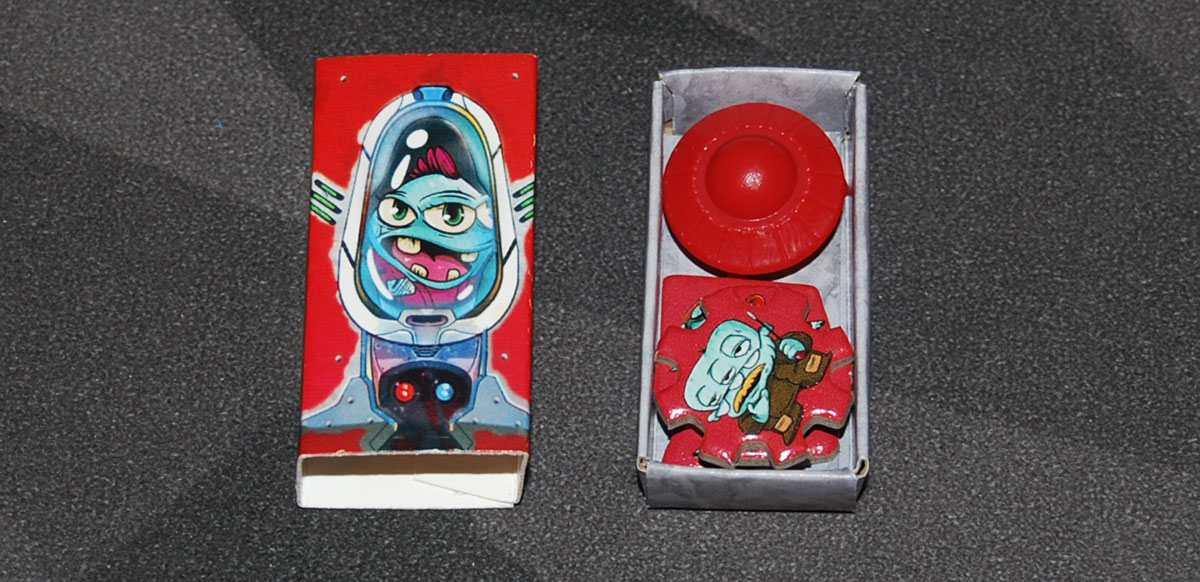
The escape pods are tiny little boxes, kind of like matchboxes but narrower, and each one holds the saucer and crew for a single player. The crew tokens are small cardboard tiles in different shapes; I like that every alien has a unique illustration, and even the illustrations on the outside of the escape pod differ from one player to another. It’s a small detail that doesn’t affect gameplay, but does give just a little bit more personality to the game. The flying saucers are small plastic UFOs with landing gear.

The saucer mats are cards, octagonal with a little cutout on one edge, and it has shaped spaces for the four crew members, as well as a space to stack boost discs and another space for 2 energy cubes.
The illustrations on the boards and movement cards aren’t particularly exciting—the ground is mostly a barren desert area presumably meant to evoke Area 51—but they get the job done. The pertinent information here (movement number, direction icon, and bonus earned) is easy to read. The upgrade cards, though, all have unique illustrations tied to the powers, which is fun.

The whole thing comes in a small box with a slipcase, much like other titles from Pull the Pin Games like Good Cop Bad Cop or The Zorro Dice Game. I like that the box has some little illustrations printed in the bottom to show you where things go (in the absence of an insert), but there are some things that just get piled on top that aren’t pictured.
How to Play Crash & Grab
You can download a copy of the rulebook here.
The Goal
The goal of the game is to be the first to grab one of each crew type so you can escape Earth.

Setup
Set up the board according to the player count and set the direction marker cards along each edge. Make a supply of energy cubes, booster discs, and upgrade cards. (Override tokens are used in a 5- or 6-player game.) Everyone gets 1 energy.
Everyone chooses a player color and takes their components. Organize all the crewmembers near the board by color and type. The pilots should be first available row, but the others can be in any order.
The player who most recently had something stolen from them is the first player and takes the probe. Everyone rolls the placement die to place their saucer on the board. (Any time you roll to place anything, if the space is already occupied, keep adding 1 to the number until you reach an empty space.) Finally, everyone except the first player and last player will place their pilot on the board by rolling the die, and the last player takes a booster disc.

Gameplay
Each round, players first plan their movement simultaneously. Choose one of your three movement cards and place it face-down in the notch on your saucer mat. The corner facing the notch should correspond to the direction you want to move, and the card determines how many spaces you will move. Then, the first player rolls the rotation die, which determines whether play will go clockwise or counterclockwise this round.
Then players take turns in order. When you move your saucer, you must move it in the direction you chose and move the exact number of spaces according to the card you chose. The three options are 2 spaces (and gain a booster), 3 spaces (and gain an energy), or 0–5 spaces of your choice.

However, there are things that can interrupt your movement. If you run into another saucer, you collide. Place your saucer on the space they originally occupied, and then move them (in the same direction) the full amount of your selected movement card. If you run into an accelerator space, stop movement, and then you may choose any direction and move your full movement amount again. (Note that if you get pushed into an accelerator by a collision, you have to continue moving in the same direction.)
After your movement, you may also spend a boost disc to move again—the number of spaces must be the same as what was already chosen, but you can move in any direction.
Any time you move onto or through a crew token, you may pick it up and put it on your saucer mat, regardless of color and even if you already have a crew member of that type.
If you ever move off the edge of the board, you crash and there’s a penalty. If you crash on your own turn, you must give up a crew member and give it to a player who has the fewest total crew. If you crash on somebody else’s turn, they get to steal a crew of their choice from you, or steal an energy from the supply. Note that your own color crew members cannot be lost or stolen!
At the end of the turn, you roll to place new crew members onto the board if any were picked up, so that there’s always the same number of available crew members at the start of each player’s turn (until they run out). The player gets to choose which color crew member to add, and spawns the next one available in that row.

Finally, you may spend 2 energy to upgrade your flying saucer. Draw 2 upgrade cards and choose one to keep, placing it face-up in front of you. Upgrades may have start of turn effects (triggered before you move), end of turn effects (triggered after spawning new crew members), or other uses. You may have any number of upgrades.
After everyone has taken a turn, spawn saucers if there are any that are still crashed, and then move the probe to the player who has the fewest total crew members. (If tied, give it to the tied player who went last in the round.)
Game End
The game ends when any player has all 4 crew types on their saucer. They immediately win the game (even if they fly off the edge of the board during this turn).
Why You Should Play Crash & Grab
Crash & Grab is a programmed movement game, and that typically means a bit of unpredictable chaos when the programs are revealed and everyone plays out their turns. What seems surprising at first is the fact that you’re only programming one move at a time, as opposed to several in a row—making it easier to predict what other players are going to do. The trick, though, is that the turn order could go in either direction, so you might know where the first player is going to end up, but the players sitting directly next to them won’t know if they’re going to be next in line or last in line.

Since anyone can grab any crew members that appear, you have a couple of decisions to make when you’re programming your movement. Do you assume that somebody will be able to snag that nearby crew member before your turn, and if so … can you crash into them to steal it? Or do you guess that you’ll reach a crew member first … but then how do you keep it safe? Also: you can grab any crew members, but you have an incentive to get your own because they can’t be lost or stolen. Figuring out how to use the accelerators and boosts to maneuver yourself across the board is important, but it can also be thrown off when somebody else veers into your path before your turn.
The movement cards are pretty simple: do you want to move 2 spaces, 3 spaces, or choose when it gets to your turn? Obviously the flexibility of the “0–5” card is really useful, but the 2 space and 3 space cards offer you something else: the chance to collect energy and boosts. Energy is used to buy upgrades—and you don’t want to miss out on those! There’s a wide variety of different powers, and each time you upgrade you choose from two options.
Not every power is useful in every situation, but I still like the way that it introduces a bit of asymmetry in the game, and when several players each have upgrades, things can get even more unpredictable. There are powers that let you move yourself or other saucers at the end of your turn, grab crew members from farther away, or even rotate an entire board tile. Some upgrades are triggered by specific events—when you crash, or when you pick up a crew member—and others are timing-based.

There is definitely a good bit of luck involved in the game. You can try to plan out your strategy, but with the randomized turn order, you’re never sure exactly how things might turn out. Generally I think getting energy cubes to upgrade is a good tactic, but I’ve also ended up choosing upgrades that I never ended up using. And the random spawning of both saucers and crew members means that players don’t always have equal opportunities. There was one game I played where one particular player just happened to be right near several crew member spawn points in a row, so he was able to scoop up several while everyone else was still trying to get into position. While that may not happen in every game, it’s always a possibility when the spawning is determined by a roll of a die.
In the 5- and 6-player games, there is a little bit of mitigation to make up for how much the board could change between the first and last players: the 5th and 6th player in the round (after the rotation die has been rolled) get override tokens, which means that they can choose what direction to fly when it’s their turn, so they still have to commit to which movement card they use, but they have a little bit of control in case things have gotten completely scrambled by their turns.
It is a pretty quick game overall, though, because even with the crashing and grabbing, there is always overall progress being made: any crew member that gets picked up stays picked up by somebody. Even though an individual player might lose a crew member here or there, the overall crew count can only go up, not down, which means the game keeps moving toward victory for somebody.
If you like games about trying to outmaneuver other players and guessing what they’re going to do, Crash & Grab may be worth checking out! I like that it can accommodate up to six players for maximum chaos without extending the game length too much. I will note that the 2-player game uses some variant rules, where each player is controlling two saucers; I think I prefer having more players with one saucer each myself. The UFO theme with the various aliens is pretty cute and pairs up nicely with the mechanics.
For more information or to make a pledge, visit the Crash & Grab Kickstarter page!
Click here to see all our tabletop game reviews.
 To subscribe to GeekDad’s tabletop gaming coverage, please copy this link and add it to your RSS reader.
Disclosure: GeekDad received a prototype of this game for review purposes.