

Today’s stack is some science fiction novels I’ve read lately. There are stories of robots and aliens and monsters, talking cats and talking plants, giant bugs and synthetic kids. Buckle up!
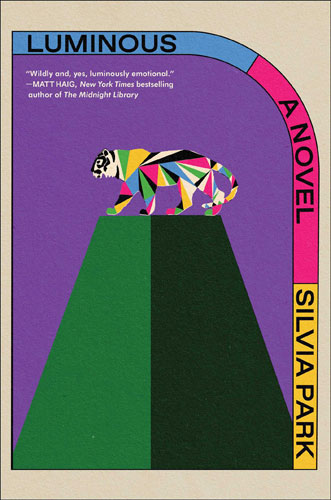
Luminous by Silvia Park
Set in the future in a unified (but still tense) Korea, Luminous pictures a world in which robots are a part of everyday life. Imagine Friends is one of the biggest producers of robots, which people buy as household workers, caretakers, nannies, or sometimes even as substitute children. Morgan is a prominent designer at Imagine Friends, and she is secretly dating a robot she created in the likeness of a celebrity actor. Her brother Jun works for the Robot Crimes Unit, though it’s a department that nobody really takes seriously because who cares if something happens to a robot anyway? You just buy another one. But his investigations into a missing child robot bring him back into contact with Morgan, stirring up long-held resentments between the two siblings.
At a school adjacent to a junkyard, a young girl named Ruijie who relies on robotic prosthetics searches for parts she could use, and meets a robot boy named Yoyo—but he’s unlike any of the models she’s encountered before. He seems alive in a way that other robots only pretend to be, and they soon become friends.
The story weaves together threads of all of these characters, along with the history of their country—deadly robots were used during the war that preceded unification, and the fear of these “angels” is still prominent. What does it mean to be human? To be alive? Jun is a war veteran, nearly killed in an explosion, and much of his body is now synthetic—in some ways he has more in common with robots than with humans. Ruijie’s body is failing and she knows that at some point the prosthetic legs will not be enough. Morgan has programmed her robot Steve to love her, but eventually tires of his attempts to follow his programming. What becomes of his purpose?
The world that Park envisions in Luminous is complex and tangled: advanced technology clearly does not solve all of humanity’s problems even though it makes some things easier. I was reminded a little bit of the TV series Sunny (on Apple TV+), which takes place in a Japan where domestic robots are commonplace. Suzie’s husband and son have died in a plane crash—or so she has been told—and she has been given a robot from the company where her husband worked. All sorts of strange new information comes to light, like the fact that her husband worked in robotics (when she thought he was in refrigeration), and the series also tackles some similar questions about whether robots can be alive or sentient.
I really liked Luminous—it’s a mix of a detective novel and a dysfunctional family story and something like E.T. with a kid befriending something like an alien, and it does it all really well.
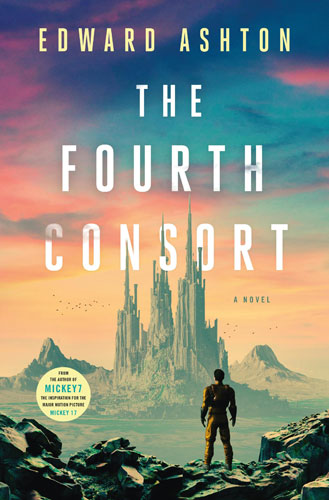
The Fourth Consort by Edward Ashton
Edward Ashton’s current claim to fame is as the author of Mickey7, which has been turned into the movie Mickey 17. (I guess the movie producers felt like 7 wasn’t exciting enough?) The Fourth Consort is its own thing, though, without (as far as I can tell) any ties to the Mickey7 world.
The Unity is made up of a vast number of species across the universe, making contact with sentient life and offering them promises of peace and progress. Since the time they showed up in our solar system, they’ve recruited a few humans to go on missions, and those who survived were paid extremely well, set for life. Dalton Greaves really has nothing to lose—his life sounds a bit like a country western song where he’s lost his job, lost his parents, and just got dumped by his girlfriend—so when he’s approached by Neera and offered a position as a diplomat for new contacts, he takes it. That’s how he ended up on the spaceship Good Tidings, with only his fellow human Neera and the giant alien snail Boreau for company.
When they arrive at a planet with mantis-like aliens called minarchs, they find they’ve been preceded by a contingent from the Assembly, a competing confederation that has some ugly things to say about how the Unity actually operates. Through a series of mishaps, Dalton and Neera find themselves stuck on the planet without support, along with Breaker, the “stickman” representative from the Assembly who has a very low opinion of humans. Neera quickly nopes out and hides out in the lander, leaving Dalton to win the minarchs over to the cause of the Unity … a cause that he’s increasingly unsure that he believes in.
Dalton’s struggles to figure out minarch society make for a comedy of errors: he’s constantly offending them in ways he doesn’t understand, or agreeing to things he shouldn’t have. There’s definitely some internal political intrigue happening, and the minarchs have used Dalton as a pawn. It also doesn’t help that the AI translator in his head doesn’t quite understand everything that the minarchs or Breaker say to him, and it gets pretty offended and snippy when he complains.
Dalton is a bit too perfect. Sure, when his story starts he seems like he’s a good-for-nothing, but when we get more about his background it’s like he’s a war hero and a genius and an all-around considerate guy, who always ends up doing the right thing even if it’s going to cost him. He’s basically the ideal human, and Neera turns out to be basically the worst of humanity by contrast—that just felt a little too convenient at times. Still, it’s a fun story—a lot of “how will he get out of this one?” moments, and some interesting observations about how humans stack up to these other alien species that are built for predation when we’re so soft and squishy.
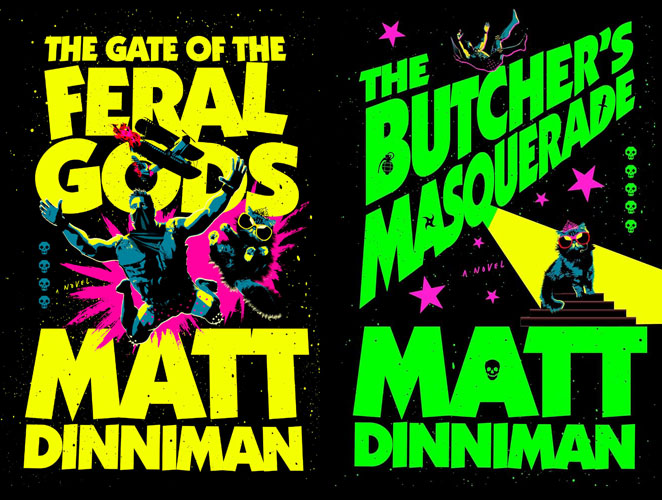
The Gate of the Feral Gods and The Butcher’s Masquerade by Matt Dinniman
Books Four and Five in the Dungeon Crawler Carl series, these two are hefty tomes, clocking in at about 600 and 700 pages respectively, but as with the others in the series (see here and here), they are fast-paced and make for pretty quick reading. If you’re new to the series, you should probably skip this section and just go back and read my previous comments about them, but it’s about a guy and his cat who get sucked into a real-life dungeon crawl when aliens show up to claim Earth. It’s very videogame-like (the crawlers all have user interfaces they can pull up with their minds), and is also a reality TV show that is watched by zillions of aliens all across the universe. So although much of the story has a sort of Dungeons & Dragons-esque fantasy setting, I think the larger story still qualifies as sci-fi.
The Gate of the Feral Gods is the fifth floor of the dungeon, and it consists of over a thousand bubble worlds in a vast grid, like a sheet of bubble wrap. Inside each enormous bubble there are four “quadrants” for the crawlers to overcome: air, land, sea, and tomb. Each quadrant has its own castle, and the crawlers can’t leave their own quadrant until they’ve beaten their castle. Once all four castles have been defeated, the bubble pops and they could, in theory, leave the bubble and go explore other bubbles—as long as they’ve been popped as well.
Since we’re following Carl and Princess Donut, most of the action in the book takes place in this particular bubble, which involves gnomes with a flying castle, a vast desert on top of a tall plateau with a couple of settlements run by camel people, and a pterodactyl-headed ghost. The problem is that the crawlers only have so much time to defeat their castles, but since they’re locked out of the other quadrants, they’re very limited in how they can help each other. A few of the familiar characters are in the bubble with Carl and Donut, but they soon discover that the tomb quadrant has some lower-level crawlers who really don’t know what they’re doing, and they’re dying quickly.
But, as before, there are lots of little hints about how to beat the level, and Carl is particularly good at figuring things out. Plus he’s got the anarchist’s cookbook from Book Three, a secret source of information that thus far he’s managed to keep hidden. That said, the corporation running the dungeon crawl is most interested in making money, which means viewers, which means spectacle. They aren’t above setting up the crawlers to unleash havoc on themselves—this time, in the form of that Gate of the Feral Gods, a device that is supposed to allow teleportation, but also summons a feral god—not so great when you’re trapped in a bubble. They know it’s something Carl can’t resist using, and the question is simply how much damage will result when he does.
The Butcher’s Masquerade is the sixth floor, and this is one in which various alien factions can join in on the crawl. They take on the role of hunters, and they’ve been able to start exploring the floor, leveling up, hunting mobs and setting traps, and a short time after all the crawlers arrive, the hunters will be set loose. It’s a way for factions to gather equipment and loot in preparation for the 9th floor, which will be a faction war.
But Carl’s been working on various plans from the previous floor, and he has lots of ideas on how to break things, which has resulted in lots of administrative consequences. Outside of the crawl, his actions have kicked off lawsuits among the various corporations and factions who have a stake in things. There are even secondary shows who run in tandem with the dungeon crawl, using NPCs to play out elaborate stories that often trigger their own quests within the game. It’s a lot to juggle.
The more serious parts of the books are those in which Carl is trying to fight back against the system, not just the various monsters in the dungeons. Crawlers aren’t considered real people by the corporations who run the show, by the factions who pay money to come hunt them for sport, for the viewers who clamor for more violence. Carl even ends up attending a con, getting zapped away to sign autographs and sit on a panel, and it’s a parody of our own comic-cons and celebrity culture. It’s a sharp critique of corporate culture and capitalism, and in the book it’s framed as humans vs. powerful aliens even though in reality a lot of what’s happening there is really inspired by what we humans do to each other.
As I said before, the big weakness here is that Carl and Donut have plot armor. As the books have progressed, we see how much Carl cares for Donut and what he would do to keep Donut alive—and yet at the same time I don’t really believe that Matt Dinniman is going to kill off either of them. Other characters, yes—don’t get too attached to anyone else, because the showrunners (and therefore Dinniman, by proxy) are very good at manipulating things to force Carl to make tough decisions all the time—what makes for good TV on the dungeon crawl is what makes for good drama in a book, too.
The extra content in each book, “Backstage at the Pineapple Cabaret,” has been very intriguing too, revealing little pieces of an ongoing story involving the NPCs of the dungeon world. They are preparing a floor for the crawlers, but there’s something weird going on. Some of the characters have become more self-aware, understanding their place in this larger realm outside of the dungeon crawl, and that’s definitely pointing to something huge happening in the future.

Semiosis by Sue Burke
My current read is Semiosis, another story that takes place on an alien planet. A small group of humans left Earth and its troubles behind, hoping to start a new community free of the strife they’d grown up with. Their new commonwealth is called Pax, and they found a lush planet full of flora and fauna to build their home. What they don’t expect is that on this planet, much older than Earth, it’s the plants that have attained sentience.
The book is told through the eyes of various characters from the different generations of the colony. The first chapter is by Octavo, one of the original settlers, who also happens to be a botanist, and he’s the one who first realizes that the vines growing on the edges of their settlement are adapting to their presence—and are also at war with each other. The next chapter jumps a few decades and is told from the point of view of Sylvia, a member of the second generation. Octavo and a few of his generation are still around, and some in the younger generation chafe at the way Pax is run. They have little say and their ideas are dismissed—but Sylvia has some big ideas about what Pax could be.
As we progress through the book, we eventually start to get portions of the story from the perspective of plants, too: understanding how it gathers information, the symbiotic relationships it has built with the insects and animals and other plants, and the way that it understands these new creatures who have appeared. The plant can adapt the fruit it produces, change the color of its leaves or flowers, and much more—and it sees the humans as just another creature that it needs to train to serve itself.
Each chapter, with its own narrator, has a different feel to it. One chapter begins with a murder mystery—but the woman investigating it is relying on old Earth texts, because there’s never been a murder on Pax before. It reminded me a little of the graphic novel Tectiv, set in a future LA when most people are illiterate and a young woman tries to become a detective patterned after some books she’s read.
I’m about halfway through Semiosis now and it’s utterly fascinating. A second book, Interference, was published in 2019, followed by Usurpation last fall, so I’m adding those to my list!
Disclosure: I received review copies of these titles. Affiliate links to Bookshop.org help support my writing and independent booksellers!

Jonathan H. Liu

Jonathan H. Liu is a stay-at-home dad in Portland, Oregon, who loves to read, is always up for a board game, and has a bit of a Kickstarter habit. I can be reached at jonathan at geekdad dot com.


