

This year’s GeekDad Game of the Year timeline was a little different, as I mentioned when we announced our 2024 Finalists, but the process is still the same. After a few months of juggling schedules (as it turns out, waiting until after the winter holidays does not automatically mean we have plenty of free time!), we finally got together for a weekend of gaming. This year it took place at my home in Portland, Oregon, where I was joined by Rob Huddleston, Paul Benson, and Alex Hart. We played through all ten of the finalists in record time, and I came away pretty pleased about this year’s batch of finalists. As always, we try to have a breadth of games so there is quite a mix: a quick filler game, a cooperative party game, some games that feel like puzzles, and a few bigger, more complex titles.
The game that got us all buzzing the most this year was Apiary, designed by Connie Vogelmann, illustrated by Kwanchai Moriya, and published by Stonemaier Games.
We’ll share our thoughts below on what we love about Apiary. You can also read my review here for a more detailed look at the game.

Jonathan H. Liu
Apiary is a game that just seems to click on every level: the gameplay is engaging, the artwork is top-notch, and the components are excellent, even down to the well-planned storage tray for the box. While it is one of the heavier games from our list this year, some of that weight is simply from the number of different things you can do, not that any given action is complex or difficult to grasp.
Although it is a competitive game, most of what you’re doing is building up your own hive, deciding what types of tiles to get and the best way to arrange them on your own mat. While it’s quite possible that somebody may take a tile that you’d hoped to get, there aren’t any direct attacks: your hive is your personal domain, and you can construct it however you like.
Connie Vogelmann took a common genre—worker placement—and introduced a small twist that really changes the nature of the game: any worker can be bumped out of the way so there’s no blocking, but if your bee gets bumped off the board, it returns to you at a higher strength. That means a couple things: first, that the game feels a little less confrontational overall. You never feel like you have no good choices on your turn simply because the spaces you wanted to use are occupied. Instead, it raises a new question: do you want to bump a rival’s worker and make it stronger for them?
Apiary is a great example of the way that a lot of simple actions can be more than the sum of their parts: the result is a game that has a lot of depth, and repeated plays will be rewarded with a better understanding of how all those little parts fit together.

Alex Hart
As someone who is constantly introducing games to new players, I’m always on the lookout for board games that appeal to an audience wider than the typical core gamer demographic, and Apiary, despite it being one of our more complex nominees, accomplishes that feat as well, if not better, than some of its other Stonemaier Games predecessors.
From a gameplay perspective, Apiary presents an accessible but challenging worker placement puzzle that feels like it values both timing and contrarian thinking equally. Sometimes, it makes the most sense to zig while others zag and gain advantages in a sector that other players are ignoring. And sometimes, it makes sense to grab a space that you know your neighbor is gunning for, just so they can bump you out and improve the value of your worker bee. Whichever you choose, the “bumping” mechanic makes sure that no action feels lost and that no interaction feels too spiteful – sure, there will always be moments when someone grabs the tile you were working towards for several turns, but with your newly-improved bees and a plethora of options, Apiary makes it easier than most worker placement games to pivot to a new target.
Another big selling point of Apiary for me was the theme. I’m the type of person who is constantly promoting games to others (I’ve even picked up a few shifts at my local game store so I could get paid to promote these games!) and I have found that games that have good elevator pitches make it to the table more often. Being able to condense your game into one sentence or less allows people to instantly wrap their heads around it and make a judgment call on whether it’s a game for them and I think Apiary has one of the simplest pitches of all: Space Bees! It’s amazing to me how many folks I’ve seen have a visceral response to that specific phrase and it almost always gets people wanting to know more. Ultimately, I think this is the goal of board game theming and Apiary does a wonderful job of balancing that fine line between a pasted-on theme and something that feels gimmicky.
Apiary is a blast: it’s challenging, it’s puzzly, your decisions feel like they really have weight to them, and just like any good worker placement game, you can never do everything you originally set out to do. Despite it being overshadowed by some of the more flashy Stonemaier titles in recent memory, I think Apiary, with its wonderful mix of theme, strategy, and gameplay, deserves its place alongside Wingspan and Scythe in the Stonemaier Games pantheon. But regardless of how you rank it against the classics, one thing’s for certain: Apiary absolutely deserves to take home 2024’s GeekDad Game of the Year!
Paul Benson
Bees… in… spaaaaace!
Yes, that’s right. Apiary grabs you right at the get go with a surprising theme that’s, let’s face it, quite intriguing. And one that plays out quite nicely using worker placement! The designer, Connie Vogelmann, could have chosen to make it a game about terrestrial bees instead of extraterrestrial, and mechanically the game would still work the same. For your exploration area on the board, you’d just be visiting different neighborhood yards instead of planets. But somehow, making them space bees just makes the game so much more attractive for the average player!
Speaking of attractive, that Kwanchai Moriya artwork is absolutely gorgeous. It adds to the atmosphere of the game, without distracting from the graphic design. It’s easy to see all the different spaces on the board, and read the symbols to know what actions you can take. There’s a lot of player agency in Apiary, but you don’t get overwhelmed or confused when you look at the board, even if this is your first time playing.
I know I’m certainly not the first person to say this, but one of the best things that Apiary brings to the table is the mechanic where you can upgrade the strength of your workers. As opposed to most worker placement games, with Apiary none of the spaces are ever blocked. Instead, you can bump another player’s worker (or even your own) either into an adjacent second space, or off the board completely. When they’re knocked out of a space, the worker bee grows in strength, which you indicate by simply rotating your bee to the next highest number, as you can see in the photo below. Some of the worker spaces either give you bonuses if you have a level 4 bee, or even require your workers to be level 4, so this is a strategy that you’ll want to pursue.
Once a level 4 bee is bumped, it goes into “hibernation” and removed from the game, and you take a spot in the Hibernation Comb. The hibernation spaces give you one-time bonuses, and may even give you extra points at the end of the game. The worker bee mechanic gives a nice additional puzzle for Apiary, as you’re not just focusing on your objectives while building the hive, but managing your workers’ strengths and deciding when to grow new workers to replace the ones that have hibernated.
This marriage of theme, artwork, and mechanics makes Apiary a truly engaging and satisfying experience. It’s a game with a lot going on, but it’s not difficult to teach and learn. But I should point out the one flaw that I found in the game. At our Game of the Year playthroughs, Jonathan pointed out to us that bees breathe through their abdomen, not their heads. That means that the helmet on the bee on the box cover art should really be on its body. But I’m guessing most of you reading this didn’t know that factoid (I certainly didn’t) so I applaud artist Kwanchai Moriya for putting that helmet right where most people think it belongs!

Rob Huddleston
Jonathan first introduced me to Apiary when we got together to determine the 2023 Game of the Year and I immediately fell in love. I bought my own copy that weekend, and have played it a bunch since then. In fact, one of the regulars in my gaming group consistently asks to play “bees in space.”
I like the twist it puts on worker placement games–rather than having a space blocked by a previous player, you can “bump” them, but at a price: you’re increasing the value and utility of that opponent’s bee, making for an interesting strategic choice. And, there are plenty of times when you are trying to play your own bees so that they will get bumped by others.
I also appreciate that there are quite a few paths to victory, and that they can be largely shaped by your initial, random selection of your starting faction and hive mat. When we played in it last weekend, I got a board that awarded me a lot of Queen’s Favor, and so I adjusted my strategy, which normally doesn’t focus on that aspect of the game, to work towards collecting a lot of that. While hardly unique to Apiary, I do like games that both provide multiple paths to victory and give some kind of starting condition that should point a player to a particular path.
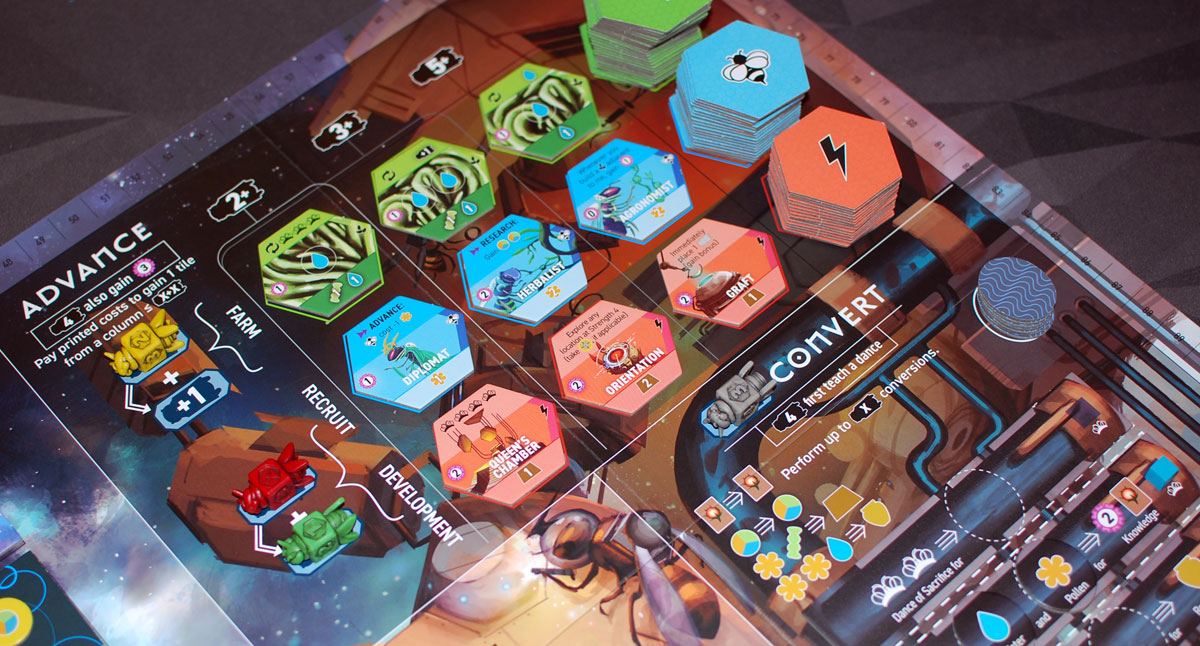
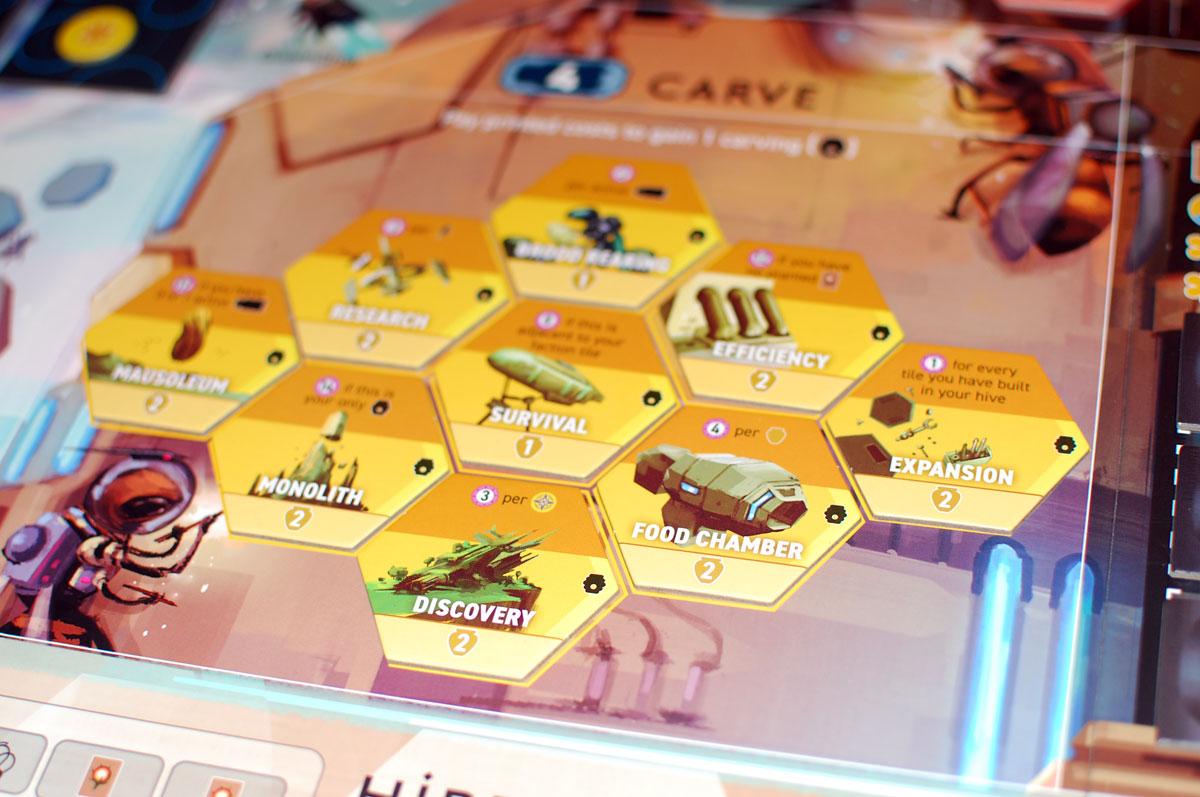
I also really like the look of the game. The design here is great. The plastic bees are cool. The Queen Bee mothership is a fantastic mini. And design of the boards and the tokens and all the rest are beautiful. It’s a really fun game to play that also has great table presence.
A well deserved win for a truly great game.
Once again, congrats to the Apiary team for creating our Game of the Year, and a round of applause for all of our other finalists for some excellent competition for the crown!


