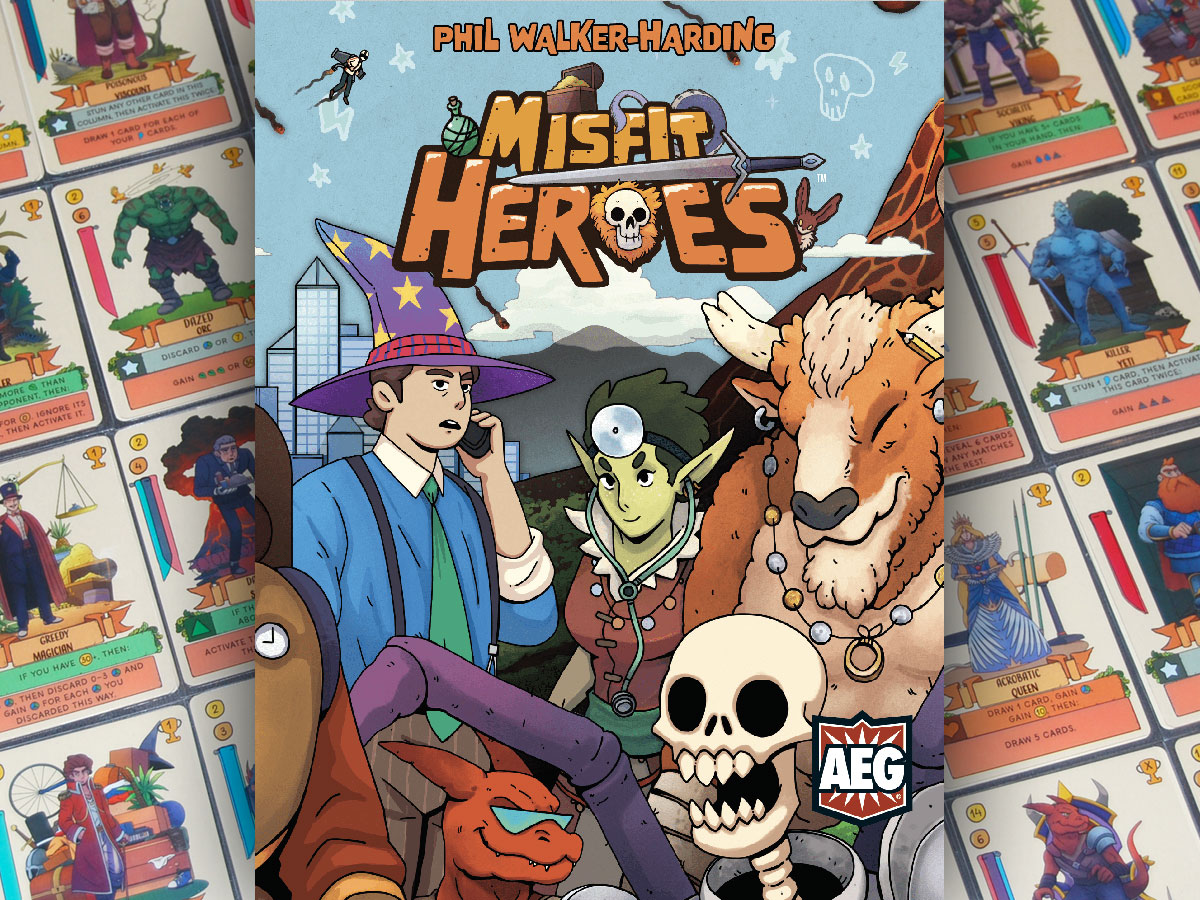
Build your crew of wacky heroes in the land of Absurdia, from the supermodel skeleton to the many-limbed stock broker.
What Is Misfit Heroes?
Misfit Heroes is a tableau-building game for 2 to 4 players, ages 10 and up, and takes about 30-45 minutes to play. It’s currently seeking funding on Kickstarter, with a pledge level of $40 for a copy of the game (or $80 for the deluxe edition). Some of the cards can be a little more complicated than others, but for the most part I think the 10 and up age rating seems about right, both for the gameplay and the content; the mix-and-match heroes are often silly and a little cartoony.
Misfit Heroes was designed by Phil Walker-Harding and published by AEG, with illustrations by Matthew Owen.
New to Kickstarter? Check out our crowdfunding primer.

Misfit Heroes Components
Note: My review is based on a prototype copy, so it is subject to change and may not reflect final component quality.
Here’s what comes in the box:
- 82 Character cards
- 82 Attribute cards
- 4 Reference cards
- 125 Card sleeves
- Influence tokens:
- 54 Single-influence tokens (18 each Forest, Sea, Mountains)
- 6 Triple-influence tokens (2 each Forest, Sea, Mountains)
- 24 Quest tiles (6 each Forest, Sea, Mountains, City)
- 70 Coins (38 copper, 16 silver, 16 gold)
- Start Player token
- Scorepad
The deluxe edition includes neoprene playmats, wooden influence tokens, and the Misfit Healers mini expansion with more characters and attributes, along with a larger box that can hold everything. The prototype did not include these, so my review will only cover the base game.
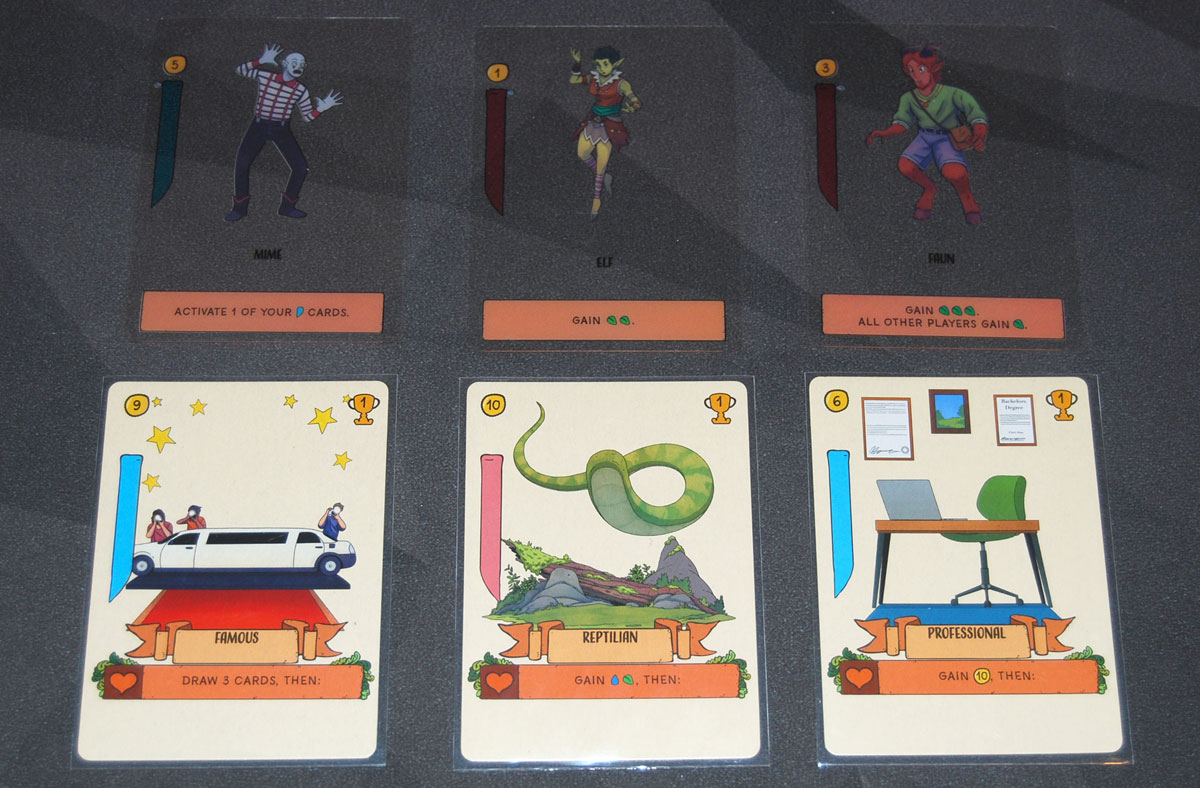
Misfit Heroes uses AEG’s Card Crafting System, where transparent cards are layered over other cards inside a sleeve to create different combinations. (Mystic Vale was one of the earlier titles in the series.) In this one, the character cards are transparent and include the character portrait, name, and an activation effect, along with potentially a coin cost and a faction banner. The attribute cards are opaque, with a background illustration for the character, the attribute name (like “scared” or “reptilian”), an activation box, and a point value trophy; these cards may also have a coin cost and banner. They’re layered together to create the titular misfit heroes, with 6,724 possible combinations. Often the attribute card has illustration parts that will combine with the character—extra arms, tails, wings, and so on.
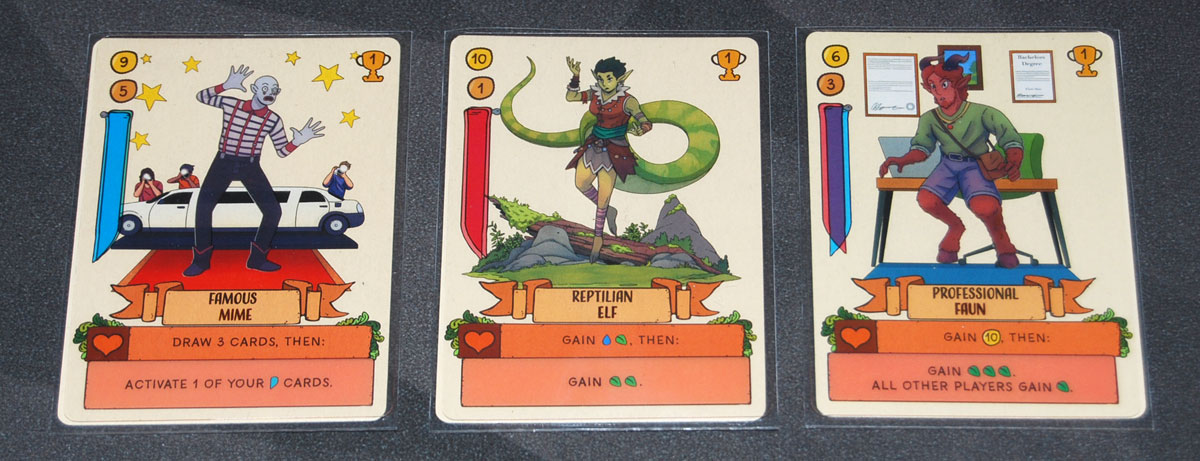
The sleeves are pretty sturdy, and you get a bunch of extras in case any of them come apart. Before the first game, you’ll need to mix up the cards and sleeve them all. (You may also need to peel off the plastic protective film on the transparent cards if you want the transparency to be a little more clear—for some reason the prototype’s film was harder to remove than what I’m used to from AEG’s other Card Crafting games, so I’m not sure if it was something specific to the prototype.)
One minor complaint about the cards is that the color on the transparent cards can be a little darker, which made the tiny influence icons a bit harder to read, particularly because the leaf and the water drop are both the same overall shape. Some of my players had a hard time making out these icons and recognizing the “any influence token” icon—it would be nice if they were just a bit larger in general. The other change I hope they make is the wording on some of the cards—the triangle cards are all phrased as “If X, then Y” which makes it sounds like you can play the card, but you only get Y if X is true. In fact, you can only play the card at all if X is true.
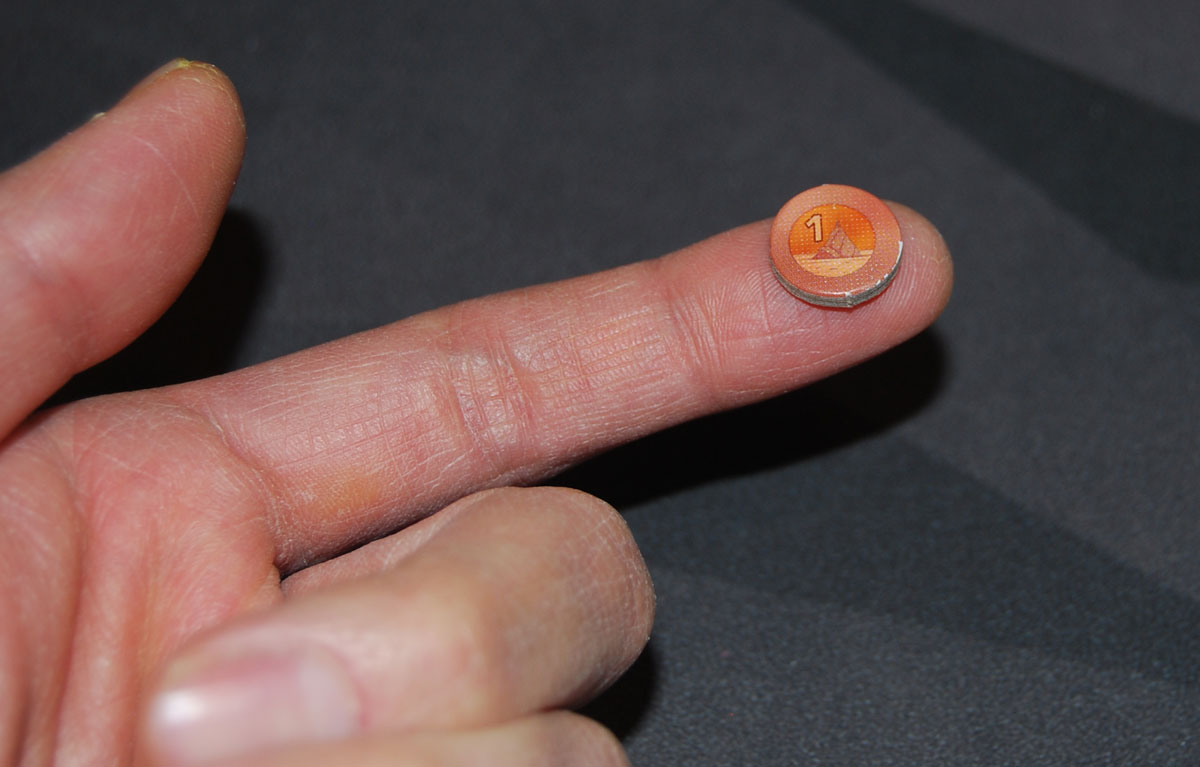
The coin tokens were pretty small in the prototype, particularly the copper coins. I’m not sure if they’ll make them any larger, but I had lobbied for more gold coins, since we’ve had games where we ran out and had to supplement with coins from other games. (Each player can have a maximum of 80 coins at the end of their turn, but the entire coin supply maxes out at 278—not enough for a 4-player game if everyone is hoarding wealth.)
How to Play Misfit Heroes
You can download a copy of the rulebook here.
The Goal
The goal of the game is to score the most points.

Setup
As an optional setup step, deal everyone 4 cards from the deck, and let them mix and match the characters and attributes for those cards, and then shuffle them back into the deck.
Deal 5 cards to each player, placing the rest of the deck within reach. Make a supply of influence tokens and coins. Place the quest tiles in a supply—depending on player count, some of will be removed.
Choose a starting player and give them the start player marker and 35 coins; each subsequent player gets 5 more coins than the previous player.
Gameplay
On your turn, you do one of four things: Recruit, Draw, Gain Influence, or Gain Money.
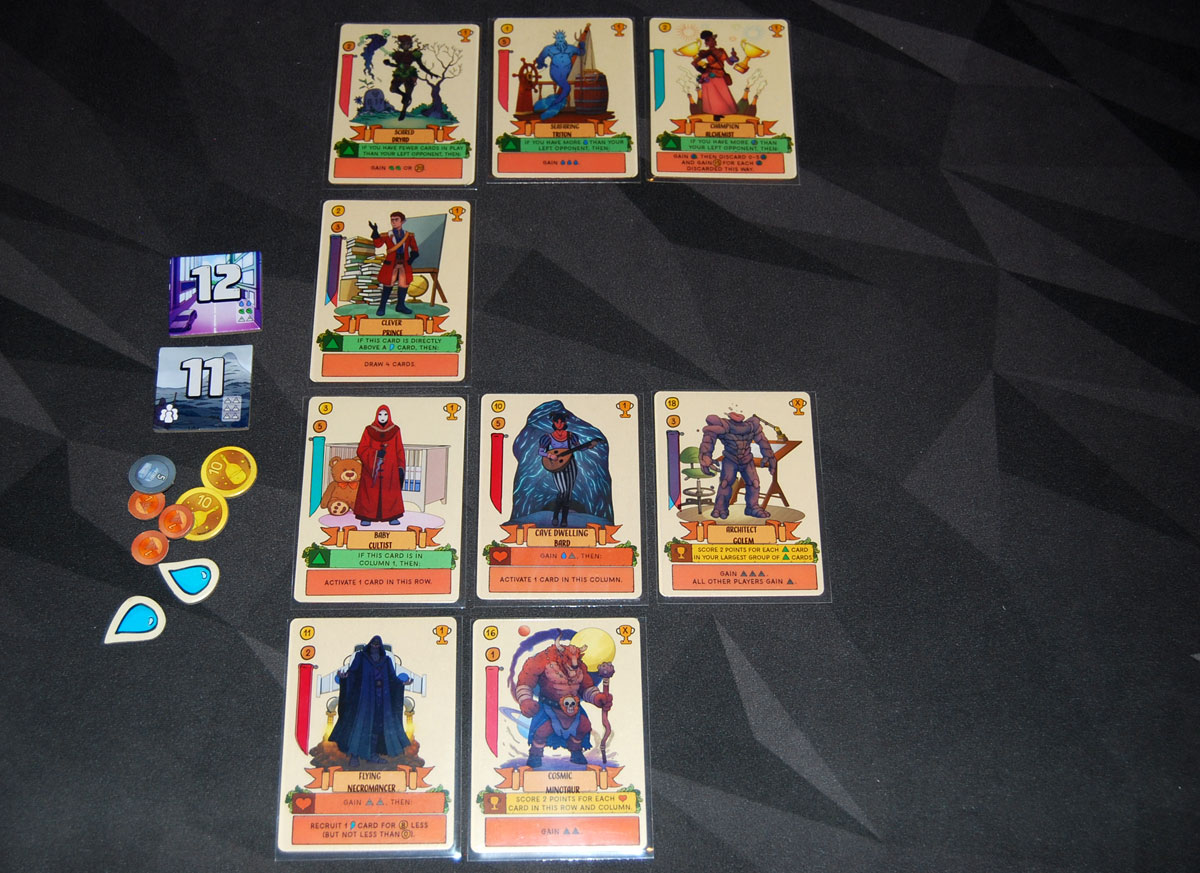
Recruit: Recruiting is how you play cards from your hand to your tableau, which is a 4×4 grid on the table. Every player has their own tableau, and the first card you play should be in the lower left-hand corner, which is considered the first column and first row, and later cards just need to be touching an existing card. To recruit a card, pay the coin cost shown at the top left corner of the card—if there are two costs, add them together.
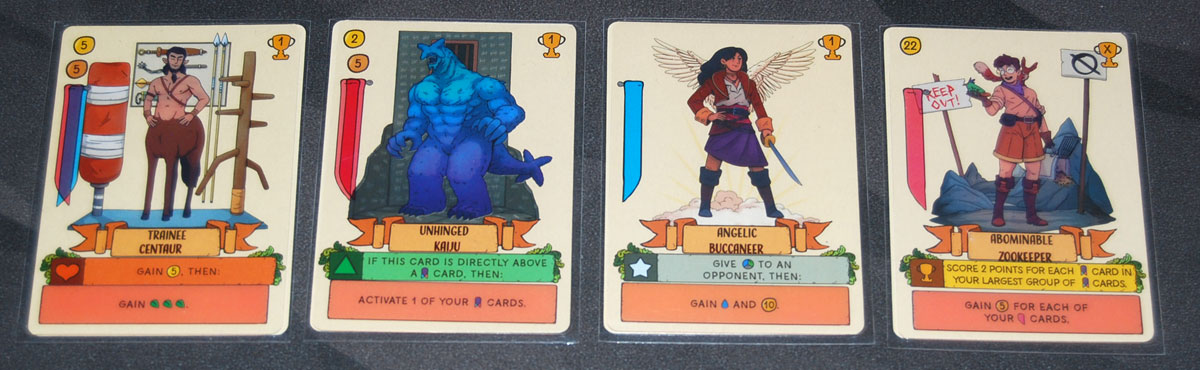
The first box below the name is the activation box, and there are four types:
- Heart: Triggers once when you recruit the card
- Triangle: A condition you must meet in order to recruit the card
- Star: A fee you must pay when you recruit the card
- Trophy: Includes a condition for end-game scoring
At the bottom of the card is the activation box—this is the card’s effect and takes place when you recruit the card. Some cards will also let you activate other cards—if so, it only triggers their activation boxes, not their recruitment boxes. Cards may let you gain influence or money, draw more cards, recruit more cards, and more. Some star cards will “stun” other cards, turning them face-down so they no longer count for anything.
Draw: You may discard any number of cards, and then draw that many cards plus two more.
Gain Influence: Take one influence token of your choice.
Gain Money: Take 10 coins from the bank.
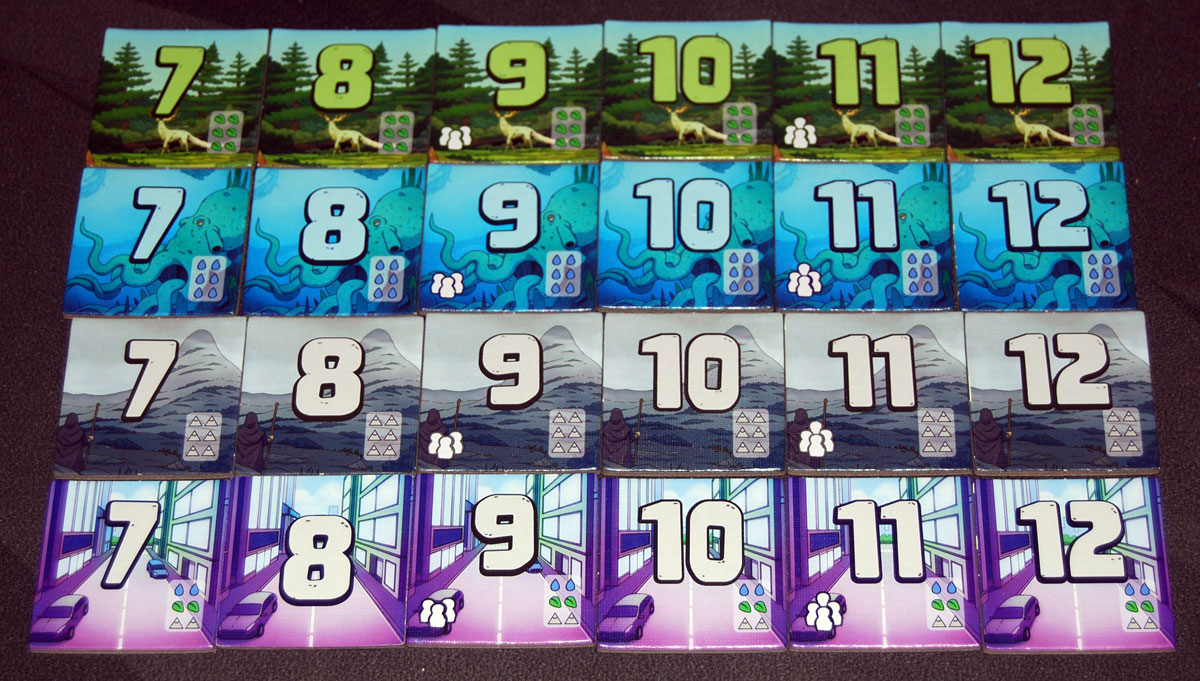
At the end of your turn, you may claim one quest tile. For the Forest, Sea, and Mountain quests, you must spend 6 influence of that type to take the highest available tile from the supply. For the purple City quests, you must spend 2 of each influence.
Finally, you must discard down to 8 cards, 8 influence of each type, and 80 coins.
Game End
The game end is triggered when any player recruits their 16th hero, filling the tableau. Finish the current round so everyone has had the same number of turns total.
You score points for the following:
- Face value of all of your quest tiles
- Face value of the hero cards in your tableau (non-trophy cards are 1 point; trophy cards have conditional scoring)
- 1 point per influence token
- 1 point per 10 coins
The highest score wins, with ties going to the player with the most cards left in hand.

Why You Should Play Misfit Heroes
Phil Walker-Harding has designed a lot of games that I’ve enjoyed (including Sushi Go! and the GeekDad Game of the Year Finalist Museum Suspects), and I was delighted to see his take on AEG’s Card Crafting System, which was created by John D. Clair and has so far been primarily used by Clair himself. In this case, the system lets players mix and match heroes in a way that reminds me of those little flip-tab books I had as a kid where you could combine different creatures or people, maybe putting a Viking head on a doctor torso with a mermaid tail. It’s a lot of fun to create silly combinations, particularly since there’s such a broad range of attributes and heroes: you get a lot of traditional fantasy characters or attributes, but also a lot of everyday, mundane things too.
What I hadn’t expected from the description is that you don’t mix and match cards during the game. When you first unpack the game, you’ll assemble your first 82 combos, and then each time you play you can give players an opportunity to re-scramble a handful of them, but the card crafting all takes place in between games rather than as part of the strategy. After playing it, I can see that it would probably lead to analysis paralysis if the heroes and attributes were in separate piles and you were building them as you played. Just a hand of 5 of each gives you 25 possible outcomes, which is already overwhelming, let alone doing that for a whole 16-card tableau. For a “10 and up” game, that’s probably too much.
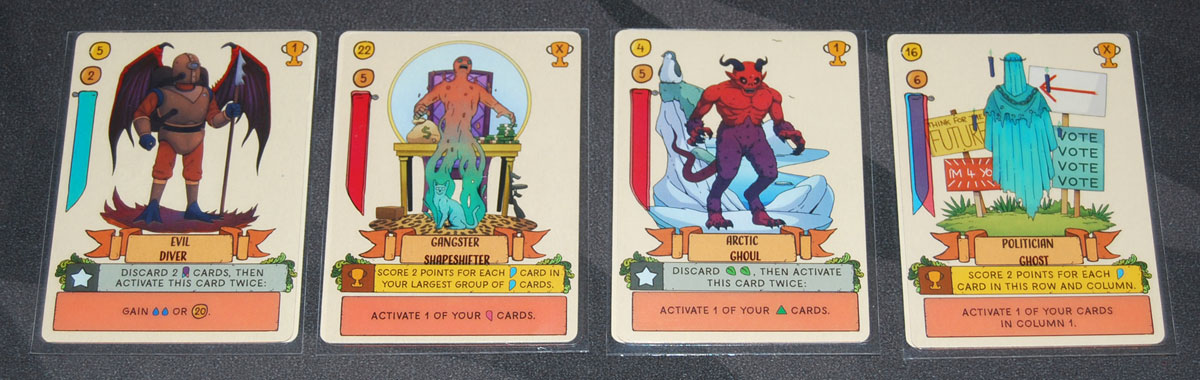
But just because you aren’t crafting cards during the game doesn’t mean it’s not a crafty game: Misfit Heroes is all about making the most of the weird heroes you’ve been dealt. There are all sorts of interesting combinations: cards that recruit other cards, cards that activate other cards, and cards that are worth points depending on how you arrange your other cards. There aren’t that many trophy cards, but they tend to score for things like “heart cards in the same row or column as this one” or “your biggest group of star cards.” There are also cards that refer to the faction banners on the left side of the card: blue for human, red for beast, purple for misfit. Once you get a sense of what types of trophies are out there, you can start to set up your tableau to prepare for them in case they show up.
Another tactic is to go for the influence tokens quickly: each influence token is worth a point, but you can exchange 6 of them for a quest, and the earlier you do it, the more points it will be worth. The first tile of each type is worth 12 points—that’s double the value! But you have to keep an eye on what your rivals are collecting, because sometimes waiting a single turn to get a quest could cost you a few points as other people snatch up exactly the ones you were saving up for.
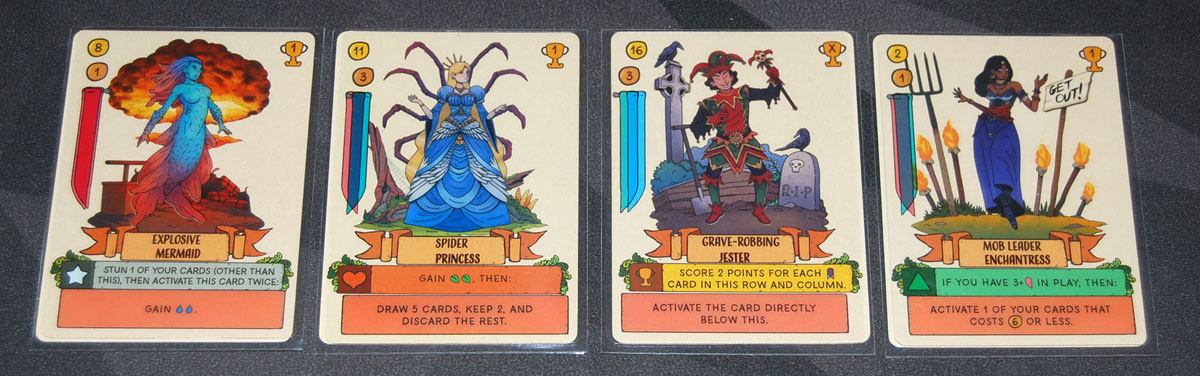
Filling up your tableau is what will end the game, but it’s not necessarily a guarantee that the person with the most cards will have the most points. I’ve played some games where the winner had the fewest heroes, but they had made good use of them to gain influence for quest tiles. The trophy cards can be worth a lot of points if you can get them placed right, but sometimes they’re barely worth more than the default 1-point cards (and usually cost more!).
I like the fact that there are different viable scoring strategies, but mostly I just like the wackiness of the heroes and figuring out how to make an effective team out of a band of misfits. (I highly recommend having your players announce the names of the heroes as they recruit them!) If you like card combos and games with a bit of humor, check out Misfit Heroes!
For more information or to make a pledge, visit the Misfit Heroes Kickstarter page!
Click here to see all our tabletop game reviews.
 To subscribe to GeekDad’s tabletop gaming coverage, please copy this link and add it to your RSS reader.
Disclosure: GeekDad received a prototype of this game for review purposes.