On a scale of 1 to 100 of things that make you happy, what would 37 be?
What Is ito?
ito is a cooperative party game for 2 to 10 players, ages 8 and up, and takes about 10 minutes to play (though that can vary based on player count and how much time you spend gabbing). It retails for $14.99 and is available in stores; Arcane Wonders is currently sold out but you can be notified when it’s back in stock. The version in this review is from Arcane Wonders, though there are previously published versions—this appears to take some of the rules of ito Rainbow from 2022, itself a variation from 2019’s ito.
ito was designed by Mitsuru Nakamura and published by Arclight Games with Arcane Wonders, with illustrations by Nadia Carrim.
ito Components
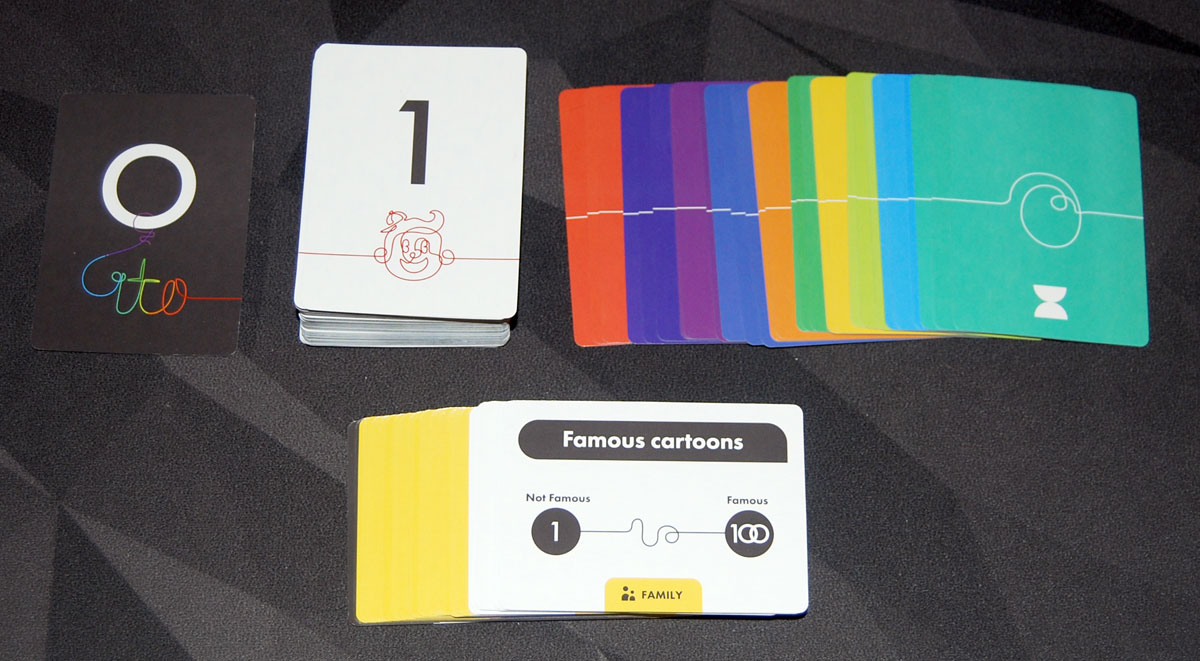
ito‘s components are pretty simple:
- Zero card
- 100 Number cards
- 50 Category cards
- 30 Player cards (3 per player)

The zero card has a 0 on one side, and on the other has “3 Promises of ito” to help set expectations: the main goal is for everyone to have fun, you can help other people think of ideas, and enjoy the different ways of thinking.

The number cards go from 1 to 100 and the cards are easy to read: a large number on a white background, with a little decoration at the bottom. The decorations are all one-line drawings that extend to both edges of the card, so that when you play all of the numbers in a line, it forms a continuous line across them, representing a connecting “thread,” one of the translations of the Japanese word “ito.”

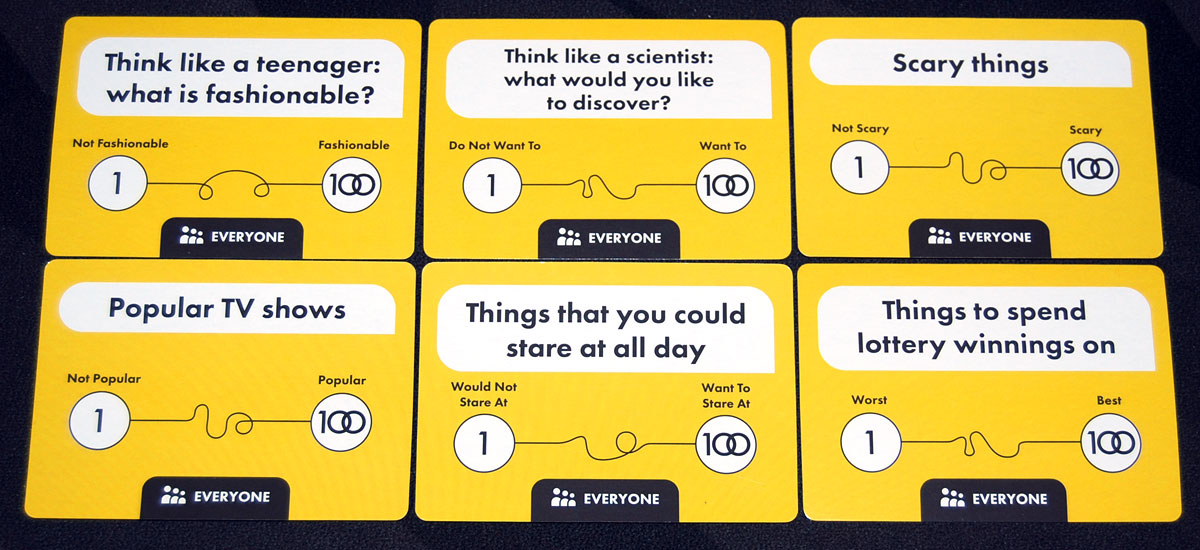
Category cards are double-sided and there’s a wide variety of topics. Some are simply phrased like “Popular ____” and others are more niche, like “Good things to say with a special move or attack.” Most of the cards are yellow “Everyone” cards, but there are about a dozen white cards that are marked as “Family” topics that are a little more geared toward kids (“Flavors of ice cream that would be tasty”), and then a handful of black “Action” cards with things like “Most ridiculous dance (act it out!)”

Player cards are mostly solid color cards with a little thread decoration; each color also has a unique icon at the bottom to assist with color identification, which is helpful because there are multiple shades of blue, green, and purple.
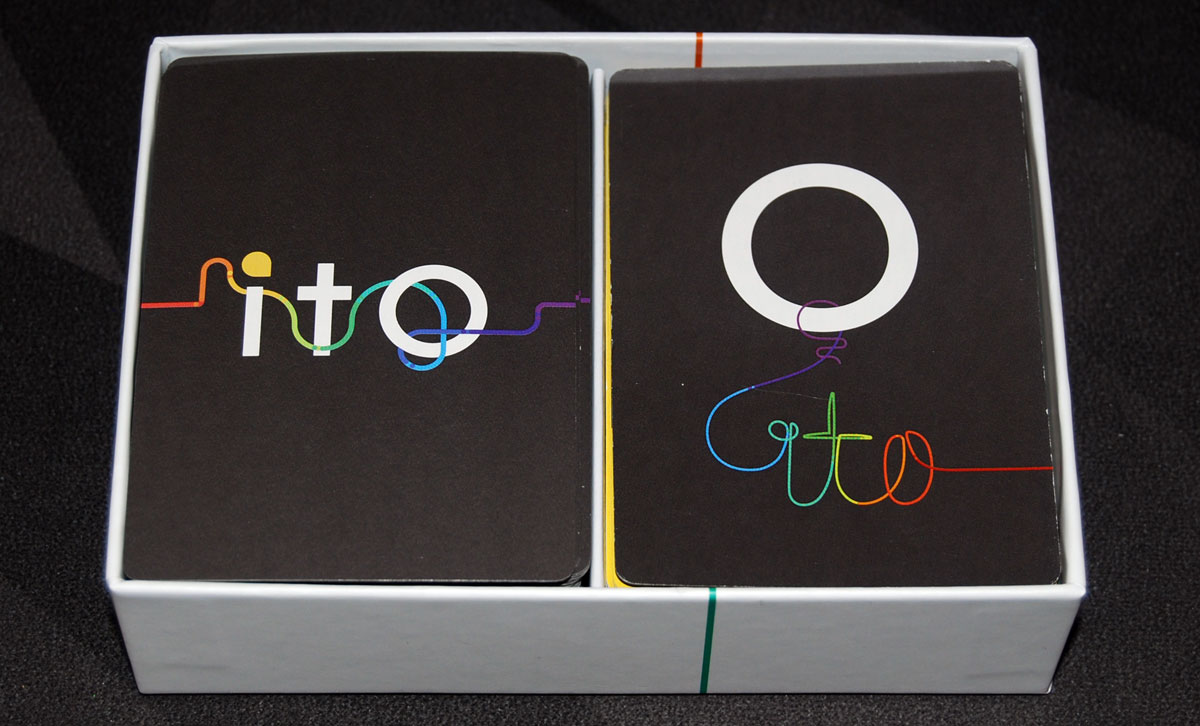
The whole thing comes in a very compact box, almost exactly the size of the cards stacked side by side.
How to Play ito
You can download a copy of the rule sheet here.
The Goal
The goal of the game is to play all of your number cards in the correct order, using descriptive clues based on the category.
Setup
Set the zero card in the center of the play area. Shuffle the category cards and draw one at random (or choose one as a group).
Shuffle the number cards and deal each player 1 card secretly. Give each player a set of player cards.
Gameplay
Each player should look at their number and compare it to the category, and come up with a clue that they think best fits their number. There is no turn order—you just play when you’re ready.

When you have a clue, you state your idea and place your card face-down on the table, with one of your player cards tucked underneath it so everyone can see whose cards are whose. Cards must be played directly next to other cards (including the zero) or can be inserted in the row, but you should not leave any gaps to indicate how far you think your number is from any existing cards. Your hint cannot contain numbers!
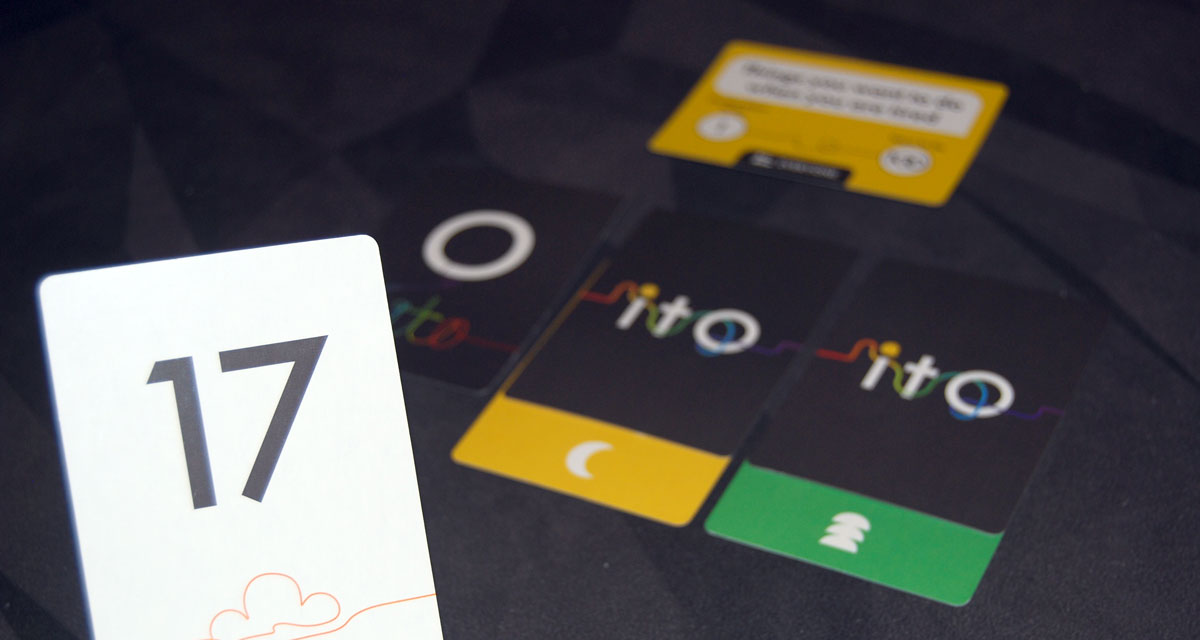
Players are free to discuss where they think cards should go based on the hints and can rearrange cards as long as everyone agrees.

Game End
Once everyone has placed their card into the line and everyone agrees with the order, reveal the cards one at a time starting from zero. If all the cards are in numerical order, you win!

In this example, it was pretty easy because we only had three numbers and they were all pretty far apart, but sometimes you’ll have multiple cards that are close together, and of course that’s more likely when you have more players.
Challenge Mode
For a bigger challenge, give one player 2 number cards instead of 1. If you win, add another number card the next round and play again. You win when everyone has 2 cards and you get all the cards in the right order.
(For a simpler variant, you can also just give everyone 2 number cards.)

ito is a 2025 GeekDad Game of the Year Finalist!
Why You Should Play ito
I received an advance copy of ito back in December, and it quickly became my most-played game for the month. Sure, it’s a very quick game, the sort where you’re likely to play a few times in a row, but it’s also a game that I was able to play with a very broad range of players, including the members of my family who aren’t normally as excited about games. My kids have been borrowing it to play with their friends, and it’s one that I’ve had just as much fun playing with my close friends as with strangers at a convention. I had more than one person from my gaming group who immediately wanted to buy a copy after playing it the first time—and then had to wait until January when it was actually released.
The idea of coming up with a clue that fits a number isn’t entirely new. Wavelength is perhaps the most similar to this: the clue-giver gets a category and a random target on a dial (basically a number from 1 to 100), and has to give their team a clue that helps them figure out the target. For the clue-giver, it’s an exercise in coming up with something that is 78% on the “sandwich/not a sandwich” spectrum, and for the guessers it is trying to figure out what number their clue-giver means when they say “Oreo cookie.” It’s a really fun game and leads to all sorts of wacky conversations, and the absolute thrill of hitting the target is amazing—but the one downside is that, as in many other clue-guessing games, there’s a good bit of downtime as everyone is waiting for the clue-giver to come up with something.
One of the things that makes ito shine is that everyone is simultaneously clue-giver and guesser. Everyone has a random number and is trying to come up with the clue, and everyone is also trying to figure out where their number is in relation to all of the other clues that have been given. Do I think Snickers or Twix are the more popular candy bar? What about Almond Joy—surely that’s lower, right?
The concept of ranking things is also not uncommon, and I feel like there’s been a slew of them just in the past year. Figment has you line up cards based on how much of a particular color is present; The Gang challenges the group to rank their poker hands; Mind Map challenges you to place random objects on a two-dimensional grid. And, of course, there’s the Timeline series of games where you’re trying to place events in chronological order (or other challenges like placing animals in size order). I think we just have this itch to categorize and rank things, whether it’s cooperative or competitive, and ito is one way to scratch that itch.
I mentioned earlier that one translation of “ito” is “thread.” The box mentions that another translation is “intention,” and that’s another important aspect of the game. It’s important to remember that you’re ranking the cards based on what each player meant rather than figuring out some sort of objective values. For instance, in one game the category was “superpowers you would like to have” and I had a 97. My clue was “the ability to pause time” because, frankly, that’s something that I always wish I could do. There was a lot of discussion about how that compared to other powers—but the goal is to figure out my number, not whether pausing time is objectively better or worse than flying or invisibility or anything else. There’s a lot of flexibility—you can revise your clues after hearing other people’s clues, and you can ask clarifying questions, too.
That’s important, because a lot of the categories are very subjective: what you consider scary or important or fun is going to be very different from someone else. If somebody says “spiders” for “Things that make you happy if you find them in your pocket or backpack,” you should probably check if they love spiders or hate spiders.
I’ve played ito with as few as 3 players and as many as 8 (I haven’t hit the full 10 players yet), and it has been a blast every time. Of course, it does get a bit harder when you have more people, so when we have fewer players we often play the challenge version or give everyone two numbers just to up the difficulty a bit. I like that it’s small enough that it’s easy to take with me, and it’s very easy to learn so you can get going quickly.
In the groups I’ve played with we’ve primarily used the yellow “Everyone” cards, though I have used some of the white “Family” cards with younger players. (So far we haven’t been brave enough to try the “Action” cards yet!) My groups have preferred the cards that are a little more descriptive or situational rather than the ones that are popularity scales, and there are enough that you can play several games in a row and change it up each time.
Although the publisher Arcane Wonders is currently sold out, ito should still be available in game stores and other online retailers. Just be sure to compare the cover image, or you’ll be getting a different version than what I’ve described here. The original 2019 Arclight Games edition rules are significantly different, but the 2022 ito Rainbow sounds like it’s pretty close.
If you’re looking for a game that’s a great conversation starter and can accommodate a wide range of player counts and player types, ito is a great option!
Click here to see all our tabletop game reviews.
 To subscribe to GeekDad’s tabletop gaming coverage, please copy this link and add it to your RSS reader.
Disclosure: GeekDad received a copy of this game for review purposes.