After a lean June, I was back in action this month, reading all but one book on my reading pile. (Prophet Song has been skipped over twice now. I must make time for it in August!). There are lots of great books to cover in my July 2024 Book Review Roundup, including one that I think will push for the title of my favorite book of the year come December.
The One Where the World is Ending.
Dystopian fiction is never far from my reading pile and July saw me read A Better World by Sarah Langan. This is published by Titan Books, in the UK, who kindly sent me a proof copy to review.
I enjoyed A Better World very much. Set in the near future, the Earth was on the edge of climate catastrophe. Brought back from the brink by the invention of “Omnium” – A biodegradable wonder substance that greatly reduced humanity’s reliance on plastic. The company that makes Omnium has a number of “Company towns” all over the world – the one in the story is set somewhere in the American Midwest. The Farmer-Bowen family has a rare opportunity to move into a company town.
In Plymouth Valley everything is perfect.
Except, of course, it isn’t.
The book is a “Stepford Wives meets Elon Musk gone mad,” story. The central mystery of the town, and exactly what goes on there was interesting, drawing the reader in, as the peculiar becomes the odd, the odd becomes the waving of giant red flags, and those red flags turn into something horribly, horribly disturbing. As an uneasy horror story, it works extremely well.
There’s an extra layer on top of that though that I found even more compelling.
The book examines our relationship with technology companies and perhaps more, the “tech bro.” A Better World marries very nicely with the musings of Cory Doctorow, a regular decrier of the “enshitification” process. Sarah Langan analyses how a combination of a lack of understanding from those on the outside and the Messiah complexes of those on the inside, mean that billion-dollar companies and their CEOs can largely carry out their actions unchecked. Omnium could, for example, stand in for AI.
More often than not, the benefits of a new technology are not what they first appear. Whilst the money rolls into the coffers of corporations, it’s the general public that suffers; particularly the disadvantaged who have no voice. “Money talks” is forever a truism. The genie has often left the bottle, long after we discover that the wish fulfillment had an edge that the darkest fairy tales would be proud of. (A depressing real-world example of how these things can play out, has materialized whilst I wrote this post.)
A Better World has an interesting structure. We can see from each section’s foreword, that we are looking back in time. The events in the book have happened, and future generations of academics are examining the impact and aftermath on the history of an evolving Earth. A Better World, then, is a dystopia, but one that leaves us with hope that things will one day be better.

A Children’s Novel That Is Too Good for Children
Of course, I don’t really believe that.
Movies Showing Nowhere by Yorik Goldwijk is an excellent novel, but much like Disney’s Coco, it feels wasted on the young. I read lots of children’s books, both to my kids and for review on GeekDad. Very few have the depth of Movies Showing Nowhere. It is a great children’s novel, but it is adult readers who will fully appreciate its devastating beauty.
The story follows 12-year-old Cate, whose mother died in childbirth. Her dad has been absent ever since. Physically present but emotionally unavailable. Her father’s housekeeper seems to hate her. Cate is a loner, she plows her own furrow and stands apart from her peers. When she meets Mrs Kano and discovers her unusual movie theater, Cate’s life will never be the same again.
Nominally, Movies Showing Nowhere is a time travel novel. The movie screen in Mrs Kano’s theater, allows you to step into a memory and interact with it. People can spend a few more minutes with loved ones or beloved pets. Cate in theory could return to meet her mother.
When she does finally use the theater she goes with Mrs Kano to an unknown past where she meets a curious boy called Tubs. He’s a loner like Cate – one who seems to “get” her without really trying.
The plot construction in Movies Showing Nowhere is artful, but it is the theme of lives not lived that makes this excellent novel shine. The end brought tears to my eyes. I can’t say too much more without giving spoilers, but take my word for it, this is a very special novel. One that examines acceptance, family, and grief, while delivering an entertaining story. Cate is a complicated but relatable character. The time travel motif is subtle and thought-provoking. Movies Showing Nowhere deserves to be read far and wide.
The Book Club Pick
There is a lot of debate about genre fiction and literary fiction. Most of it filled with snobbery. I read a lot of genre fiction with the odd slice of literary fiction thrown in and consider myself above such debates. Yet it is hard to argue that the writing Ann Patchett’s Tom Lake does not stand head and shoulders above most of the books I read.
The book is ostensibly about very little. During the pandemic lockdown, Lara tells her three daughters the story of the summer she spent as Emily in Thornton Wilder’s play Our Town. How she nearly became a Hollywood actress and dated a future Oscar winner. Now she lives with her husband on a Cherry farm in Michigan. She swapped a life of fame and fortune for a difficult parochial existence, working hard on a farm. Or did she?
Tom Lake is a marvelous book about paths not taken and about what constitutes happiness. It’s also a story about the face we show the world and the things we keep inside us. A slender book, coming in at just over 300 pages, yet there is so much in Tom Lake. It’s not my favorite book of Patchett’s – That is Bel Canto, which recently appeared on the much-discussed NY Times Best 100 books of the Century – but it has stayed with me since reading it.
I’ve never considered the Mid West as a tourist destination (living in the UK and rarely able to travel to the US, I have to pick carefully where I visit) but Patchett portrayed a beauty that makes me want to check it out. Tom Lake is a book about life’s journeys and the people we share it with. I had slightly conflicted thoughts about the book’s conclusion but overall I found it to be excellent. Sometimes literary fiction is just wonderful. 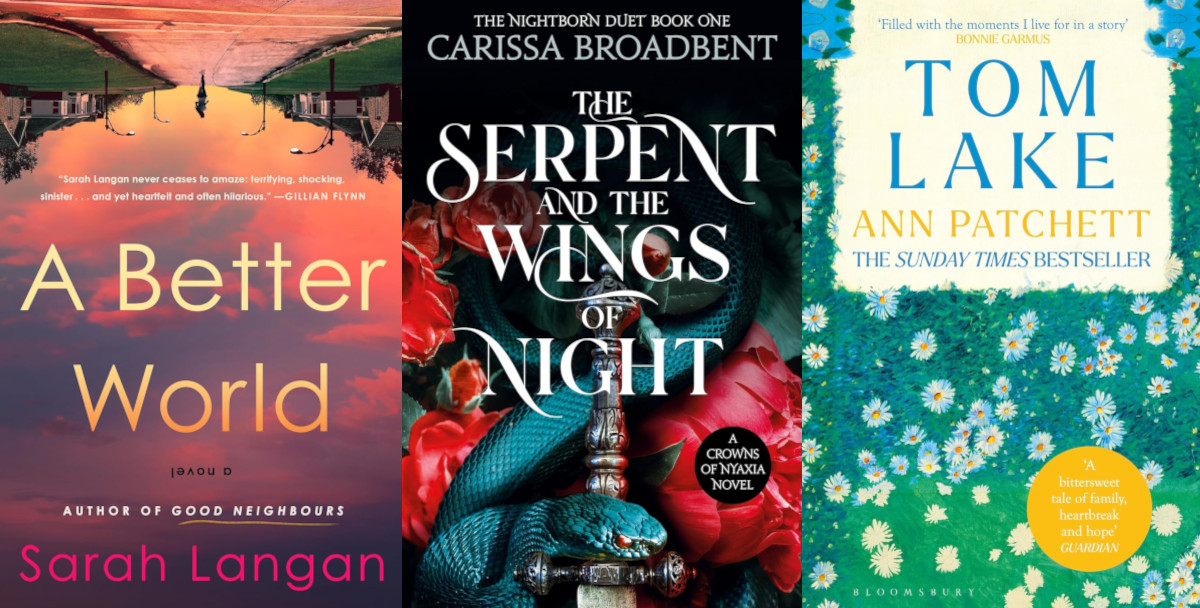
The One With Vampires
On the complete flipside of that is The Serpent and the Wings of Night by Carissa Broadbent. A vampire romantasy and June’s pick for Waterstone’s SFF book of the month. Fiction doesn’t become more “genre” than this!
This is the second romantasy novel I’ve read, after Fourth Wing (Another SFF book of the month) and I’m not going to lie the plots are very similar. Based on these two novels there is definitely a formula to these things.
In TSatWoN there’s a contest (which, as is often the way, seems like an ill-thought-out way to kill the brightest and the best), a plucky underdog (our narrator, Oraya – the titular “Serpent”), and a bad guy, who is extremely handsome, and not as bad as the press he receives might suggest.
Whilst the novel has some (many) predictable elements, I tore through it. Much like Fourth Wing, the finale of the book turns things on their head, and I’m left wondering where the story will go next. There is an interesting theme of autonomy and consent in the book, which considering the popularity of these types of books, demonstrates how power dynamics in relationships have improved in the last 30 or 40 years. Oraya is an interesting character. A (comparatively) powerless human in a world of Vampires. Vampires have long been used to explore sexual dynamics and TSatWoN is no exception.
The prose in TSatWoN is nothing like that of Tom Lake, the stories could not be further apart but both entertained me in entirely different ways. TSatWoN reminded me a little of reading Ken Follet’s Pillars of The Earth. A thick book that’s a breeze to read with a plot that demands to be devoured, as I race to find out what would happen.
The problem with reading all these SFF books of the month is that, more often than not, they’re the first books in a series. I want to know what is going to happen to Oraya in book two. The pile of books to read gets ever higher!
The One That Could Have Had Vampires but Didn’t.
Navola by Paolo Bacigalupi is steeped in medieval Italian history, despite being set in an entirely fictional world. It’s the story of Davico di Regulai, heir to a mercantile empire. This is a slow-burning novel that does require a bit of staying power to work your way through. Your efforts will be rewarded however as the book is artfully constructed and its denouement will leave you hanging out for more. The first in a series (I assume), you can read my full review of Navola, here.
The One With the Orisha’s
My final two reads of the month were children’s books from Usborne Books, both of which I reviewed in full. Ashley Thorpe’s The Boy to Beat the Gods is inspired by the Yoruba Pantheon. Kayode takes on the mantle of the gods as he tries to stop them from terrorizing his village. A story of trust and friendship from a bright new voice in children’s fiction. You’ll find my full review, here.
Jenny Pearson has a number of bestsellers under her belt and she’s sure to add another with Shipwrecked. A lighter-hearted reimagining of a Lord of the Flies scenario. Another book that examines friendships and inner confidence, much like Pearson’s other books, Shipwrecked is a comedic caper wrapped around an important central message. This one is about parental love, accepting who you are, and how to elevate your friends. My full Shipwrecked review, is here.
A solid month of reading in July then. Look out for my August picks soon!