You’re in charge of a magitech factory, enchanting gears with magical runes and seals. Vie for the favor of the noble houses of Sprocketforge as you complete orders to impress your customers.
What Is Sprocketforge?
Sprocketforge is an engine-building game for 1-5 players, ages 14 and up, and takes about 60-90 minutes to play. It’s currently seeking funding on Kickstarter, with a pledge level of $60 for a copy of the game.
Sprocketforge was designed by Ananda Guneratne and published by Sophisticated Cerberus Games, with illustrations by Tyler Edlin.
New to Kickstarter? Check out our crowdfunding primer.
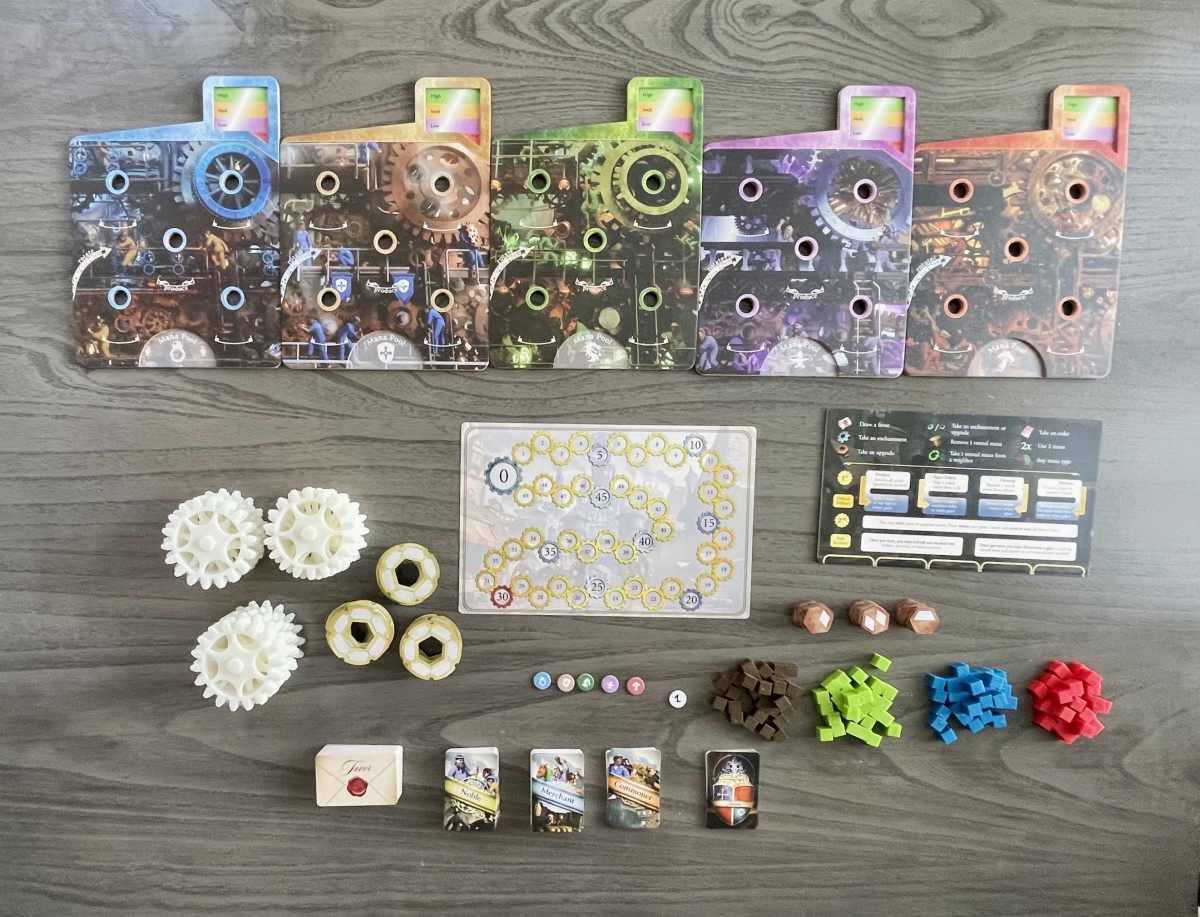
Sprocketforge Components
Note: My review is based on a prototype copy, so it is subject to change and may not reflect final component quality. Sophisticated Cerberus Games also plans several component upgrades as stretch goals.
Here’s what comes in the box:
- 5 Factory boards
- 30 Gears
- 5 Player aids
- 30 Enchantments
- 30 Upgrades
- 112 Order Cards
- 12 House cards
- 49 Favor cards
- 120 Mana cubes in 4 different colors
- Renown Tracker
- 5 Renown tokens
- First Player token
Kickstarter backers on the mailing list by the end of the campaign will also receive a free mini expansion. Additionally, there will be an included single-player mode with an automa deck.
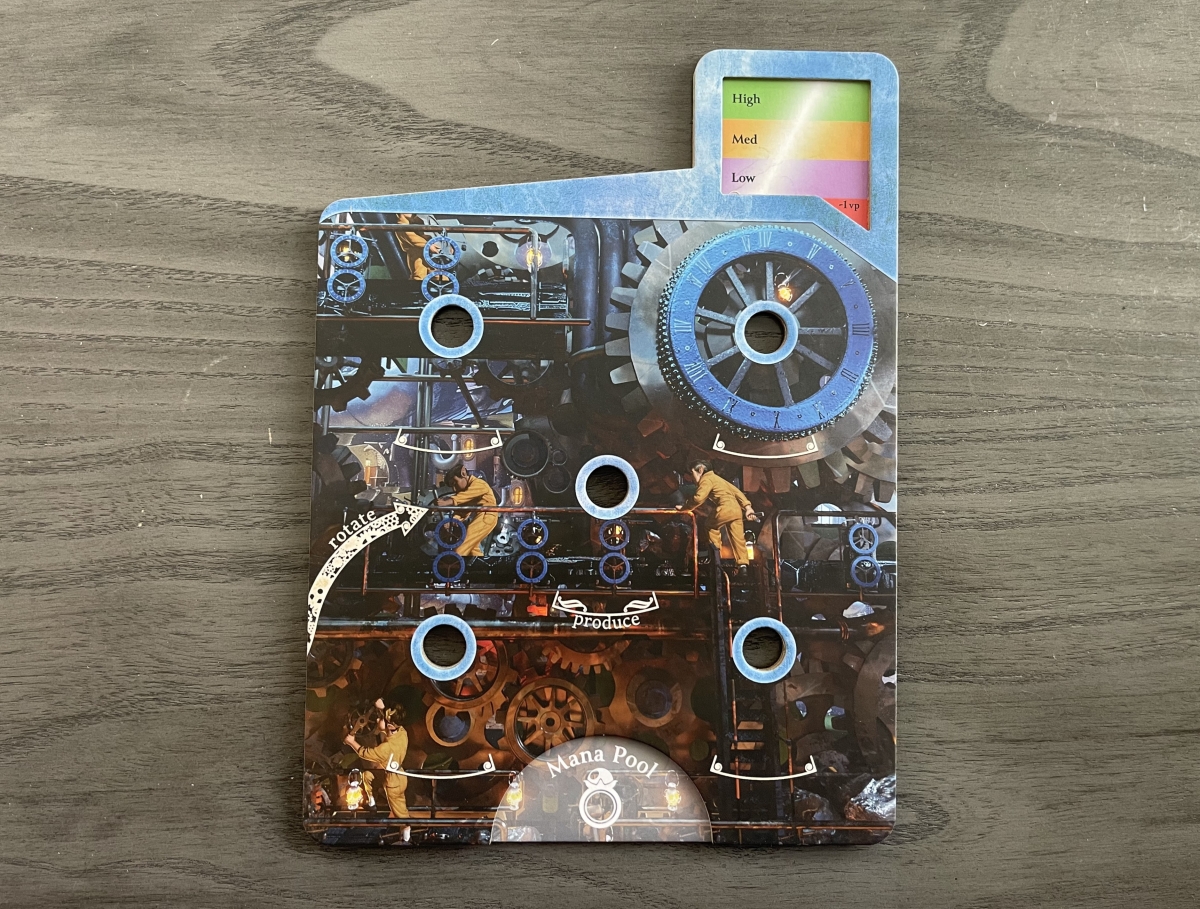
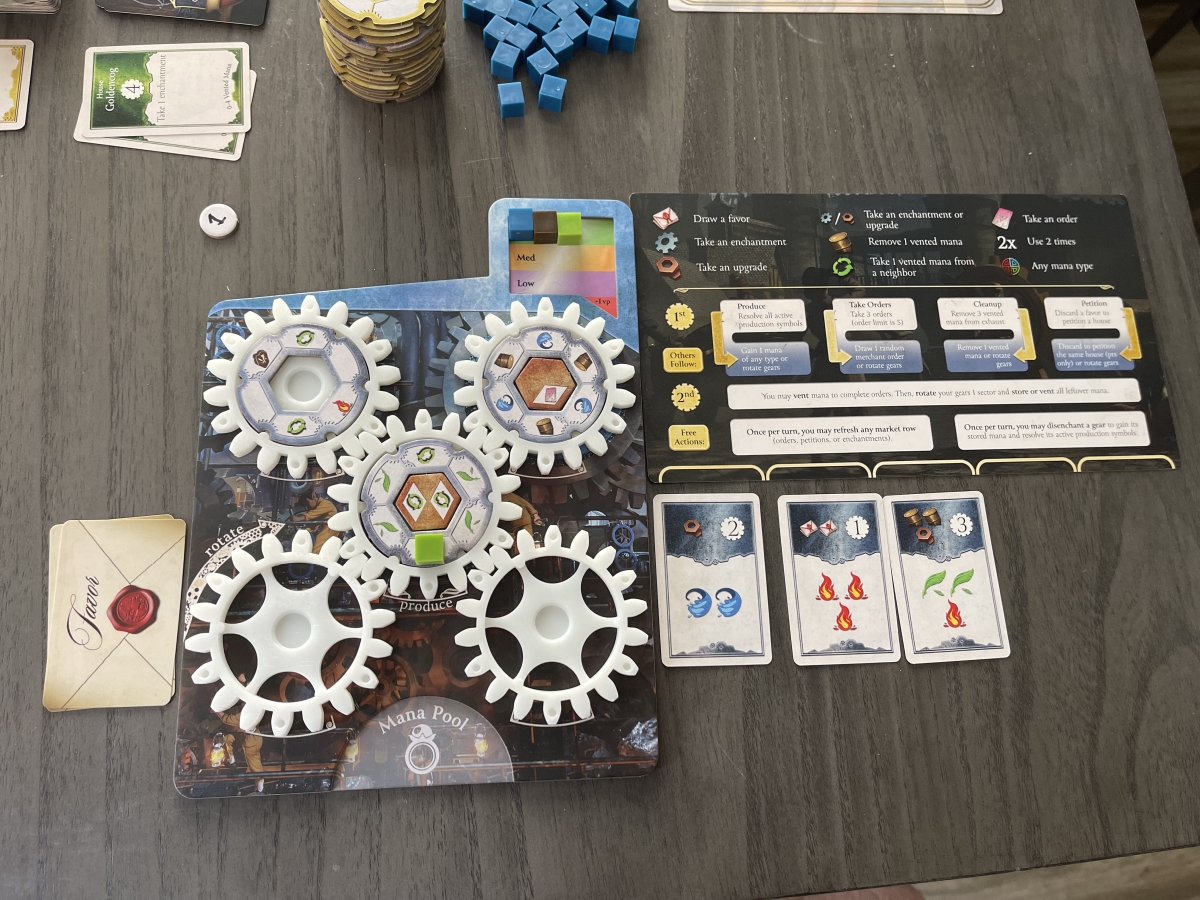
Each player has a dual-layered Factory board, which houses five of the gears which are fundamental to how the engine building proceeds in Sprocketforge. There is the Mana Pool, where Mana goes when it is produced, and up at the top right of the board is the Exhaust, where you place the “Vented” Mana that was used in fulfilling an order.
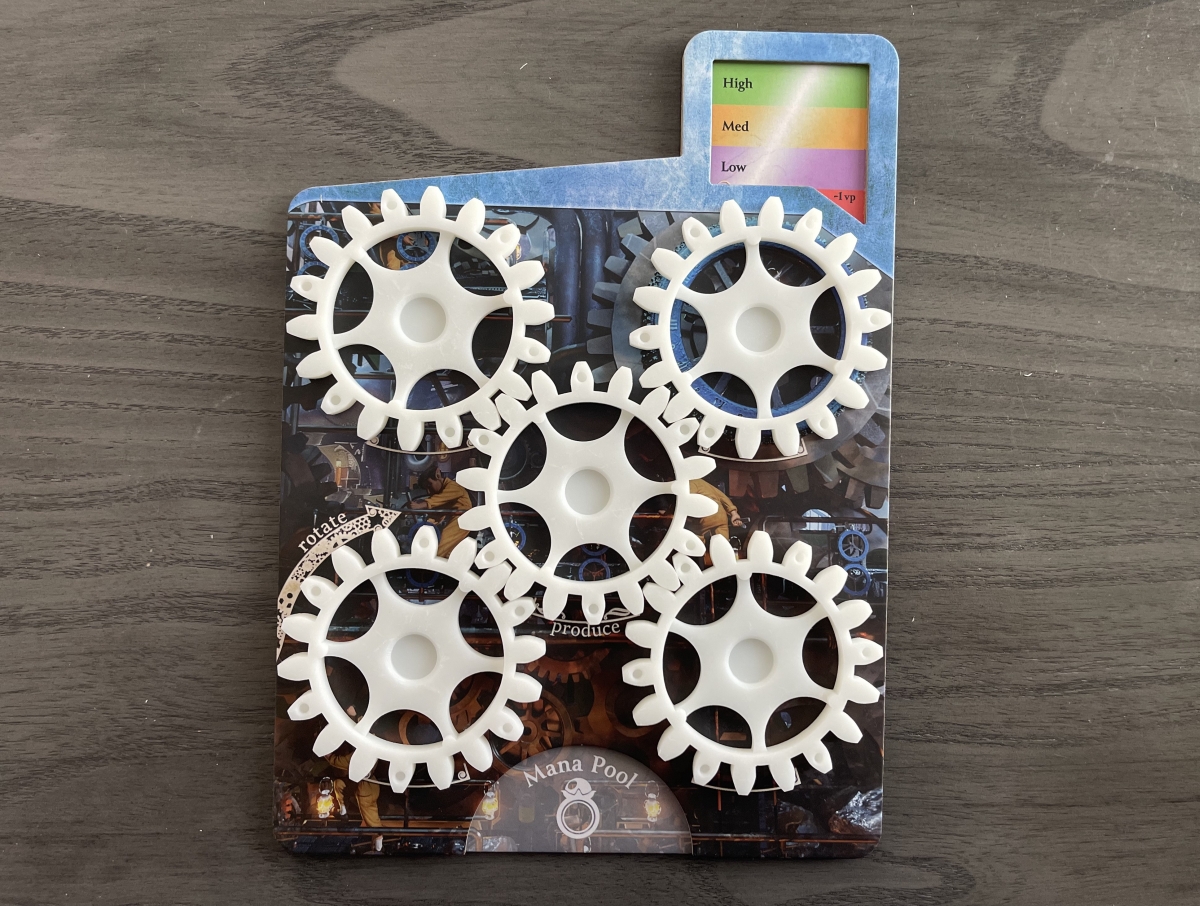
The gears have been engineered to mesh perfectly. Each one can hold an Enchantment, which is the primary way to generate resources in the game.
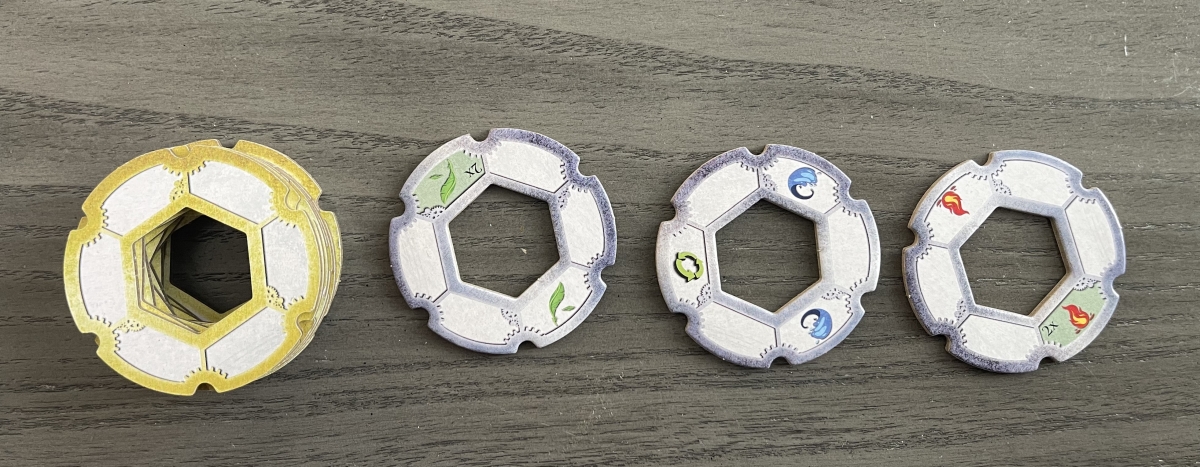
Furthermore, each of the Enchantments can receive an Upgrade. In my prototype copy, there are only three different Upgrades: The Order Upgrade allows you to take an order from the Market, The Transmute Upgrade allows you to take a Vented Mana from the Exhaust of an opponent, and the Trash Upgrade lets you remove one of the Vented Mana from your Exhaust.
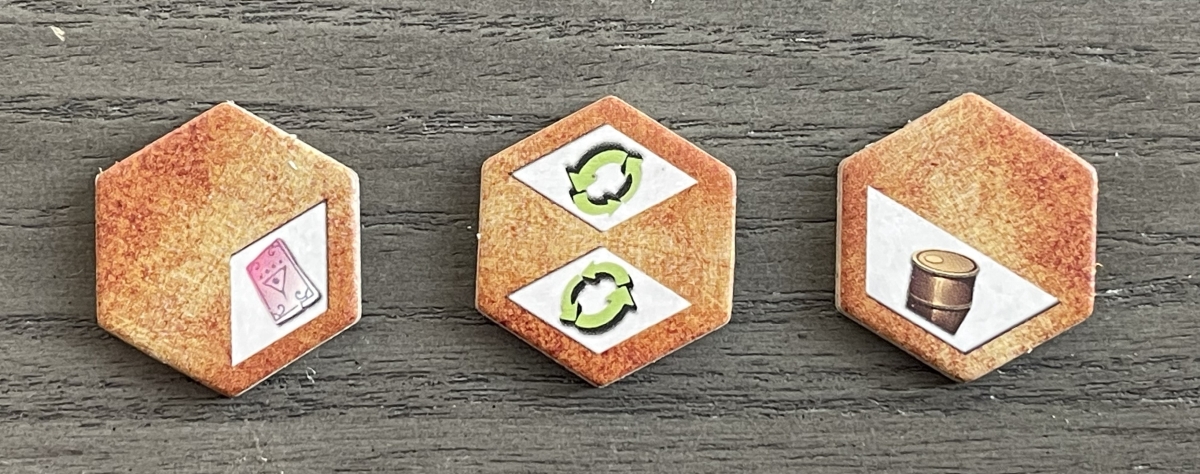
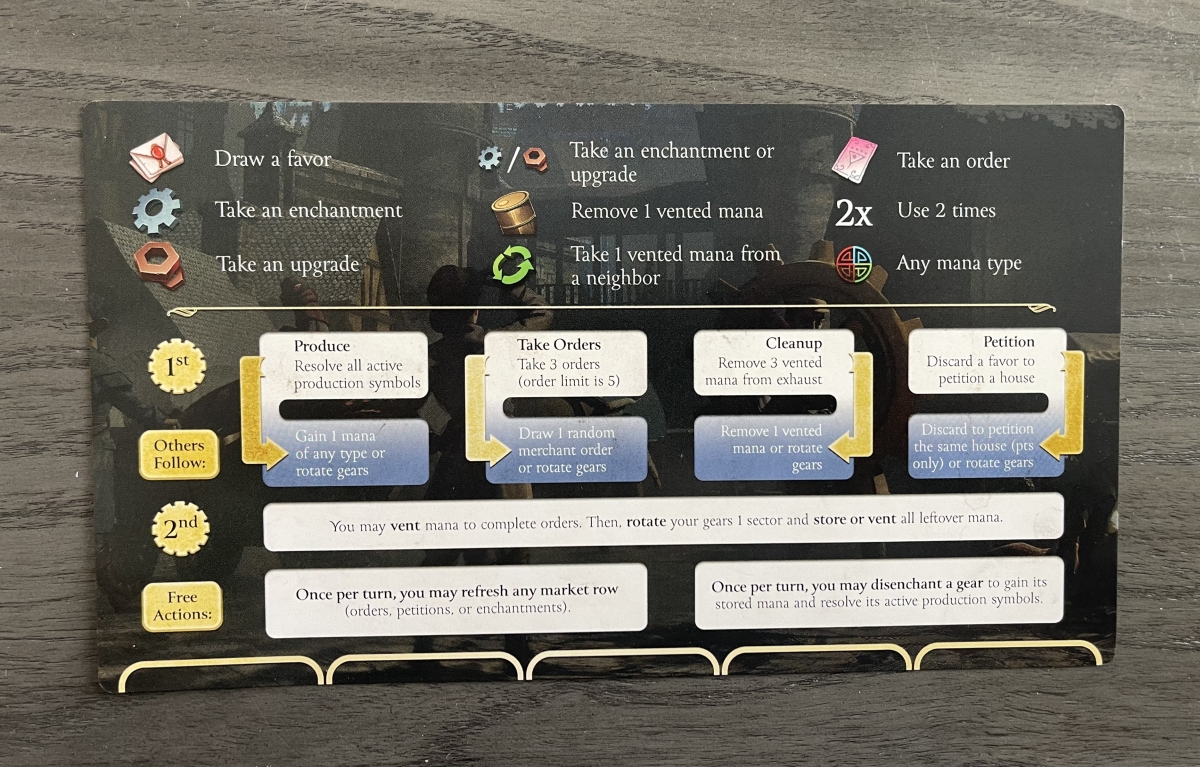
Besides the Factory board, players each get an oversized Player Aid board. Not only does this clearly outline the steps of play, but it also provides a spot for players to place their Order cards.
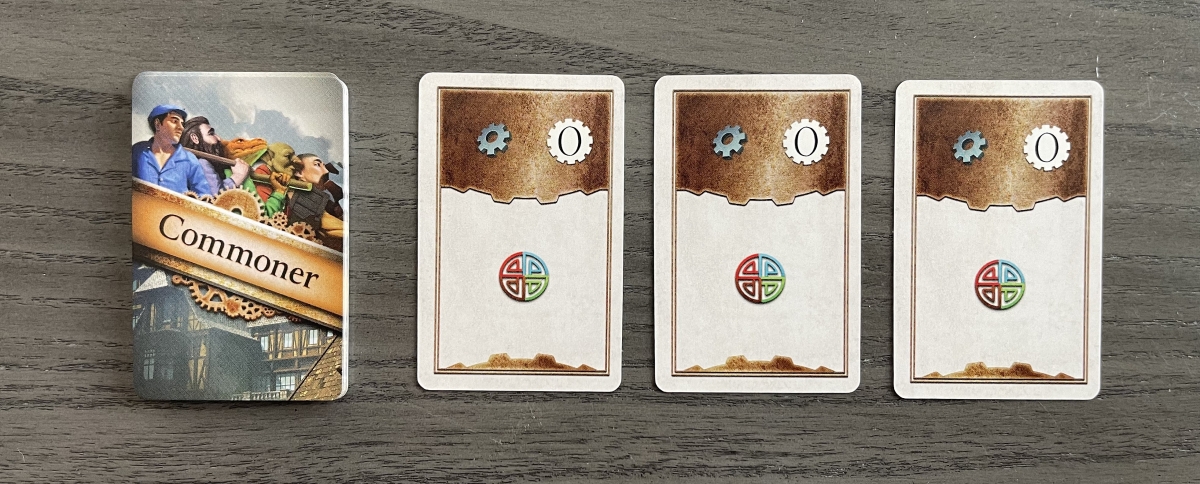
Fulfilling Orders is the primary way that you will earn Renown (points) in Sprocketforge, as well as giving players other valuable actions during the game. There are three decks of Order cards. The first is the Commoner Order cards. These are identical, and allow you to purchase an Enchantment by spending a Mana of any color.
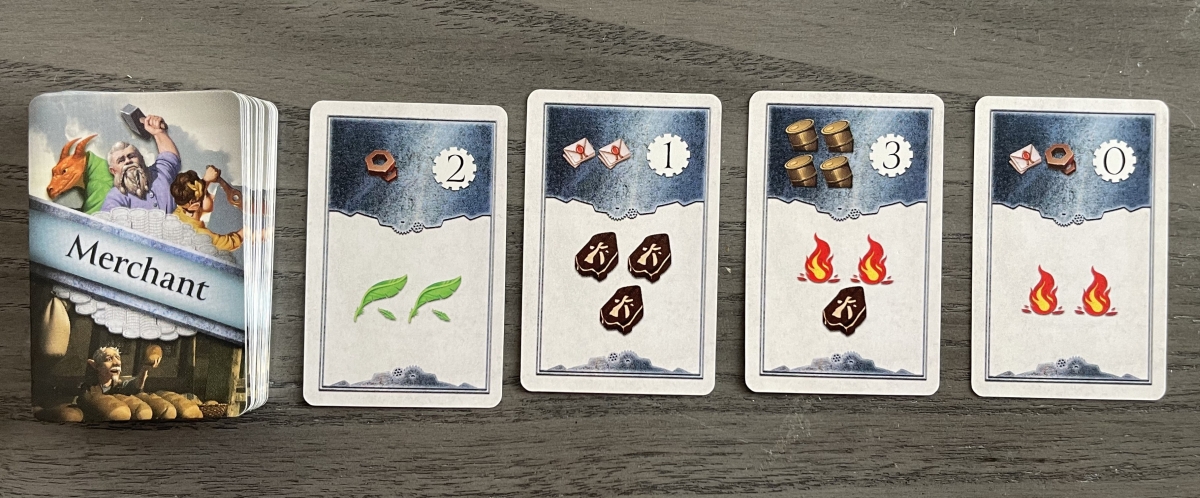
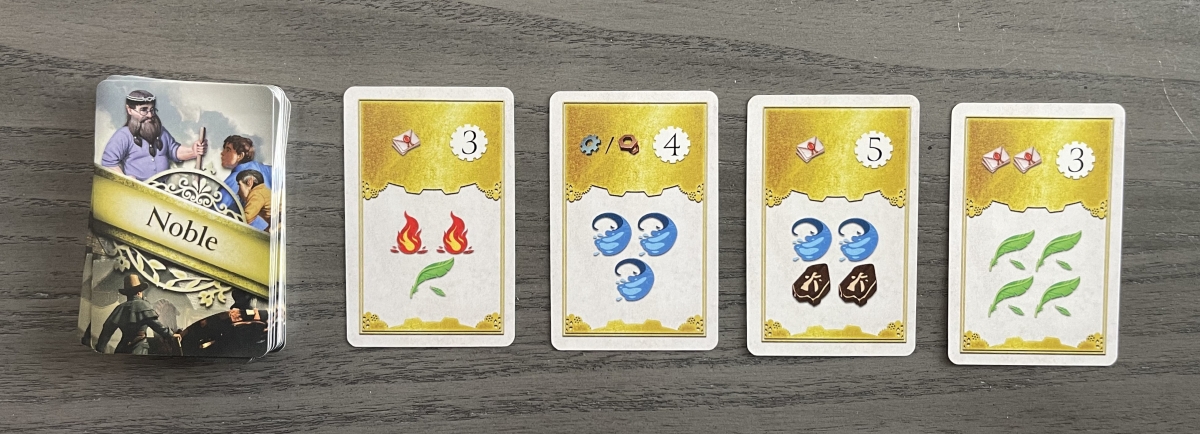
The next set is the Merchant Order cards. These are variable, with moderate difficulty to complete. The top part of the card shows the rewards for filling the order, and the bottom shows the Mana needed to complete it.
And finally, there are the Noble Order cards. These are variable like the Merchant cards, but with more demanding Mana requirements. Correspondingly, they also have better rewards.
How to Play Sprocketforge
The Goal
The goal of the game is to gain the most Renown.
Setup
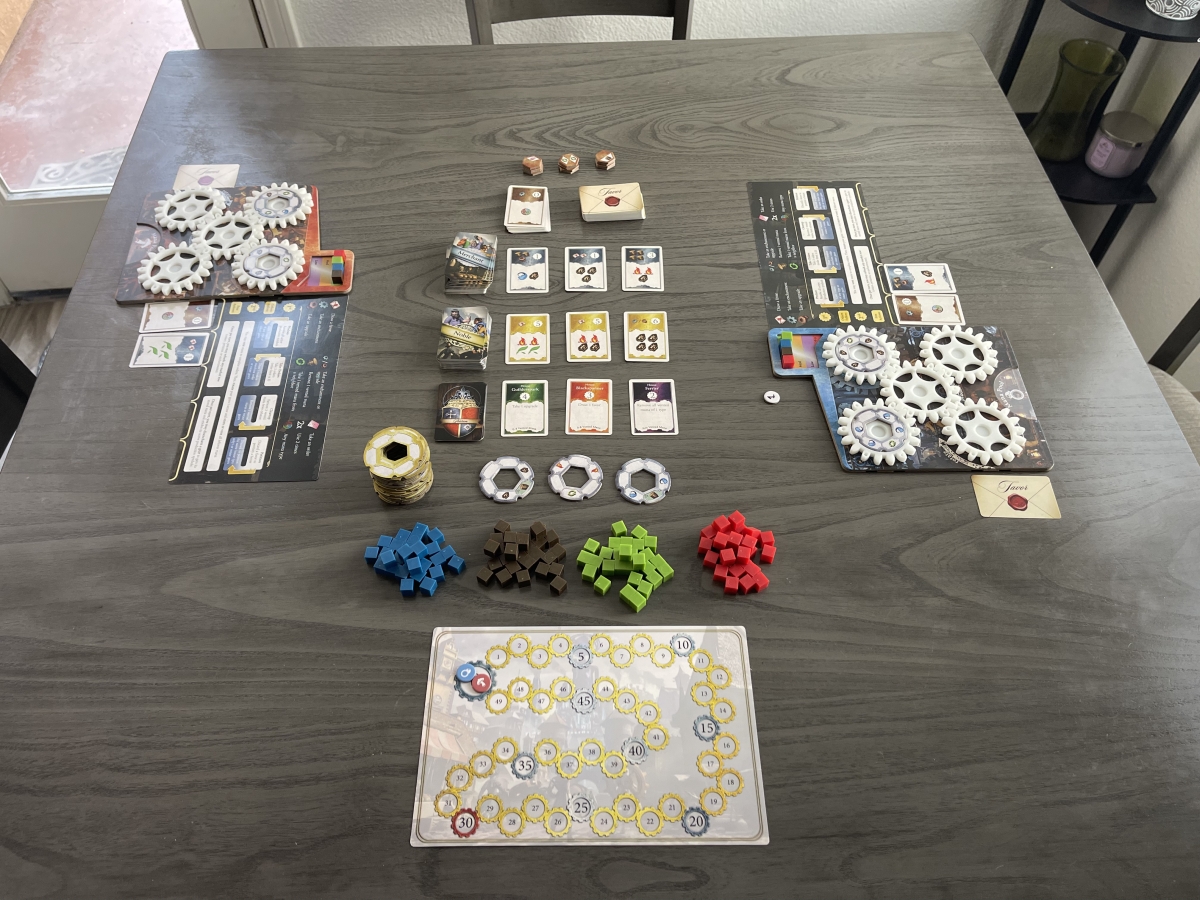
Market Setup
Make three stacks of Upgrades, 1 for each stack near the middle of the table. Each stacks should have 2 upgrades per player.
Place the Commoner Order cards in a face-up stack below the Upgrades.
Shuffle and place the Favor cards face-down next to the commoner order cards. Set aside enough 1 Renown-value Favor cards for each player.
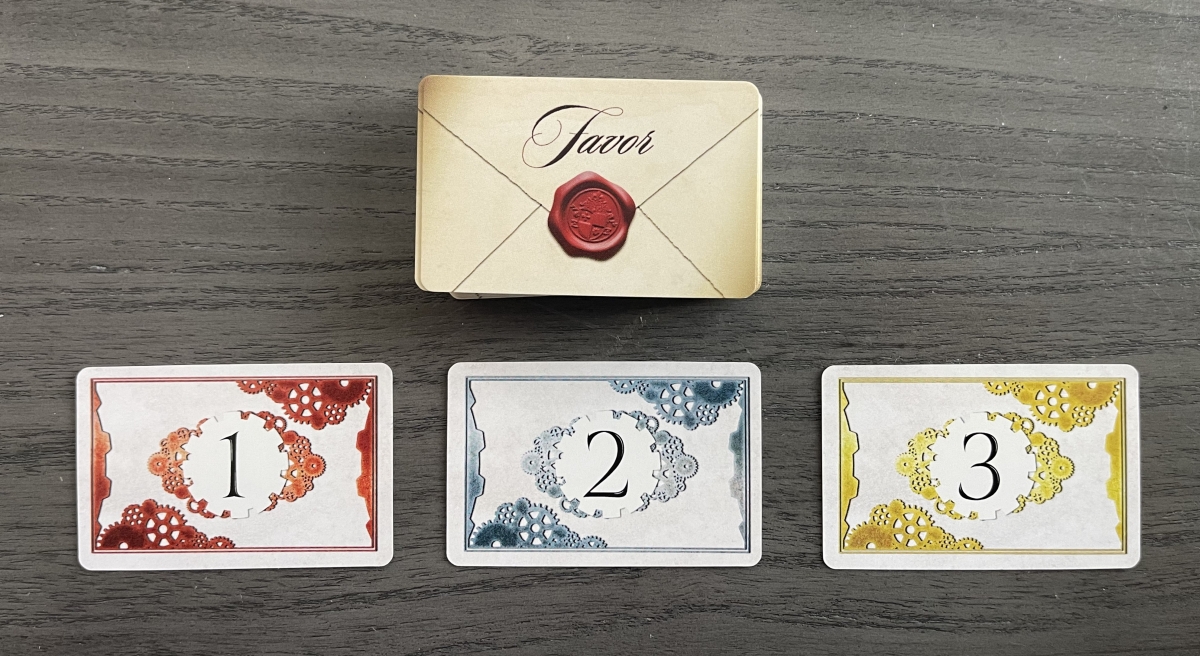
Shuffle and place the Merchant Order cards face down below the Common Order cards. Flip three of the cards face up next to the stack. Do the same for the Noble Order cards, placing them below the Merchant Order cards, and the same for the House cards, placing them below the Noble Order cards.
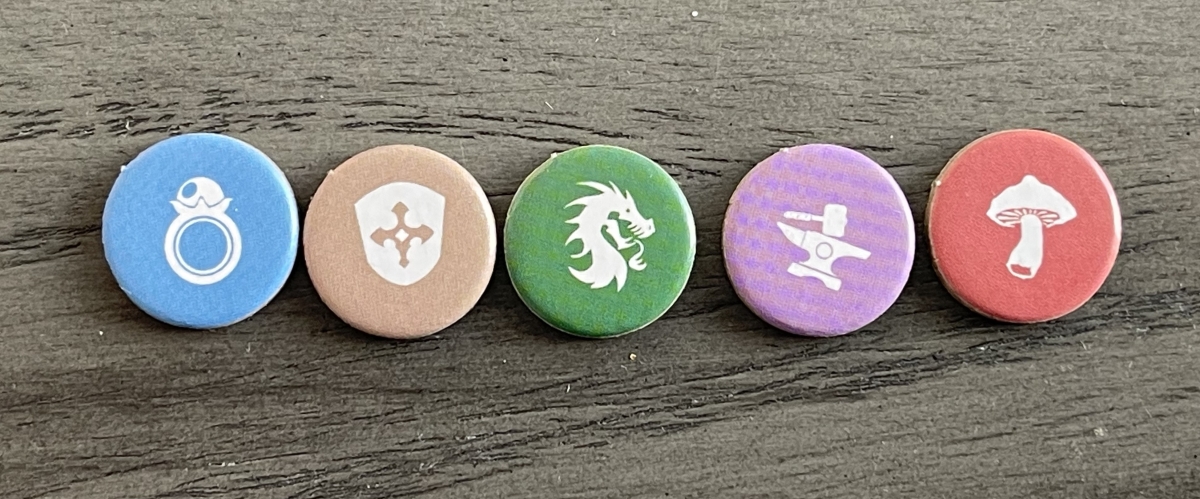
Shuffle and place the Enchantment tiles face down in a stack below the House Order cards. Flip 3 of them face up next to the stack.
Separate the Mana cubes into their four types and place them below the Enchantment tiles. Finally, place the Renown Tracker below the Mana cubes.

Player Setup
Each player takes a Factory board and matching Renown token. The Renown token is placed on the “0” space on the Renown track.
Players take one Mana cube of each type, and place it in the topmost row of the Exhaust track on their Factory board. Take a Player Aid, and place it to the upper right of the Factory Board.
Each player takes a 1 Renown-value Favor card, and places it facedown to the left of their Factory board.
Each player takes 5 plastic gears, and places them in the slots on the Factory board oriented so that each has a dotted tooth pointing directly down.
Finally, each player draws a Commoner Order card and a Merchant Order card from their respective decks, and places them in the Order slots at the bottom of their Player Aids.
Randomly determine the first player, who will receive the First Player token. Then, perform a draft starting with the first player, where each player will take 2 Enchantments. These can be slotted into any open gear, and rotated to any orientation before slotting.
Gameplay
Sprocketforge is played in rounds, starting with the First Player. After each round you will check to see if a player has 30 or more Renown, which will trigger the end of the game.
Round Structure
Player Turn:
- Take 1 Main action. Other players take Follow actions if applicable.
- Complete any number of Orders.
- Rotate Gears, then store leftover Mana.
Then check for Game End.
Player Turn
A player must take one of four Main actions: Produce, Take Orders, Cleanup, or Petition. Each Main action has a less powerful Follow action that other players may then take, simultaneously with the active player’s turn.
Their are also two Bonus actions that may be taken, either before or after taking the main action.
Produce
Gain any resources or actions shown in the active sector of every Enchantment and Upgrade on your Factory board. The active sector is at the bottom of the gear. Any Mana gained goes into your Mana Pool.
As a Follow action, all other players may gain 1 Mana of any type, or rotate their gears one sector.
Take Orders
Take any 3 Order cards, either from the face-up Market or drawn from the decks. Place them in the Order slots below your Player Aid. There is a maximum of 5 Orders that you may have at any time.
As a Follow action, all other players may draw 1 Order from the Merchant Order deck, or rotate their gears one sector.
Cleanup
Remove any 3 Mana cubes from your Exhaust and return them to the supply, consolidating the remaining Mana.
As a Follow action, all other players may remove 1 Mana cube from their Exhaust, or rotate their gears one sector.
Petition
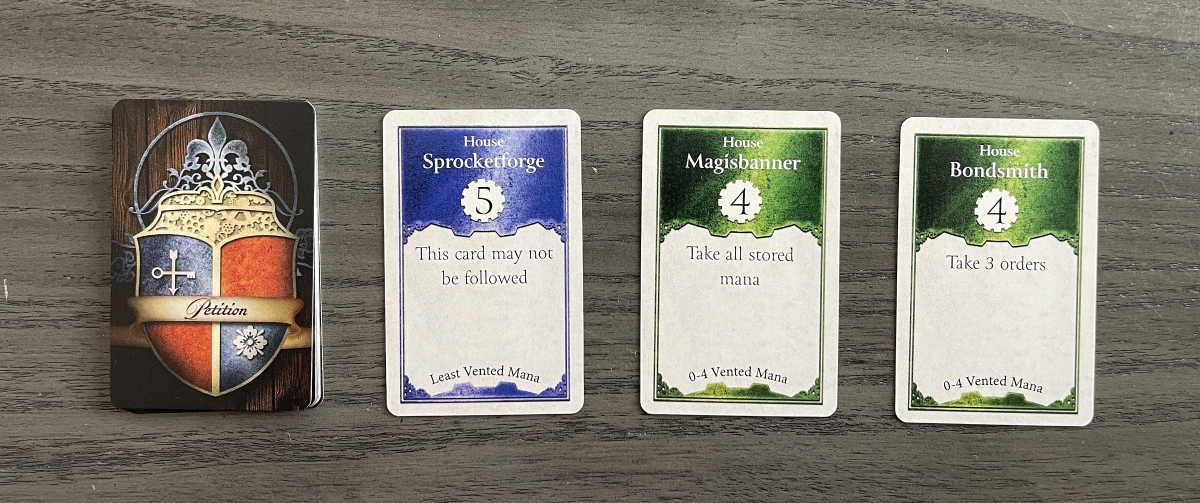
Discard any Favor card faceup in order to Petition one of the face-up House cards. You must satisfy the Mana exhaust requirement shown on the bottom of the card to Petition them. The less Mana you have in your Exhaust, the more powerful House you can Petition.
When you Petition, gain the Renown shown on the card, and perform any text on the card. Then discard the House card and draw a new one for the Market.
As a Follow action, a player may discard a Favor card to receive only the Renown shown on the active player’s House card, or rotate their gears one sector. To gain the Renown, the other player(s) must meet the Mana requirements of the House card as well.
Bonus Actions (optional)
- Disenchant a Gear. Move all Mana stored on the gear’s Enchantment tile to your Mana pool, then resolve the active sector of the Enchantment and the attached Upgrade tile (if there is one) as if you were Producing. Then remove the Enchantment and Upgrade, returning them to the bottom of their piles.
- Refresh Market Row. Once per turn, you may discard the face-up cards or Enchantments in any one row of the Market, and draw three more to replace them.
Complete Orders (Optional)
After you take your Main action, you may complete any number of your Orders. Take the Mana listed on the order from your Mana pool, and move it to your Exhaust, filling the Exhaust rows from left to right, top to bottom. If you exceed the limit of 12 Mana in your Exhaust, return the excess to the supply and lose 1 renown per Mana discarded. Then, gain the reward and Renown shown on the Order, and discard the Order card.
Rotate Gears and Store Mana
Finally, rotate your gears one sector in the direction indicated on your Factory board. Then, store all remaining Mana from your Mana pool, placing it on empty sectors of Enchantment tiles.
If you cannot or choose not to store all your remaining Mana, it is placed in your Exhaust. If you exceed the limit of 12 Mana in your Exhaust, return the excess to the supply and lose 1 renown per Mana discarded.
Game End
Once a player is at or over 30 Renown, the end of the game is triggered.
First, the current round is finished so that each player has an equal number of turns.
Then, each player gets to take the Produce action once more, and complete any remaining Orders. Importantly, there are no Follow actions taken, but players can take Bonus actions.
Finally, players reveal their face-down Favor cards, and add that Renown to the tracker. The player with the most Renown wins.
Ties are broken by fewest Mana cubes in their Exhaust, or if still tied, then most Favor cards.
Why You Should Play Sprocketforge
When someone sees all those gears in Sprocketforge, there is usually one of two reactions. Either the person will get excited and go, “cool!”, or they’ll turn down their noses at it and say it’s “gimmicky.” Well, I’m happy to announce that the gears fall into the “cool” category. And that’s because they are an intrinsic part of the gameplay puzzle.
Sprocketforge has deceptively simple gameplay. Each player is restricted to one main action per turn, and those actions are easy to execute. The challenge lies in how you build your engine to optimize your points. And you’re faced with this challenge immediately during setup, when you draft your initial two Enchantments. How you slot them into your gears is important, because what you can generate on a Produce action is dependent on the positions of those Enchantments. Those gears will be constantly turning throughout the game, and not only that, but the middle gear rotates in the opposite direction of the four other gears! That’s something that is easy to forget when you first start playing.
The gears themselves are engineered perfectly, and are physically satisfying to rotate. Of course, for a game like this, the only way it would be successful is if they worked flawlessly. Hopefully the metal gears available in the more expensive “Tinkerer” pledge turn just as smoothly as the plastic ones in the base game.
One of the other features of gameplay that I really like is the Follow actions. Besides allowing other players to better set themselves up for their own turns, it importantly keeps everyone at the table engaged at all times. All too often, engine building games can feel like solo games that you happen to be playing at the same table as other people. Sprocketforge avoids that trap.
While there’s not intrinsically a “catch up mechanism” built into the game, there are multiple ways to dig yourself out of the hole if things aren’t working out for you during a game. On one of my games, I made poor choices in my initial Enchantment setup. That, coupled with the Order cards I had available, left me struggling to accomplish anything. Thankfully, I had many ways to get out of this. One of the symbols on my Enchantments was “transmute,” which allows you to take one of the Mana cubes from another player’s Exhaust. That, coupled with a strategic disenchanting of one of my gears, allowed me to fill a couple of orders and get back into the fight. It’s also nice that anyone can refresh any market row on their turn, though I do worry that ability may be a little too powerful. It can certainly lead to one’s plans getting thwarted before their turn comes around.
Overall, Sprocketforge is a genuinely fun puzzle of a board game with satisfying mechanics. The gameplay is easy to learn, with the challenge for players being to look at what options are available to them each turn, and make choices appropriately. Sophisticated Cerberus Games also continues to iterate on their design for Sprocketforge, as I know there are already some rule changes and additions that they’ve added since the rulebook for the prototype. The game is already a lot of fun, and I’m looking forward to seeing what refinements they make during the Kickstarter campaign.
For more information or to make a pledge, visit the Sprocketforge Kickstarter page!
Click here to see all our tabletop game reviews.
 To subscribe to GeekDad’s tabletop gaming coverage, please copy this link and add it to your RSS reader.
Disclosure: GeekDad received a copy of this game for review purposes.