Today’s stack doesn’t have a particular theme—just several books I’ve finished in the past couple weeks, starting with two that I mentioned last week.

Wild Massive by Scotto Moore
I read Scotto Moore’s previous novel, Battle of the Linguist Mages, back near the end of 2021, and really enjoyed it. It’s off-the-wall fiction, one that is just chock-full of made-up brands and words and concepts, and Wild Massive shares that DNA. In this book, there’s a Building that is basically a multiverse in itself, though it exists as part of some sort of larger multiverse in a way that gets a little mind-boggling to comprehend. Each floor of the Building is an entire world—what we think of as our universe is actually a single floor of the Building, and there are four elevator shafts that can travel between the floors… if you can find their locations.
Carissa has taken up residence in one of the elevators (there are multiple per shaft, able to teleport past each other), choosing to just ride it up and down, and the cloudlet AI that runs the elevator has gotten used to her and even helps her avoid other passengers. But then a shapeshifting fugitive sorcerer lands on the roof of her elevator, and Carissa finds herself tangled up in a plot that could wipe out entire floors. Wild Massive is the name of the entertainment conglomerate that runs a series of theme parks throughout the building, as well as Storm and Desire, a centuries-long semi-fictional series about the Building itself, focusing on the Association (sort of a governmental body that held sway over about a thousand floors). It turns out Carissa has some personal ties to Storm and Desire, and eventually her paths cross with some of those who are intimately involved in its creation.
It’s a sprawling adventure with a huge cast of characters, taking you all the way from the ground floor of the Building to the mysterious chasm that separates it from the seemingly unreachable top floor. If you like a good dose of wackiness in your sci-fi, I highly recommend getting a ticket for this ride.
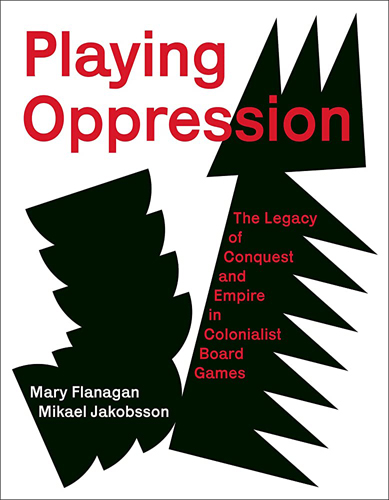
Playing Oppression by Mary Flanagan and Mickael Jakobsson
I mentioned this one last month when I’d just started reading it, and I’ve finished it in the meantime. Flanagan and Jakobsson dig into some of the history of board games (particularly in Europe and America), explaining their ties to military games and conquest, as well as Western colonialism. There are many modern games (as you may already be aware) that include colonization as a setting, whether they’re simulating history/alternate history or sending humans into space, and there doesn’t seem to be any slowing to that trend. But in addition to that, the authors note that even games without an explicit colonizing theme often use concepts and mechanics that are rooted in a colonialist worldview: resources are to be harvested and exploited in the name of progress; exploration leads to displacement and settlement; even the act of drawing a map is a way of claiming territory.
The book also investigates how other cultures are represented in Western games, whether it’s with harmful stereotypes or infantilization or complete erasure. It also looks at attempts by game designer to subvert the colonialist mindset and explains some potential pitfalls. For instance, although Spirit Island (often described as a reverse Settlers of Catan) is about spirits of nature helping the indigenous people fight off the spread of invaders, the indigenous people themselves are faceless and have no agency of their own, while the invaders are more complex and have distinct personalities. The authors do remark that the question of who can and should play certain characters (such as indigenous people) is a complex one, and state their hopes that there will be games in the future that give oppressed people more agency.
As I mentioned before, the book is pretty academic so it can be a little dry, but I found it to be informative and is a new (to me) lens for how I look at games. It doesn’t mean that I’m ready to throw out my game library and start over, but it does mean that I’ve been thinking more critically about the games I’m playing, and what certain mechanics or game components represent. Once you know what to look for, you really do start to see it everywhere. I’d definitely like to see more writing like this about board games, though perhaps something a bit more tuned for a casual reader.

Invisible Kingdom written by G. Willow Wilson, illustrated by Christian Ward
I’d picked up the first trade paperback collection of this a couple years back—the cover caught my eye, and I’d enjoyed G. Willow Wilson’s Ms. Marvel run. Just recently, I got caught up with the rest of the series with the omnibus edition published last fall. I finally figured out how to get some of these digital comic book review copies onto my iPad, so I’ve been making my way through them. (I have a big collection of them just sitting on my desktop computer, but I’ve never enjoyed reading them on that screen.)
It’s a sci-fi saga set in a galaxy far, far away, and the story centers on two women whose lives intersect: Grix is a rough-and-tumble pilot who makes deliveries for the megacorporation Lux, barely scraping by in a ship that’s always in need of repairs. Vess has just been initiated into the Renunciation, a religious order that eschews materialism, turning away from the gotta-have-it lifestyle sold by Lux. Both of them stumble upon a dangerous secret: it seems that Lux and the Renunciation are actually in cahoots—but what can they do with this information?
What follows is an underdog story as Grix and Vess try to figure out how to navigate their own path through this mess, while being caught between two very powerful forces. One of the things that Vess (and her fellow “nones”) has to consider is whether her faith can be true even if the leaders of her religion are false. Grix doesn’t have any such dilemmas—she knows from the start that Lux only cares about profit and its own image, and makes no claims about being “good.” I really enjoyed the story, and the artwork is striking, with bright, saturated colors and dynamic panel layouts throughout the book.

Paranorthern and the Chaos Bunny A-Hop-Calypse written by Stephanie Cooke, illustrated by Mari Costa
My 10-year-old picked this one out of the pile and has read it a handful of times in the past week, so I decided I should check it out! The town of North Haven is filled with supernatural beings: witches, wolf-people, ghosts (sort of), vampires, and so on. Abby comes from a family of witches, and she helps run her mom’s magical coffee shop. She’s still learning spells and potions, but somehow in a moment of stress she opens a portal and lets in a fluffle of chaos bunnies. She insists this is something she can fix on her own, but her friends start to worry as the bunnies start tearing up everything in town. It’s a cute comic with a message about friendship and family, but also lots of magic and humor.
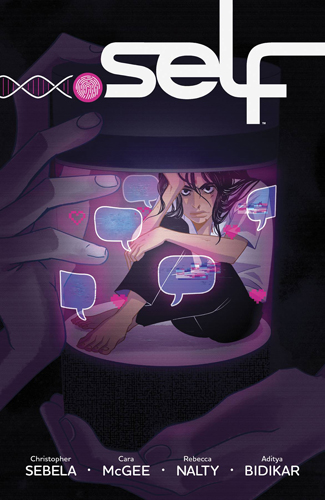
.Self written by Christopher Sebela, illustrated by Cara McGee, colors by Rebecca Nalty, lettering by Aditya Bidikar
Natalie Winters has a pretty nice life: a decent job, a doctor husband, a “pet” robot vacuum, a nice house. And her life is all backed up in the cloud, thanks to Postscript, a tech company that uses nanotechnology to record your memories and feelings and social media presence and stores it in a .self file. When you die, your .self gets uploaded into a blank, an artificial body that gives your family and friends 48 hours of closure. At least, that’s the idea.
Unfortunately, Natalie’s account was hacked, her .self file was posted online, and now there are dozens of blanks walking around with her memories and feelings … as well as all of her passwords, logins, and financial information. Her life devolves into chaos: her husband discovers thousands of dollars missing from their bank account, her mom has been calling and texting, and now some of these blanks have shown up at her house (because of course they know where she lives). Oh, and Postscript promises they’re on the case and will clean everything up, but the two operatives seem a bit unhinged, too.
The story is told out of order, with Natalie narrating but skipping ahead and then backtracking to explain things. It’s a strange story that reminds me a bit of Calvin playing with his duplicator and making too many copies of himself, but in this case the blanks don’t actually look like Natalie—and most of them have some different skills that were programmed in separately before her .self file was uploaded. It’s a bit of a mystery and a bit of a chase, with some existential dread mixed in.
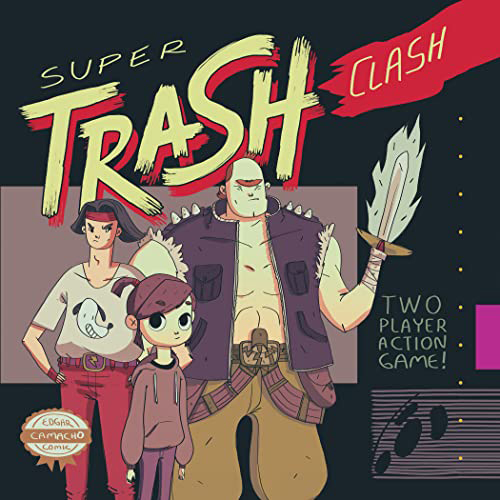
Super Trash Clash by Edgar Camacho
When Dul finds a copy of Super Trash Clash in a pawn shop, it brings back a flood of memories.
Dul’s single mom hasn’t been able to afford to buy any new video games for her beyond Italian Bros., the cartridge that came with her Super Kit system. What she really wants for her birthday is the new Super Encounter 2 fighting game … but instead her mom gives her Super Trash Clash, the worst-rated game in history. After trying it out with her friend, she trades it away … but then regrets it and tries to get it back. That leads to a wild goose chase reminiscent of The Day I Swapped My Dad for Two Goldfish as Dul and Misa follow the cartridge as it changes hands again and again.
There are lots of video game allusions scattered throughout the story: we see some scenes from Super Trash Clash itself (which looks a bit like Double Dragon), as well as Super Encounter 2 (definitely inspired by Street Fighter), plus a few others here and there. It’s a short book, but the story is about the memories Dul has, both about her friend and her mother, around playing video games. It’s a sweet story and it was fun to read.
My Current Stack
Still reading Atomic Anna by Rachel Barenbaum, plus various more comics on the side!
Disclosure: I received review copies or digital proofs of the books in this column, except Playing Oppression, which I purchased myself. Affiliate links to Bookshop.org help support independent booksellers and my writing!