Today’s books are quite different from each other, but all of them involve a bit of world-building, sometimes more literally than others!

LEGO in Focus: Explore the Miniature World of LEGO Photography by Stuck in Plastic and BrickCentral
This art book is exactly what the title describes: up-close photos of the world of LEGO! Some involve more complex builds, and some feature minifigs interacting with non-LEGO objects, but all of them are up close and personal. I particularly enjoyed seeing the minifigs out in the world, whether in natural or built environments, and the photographers (from the two groups, Stuck in Plastic and BrickCentral) make great use of creative angles and innovative props to set up some amazing scenes.

The Art and Making of Dungeons & Dragons: Honor Among Thieves by Eleni Roussos
Here’s another art book, this time about the Dungeons & Dragons movie, which I really enjoyed watching with my family. The book has a mix of concept artwork, on-set photography, and scenes from the finished film, along with plenty of stories about how things were made. I was particularly impressed by how many of the effects were done practically, from giant winged costumes to simulated quicksand. There’s still certainly a lot of CGI effects in the movie, but a lot of it was actually constructed and shot with old-school techniques.
The book also describes how the directors, John Francis Daley and Jonathan Goldstein, worked to include a lot of the lore that long-time D&D players would appreciate, while still giving the movie mass appeal for those who have never picked up a d20. If you’re new to the world of D&D, this book explains the background of many of the references in the film. With the home release coming this week, the book got me excited to watch the film again, this time with some new perspectives on it.
Of course, it’s not all fun and High Sun Games in the world of Dungeons & Dragons. As much as I enjoyed the movie and perusing this book, Wizards of the Coast has lost some of its luster this past week with the news that they sent the Pinkertons after a YouTuber for publishing videos of unreleased Magic: The Gathering cards. In the film, you have a story about a band of thieves who triumph over the rich, greedy despot … and in real life, you have Wizards of the Coast using the tactics of rich, greedy despots. It’s not a great look.

The Terraformers by Annalee Newitz
This sci-fi novel takes place in the far future, when humanity has spread far beyond Earth and the concept of “people” includes both bots and some non-human animals who have been given human-intelligence such as cats and dogs (and naked mole rats, of all things). The planet Sask-E, owned by the Verdance Corporation, is undergoing terraforming to make it similar to Earth, perfect for wealthy folks who have dreams of living out the Pleistocene era on a pristine planet designed for their consumption.
The Environmental Rescue Team (ERT) is in charge of maintaining the ecological balance as the planet undergoes the long process of terraforming—but lifespans now number into the hundreds of years, so there are people who have been working on this project for centuries. When part of a lava tube collapses and reveals a strange anomaly, Ranger Destry (along with her moose mount, Whistle) go to check it out and discover a huge hidden secret that will have a significant impact on the future of the planet.
I can’t tell you much more about the plot specifics without spoilers, but the story itself also spans over a thousand years, as we jump from the terraforming process to the early stages of cities appearing on the planet to, eventually, gentrification and resistance to it. The world of The Terraformers reminds me a little of The Murderbot Diaries—it’s a future where it feels like humanity has made progress in certain areas, but is still susceptible to the same old foibles that we struggle with now. Technology is amazingly advanced but is often controlled by the wealthy. Corporations have too much power, but there are also people working on finding other ways to live.
I really enjoyed The Terraformers; it accomplishes what sci-fi can do best, showing us a reflection of ourselves by telling an engaging, imaginative story about other people in a different world at a different time, and challenging us to work toward a better path forward.

Titanium Noir by Nick Harkaway
I’m always excited to see a new novel by Nick Harkaway, who always captivates me with his bizarre worlds. This time, here be giants—in the form of Titans, people who have undergone a medical procedure that rejuvenates them. It sort of resets you back to puberty so your body is young again, but with the side effect that you also grow; each time you repeat the process, you gain another century of life and get another size bigger, to the point where you’re effectively no longer human. And, of course, the process is only available to the ultra-wealthy (or ultra-connected), and it’s controlled by the Tonfamecasca family.
Cal Sounder is a private detective, and he specializes in cases that involve Titans. The Tonfamecasca family keeps things quiet, and the police have a fall guy if things go south. When a relatively unknown Titan is found murdered, Cal is drawn into an investigation that will send him all over the city looking for answers.
The book, narrated by Cal, has that detective noir feel (okay, I’ll admit, I pictured Calvin as Tracer Bullet a lot while reading it) but in a world that is filled with strange things and stranger people. Yeah, there are still tough cops and shady bars and femme fatales, but everything has that magical Harkaway twist. I liked this one enough that I stayed up late finishing it—my only complaint was that it ended so soon and I wanted to spend a little more time exploring this world.
Playing Oppression by Mary Flanagan and Mikael Jakobsson
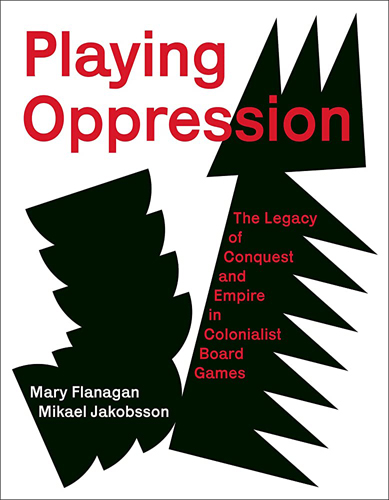
I picked this one up at the store recently after seeing it shared on social media by Mary Flanagan, who I know from her board game company Resonym Games. I haven’t finished it yet, but I thought it was worth including in this column because it fits the topic: it’s about board games, which are often exercises in world-building, and in particular it’s about games that include themes of colonialism. The subtitle of the book is The Legacy of Conquest and Empire in Colonialist Board Games.
Flanagan and her co-author, Mikael Jakobsson, have been collecting and studying games that “fit the criterion of directly referencing Western colonialism both thematically and mechanically,” and found back in 2019 that there were far more titles at Essen Spiel than they could fit in their luggage, and the pace at which such games continue to be published seems to be growing. This book digs into the history of board games and their connection to empire-building, and also examines some alternatives that take players in a different direction.
The book is from MIT Press and is pretty academic, but this is a topic that I’ve personally become more interested in over the past few years. Admittedly a lot of the games I play are about colonizing, whether overtly or not, and I’m sure I’ve absorbed a lot of concepts passively without really being conscious of it. I’m trying to pay more attention to that now, and I felt like this book would be a good entry point in learning about what to look for and how to approach the topic.
Disclosure: Except where noted, I received review copies of these books. Affiliate links to Bookshop.org help support my writing and independent bookstores!