Celebrate Lunar New Year with tasty snacks and red envelopes!
What Is Fú: Festive Fortunes?
Fú: Festive Fortunes is a worker placement game about Lunar New Year for 3 to 5 players, ages 10 and up, and takes about 45–75 minutes to play. It’s currently seeking funding on Kickstarter, with a pledge level of about $38USD (50 Singapore) for a copy of the game, or $58USD to include the Feast & Flavour expansion, or $80 for the all-in level that also includes deluxe components and an additional expansion. (Note that the publisher is planning to absorb 50% of tariffs for US backers at the time they arrive in the States so you will be charged for the other half.) The game has a family-friendly theme and the rules aren’t too complex, but there’s still a bit of strategy involved that can be tricky at first.
Fú: Red Envelopes was designed by Yixian Ho and published by King and the Pawn Games, with illustrations by Marcus Quek.
New to Kickstarter? Check out our crowdfunding primer.

Fú: Festive Fortunes Components
Note: My review is based on a prototype copy, so it is subject to change and may not reflect final component quality.
Here’s what comes in the box:
- Market board
- 5 Snack Stalls
- 82 Snack tokens (in 5 types)
- 5 Player boards
- 20 Red envelopes (4 per player)
- 35 Meeples (7 per player)
- 100 Money cards (in 5 and 10 denominations)
- 5 Reference cards
- 20 Decoration cards
- Distant Relative tile
- Year marker
- 5 Turn markers
Fú: Festive Fortunes is a delightful game to look at. The illustrations are all very cute and there are lots of little cultural details. For instance, the decoration cards all have a line about what the item represents, and the rulebook has little notes explaining the significance of the various snack items as well. The year marker is a little tiny gold ingot, another traditional element.
I noticed that the Chinese character fú (福) meaning “good fortune” that appears at the start of the score track is upside-down: that’s not a mistake! The word for “upside down” is a homonym for “arrived,” so it’s traditional to hang your 福 decoration upside down to indicate that “good fortune has arrived.”

Fú: Festive Fortunes includes five animals from the Chinese zodiac: pig, tiger, dog, dragon, and rabbit. If one of those is your symbol, you’re in luck! Otherwise you’ll have to make do. While I understand why they didn’t include 12 different options, I suppose some people might feel left out. (Note that the pig meeple has been redesigned so it looks more pig-like—the photo above is a prototype!)

Red envelopes are a Lunar New Year tradition—you put cash in them and give them as gifts. The game’s red envelopes are cardstock sleeves—sturdier than the real thing and without a flap to close them up, but they do a good job of reproducing the look, customized with their five animals. The text on each envelope are phrases about good fortune with animal puns!
The market board looks like little vendor stalls, and the player boards include a dining table area where you put all the snacks you’ve eaten during the game, and a little portrait of the animal family at home. And, of course, each player has the traditional compartmentalized red serving dish for their snacks!
The snack stall tiles are all double-sided, so that each snack type has two different scoring options.
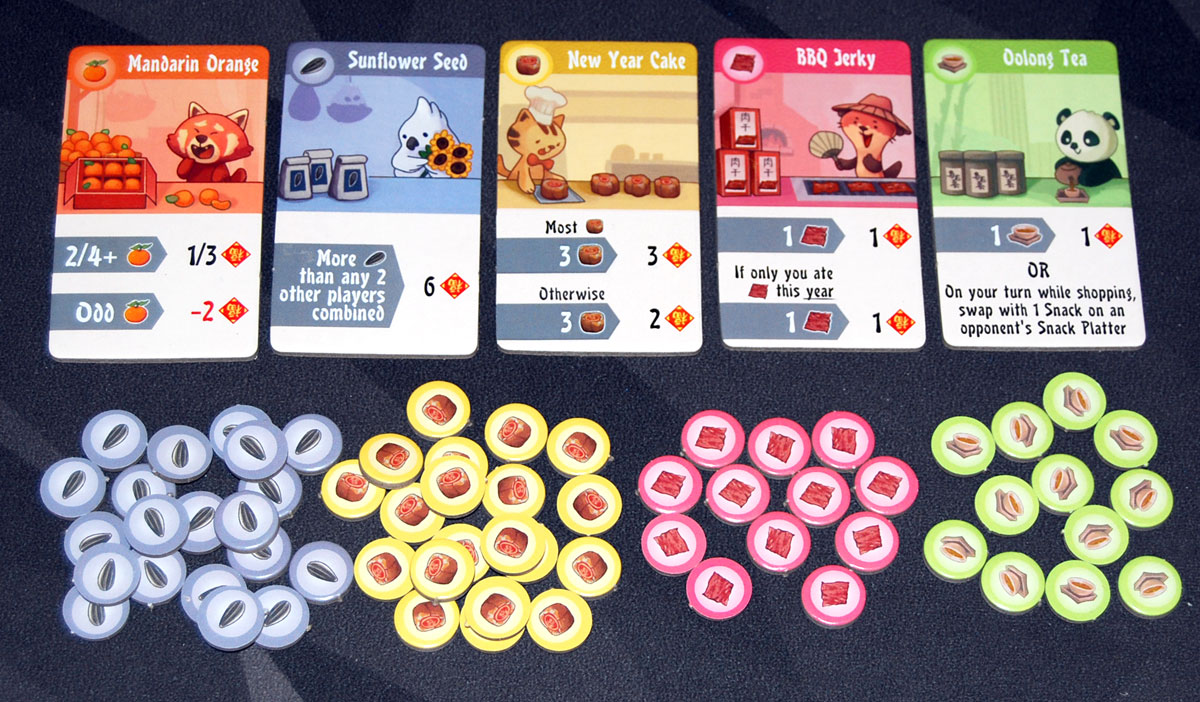
Kickstarter backers can also get the Feast & Flavours expansion—this adds five more snack stall tiles for even more mix-and-match scoring. (It also includes the tokens for the four new snacks, but the mandarin oranges are already in the base game.) The “all-in” pledge includes a Devious Decorations mini-expansion and deluxe components (replacing the cardboard tokens with wooden tokens, and mahjongg-tile turn order tokens), though my prototype did not include these so they aren’t pictured here.
How to Play Fú: Festive Fortunes
You can download a copy of the rulebook here.
The Goal
The goal of the game is to score the most points on the fortune track by welcoming visitors to your home and by eating the best snacks.

Setup
Set up the market board: choose a side to use for each of the snack stall tiles and place them in the corresponding stalls on the board. Place the supplies of snack tokens below each vendor. Shuffle the decoration cards and place them in the indicated area, revealing the top three cards in the market. Place the year marker on the Year 1 space based on the number of players. Give everyone money as shown on that space.
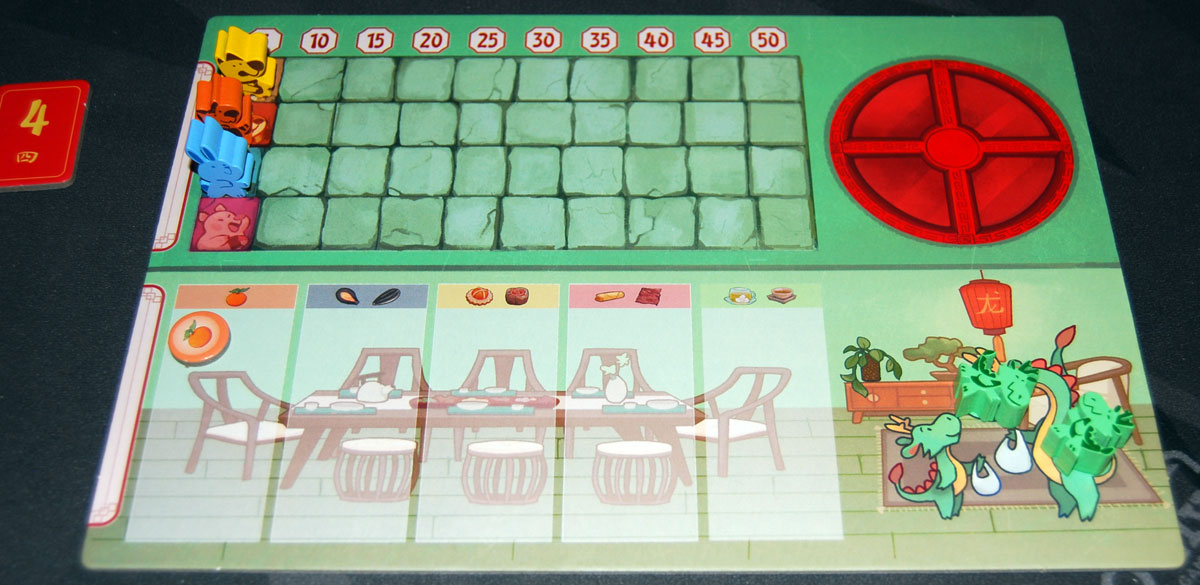
Each player takes a player board, meeples, and red envelopes of their chosen animal. Then, place two of your meeples on your player board (on the illustration) and give each other player one of your meeples. The meeples you receive from other players should be placed at the start of the generosity track at the top of your player board.
Also, everyone starts with one mandarin orange (you got started snacking already!) placed on their dining table in the corresponding column.
Give the oldest player the “1” turn order token, and distribute the others going clockwise from there.
Gameplay
The game has four phases each round: Shopping, Visiting, Eating, and Time Passes.

Shopping: In turn order (from lowest to highest turn order token), each player places one of their workers on a space to buy either snacks or a decoration. If you buy snacks, you may buy one or two of that snack—the price shown on the location is per item. For instance, the dog at the far left in the photo above could buy one mandarin orange for $5 or two oranges for $10. If anyone else comes to buy oranges this round, they will have to pay $10 per orange. Snacks you’ve purchased go into the little dish on your player board—each compartment can only hold one type of snack, but you are allowed to separate the same type of snack into different compartments if you want.
The snack tokens are limited—if they run out, nobody can buy any of that type anymore.

The right side of the market board has a decorations market—these always cost $15 and there will be three in the market to choose from at the start of the round. Below the first two cards, there are also some spaces that will be revealed that allow you to collect $10. Decorations are placed on the left side of your player board, and you may only have two at a time—if you buy a third, you will need to choose one to discard.
The shopping phase continues around the table until everyone has placed their two workers to go shopping.
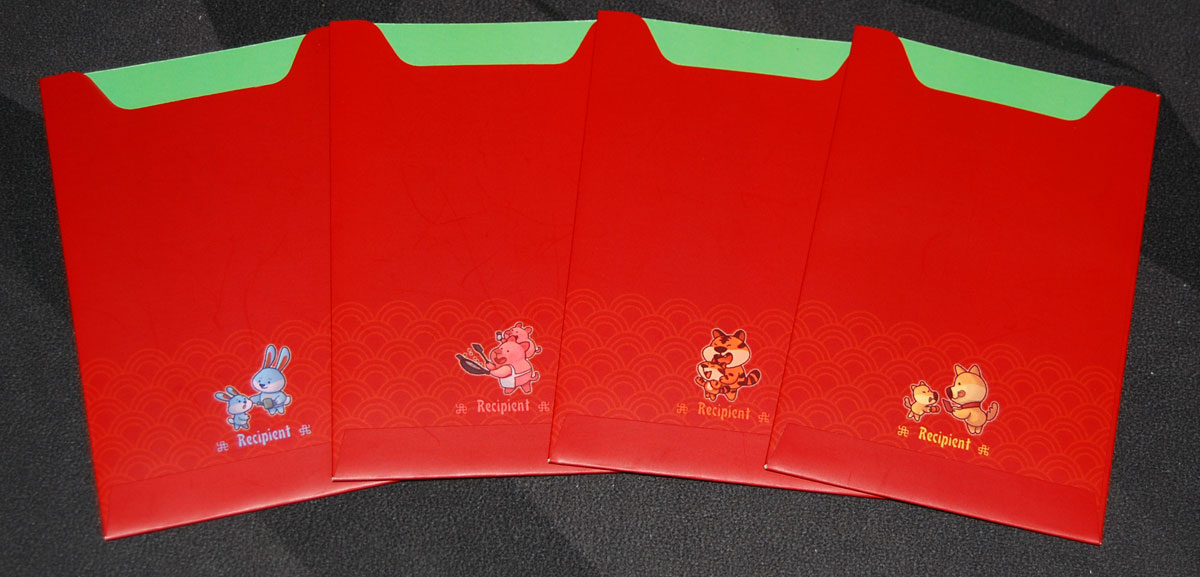
Visiting: Everyone secretly prepares their red envelopes simultaneously. Each envelope has the recipient on the back—for instance, the envelopes pictured above belong to the dragon (green) player, and there’s one for each other animal. You put money in the envelopes and then pass them to the other player—if you want to visit somebody, you must give at least the amount of your current location on that player’s generosity track ($5 in the first year). You may also put nothing in the envelope, in which case you are skipping a visit to that house this year.
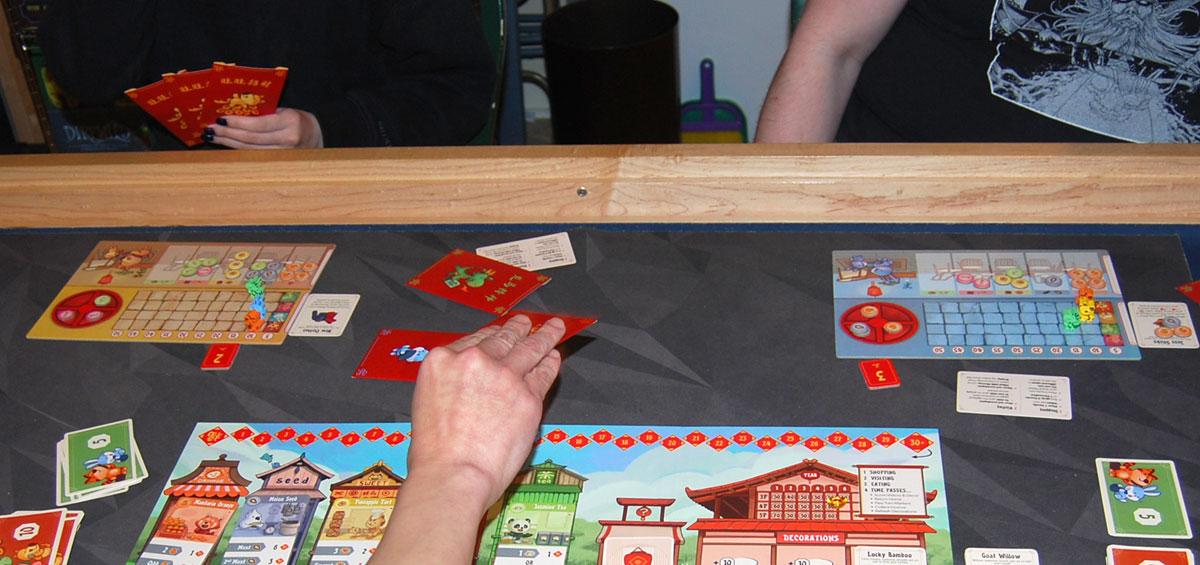
Once you have received envelopes from all the other players, you adjust their positions on your generosity track as needed. If somebody gave you nothing and did not visit, you lie their meeple down in its current position. Otherwise, place their meeple on the space of the generosity track equal to how much they gave you this year. (Remember, if somebody gives less than their current location, that’s an error that they’ll need to fix.) In the photo below, the tiger and dragon each gave the dog $20, and the rabbit gave the dog $15. (There is no pig player in this game.) The money you receive in the envelopes is added to your supply!
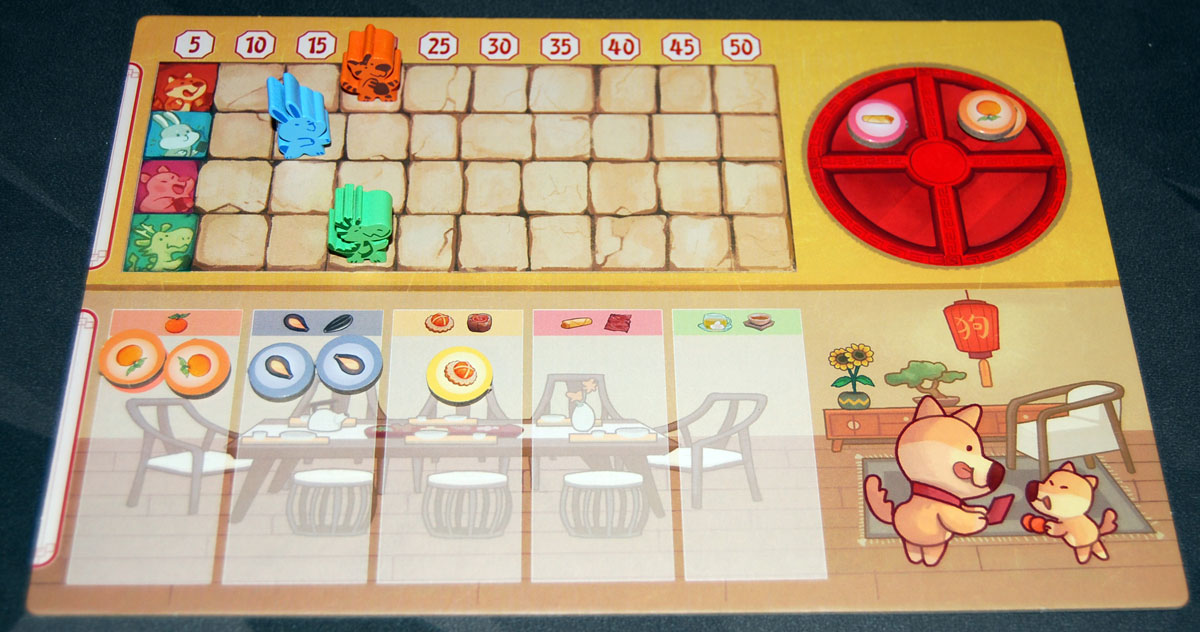
Eating: Now players will eat snacks at the houses they’re visiting! The player highest on the generosity track gets to choose one compartment first, and eats all of the snacks from that compartment. If there’s a tie for generosity, the player with the highest number turn order token goes first. The visitors just keep taking turns eating until all the snacks are gone. In the photo above, rabbit will not get to eat since there are three visitors but only two compartments have snacks in them. (The host doesn’t eat snacks unless nobody came to visit, in which case they eat all of them.) Put the snacks you’ve eaten into the corresponding sections of your dining table. Resolve each player’s house separately.
Time Passes: Score 1 point for each visitor who came to your house this year, and also score points for any decorations that score at the end of the year.
Then, prepare for next year: return all red envelopes and collect your workers from the market board. Stand up all meeples on your generosity tracks (but do not change their locations). Pass turn markers to the left. Advance the year marker one space, and everyone collects income as shown.
Discard any remaining decorations and refill the decorations market.
Game End
The game ends when the year marker can’t be moved any further—the number of years depends on the player count. Everyone scores points for the snacks they’ve eaten, as well as any decorations that offer end-game effects.
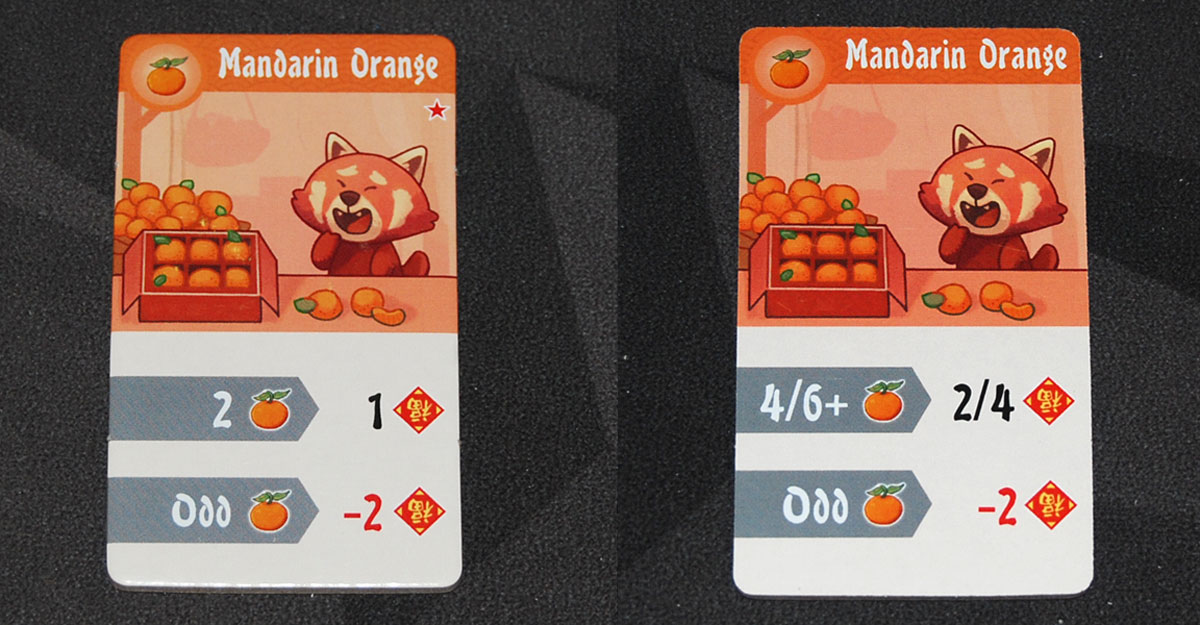
Each of the snack types has a different scoring condition, as shown on the snack stall.
Finally, you score 1 point for every $50 left in your supply.
The highest score wins, with ties going to the player who ate the most snacks total.
3-Player Rules
In a 3-player game, there’s a “Distant Relative” automated player which has a single-compartment snack tray. The distant relative will buy only one snack type, and whoever sends them the most money will get to eat the snacks. Unlike the other players, you do not track generosity so you can give them any amount each year. (The distant relative does not come visit anyone.)
Why You Should Play Fú: Festive Fortunes
I love playing games that incorporate Chinese traditions, so I was very curious to see how Fú: Festive Fortunes played out. I don’t think I’ve seen any games that involve the custom of handing out red envelopes, despite that being an iconic part of Chinese New Year celebrations. The game is filled with fun little details that highlight different aspects of the holiday—including, of course, enjoying lots of tasty snacks!
The gameplay itself is not too difficult: it combines some elements that are mostly familiar, like worker placement to purchase snacks or the set collection for snack scoring that is a little reminiscent of games like Sushi Go. And although the passing of red envelopes is a fun thematic twist, in gameplay terms it’s a blind auction: you’re bidding on the available snacks, but you get one bid and you don’t know what the other players are bidding.
The interaction between the shopping and the visiting is what really makes the game. When you’re shopping, you want to get snacks that people will want to eat, both because you get points for visitors and because you really hope people will give you a lot of money in those envelopes. Since you only send two workers each year, at most you can buy four snacks—but do you split them up into four compartments, or group some of them together? Grouping them might start a lucrative bidding war … or it might backfire if it discourages some people from visiting altogether.
When it comes to visiting—and filling those red envelopes—there’s also a lot to think about. How much do you want to spend at each house to get to the front of the line? There are often ties, so you have to consider the turn order tokens as well. As the game progresses and everyone has eaten different snacks, you’ll also start to get a feel for what is more valuable for your opponents so you don’t overbid. But the biggest difference between Fú: Festive Fortunes and most other bidding games is that you’re not just bidding against other players, but you’re sort of bidding against your future self, too. Every time you increase the amount you give somebody, you’ve raised your own minimum bid for future years! (Thematically, it’s about saving face and not decreasing your generosity from one year to the next.) If you go all out to make sure you get that jasmine tea this year, you might find yourself unable to afford visiting the same house next year!
It may feel a little funny that the players are all just passing money back and forth to each other every year, but it’s also kind of an accurate reflection of what often happens with Chinese families, too: usually it’s the older generation giving red envelopes to the younger generation, so it’s not a direct trade. (And, unlike the game, giving more generously does not mean you get first dibs on the snacks.) In the game, this all adds up to make a clever puzzle: how much to spend on snacks, how much to send to other players in your red envelopes, how much you expect to receive this year from other players.
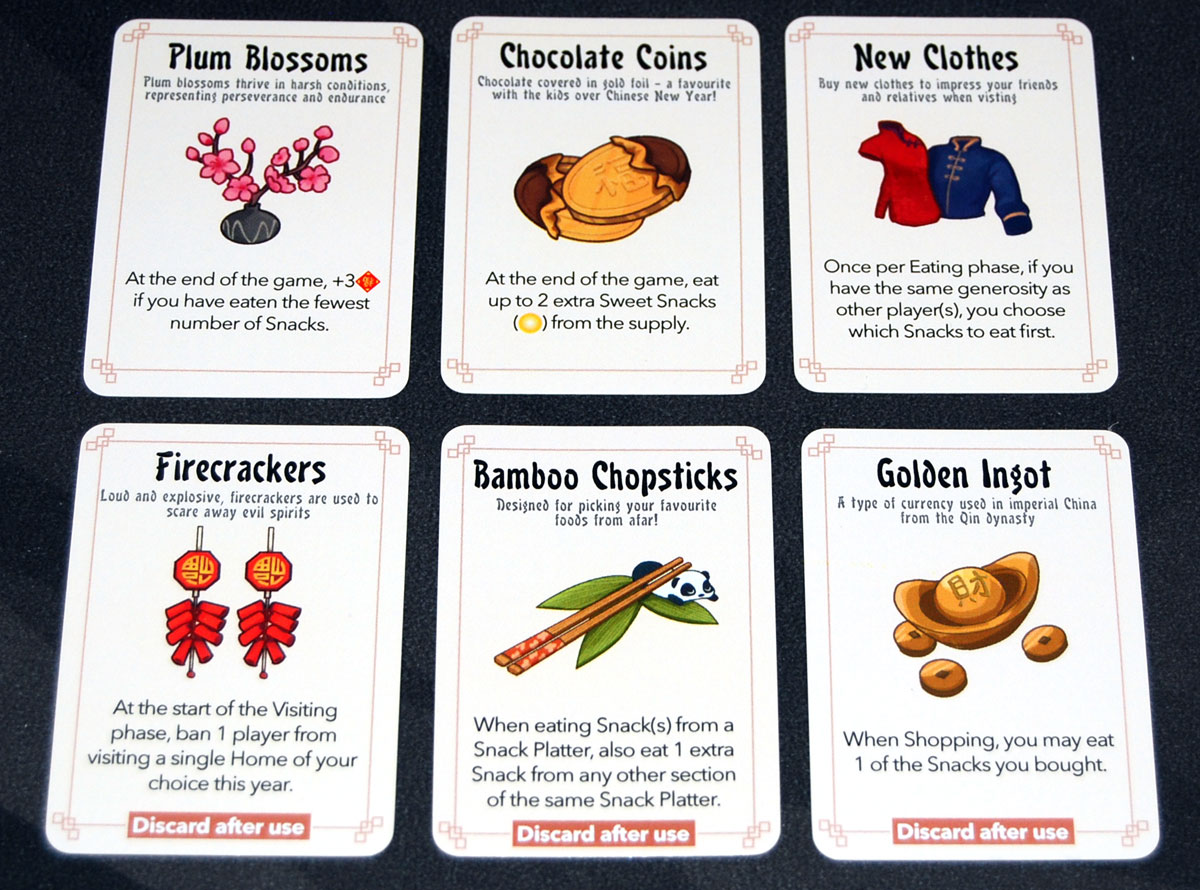
And then there are the decorations! The decoration cards are delightfully illustrated and have a little flavor text that explains their significance. There’s a wide range of effects—some will give you points for meeting particular conditions (often having to do with eating snacks), and some give you special abilities like skipping the line when you’re tied in generosity. The single-use decorations can be quite powerful but you have to decide the best time to discard them. The tricky thing about decorations, though, is that since you only get 2 workers each year, if you buy a decoration then you’ve only got one worker to go get snacks, which means your snack bowl may be a little slim! Will it be enough to attract visitors anyway? (Of course, if you buy two decorations the same year, your snack bowl will be totally empty, so you won’t be earning any money or points from visitors—hope those decorations were amazing!)
The game is not too complex; some of my gaming group felt like there were times when it seemed like your choices were a bit limited, and I think that’s in part because the number of snacks available at each house was so small. You are only collecting a bite here and a bite there. But I also really liked the way that allows for some interesting mind games in terms of what snacks you purchase and how you decide to divvy them up. You’re also trying to read the other players: how badly does my opponent want that lone shrimp roll?
Overall, I’ve really enjoyed Fú: Festive Fortunes, and I’ll be happy to add it to my stack of Asian-themed games from Asian designers! If all goes as planned, I look forward to breaking out the finished version for a Lunar New Year game night next year.
For more information or to make a pledge, visit the Fú: Festive Fortunes Kickstarter page!
Click here to see all our tabletop game reviews.
 To subscribe to GeekDad’s tabletop gaming coverage, please copy this link and add it to your RSS reader.
Disclosure: GeekDad was loaned a prototype of this game for review purposes.