
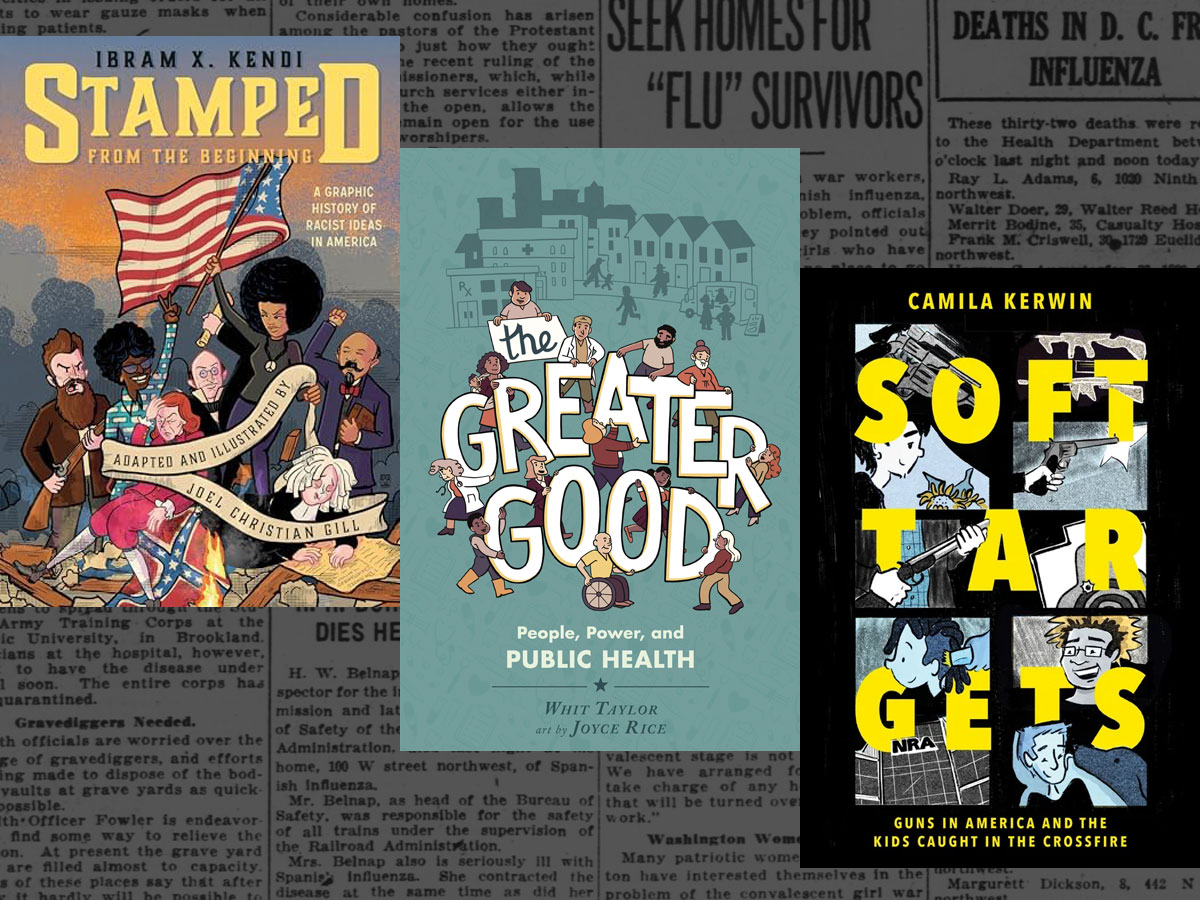
Today’s stack includes three non-fiction comic books about serious subjects: racism, public health, and guns. These are topics that can often lead to very heated disagreements, and they have a significant impact on who we put in charge of running the US (and probably other countries as well). Since these are issues that literally matters of life and death, I think it’s important to dig into them and try to separate the information from the misinformation, and to learn what we can. These three titles primarily focus on the United States of America, though many of the lessons may apply to the broader world.
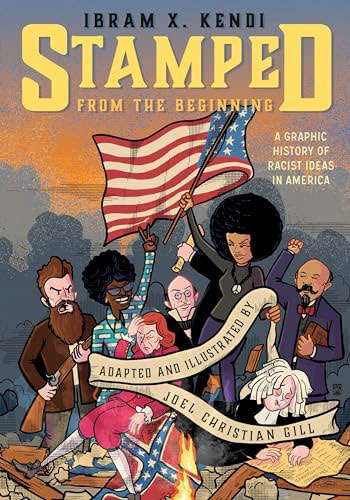
Stamped from the Beginning: A Graphic History of Racist Ideas in America by Ibram X. Kendi, adapted and illustrated by Joel Christian Gill
This is a graphic novel version of Kendi’s Stamped from the Beginning, which explores and explains racist ideas through the stories of five historical figures: Cotton Mather, Thomas Jefferson, William Lloyd Garrison, W. E. B. Du Bois, and Angela Davis. Since it’s presented in a comic book format, there are often dialogue bubbles from historical figures that are not actual quotes, but are conveying the narrative with some creative license. (For instance, it’s unlikely that Governor George Berkeley, when confronted by Bacon’s Rebellion in 1676, said “We should probably bounce.”) Direct quotes are marked with quotation marks, but the various real-world figures are also sometimes used as meta-characters who can provide additional commentary from the margins of the page.
I think one important distinction that Kendi makes right at the outset is that we’ve been taught to think of racism as “bad people vs. good people” and that often leads to caricatures of racists that are easy to distance ourselves from. Instead, he defines racist ideas, putting them into the categories of segregationist and assimilationist, both of which can appear attractive and good at times, and set those against anti-racist ideas. Sure, there are certainly people who are openly racist and match the caricature—there has been plenty of “science” throughout our nation’s history claiming that Black people are inferior for one reason or another. But there were still many ways in which well-meaning people held beliefs that were still harmful. It’s often easier to see segregation as racist if the proponents want to keep ethnic groups separate because they don’t want to be around them; it can be harder to see the racism in the assimilationist idea that puts ethnic groups together, until you dig deeper and realize that the expectation is to help everyone become more like white people.
America’s history is deeply interwoven with various racist ideas; even while our founding documents proclaim “all men are created equal,” the founders did not treat Black people as fully human. We learned as kids that Abraham Lincoln freed people from slavery, but we don’t always get all the details of the political maneuvering that led to the signing of the Emancipation Proclamation. Even ideas espoused by Black people aren’t automatically anti-racist; Du Bois promoted the concept of the “Talented Tenth,” believing that assimilation—that is, Black people achieving success as defined by the dominant culture—is what would lead to acceptance.
Despite being a comic, it’s still a pretty hefty read: it’s about 280 pages long, and there is a lot of text in it. The comic is in black and white, and a lot of the dialogue bubbles have a grey background and I found the lack of contrast a little harder to read at times. Gill also uses little chibi versions of some of the people when they’re providing meta-commentary, and sometimes that meant I had a harder time connecting that version of a person with the more realistic portrayal so I could tell who was who.
Of the stories included in the book, I had learned at least a little bit about most of the figures already, so I wouldn’t say that I found a lot of surprising new facts, but I did find Kendi’s analysis educational, and it’s helpful to have these various stories grouped in a way that illustrates various ideas and how they have shaped our nation. What I took from the book is that things are not always clear-cut, and I could identify ways in which my own opinions were shaped by the belief that segregationist and assimilationist ideas were the only two options.
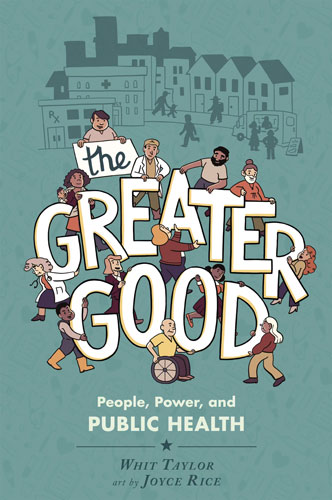
The Greater Good: People, Power, and Public Health written by Whit Taylor, illustrated by Joyce Rice
Why don’t we dump our sewage into cesspools in our basements? How do we know that smoking cigarettes causes lung cancer? What’s the connection between speed limits and traffic fatalities? All of these questions involve public health—the systems that deal with health on a population level rather than just at the individual level. While there are many individual choices you can make to keep yourself healthy and safe, there are a host of other factors that affect you as well, like whether there’s a factory spewing chemicals right next to your home or whether the packaged food you buy is actually safe to eat.
This comic book digs into the topic of public health (primarily in the US), from its foundations to the modern day. It begins with the origins of epidemiology: cholera was not well understood in the early 1800s, but a doctor named John Snow became convinced that it had to do with the water supply. His work mapping cholera deaths to water sources eventually led to a better understanding of disease transmission, and the creation of London’s sewer system. While the book does cover advancements in public health like the development of vaccines or improving food safety, it also includes some times when officials made bad choices. The story of “Typhoid Mary” showed that the process of tracing diseases had improved, but not necessarily what to do about it. Mary Mallon’s imprisonment—while other asymptomatic carriers went free—was unjust and harsh. Another horrific incident covered in the book was the Tuskegee Syphilis Study, where Black men were infected and studied for decades, without treatment even when it became available.
The book covers the development of public health infrastructure: the various governmental bodies in charge of things like transportation safety, food standards, and so on. It includes the 1918 flu pandemic, as well as the AIDS epidemic in the 1980s and the missteps that were made in addressing it. There is a mention of COVID-19, but they explain that despite the toll it has already taken, it is still too early to see the long-term effects and what will happen with the virus and treatments in the years to come.
This subject is close to home for me: my wife is a family physician, and her residency also included preventive medicine and public health. There’s more to health than just treating diseases and ailments when they occur—it’s even better if you can avoid getting sick in the first place. Public health, whether it’s getting vaccinations or wearing a seat belt or ensuring that communities have clean water, is important to invest in. This book does a great job of introducing the idea and explaining its history.
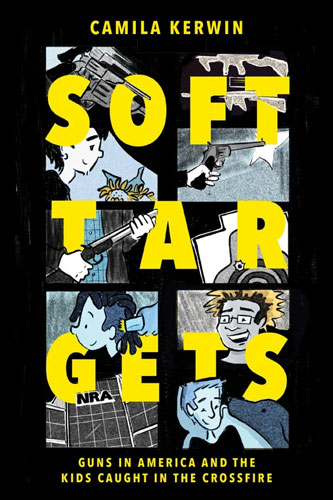
Soft Targets: Guns in America and the Kids Caught in the Crossfire by Camila Kerwin
America—as I’m sure you already know—has one of the highest rates of gun deaths in the world. As of 2020, guns are the leading cause of death for kids in the US. School shootings are frequently in the news—in fact there was one here in Oregon the week before I read this book—but there are a lot more stories that never make the news: accidental deaths, collateral damage from crossfire, troubled kids who take their own lives.
Kerwin has a strange relationship with guns, as she explains in the introduction. Her stepfather was a gun owner and collector, and taught Kerwin about gun safety and how to aim. But when he died while she was in high school, she lost her connection to gun culture; she eventually moved to NYC and worked in public radio, and said “nobody in my orbit had guns.” But when her job led her to report on the anniversary of the school shooting in Parkland, Florida, she was reintroduced to the world of guns and gun violence.
In this book, she tells the story of four kids who died from gun violence. She interviews the families and tells their stories, and she also explains some of the history of gun culture in the United States. These are hard stories to read—whether through an accident, a targeted shooting, or anything else, losing a child is devastating, and it is happening again and again in our country. But what can we do about it? I’m reminded of the headline that the satirical news site The Onion posts after every school shooting: ‘No Way to Prevent This,’ Says Only Nation Where This Regularly Happens.
There are statistics, but one of the biggest obstacles to getting hard data has been the Dickey Amendment, passed in 1996, that banned the CDC from using federal funds to “advocate or promote gun control.” The amendment squashed research that would look into gun violence, which means that the type of public health information we have on things like disease spread or cigarette smoking or car safety is missing when it comes to guns. Soft Targets includes a chapter that digs into the history of the Dickey Amendment and the CDC researcher Mark Rosenberg whose studies raised the ire of the NRA. (The amendment was not repealed, but some language was clarified in 2018 that finally restored federal funding to study gun violence, though of course the CDC has since had staffing significantly reduced overall.)
Kerwin shares several stories that shed light on America’s gun culture. She digs into the myth of the “Wild West,” and shows that gun laws were in reality much more strict than what is portrayed in movies and TV shows. She relates the history of the NRA and how it became one of the strongest lobbying groups in the country. She tells us about the Black Panthers, and the founding of the National African American Gun Association in 2015.
Reading all of these stories—of kids who have been shot, of the long history of gun culture in our country—could just be depressing, but Kerwin ends the book on a hopeful note. Gun deaths decreased in 2025 (though they’re still much higher than they should be). Most Americans actually agree about a lot of things about basic gun safety laws, despite what lobbying groups try to tell us. The hope is that we can reach that understanding and urge our representatives to act, and not let ourselves be controlled by this “small but highly motivated minority.”

Jonathan H. Liu

Jonathan H. Liu is a stay-at-home dad in Portland, Oregon, who loves to read, is always up for a board game, and has a bit of a Kickstarter habit. I can be reached at jonathan at geekdad dot com.


