
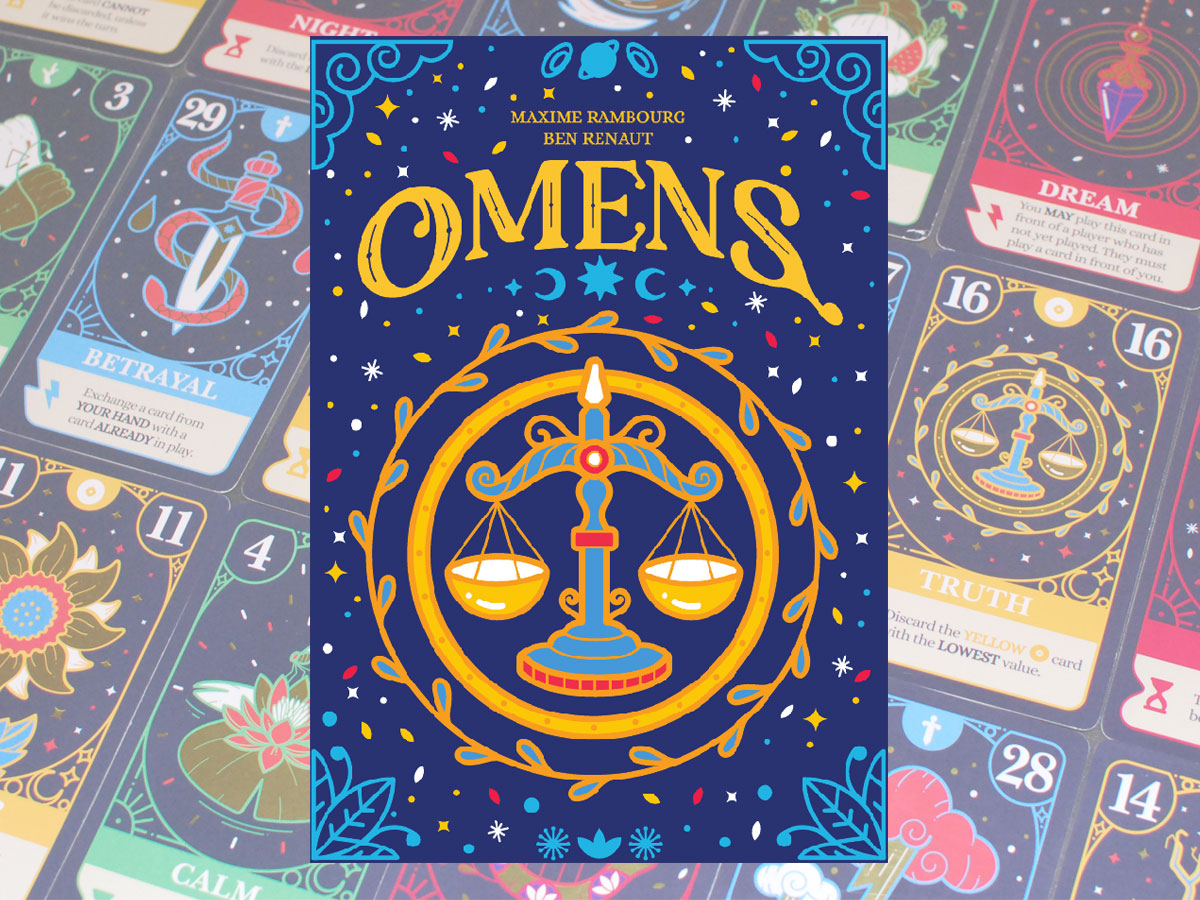
Be the first to get rid of your cards—but it may be harder than you think!
What Is Omens?
Omens is a team-based card game for 4 to 6 players, ages 14 and up, and takes about 30 minutes to play. It retails for $19.99 and is available in stores or directly from Hachette Boardgames USA. The game has tarot-inspired artwork and theme, but it’s family-friendly and I think you could go as young as 10 with kids who have some gaming experience.
Omens was designed by Maxime Rambourg and published by Spiral Editions, with illustrations by Ben Renaut. It is distributed in the US by Hachette Boardgames USA, who provided the review copy.
Omens Components
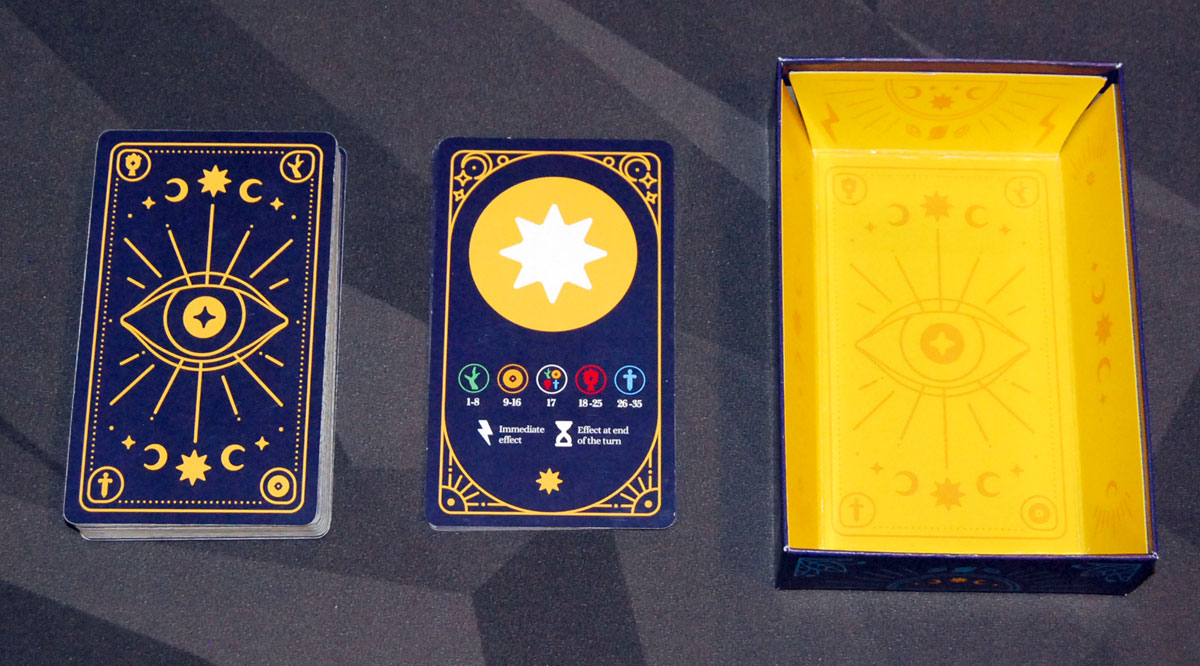
The components for Omens are very simple: 35 Arcane cards, and 7 Player Aid cards. All of the cards are tarot-sized cards, and the whole thing comes in a small box with a simple cardboard insert.
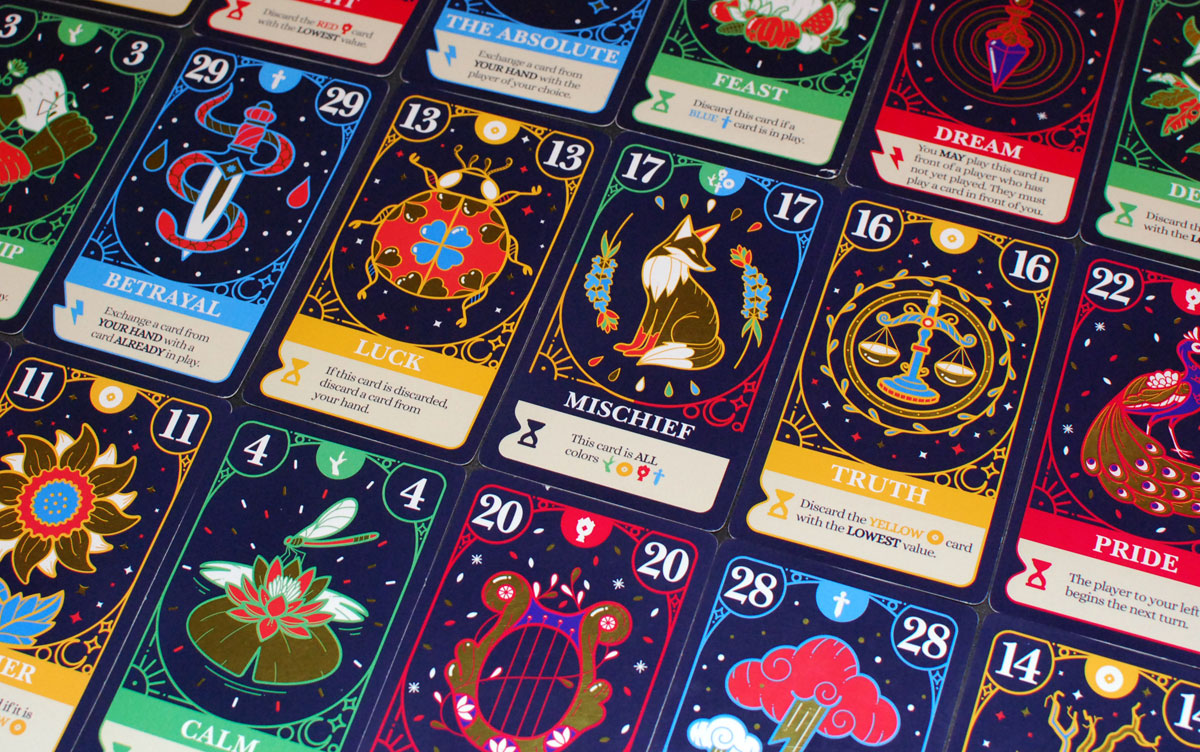
The Arcane cards are numbered from 1 to 35. Numbers 30–35 are all called “The Absolute” and have the same ability, but all of the other cards are unique. There are four colors (green, yellow, red, and blue). The illustrations are really beautiful, with gold foil accents. Each card has the number in both top corners, and the name and ability at the bottom of the card.
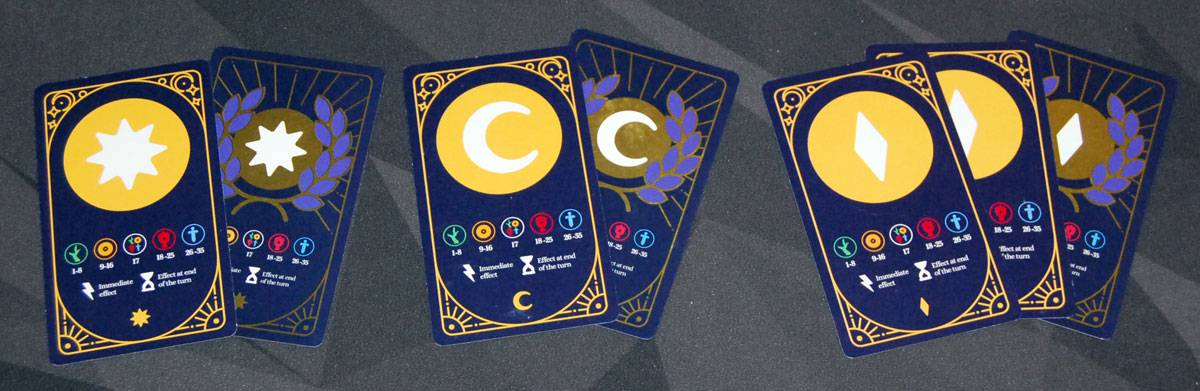
The player aid cards have a little reminder that shows you the number range for each color, and also reminders of the two types of abilities: instant (lightning bolt) or end-of-round (hourglass). The player aid cards are also used to indicate teams—there are two suns, two moons, and three diamonds. One side of the card has gold foil accents and a laurel to indicate the team has earned a point.
How to Play Omens
You can download a copy of the rulebook here.
The Goal
The goal of the game is to win two rounds; you win a round if a person on your team has only 1 card left in their hand.
Setup
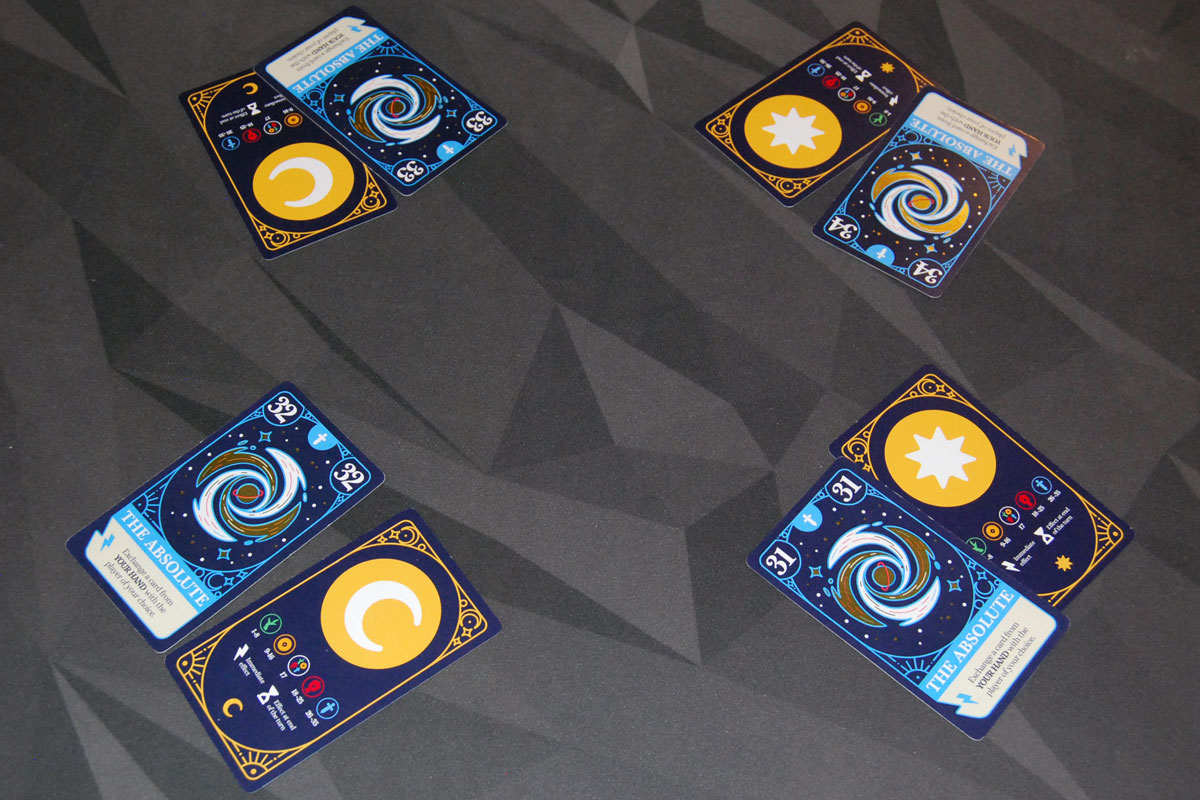
Find the 6 Absolute cards and shuffle them, dealing one to each player. (Any unused ones are returned to the box.) Reveal the Absolutes and then assign teams. If you have 4 or 5 players, the highest and lowest Absolutes are on a team, and the other two or three players are on a team. For 6 players, 30 and 35 are on a team, 31 and 34 are on a team, and 32 and 33 are on a team. The Absolutes are now placed in the players’ hands.
Distribute the player aid cards to indicate the teams: suns, moons, and diamonds. Note that once teams have been decided, they will not change for the rest of the game.
Shuffle the rest of the arcane cards and deal cards to each player.
In a 4-player game, everyone gets 4 more cards. In a 5-player game, the team with 3 players gets 4 cards each, and the team with 2 players gets 3 cards each. In a 6-player game, deal 3 to each player.
The player with the highest absolute is the starting player for the first round.
Gameplay
Play goes clockwise.
On your turn, you play one card from your hand in front of you. If it has a lightning bolt, use its effect immediately. If it has an hourglass, read the ability to everyone but it won’t activate until the end of the round.
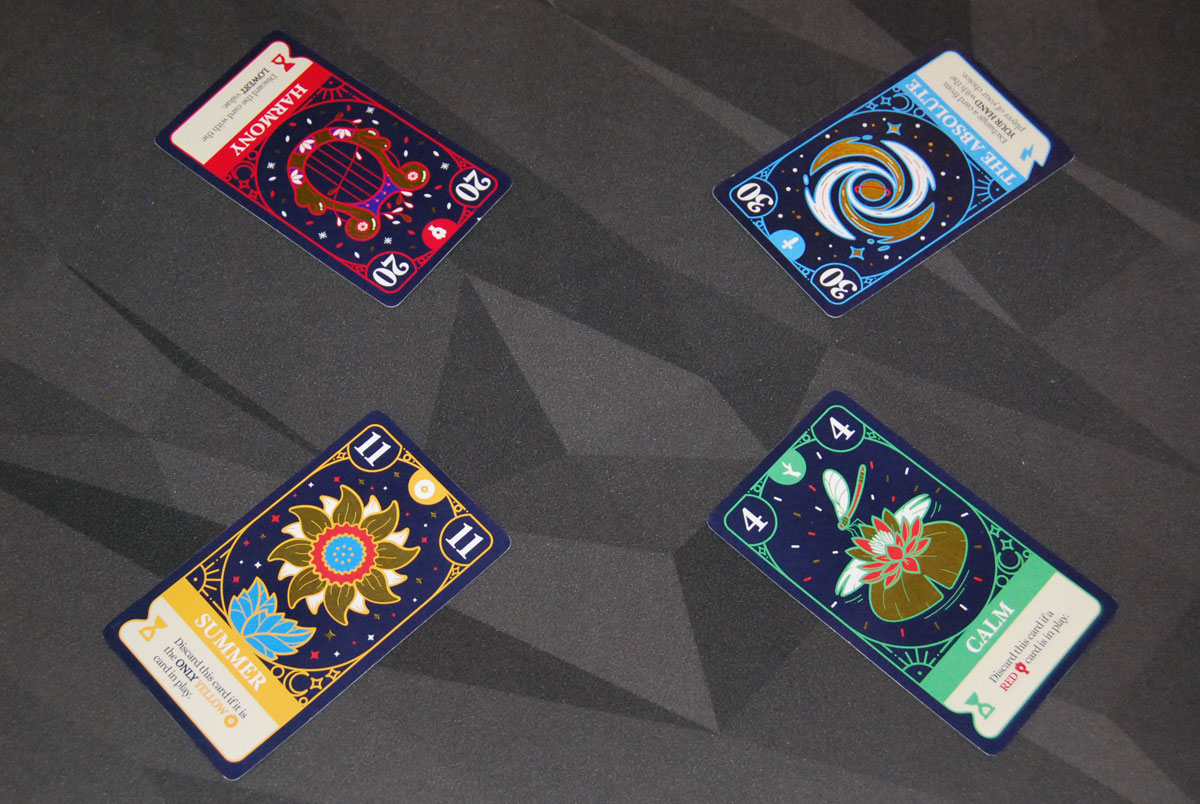
After every player has played one card, the turn ends. All of the hourglass abilities are resolved simultaneously, and you also determine the winner of the round. Typically, the player with the highest number wins the round, though there are some abilities that change this. The winner may discard the card they played.
Many other hourglass abilities allow other cards (or themselves) to be discarded if the conditions are met.
If your card was not discarded by any of these abilities or by winning the round, you put it back in your hand.
The player who won the last turn starts the next turn, unless somebody has won the round (see below).
Round End
After resolving a turn, if any player only has a single card left in their hand, then that team wins the round. If multiple players have a single card left, then they compare cards—the player with the highest value left in hand wins the round.
That team flips over their player aid cards to the victory side to indicate that they’ve won a round.
To set up for the next round, gather up all of the cards (including the Absolutes) and shuffle them together. Deal cards so everyone starts with the same total hand size as before. The player who won the last turn starts this new round.
Game End
When a team wins their second round, the game ends and that team wins!

Omens is GeekDad Approved!
Why You Should Play Omens
Omens seems like such a simple game—play a card, hope you win so you can discard it—but it has quickly become one of my favorite card games this year, and it has been a hit with just about everyone I’ve introduced it to. And since it’s just a deck of large cards, it’s extremely portable, so I’ve taken it with me on many occasions and taught it to dozens of friends and family members.
So what makes Omens so great?
At first glance it feels a little like a trick-taking game: everyone plays a card, and the highest number wins. Easy, right? You don’t even have to follow suit or anything—just play any card from your hand. The trick, of course, is in all the abilities, many of which are about discarding cards.
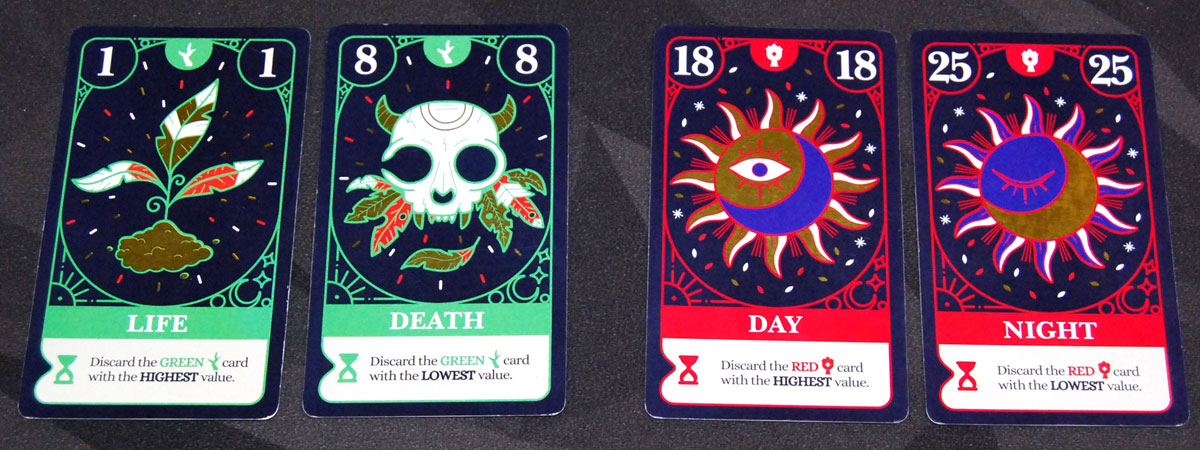
In each of the green, yellow, and red suits, there are paired abilities that will discard the highest or lowest of that color. Life discards the highest green and Death discards the lowest green—when they’re both in play, they discard each other.
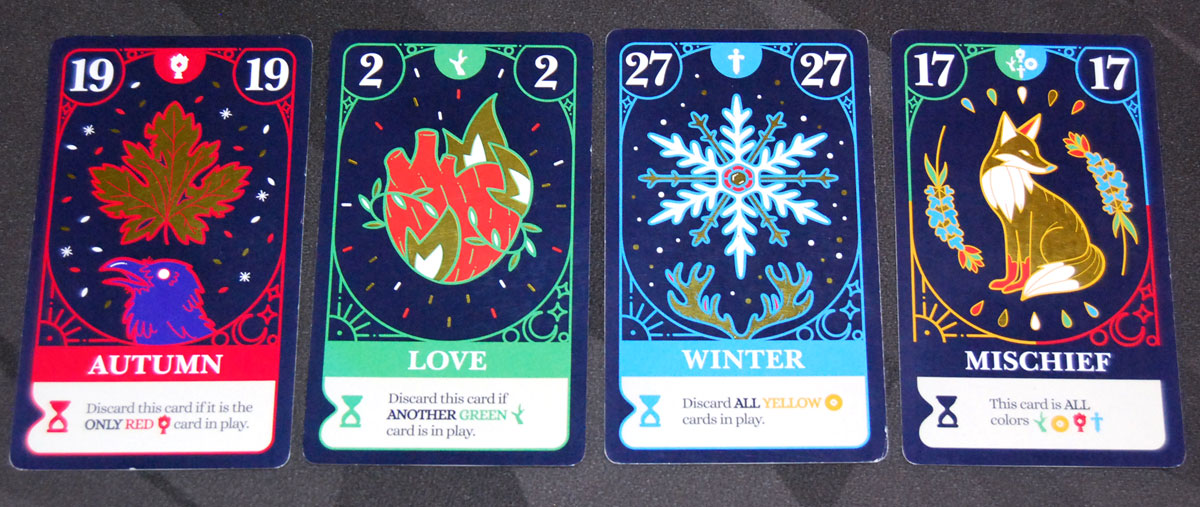
There are also cards that interact with other colors: Feast is green, but gets discarded if there’s a blue card in play; Winter is blue and will discard all yellow cards. And then there’s Mischief: it sits in the middle at 17 and is all four colors simultaneously, which can often throw off your best-laid plans.
The instant abilities are mostly on the higher valued cards, and they can be very powerful but only if you can figure out the best way to use them. Some let you change cards that have already been played, stealing them for yourself or replacing them with other cards from your hand. The Absolute cards let you exchange cards with another player—one of the only ways to share information with your partner, or else dump an undesirable card on another team (but you may risk getting something worse).
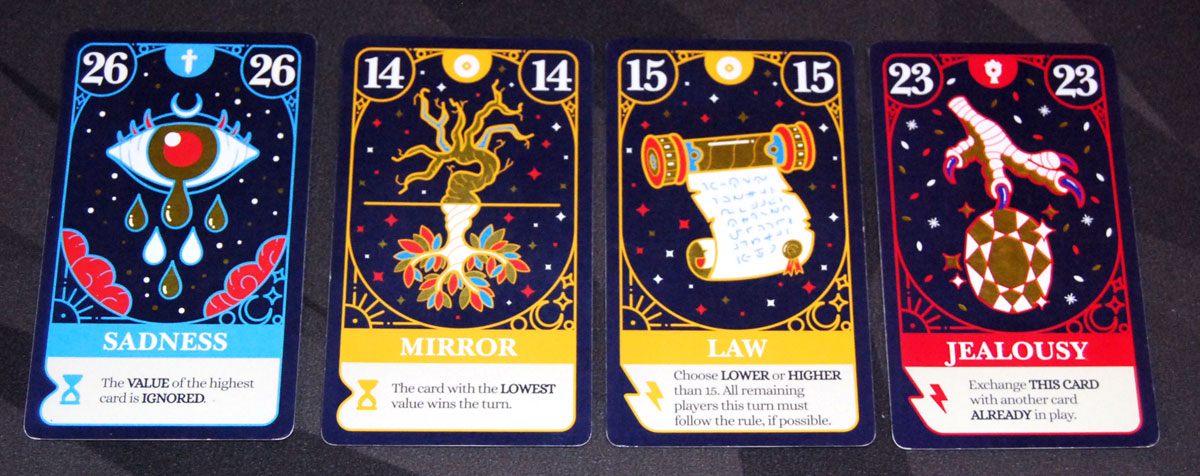
Usually the highest card wins—but Sadness ignores the highest card so the second-highest wins instead. That is, unless Mirror is in play, in which case the lowest card wins.
Although there are 30 unique abilities in the deck, there are a lot of similarities, so by the second or third time through the deck, you start to understand the patterns. This is the sort of game that rewards repeat plays, because as you learn what abilities exist in the game, you’re able to start strategizing about how to use your cards, how you might help a teammate, and so on.
The goal is to get rid of cards, but it’s important to remember that only one teammate needs to get down to 1 card for you to win the round. Sometimes it’s better to assist your teammate than to discard a card yourself. Failing that, you can try to prevent the other team from discarding anything.
Another fascinating aspect of the game is the self-balancing effect: if your team is ahead, it means you’ve discarded cards, which means you have fewer options at your disposal. Meanwhile, every card that gets played but doesn’t get discarded can be used again. In a 5-player game, the teams start with different hand sizes: the team with more players also gets more cards per player; they have more options, but they also have to discard more cards to win the round.
Since the teams are randomly determined at setup, it also means that it’s quite possible that you end up seated next to your teammate. (In fact, in a 4-player game, it’s more likely that you’ll be sitting next to your teammate than across from them.) The turn order can have weird effects the gameplay. Going last usually gives you the most control over a turn because you can see what everyone has played already, but there are also some cards that throw that on its head too.
I think one of the great strengths of Omens is that it works for a broad audience. Each individual card is generally easy enough to interpret that you could consider it just a step up from Uno, so folks who typically play simple, casual games don’t feel immediately overwhelmed by it. (Though I will note there are a few more complex abilities—these have more detailed explanations on the rule sheet.) But even with those simple card effects, there’s an emergent complexity that more experienced players will start to grasp after a round or two. There have been multiple times when I’ve introduced Omens to a group and by the second round somebody says “Ohhhh, I see!” and then immediately places an order for a copy of the game for themselves.
The biggest limitation of Omens is that it requires at least 4 people to play. A lot of the strategy comes in the interplay between you and your teammate(s), remember what cards they’ve played in the round but haven’t been able to discard, and figuring out how to help them, so it doesn’t work without at least two people per team. If you don’t consistently have at least 4 people in your gaming group, then you won’t be able to get this to the table. (There is an unofficial 2-player variant designed by a fan, though it won’t have quite the same feel.) However, if your gaming group is usually 4 to 6 players, this could make a fantastic addition to your game night rotation.
To order a copy, check with your local game store, or visit the Hachette Boardgame USA website. (Hachette is currently having a warehouse sale, so you can grab Omens and some other great titles for a discount!)
Click here to see all our tabletop game reviews.
 To subscribe to GeekDad’s tabletop gaming coverage, please copy this link and add it to your RSS reader.
Disclosure: GeekDad received a copy of this game for review purposes.


Jonathan H. Liu

Jonathan H. Liu is a stay-at-home dad in Portland, Oregon, who loves to read, is always up for a board game, and has a bit of a Kickstarter habit. I can be reached at jonathan at geekdad dot com.


