
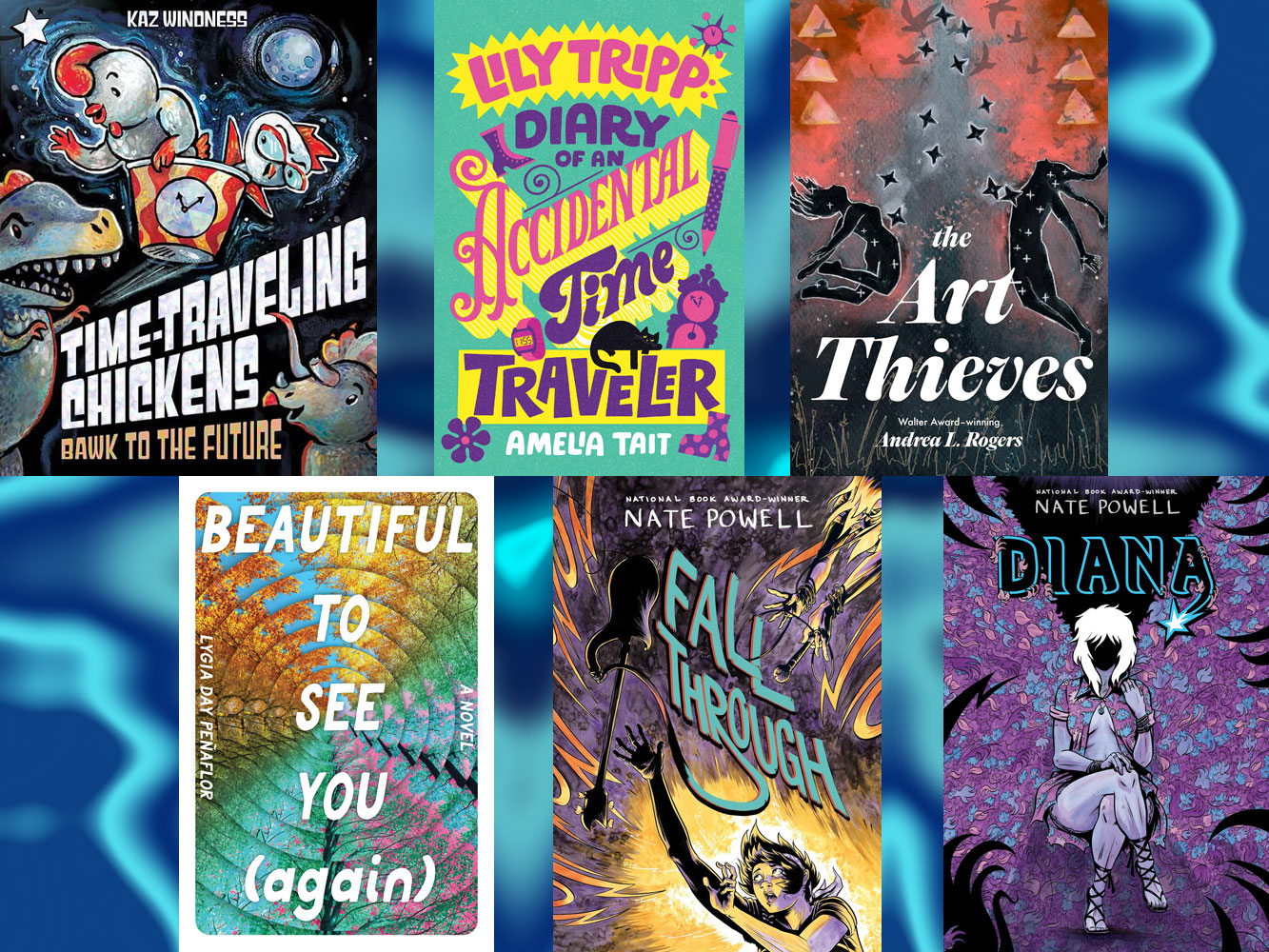
I’ve finished reading several time travel books in the past couple of weeks, so let’s take a few trips! We’ve got chickens, musicians, kids, and artists, all finding their way through time in various ways.
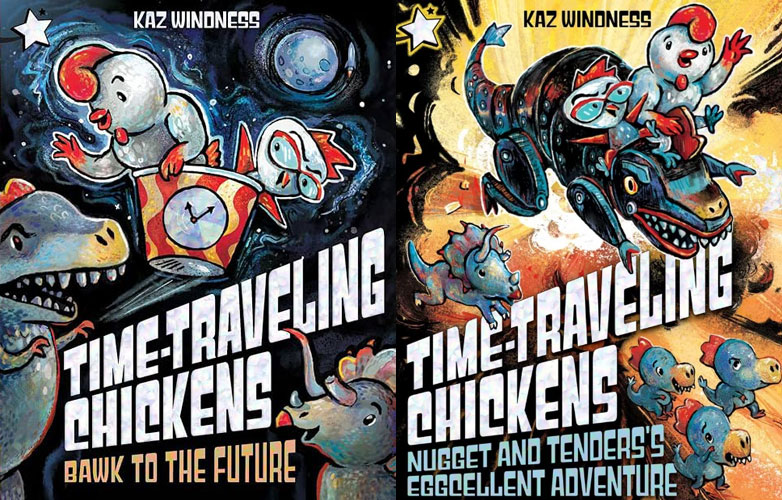
Time-Traveling Chickens: Bawk to the Future and Nugget and Tenders’s Eggcellent Adventure by Kaz Windness
These two are short kid’s graphic novels, with two chicks named Nugget and Tender, escapees from the Super-Secret Lab. They’re supposed to be part of a mindless edible chicken army, hatched by Big Chicken (the industry, that is, not a giant hen) for world domination—but thanks to a strange mixup, the two chicks are now super-intelligent. After breaking out of the Big Chicken Lab, they make their way to the Super-Secret Time Travel Lab, hop into the Time B.U.C.K.E.T., and take a trip to the late Cretaceous period where they meet their distant ancestor, T. Rex. Meanwhile, Dr. Dipping-Sauce, the scientist who was supposed to be in charge of them, is trying to catch them—or her own head is on the line!
The series is quite silly, but there’s actually a pretty sophisticated consistent time-loop sequence in the first volume reminiscent of Bill & Ted. Kind of ironic, given that the parody title for this one is Bawk to the Future, which uses the changeable future type of time travel. The second book, due out in November, is called Nugget and Tenders’s Eggcellent Adventure. It does share some commonalities with Bill & Ted in that the two chicks travel through history and assemble a team of incredible women, because somehow Dr. Dipping-Sauce has interfered with their plans to fix history. This one involves more “taking over the world” plans from Mr. Kernel of Big Chicken, a robotic T. Rex, and a few other allusions to other time-travel stories. I wouldn’t be surprised if we see more of this series … in the future.
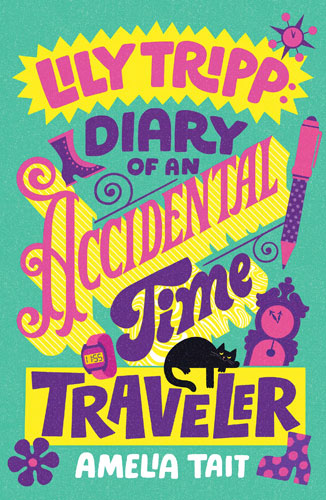
Lily Tripp: Diary of an Accidental Time Traveler by Amelia Tait
I mentioned this one back in my August time travel column because I’d just started it. For the past few years, Lily Tripp has woken up on New Year’s Day (which is also her birthday) in a totally different time. But this isn’t the case where she’s gone back into the past by herself—it’s actually more like the whole world has shifted, because her family and classmates are all there too, recast into new surroundings. The thing is, Lily seems to be the only one who remembers the different timelines—for everyone else, it seems like they’ve always been in whatever era they’re in. And although the others may not remember the exact events that happened in any given era, they seem to retain the general mood of the interactions.
At the start of the book, Lily is hoping that now that she’s turning thirteen, maybe this involuntary time travel will finally settle down. It probably comes as no surprise—given the title—that she’s still hopping through time. The book combines some of your familiar middle school themes (the popular mean girl, some difficulties with a best friend, mooning over that one boy) with Lily’s time-hopping. She soon learns that being called a “witch” has very different consequences in the 1620s than it does in the 2020s, and that what’s considered popular fashion is always just a little strange. And then there’s Joey, this one kid who always seems to be stuck at a similar social class as Lily no matter when she ends up. Lily is extremely mad at Joey because he got her in trouble a while back and she still hasn’t forgiven him—but he also seems to understand her better than her crush, Ollie.
It’s a cute story, even if the time travel is never explained—but there is a second book coming in March, so maybe we’ll get some more answers then. At the end of the book, there’s a little section that explains what’s real from Lily’s diary, like some of the strange customs that she encounters or what things were like in the 1970s.
The Art Thieves by Andrea L. Rogers
This story is set in 2052, and earth isn’t doing so great. The ultrawealthy have moved off-planet rather than deal with the effects of climate change, but the one upside is that some Native Americans have actually gotten some of their land back. Stevie Henry is Cherokee and she hopes to go to college but for now she’s getting by, working at a museum in Texas. When an “indigenous” artist arrives at the museum for an internship, Stevie is a little skeptical: where is this guy from? Who are his people? Then she meets him in person, and despite herself she finds that she really connects with him.
So what about the time travel? And who’s stealing art? Well, the book opens with a crypic email from Stevie to her lawyer auntie, explaining that she did not kill Levi (her half-brother) and that there’s a plague coming. That’s the hint that something odd is going to happen, but then the story starts and it’s this story about climate change and a slowly blossoming romance, about Stevie being unable to drive because of some traumatic event, about queer friends and their intolerant parents, about well-respected men who overstep the boundaries. It’s not until nearly halfway through the book when anyone mentions time travel at all.
Of course, if you go into it expecting an “apocalyptic time-travel love story,” as the cover describes it, then you’ll be looking for it, and it’s not too hard to figure out that Adam, the intern, is actually from the far future. But what he’s doing there, and why, is very much tied up in his Indigenous roots (which he couldn’t explain because his own parents haven’t even been born yet in 2052). There’s a disaster looming on the horizon, and Adam has a particular mission to accomplish, but his relationship with Stevie has also shifted his perspective about it.
It’s a beautifully written book about a world that’s falling apart, but still manages to find hope—both in the present and for the future.

Beautiful to See You (Again) by Lygia Day Peńaflor
Then: Tia finally noticed Natty when he gave his speech as the high school valedictorian, and soon the summer felt too short, a countdown to the time when Tia would head to Columbia and Natty would go to MIT.
Now: Tia is a college dropout, working as a dog walker in New York City, trying to convince her parents that she’s doing fine even though her life has totally fallen apart. Something tragic happened at the end of the summer, and it destroyed her.
Then she discovers a strange tunnel in Central Park, where a strange man stands ringing a bell, and discovers that she can travel back in time to relive pieces of that summer, to see Natty again. But she’s only there as a ghost, and when she tries to warn Natty and her younger self, she’s unable to communicate. How can she prevent the disaster and fix her life?
Meanwhile, in the present, she’s caught the eye of Razor Ford, a film student from Columbia who wants to cast her as the girlfriend in his autobiographical movie about a break-up. When she takes on the role, she feels like Razor brought her back to life, but she’s still torn between this new friendship and her old ties to Natty. The book takes its time bouncing back and forth between the past and present, and getting us closer and closer to the day of the tragedy—we get to see a lot of the sweet moments that Tia had with Natty. At first I wasn’t sure what to make of Razor, but his story arc also ends up being really fascinating (but I don’t want to give away spoilers). The movie that he’s been making has more significance than Tia can understand at first, and we get to “watch” the whole thing with her near the end of the book, where we finally see how all the pieces fit together.
One thing that felt a little tricky about the book is that it uses a partially omniscient third-person narrator. So it’s not the characters telling their own stories, and you don’t always know what every character is thinking, but it does shift from one character to another for some chapters. That can be a little disorienting when you’ve just been seeing things mostly from Tia’s perspective and getting some of her inner thoughts, but then it starts describing things from Natty’s point of view, all while still using the same third-person voice.
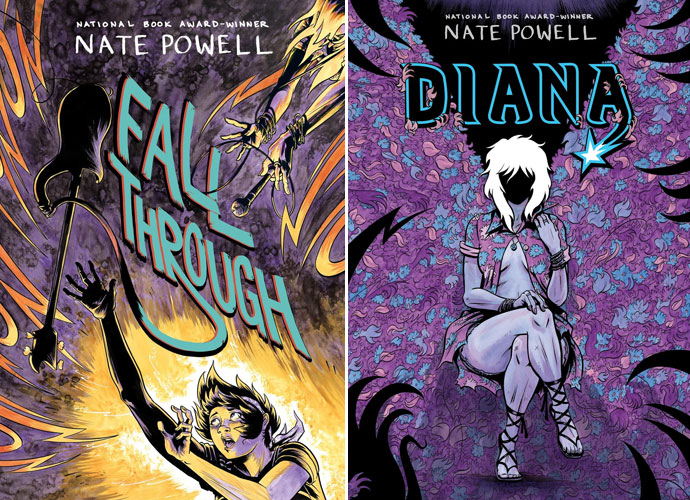
Fall Through and Diana by Nate Powell
I started reading these graphic novels thinking they might be a good fit for my creepy comics column from last week, but then I realized they kind of bridged the gap between that and time travel. I actually read Diana first, before remembering that I had a copy of Fall Through that had, well, fallen through the cracks. The two books are actually a triptych along with Come Again (which I haven’t read yet). Apparently the ordering of the books is Come Again, Fall Through, Diana, and Fall Through. Yep, nothing is straightforward when it comes to time travel.
The books are, above all else, about the punk music scene, though the time frame gets a little hazy. 1979. 1994. Fall Through is mostly centered on Jody, the bassist for a band called Diamond Mine and Diana focuses on the lead vocalist, though there is of course a lot of overlap between the two. Several of the bandmates live together in a big house that also hosts other punk bands traveling through, and they spend a lot of time on tour, crammed into a beat-up van, sleeping wherever other punks will put them up.
But Diana isn’t just writing songs—she’s weaving spells into them, and when they perform, the band is sucked through weird time warps, though most of them don’t seem to realize it at the time. Jody can’t really remember much of her life before adulthood for some reason. Diana seems to be searching for a dear friend who vanished. Things come crashing together when the band figures out what Diana is doing.
And, like I said earlier, it’s also got its creepy parts—when Diana hits the spell portion of her song, the audience’s faces turn into grotesque masks, and sometimes Diana herself has a similar face. At other times Diana’s shadow becomes a monster, grasping at her with tendrils, and you can see there’s something dark lurking below the surface. She’s looking for something, and seems ready to try anything, whether her bandmates agree with her or not.
I will admit that some of the story was a little hard for me to follow at times, but Powell is great at conveying the feel of the punk scene, of which he was a part himself—a bunch of young people rejecting conventions but who didn’t always know what they were for, a community that looked out for each other and scraped by with no budget. The musical scenes are powerful and full of energy and you can practically hear them.
Disclosure: I received review copies of these books. Affiliate links to Bookshop.org help support my writing and independent booksellers.


