
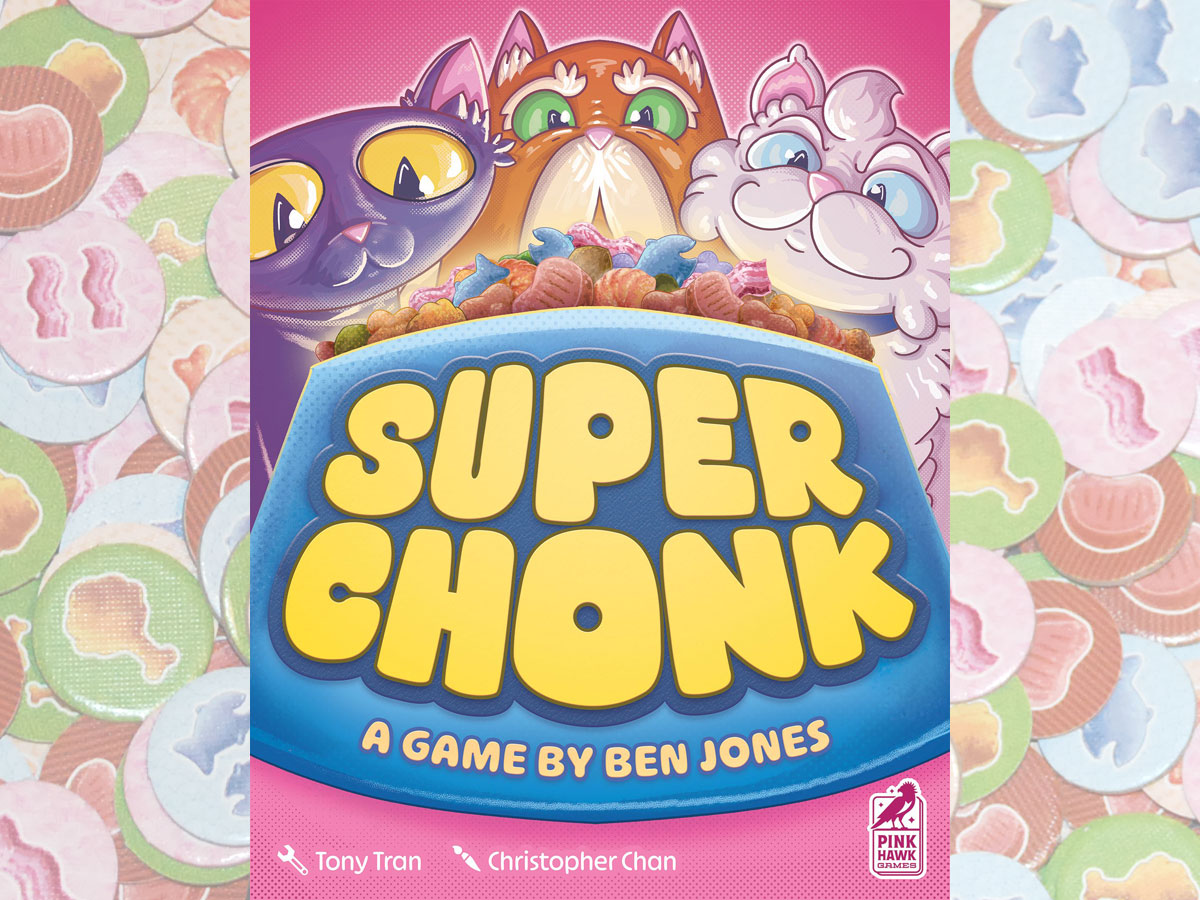
Timing your visits to the food bowls is crucial if you want to become a super chonk!
What Is Super Chonk?
Super Chonk is a quick game about hungry kitties for 2 to 6 players, ages 8 and up, and takes about 15 minutes to play. It’s currently seeking funding on Kickstarter, with a pledge level of $19 for a copy of the game, which will also include the Chaos promo pack. An Extra Chonk expansion is available as an $8 add-on, and there are also tiers to bundle it with another upcoming cat-themed game, Good Kitties (which I’ve also reviewed today!).
Super Chonk was designed by Ben Jones and published by Pink Hawk Games, with illustrations by Christopher Chan.
New to Kickstarter? Check out our crowdfunding primer.
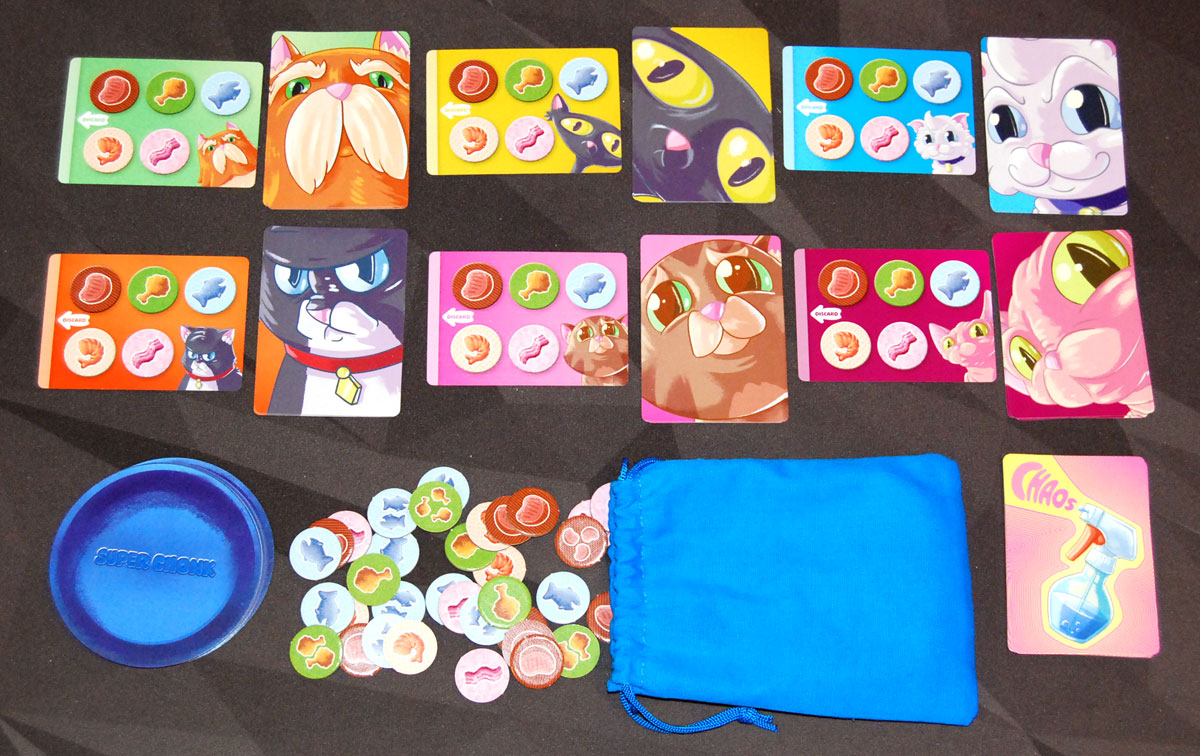
Super Chonk Components
Note: My review is based on a prototype copy, so it is subject to change and may not reflect final component quality.
Here’s what you get:
- 6 Cat decks (4 cards each)
- 6 Player mats
- 120 Kibble tokens:
- 28 Beef
- 26 Chicken
- 24 Fish
- 22 Shrimp
- 20 Bacon
- 15 Bowls
- 8 Chaos Cards
- Cloth Bag
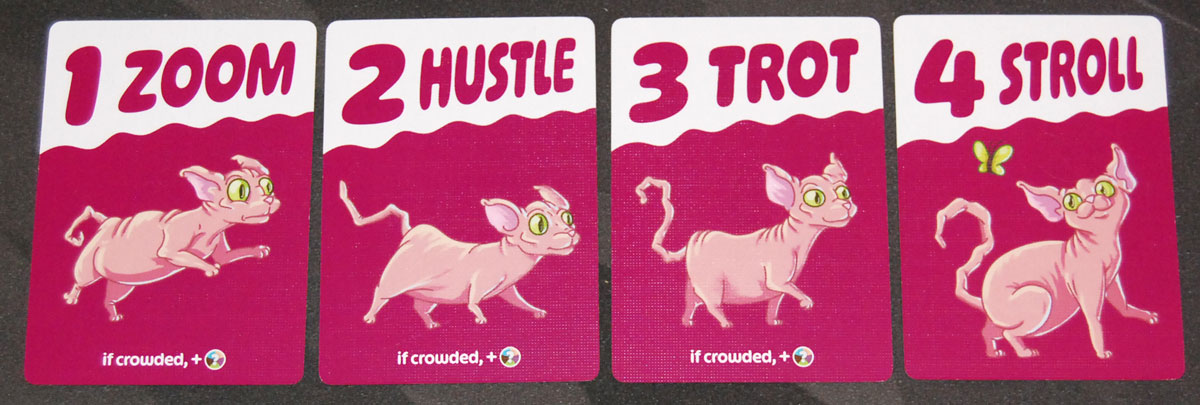
Each player has the same four cat cards, though they’re illustrated with the different cat characters, who are full of personality. The cat cards are labeled 1 to 4 and represent how quickly you’re rushing to the bowl, from “zoom” to “stroll.” The player mats are cards, each showing the portrait of the cat in the corner, with five spaces to stack the kibble tokens.

The kibble tokens show the various foods, and each one can have 1, 2, or 3 units of the same food on it. The bowls are round cards—each one has another kibble token printed in the center, and lines around the rim dividing it into seven sections.
How to Play Super Chonk
You can download a draft of the rulebook here. The 2-player game is a bit different, so I’ll explain the 3+ player rules first.
The Goal
The goal of the game is to score the most points by eating kibble! But you also have to be careful what you eat because you’ll throw up whatever you eat the most of.
Setup
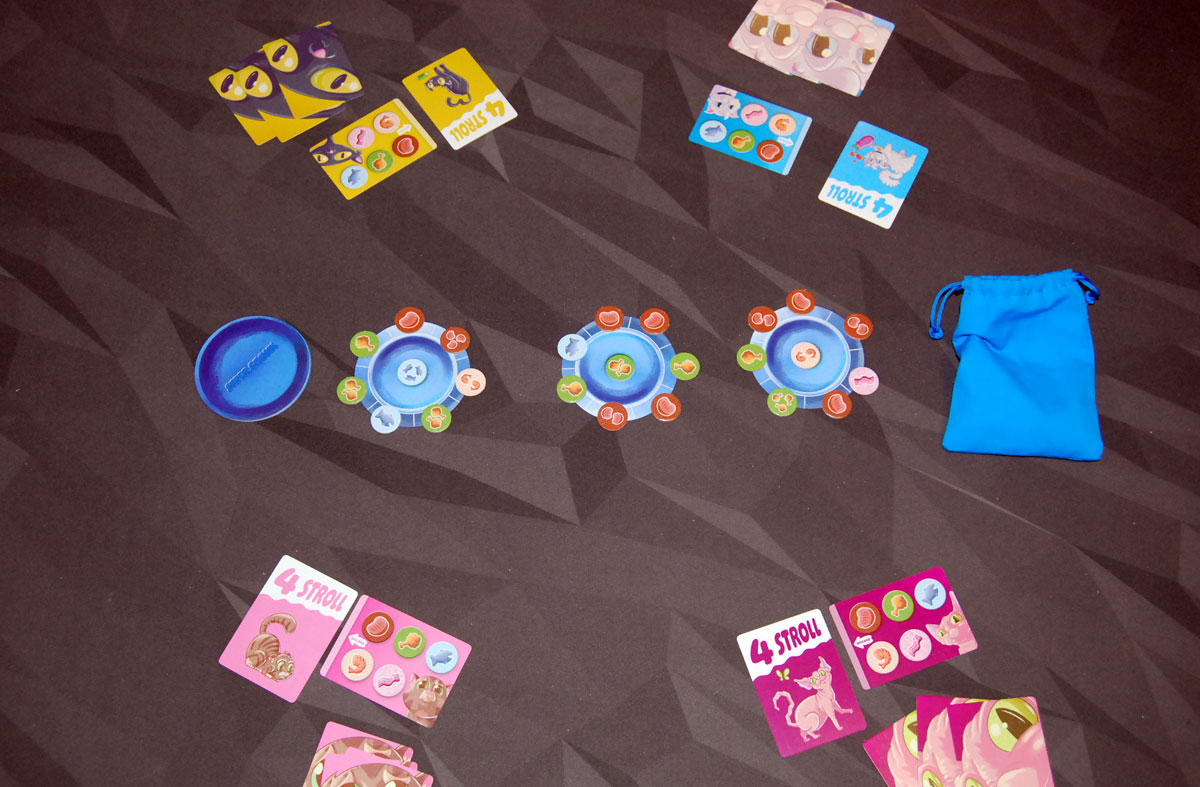
Put all the kibble tokens in the bag, and make a face-down stack of bowls based on the player count.
Give each player a player mat and the 4 cards matching their cat. Everyone places the “4 Stroll” card face-up next to their player mat, in the discard space indicated by the arrow.
Place a number of bowls (based on player count) in the center of the playing area with room around them for cards. Draw kibble tokens from the bag and place 7 tokens around the edge of each bowl.
Gameplay
Each round, secretly choose a card—the lower the number, the faster you are racing to a bowl. Place your other cards face-down in your discard area. Then, mentally select a bowl. When you’ve chosen a bowl, say “meow.”
Once everyone has said, “meow,” do a countdown, and then everyone simultaneously places their chosen card next to their selected bowl.
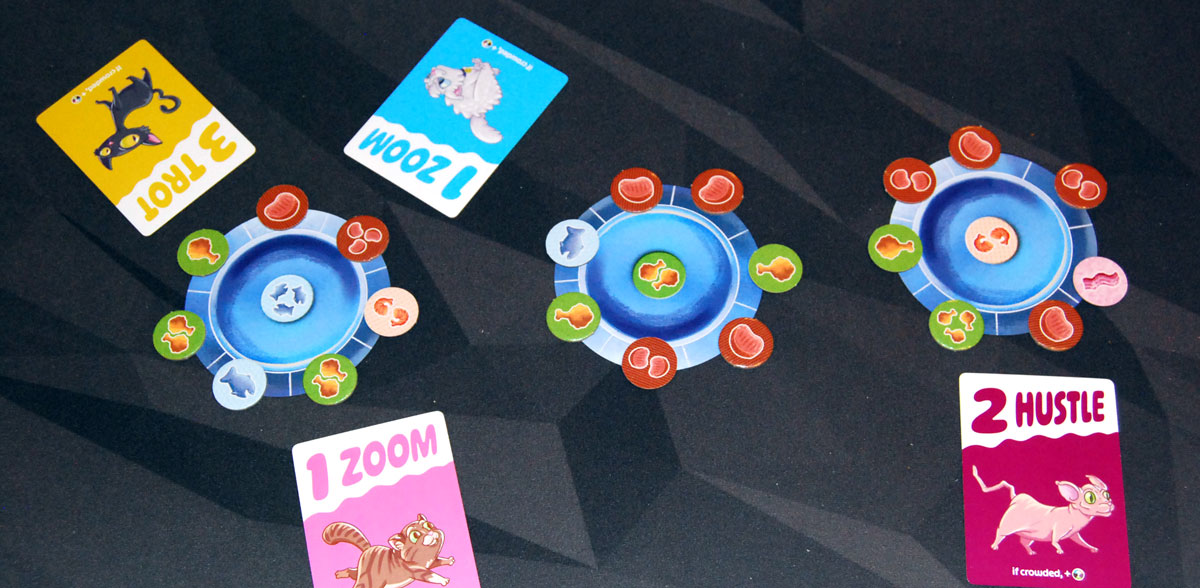
Each bowl is resolved to see who gets kibble. If you played the same number as another player at the same bowl, you bonk heads—draw a random kibble from the bag but don’t take any from the bowl. Otherwise, cats at each bowl get to eat from 1 to 4. The number on your card also indicates how many kibble tokens you may take from the bowl. (Special note: if there’s more than one cat at the bowl, it is “crowded,” and cats that played 1, 2, or 3 get to take an extra kibble.) Place any kibble you’ve collected into stacks on your player mat. Note that you’re not allowed to count the kibble in your stacks during the game!
If there’s no more kibble in the bowl when it’s your turn, too bad—you were too slow.
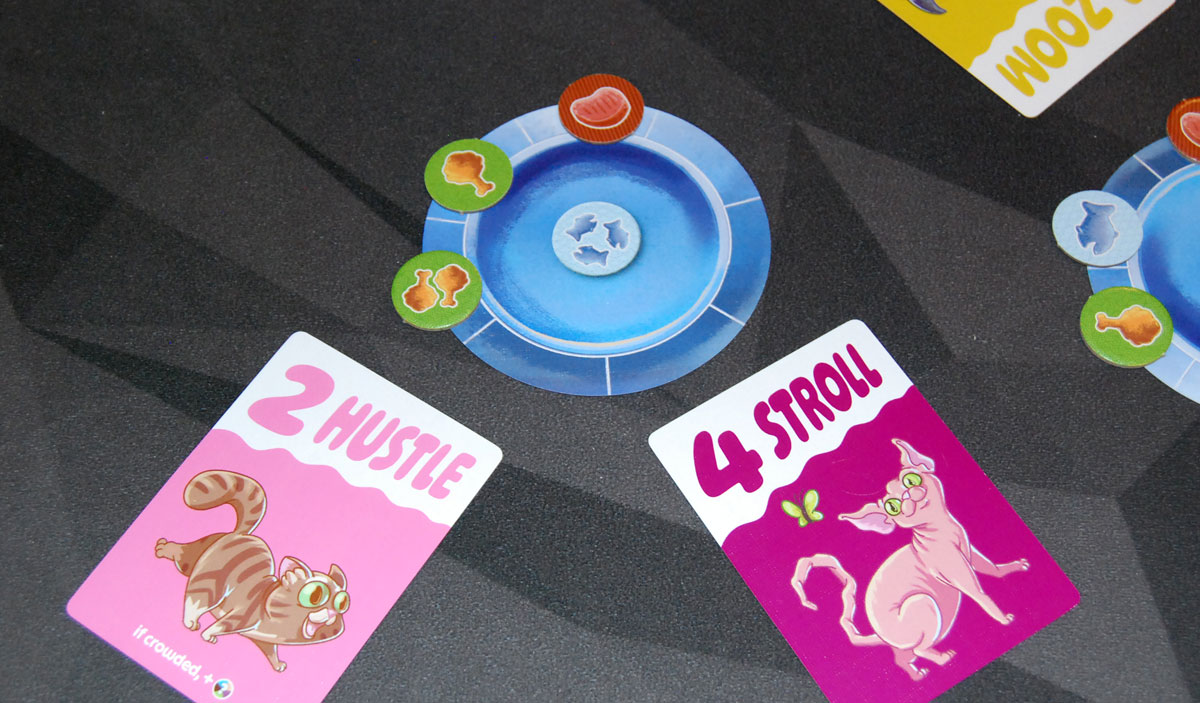
When a bowl becomes empty, the cat with the highest number at that bowl gets to “lick the bowl,” taking the card and placing it in their own scoring pile.
At the end of the round, pick up the three cards in your discard pile, and discard the card that you played this turn face-up.
If any of the bowls were taken, draw a new bowl from the stack (if there are any left) and fill it with kibble. (Do not refill the partially empty bowls!)
Repeat!
Game End
The game ends when all of the bowls have been licked clean.
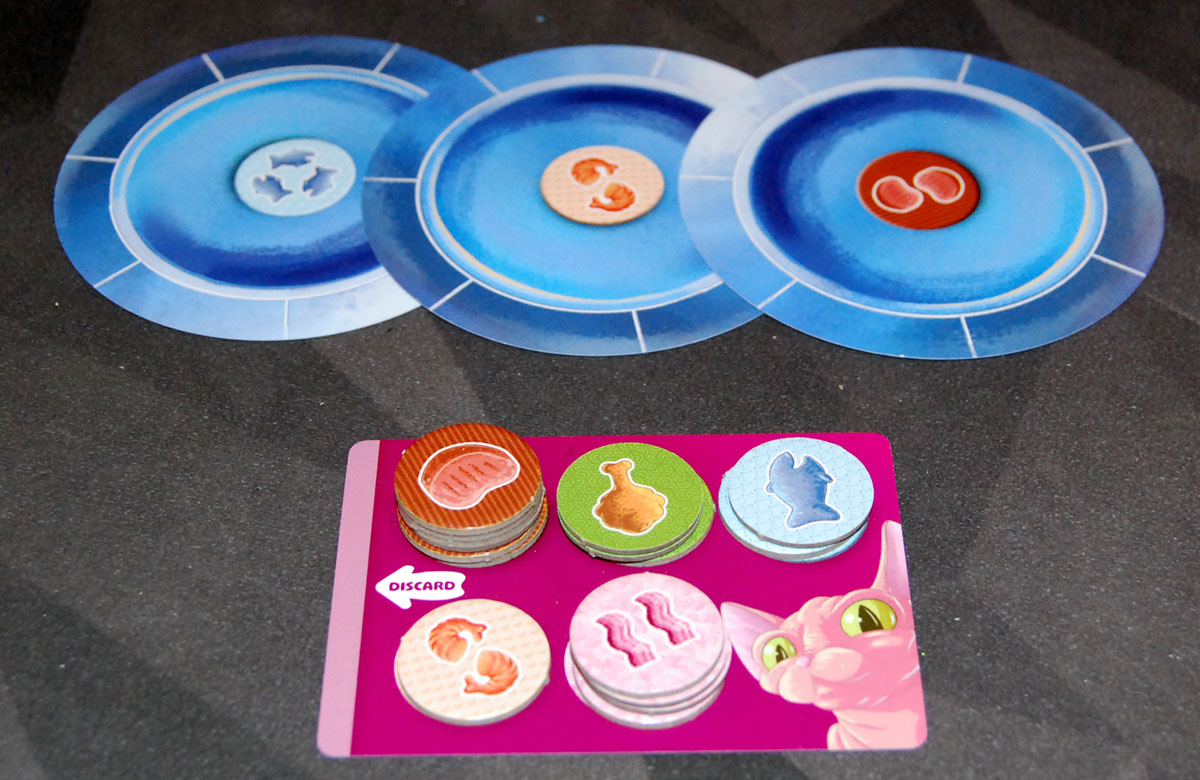
Before scoring, all the cats throw up (of course). You must discard your tallest stack of tokens, along with any bowls that match that kibble type. Note that you throw up based on the number of tokens, not the total number of items on those tokens. If there’s a tie, you choose one.

Then add up all of your remaining kibble—it’s worth 1 point per icon on both the tokens and the bowls. The player with the highest total has eaten (and kept down) the most and is declared Super Chonk! Ties go to the player with the fewest bowls.
2-Player Mode
In a 2-player game, you do not use the “1 Zoom” cards. The stack has 8 bowls, and you reveal 3 bowls at a time.
Each round, each player will play two of their cards to two different bowls. Set the card you aren’t playing face-down to the side, and then after the countdown place your two cards next to the bowls you selected. Resolve the bowls as in the regular game.
At the end of the round, all of your cards are returned to your hand.
The game ends when there are 1 or fewer bowls left to eat from—that bowl is discarded. There isn’t any throwing up.
Check each kibble flavor and see who has more of it—that player wins that flavor. The player who wins more flavors wins the game.
Chaos Cards
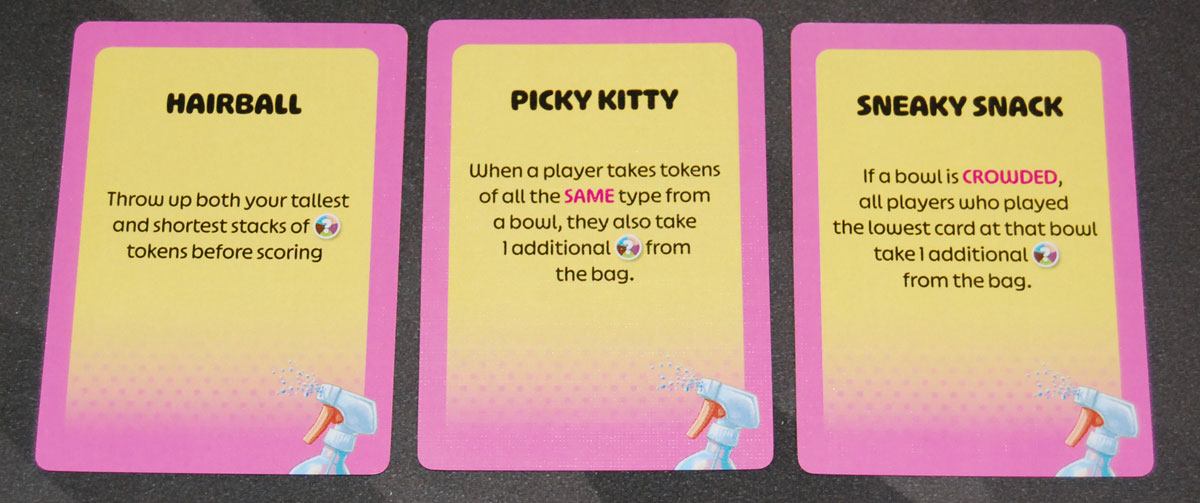
The Chaos cards are for advanced mode—at the beginning of the game, shuffle the cards and draw one—it will introduce a new change to the rules for the game.
Why You Should Play Super Chonk
Super Chonk is a funny, quick game that does a pretty good job playing out its story: you’re all racing for the food dishes and trying to eat the best kibble. The kitty that gets to a bowl first gets first pick, but if you arrive at the same time then you bonk heads. And you’re encouraged to have a balanced diet, because at the end of the game, you’ll throw up your biggest stack, so you don’t want to waste a lot of effort eating things that won’t score at all.
That said, it does raise some weird questions, too. Why do you get a food from the bag instead? Not entirely clear, but better in terms of gameplay than losing out entirely. Why do later cats get to eat more than early cats? Presumably because they’re not exhausted from zooming over. Why do you get more food when there are other cats at the same bowl? I guess you’re all greedy little goblins.

Really, though, those questions aren’t all that important—just get that food! The interesting aspect is deciding which bowl to go for, and how quickly to get there. One important factor is that everyone has one card in their discard pile, so you know what number they can’t play each round. If you’re trying to avoid bonking heads, you can go for a number that more players have in their discard. As for which bowl to choose, that depends on the food available. Since you’re going for a balanced diet, you can glance at what the other cats have eaten so far and assess whether it’s likely they’re headed to the same dish as you. The limitation is that some foods are rarer than others—it’s a lot harder to get bacon than beef—so there is a bit of an incentive for everyone to go after the less common foods.
Then there’s the “licking the bowl”: if you have the highest number, you’ll get to take the bowl if it empties. However, the later cats often don’t get to eat the full number on their card because the bowl runs out so quickly. Is it worth just getting the bowl, or are you better off grabbing more kibble? (The bowls don’t add to your stack for throwing up, but they still get discarded if you lose that food type.)
Super Chonk reminds me a bit of another family favorite, Go Nuts for Donuts. That’s another game where everyone is choosing simultaneously what they want to eat, but in that one, choosing the same donut as somebody else means it’s smushed and thrown away entirely. Super Chonk does away with the various varieties that score in different ways, but adds the multiple bowls so that not only do you choose what you want to eat, you also choose how quickly you want to get there.
I did try the 2-player game and while it works, I didn’t enjoy it as much as playing with 3 to 6 players. Choosing two cards and two bowls each round feels a little overcomplicated for what should be a quick, silly game. While the scoring in the 2-player game isn’t very complicated, it’s still more involved than “count up all the food.” I think it’ll be fine as an occasional play when you’ve only got 2 people, but it really shines when you have the chaos of lots of cats.
For more information or to make a pledge, visit the Super Chonk Kickstarter page!
Click here to see all our tabletop game reviews.
 To subscribe to GeekDad’s tabletop gaming coverage, please copy this link and add it to your RSS reader.
Disclosure: GeekDad was loaned a prototype of this game for review purposes.


