
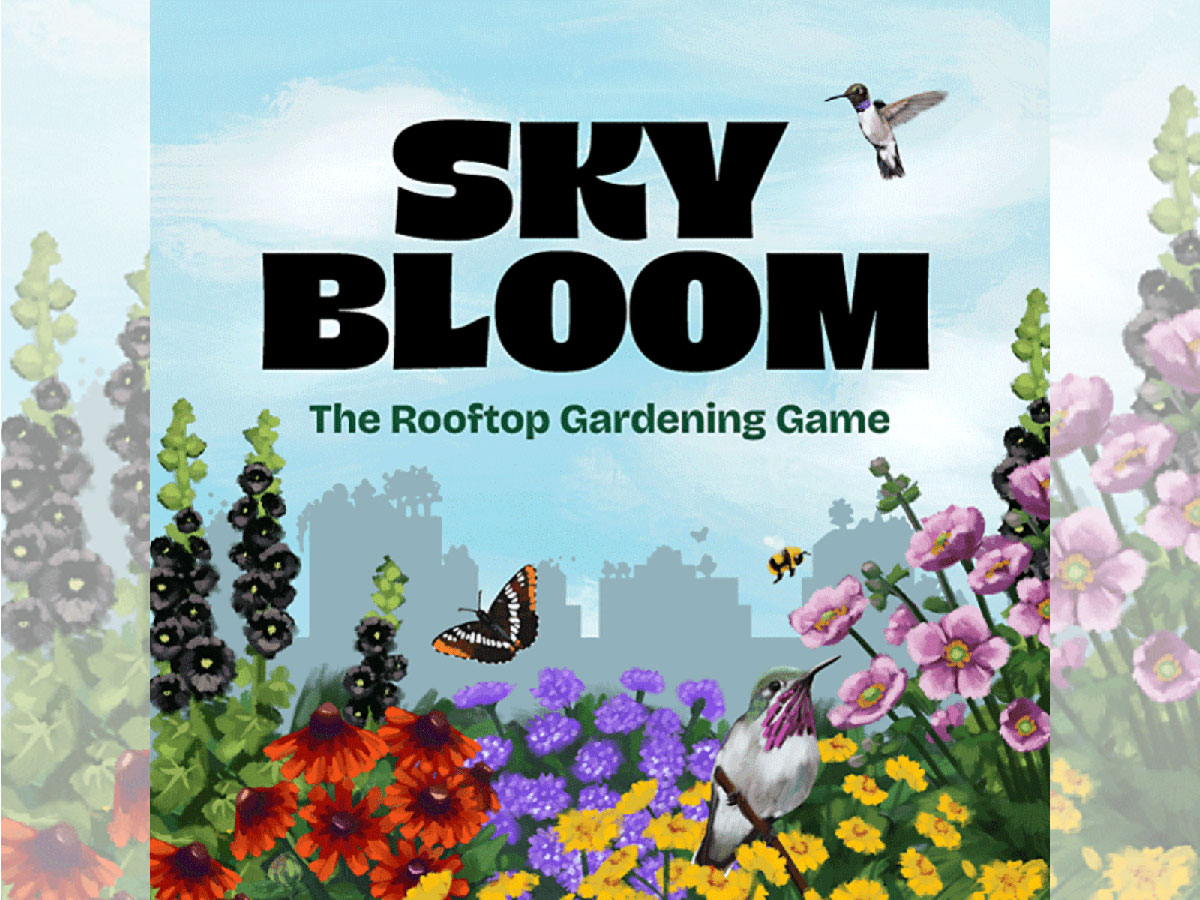
Build your rooftop garden and attract bees and other pollinators!
What Is Sky Bloom?
Sky Bloom is a gardening game for 1 to 5 players, ages 14 and up, and takes about 45 minutes to play. It’s currently seeking funding on Kickstarter, with a pledge level of $55CAD (about $40USD) for a copy of the base game; there are additional tiers that include a mix of expansions and upgraded components. Although the box says 14+, I think younger kids with some gaming experience should be able to learn it, and the subject matter is family-friendly.
Sky Bloom was designed by Mack Flavelle and published by Merchants of Play, with illustrations by Jennifer Hicks.
New to Kickstarter? Check out our crowdfunding primer.
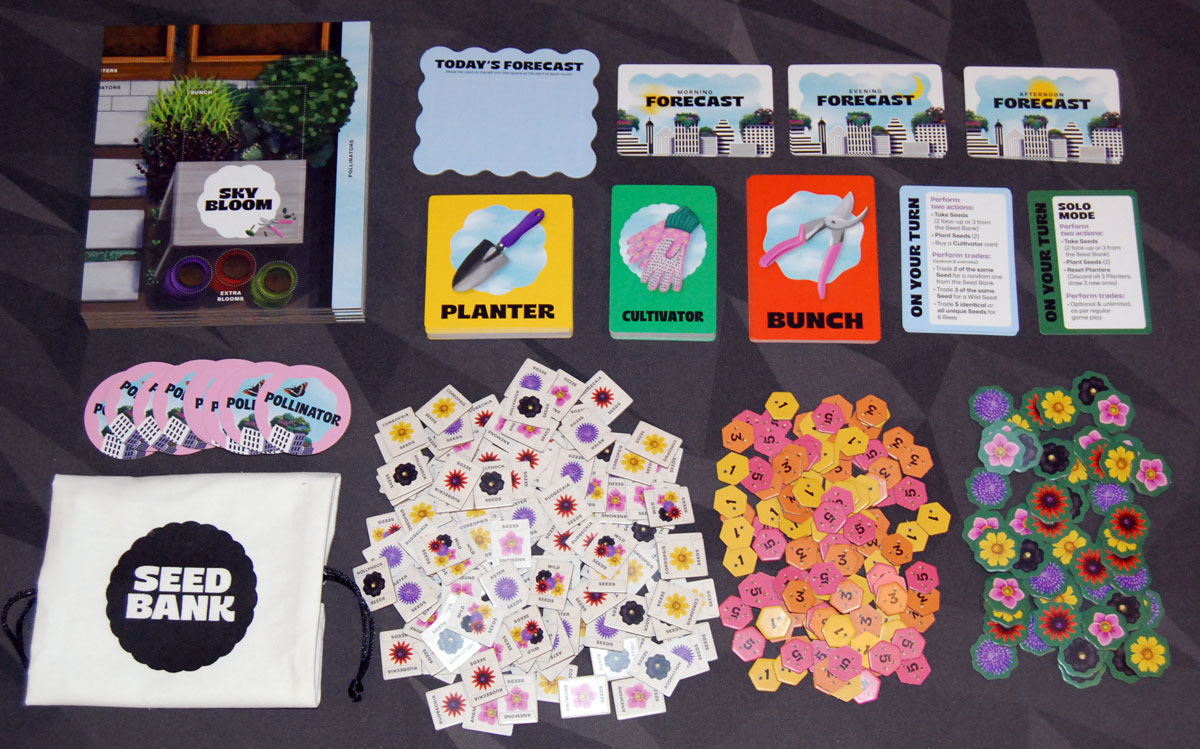
Sky Bloom Components
Note: My review is based on a prototype copy, so it is subject to change and may not reflect final component quality.
Here’s what comes in the box:
- 5 Player boards
- Forecast Indicator tile
- 18 Forecast cards
- 30 Planter cards
- 30 Cultivator cards
- 12 Bunch Cards
- 5 Player Aid Cards (solo mode on the back)
- 10 Pollinator tiles
- 10 Wooden Pollinator meeples (not pictured)
- Seed Bank Bag
- 132 Seed Packet tokens
- 120 Bee tokens
- 60 Sky Bloom tokens
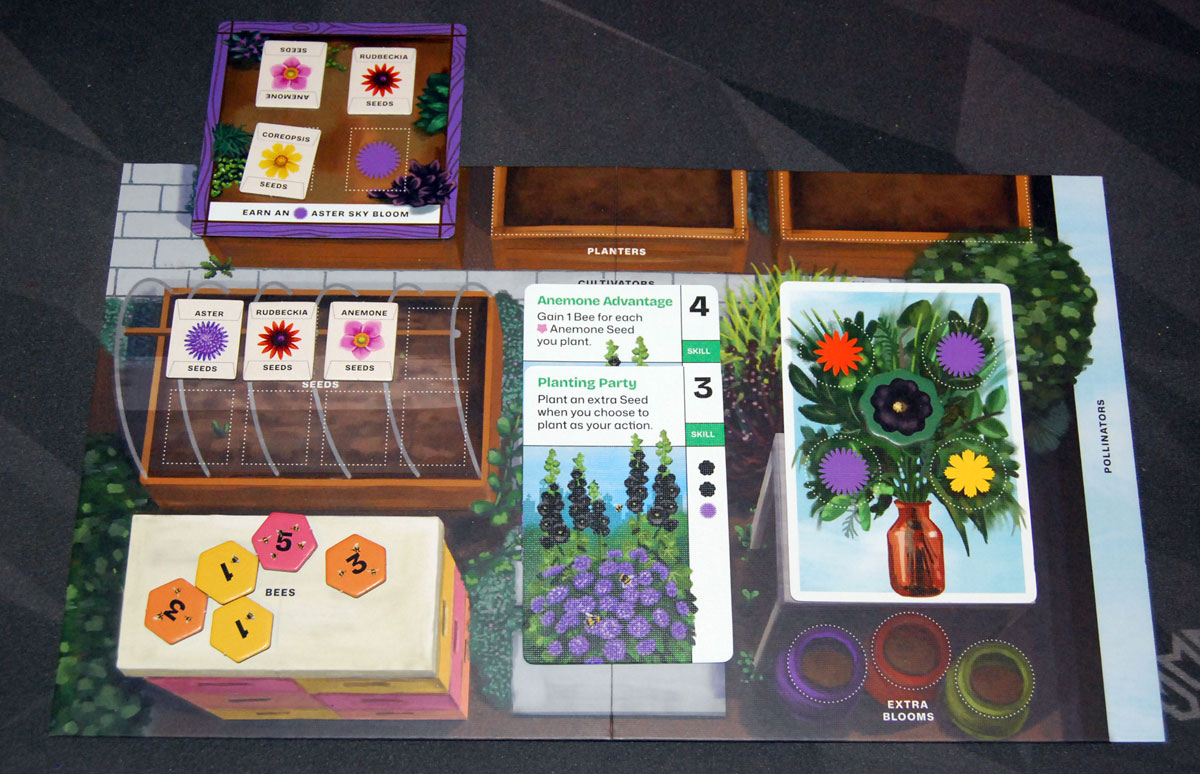
The player boards depict a rooftop, with spaces for planters at the top, a little raised bed for seeds, some beehives for your bees (point tokens), and a table for your “bunch,” a card that depicts a flower put with several flowers in it.
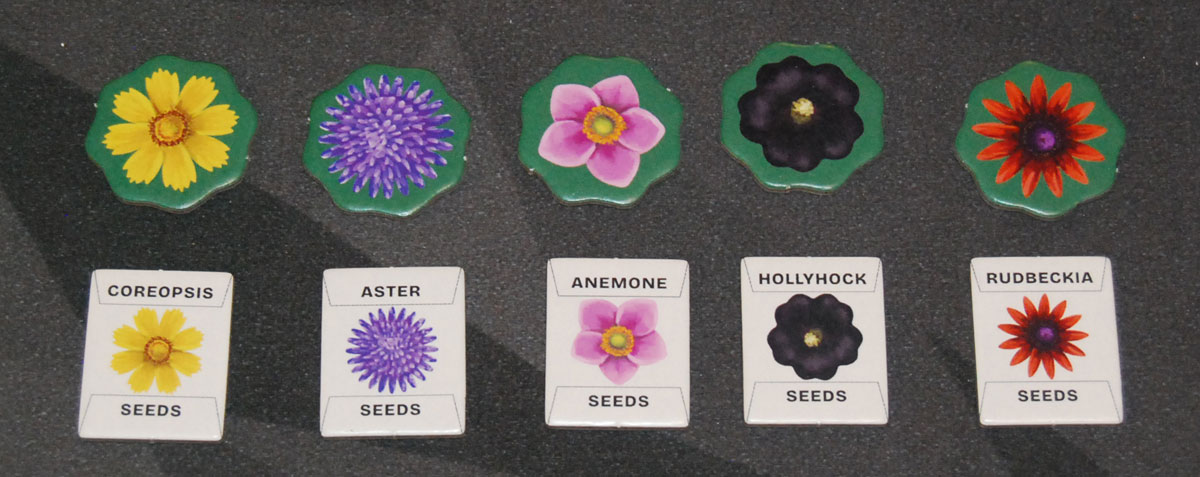
There are five different flowers in the game, each distinguished by a unique color and shape. The sky blooms are tokens with just the large flower on it, and the seed packets are small rectangular tokens made to look like seed packets with an image and the name of the flower on them.

The planter cards are large square cards, and each one has space for four seed packets of specific colors. The planter itself is also one of the five flower types with the corresponding border color (and name at the bottom of the card). The one thing I wish was that there was a reminder on the planter cards about points—when you complete one, not only do you get the indicated sky bloom, but you also score points for the seeds you’ve planted, and it would be nice to have that reminder printed on the card itself.
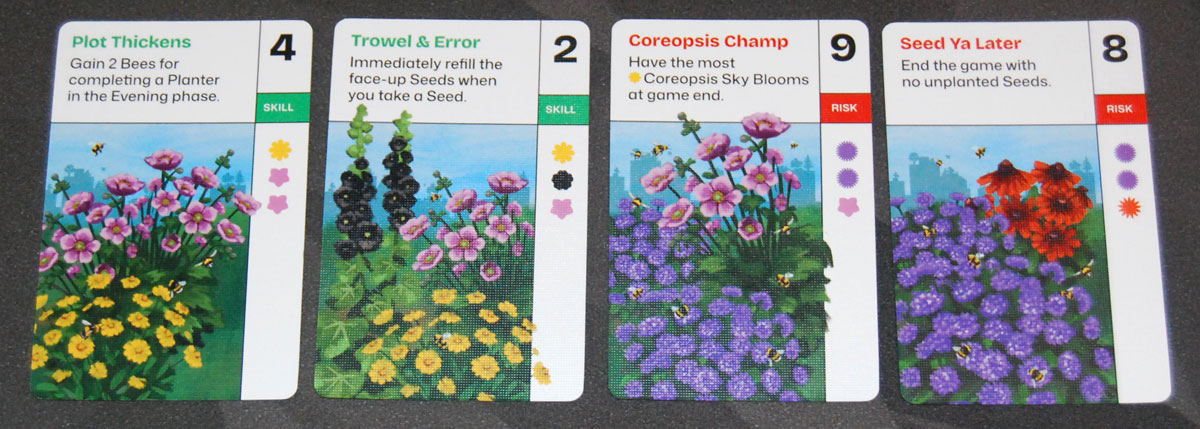
Cultivator cards have a point value, a cost (three flowers shown on the right edge), and an effect. There are two types: green cards (skills) give you an ongoing ability but are generally not worth as many points. Red cards (risks) are potentially worth more points, but only if you meet the listed condition.
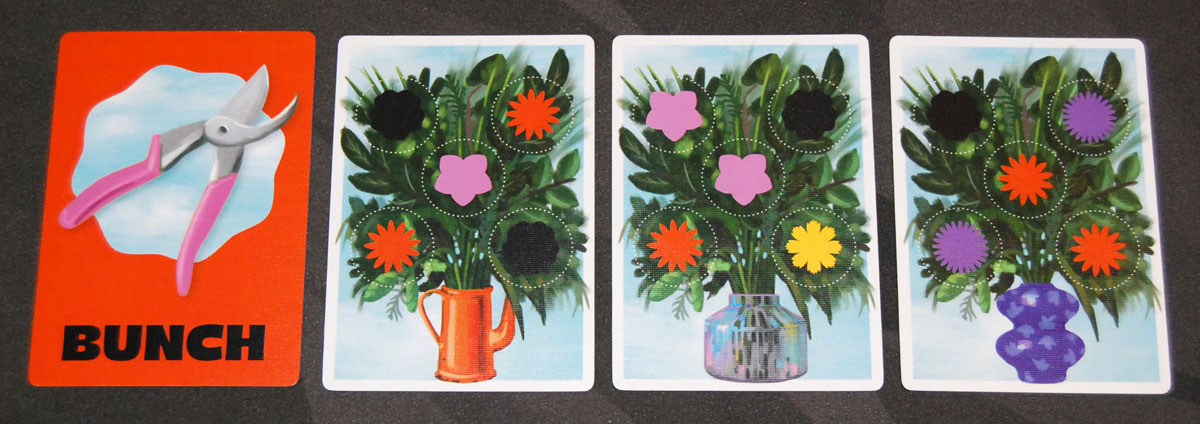
Bunch cards depict a bouquet of five specific flower types, and the sky bloom tokens fit on these cards. Each one has a unique combination of five blooms.
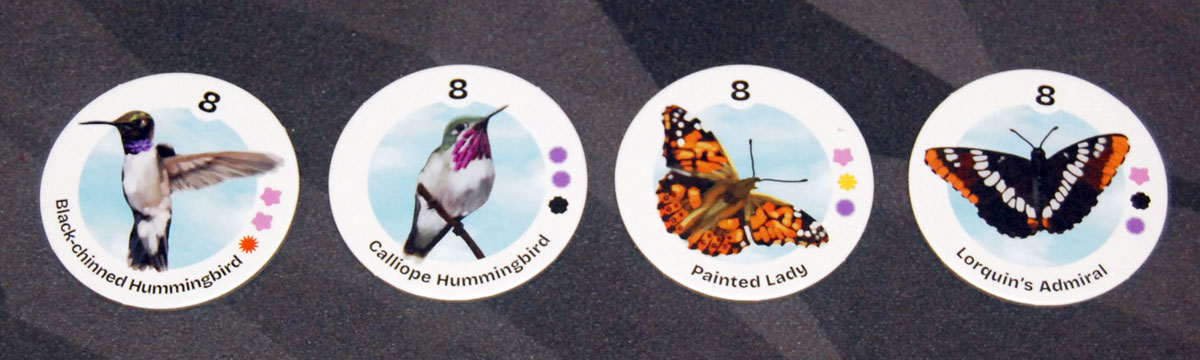
Pollinators are various butterflies and hummingbirds, each with an illustration, and three flower types indicated. The final game will also include meeples for each pollinator—they look cute, but they’re not strictly necessary since you just claim the round tile and then also take the meeple and place it somewhere in your garden for an added visual.
How to Play Sky Bloom
You can download a draft of the rulebook here.
The Goal
The goal of Sky Bloom is to be the first to complete your bunch, but if there’s a tie, then you want to score the most points (bees!) by planting seeds, filling your bunch with sky blooms, buying cultivators, and attracting pollinators.
Setup
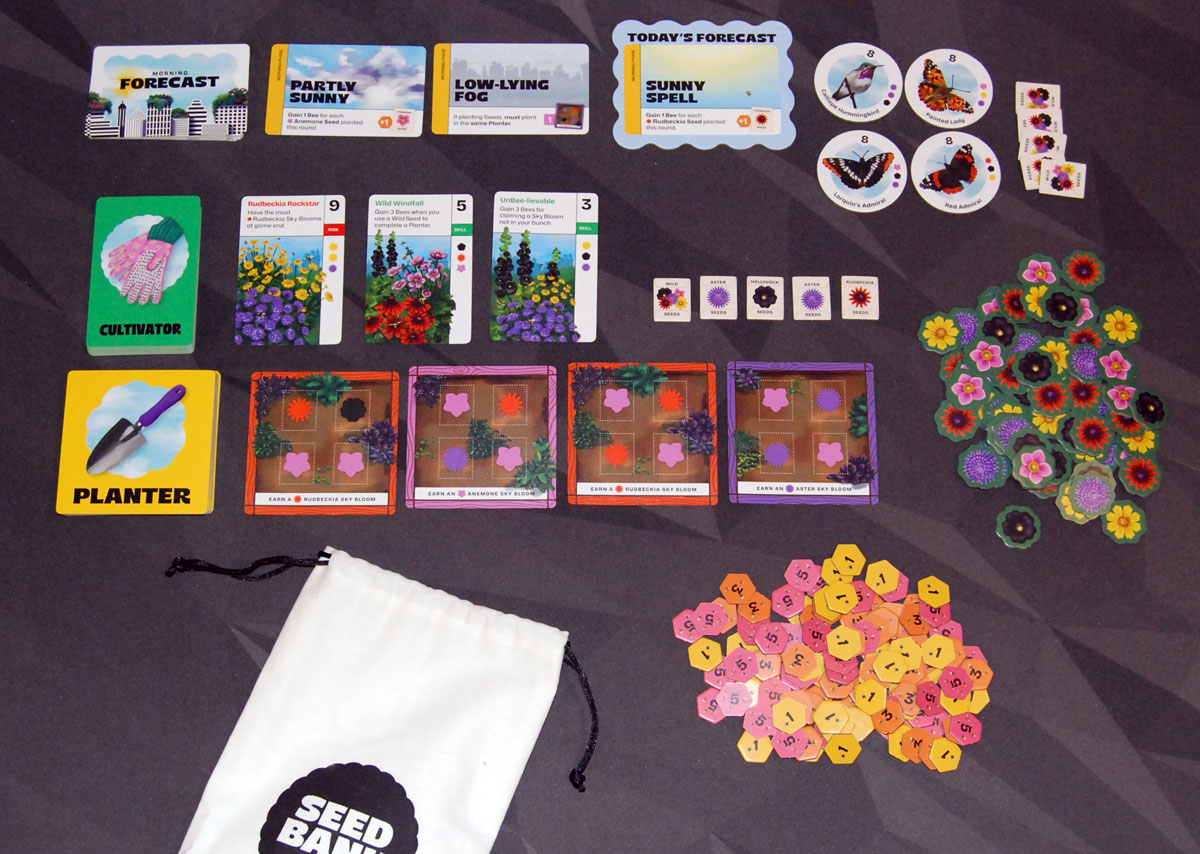
Set up the forecast deck with 5 morning, 5 afternoon, and 4 evening cards, stacked in that order. (The evening forecasts must include the First Frost card.) Reveal the top 3 cards, with the rightmost card placed on the Today’s Forecast tile.
Make a market of 3 cultivator cards, and one more planter than there are players.
Randomly draw one more pollinator than the player count and set them face-up. Make a supply of bees and sky blooms.
Set aside 5 wild seed tokens, and place the rest of the seeds in the seed bank bag. Draw 5 seeds at random and place them face-up as a market.

Give each player a player mat, 3 random seeds drawn from the bag, a bunch card, and a random starting cultivator card.
Choose a starting player.
Gameplay
Each round, everyone will take a turn, and then there’s a cleanup phase. The starting player remains the same throughout the game.
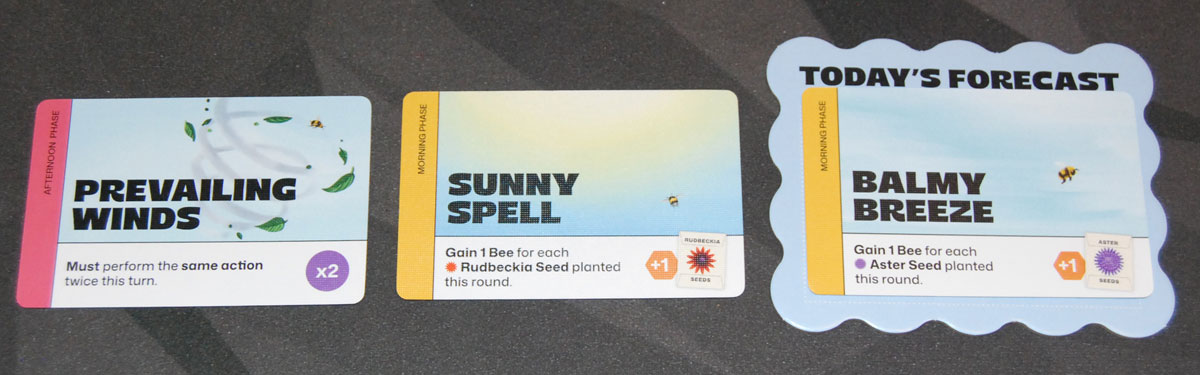
The forecast card on “Today’s Forecast” provides a special rule that is in play for the current round.
On your turn you get 2 actions chosen from the following—you may do the same action twice.
Take Seeds: take any 2 of the face-up seeds, or draw 3 random seeds from the bag. (Refill the seed market from the bag.)
Plant Seeds: place up to 2 seeds in planters in their corresponding spaces. You may draw new planter cards from the face-up market, or plant seeds in your existing planters, with a maximum of 3 planters at a time. Refill the planter market as needed, sliding cards to the right as needed. Wild seeds may be used for any color, but you may not have more wild seeds in a planter than regular seeds. At the end of your turn, you must discard down to 8 seeds.
If you complete a planter, gain 2 bees per seed planted plus any bonuses you get from your cultivators or the forecast, take the corresponding sky bloom, and then discard the planter and the seeds (to the seed bag). Your sky bloom is placed on your bunch if there’s a matching empty space, or else in the pots below the bunch card. (There is no limit to the pots below.)
Buy a Cultivator: Pay the seed cost for a cultivator from the market, and then place it in the center of your board. If you have sky blooms (on your bunch or in the pots), each one provides a permanent discount of that flower type. Slide the cultivators to the right and refill the market.
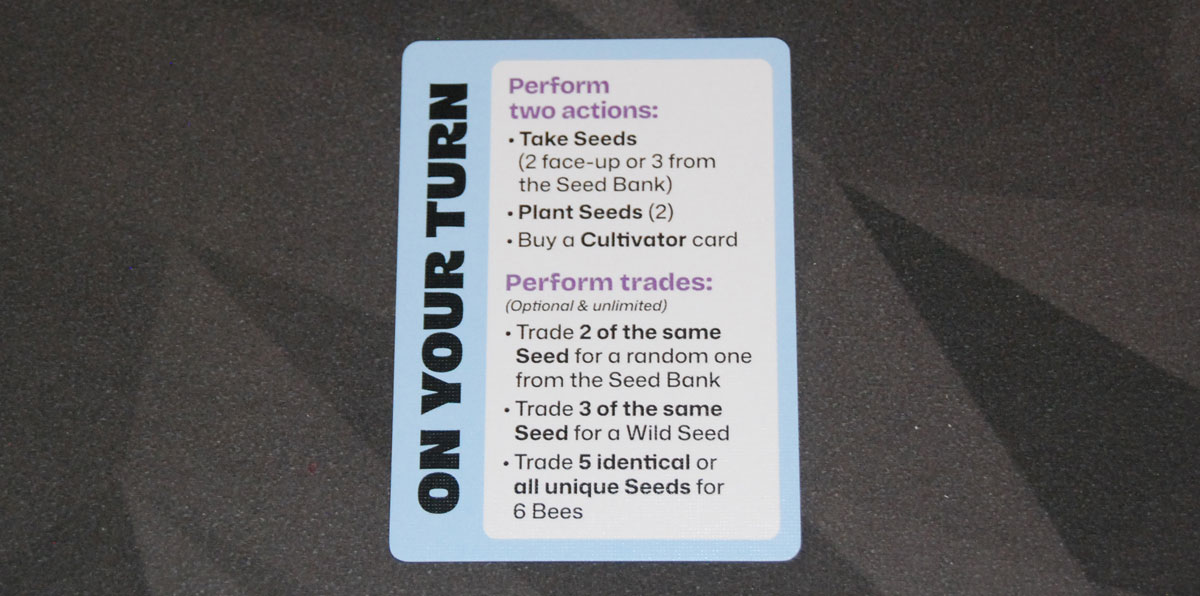
At any time on your turn, you may trade seeds:
Trade 2 identical seeds for 1 random seed from the bag (if you draw the same type that you traded, you redraw.)
Trade 3 identical seeds for 1 wild seed.
Trade 5 identical seeds or 5 unique seeds for 6 bees.
During your turn, if you have sky blooms corresponding to a pollinator, you may claim one. (You may only claim one per turn.) You do not need to spend the sky blooms—you just have to have them.
Clean up: After everyone has had a turn, you clean up: discard the rightmost forecast, cultivator, and planter, and slide everything to the right and refill. For the forecasts, you will typically have the one active forecast, and then you can see the next two that will be coming. When you reach the evening forecast cards, you only reveal the current card.
Game End
There are two ways the game could end. When the First Frost forecast card is active, that round will be the last round of the game.
If any player completes their bunch, that will be the last round of the game.
If you are the only player to finish your bunch, then you win! Otherwise, add up the scores of all players who completed their bunches: all the bees you collected during the game from planting and bonuses, plus points for your cultivator cards and pollinators, plus 2 points for each sky bloom in your bunch. You lose 2 points for each unfilled space in your incomplete planters.
Solo Mode
For solo mode, there are a few setup changes: you remove 30 random seeds (not wilds), and set aside 3 wild seeds for trades.
The market has 4 face-up seeds, 4 planters, and 5 pollinators. Cultivators are not used.
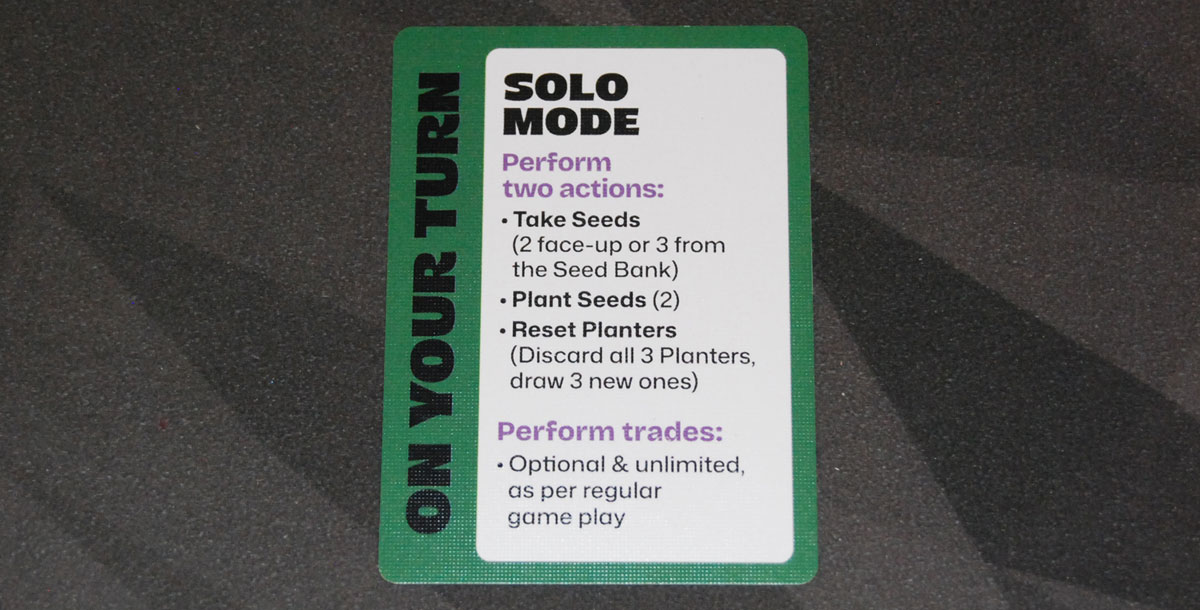
Your turn is the same as in the regular game.
At the end of each round, discard all 3 planters and refill. The forecast cards serve as a timer but do not have their effects.
To win, complete your bunch before running out of seeds or planters. You lose if First Frost arrives, the seed bank is empty (with no face-up seeds in the market), or you run out of planters.
Why You Should Play Sky Bloom
Sky Bloom is pretty easy to learn—there are only three actions to choose from on your turn, and they’re pretty straightforward. Collect seeds and put them in the matching spots to get your sky blooms, and maybe spend some seeds to get cultivators as well. The forecast lets you peek ahead at what’s coming, because maybe that will influence what seeds you plant this turn for bonus points, or you’ll see certain restrictions coming in the next couple of rounds.
What makes it interesting is that although everything is worth points—planting seeds, collecting cultivators, attracting pollinators—the ultimate goal is completing your bunch. If you finish first, you win and scoring is ignored. If multiple people finish, then they compare scores. But if you don’t fill out your bunch, it doesn’t matter how high your score is—you aren’t even in the running.
That means the game is a balance between finding the right seeds and planters so that you can go straight to collecting those sky blooms and accumulating some bees in case other people also get their bunches done. Cultivators present a tricky decision: the skill cards are a bit of engine-building so they can improve your actions later, like letting you plant 3 seeds per action instead of two, or giving you bonus points for taking particular actions. However, it costs you one of your actions to gain one—not to mention you’re either spending seeds for them if you don’t already have the three matching sky blooms for the discounts. Given that the game is a race, you have to decide if it’s worth half of your turn to gain one—will it be worth the opportunity cost by the time the game ends? The risk-type cultivators are worth a lot of points, but only if you fulfill the conditions, so that’s another trade-off to consider. Now you’re spending that turn for potential points, and fulfilling the conditions might require more actions and planning, which may put you even further from completing your bunch.
While there isn’t much direct interaction in the game—you can’t tear down somebody else’s planters or throw away their seeds, for instance—it doesn’t mean you can’t engage in a little bit of sabotage. One of my opponents noticed that my bunch required two asters, and every time an aster planter was available on his turn, he took it. Sometimes I’d get lucky and another one would appear when the market refilled, but that was enough to delay me so that I wasn’t able to complete my bunch on the same round the other two players did. Despite the fact that I had the highest score, I wasn’t eligible to win. (My only satisfaction was that he didn’t win either, because he had a lower score!)
I would consider Sky Bloom a casual game or just slightly weightier—something I can present to folks who are still becoming familiar with modern games without getting overwhelmed, and the rooftop gardening theme may appeal to players who prefer something that isn’t violent or combative. For players who like a lot of complexity and strategic depth, it may not be quite as satisfying, though I did enjoy that tug-of-war between racing to finish your bunch and making sure you have the most points.
For more information or to make a pledge, visit the Sky Bloom Kickstarter page!
Click here to see all our tabletop game reviews.
 To subscribe to GeekDad’s tabletop gaming coverage, please copy this link and add it to your RSS reader.
Disclosure: GeekDad received a prototype of this game for review purposes.

Jonathan H. Liu

Jonathan H. Liu is a stay-at-home dad in Portland, Oregon, who loves to read, is always up for a board game, and has a bit of a Kickstarter habit. I can be reached at jonathan at geekdad dot com.
