
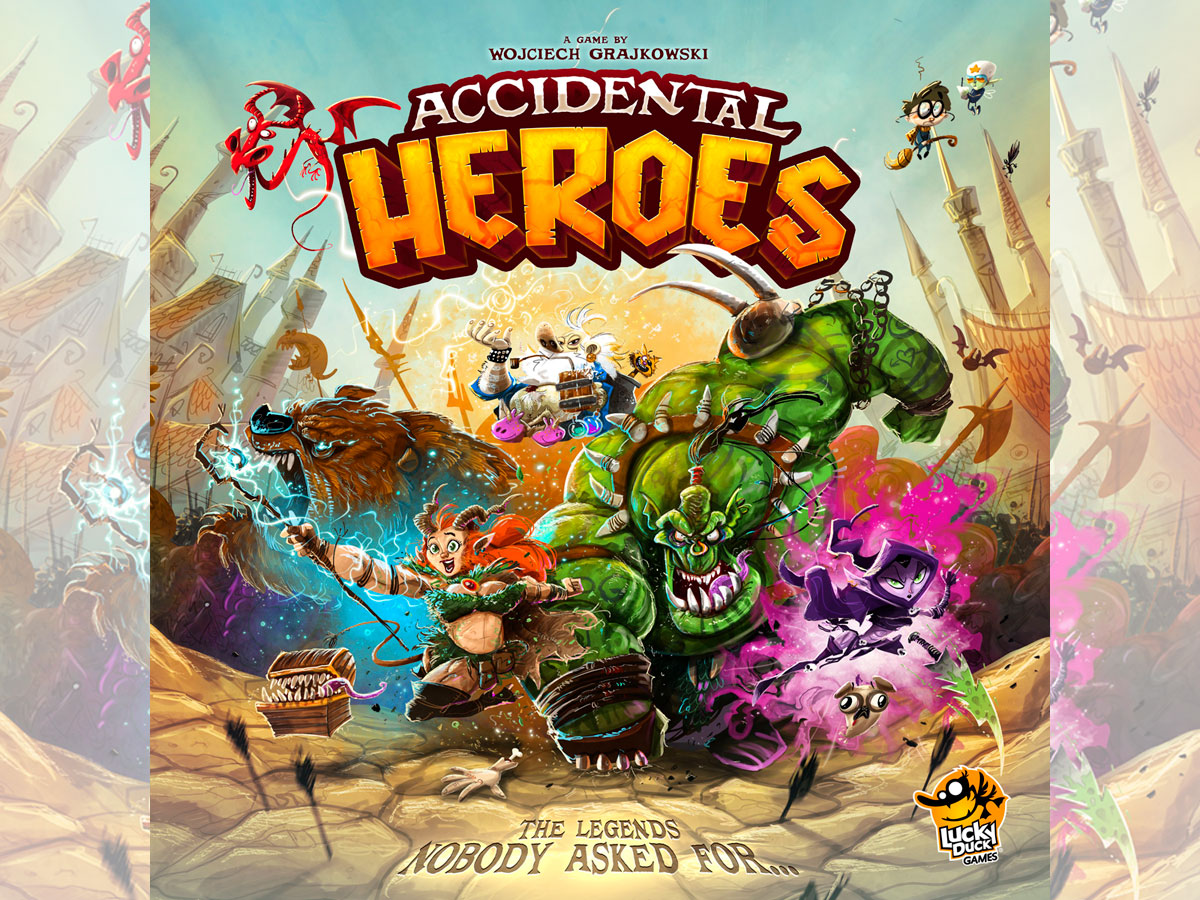
All you really wanted to do was become a humble dragon farmer, but fate has other plans for you…
What Is Accidental Heroes?
Accidental Heroes is an app-enabled adventure game for 1 to 4 players, ages 12 and up, and takes about 90 minutes to play. It’s currently seeking funding on Kickstarter, with a pledge level of €69 (about $77USD) for a copy of the base game; there are additional tiers that include one or two expansions as well as a metal coins set. The game does include some snarky humor and gives you the ability to be heroic or villainous at times, but I think age 12 and up sounds about right.
Accidental Heroes was designed by Wojciech Grajkowski and published by Lucky Duck Games, with illustrations by Dominika Bylinka, Jakub Chełstowski, Mihajlo Dimitrievski, Leo Fonseca, Mateusz Komada, Anita Kotwicka, Amelia Połtoracka, Thomas Bouzillé, and Inês Toczyska.
New to Kickstarter? Check out our crowdfunding primer.
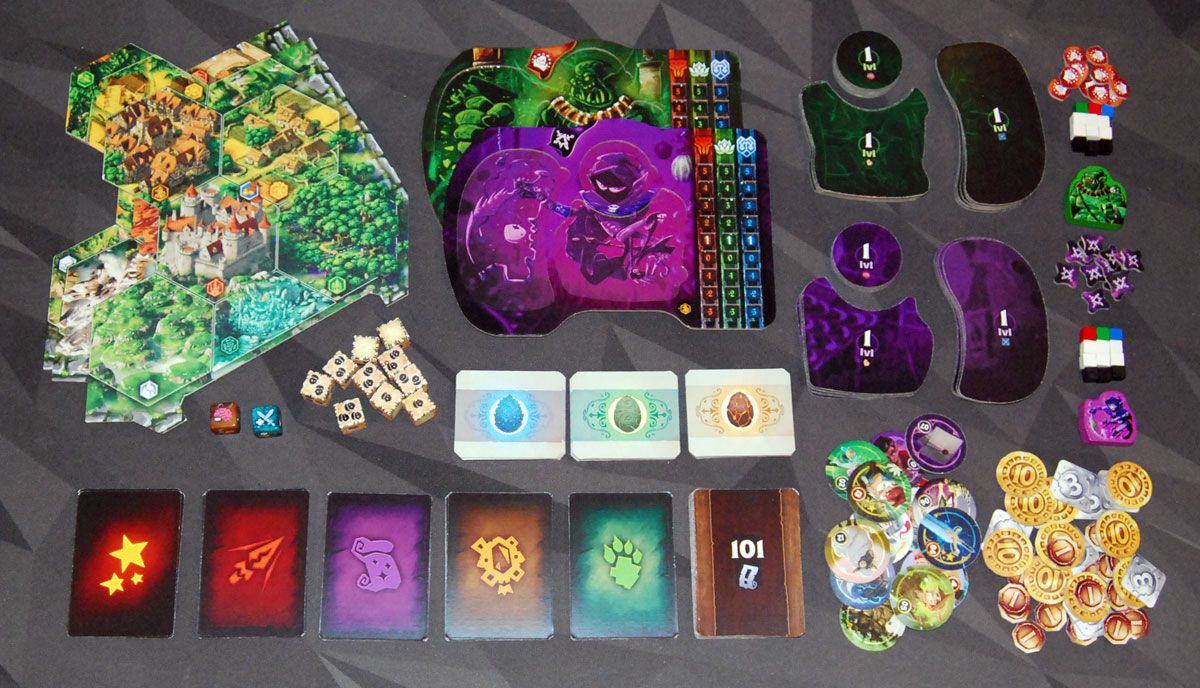
Accidental Heroes Components
Note: My review is based on a prototype copy, so it is subject to change and may not reflect final component quality. This prototype only included 2 of the playable heroes and a fraction of the adventure tokens. The app was also in beta form so the final version may look different.
Here’s what comes in the box:
- Main Board (in 3 pieces)
- 4 Player boards
- 72 Portrait tiles (18 per player: 6 heads, 6 arms, 6 bodies each)
- 4 Player meeples
- 48 Personal Marker tokens (12 per player)
- 48 Wooden cubes (12 per player, various colors)
- 10 Test dice
- Blessing die
- Punishment die
- 21 Final Mission tiles
- 10 Epic cards
- 20 Weapon cards
- 20 Scroll cards
- 20 Amulet cards
- 20 Animal cards
- 80 Quest cards
- 40 Adventure tokens
- Cloth bag (not pictured)
- 40 Coins
- Lizard Market (not pictured)
Note that you’ll also need some sort of device to run the free companion app. All reward tiers will also include stretch goals that are reached during the Kickstarter campaign—see the campaign page for more details.
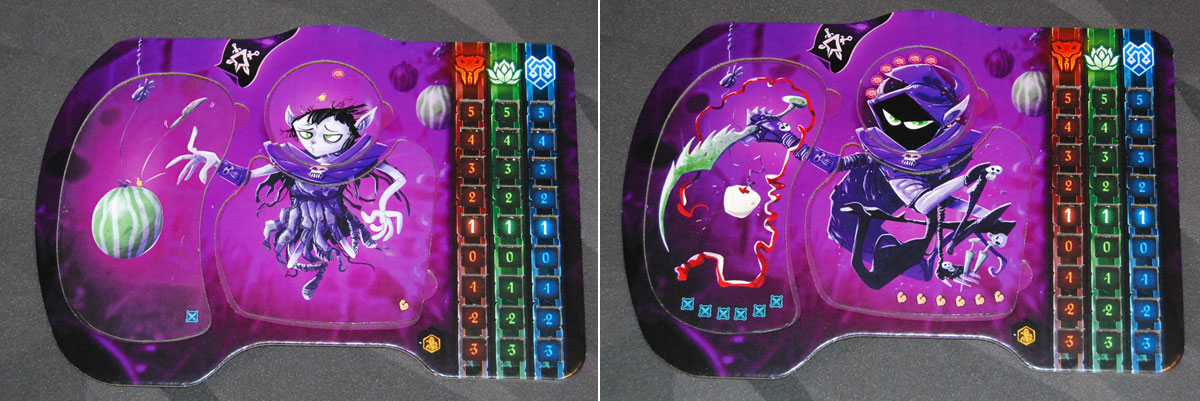
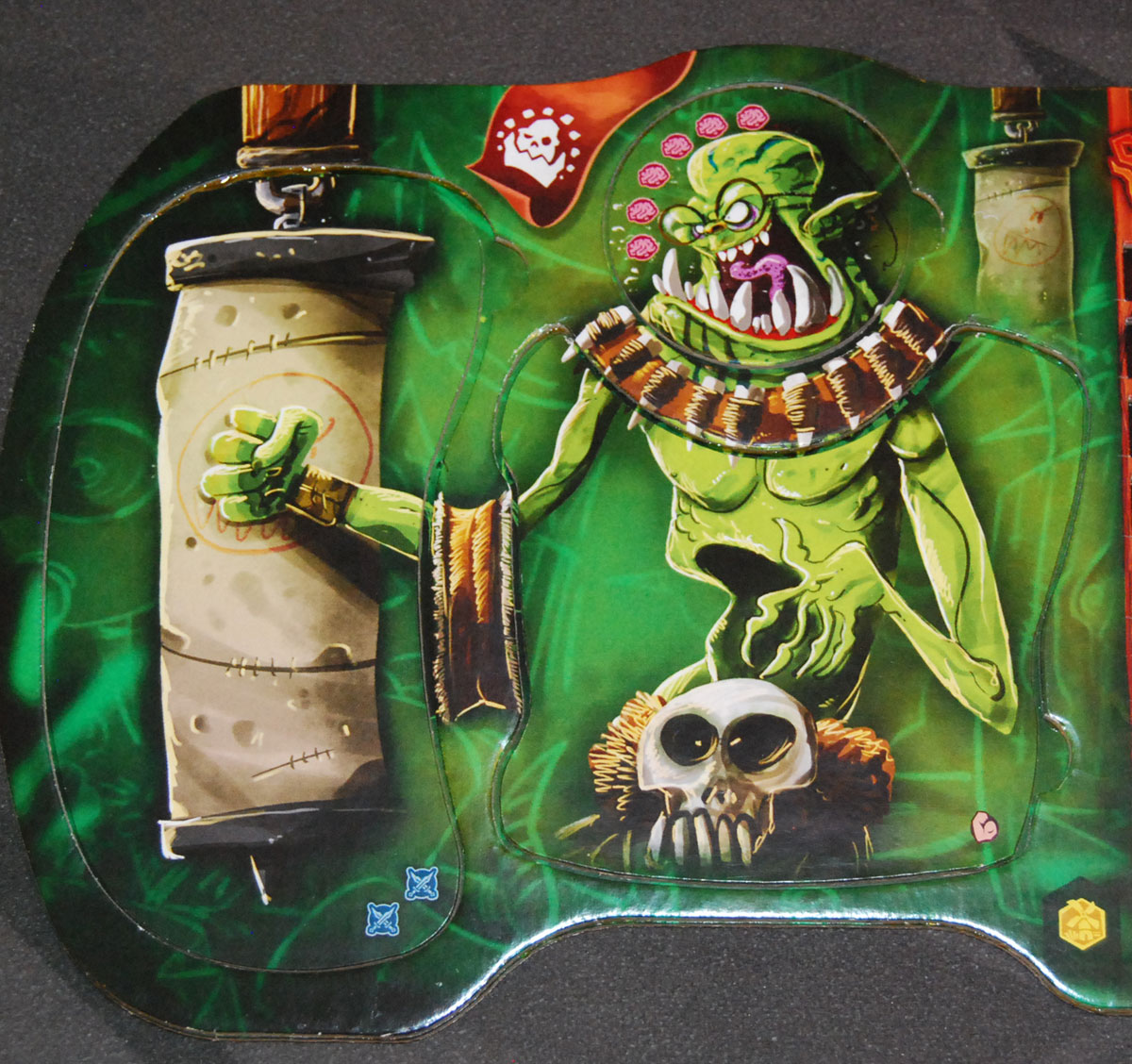
The most notable components in the game are the player boards and the portrait tiles. Each dual-layer board depicts the player character, with cut-out sections for the head, torso, and arm. The portrait tiles for each body part range from level 1 to level 6 and represent the player’s intelligence, strength, and weapons proficiency. Sure, it’s kind of gimmicky and could easily have been tracked with just a simple track or dials, but it’s a very fun gimmick, and makes for very amusing visuals. The orc’s head gets bigger and meaner, but at level 6 he also has a swollen brain and glasses. The boards also have three divine favor tracks—more on those later.
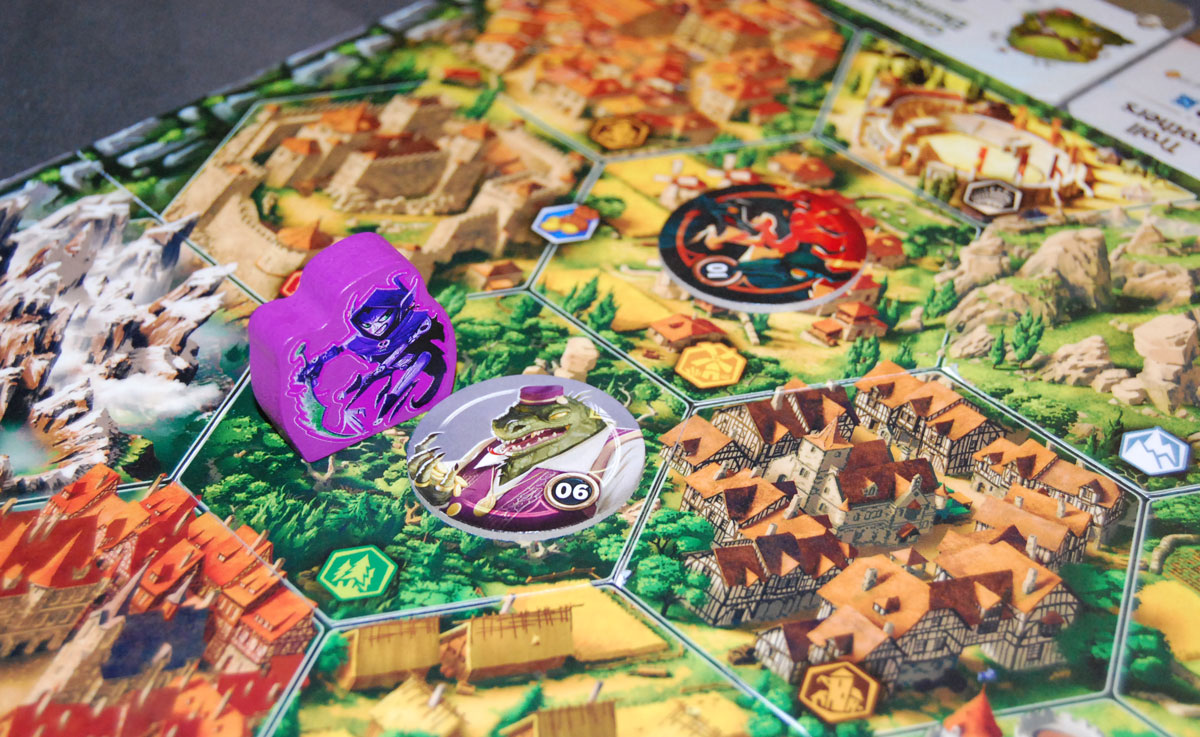
The main map board is made up of three large puzzle pieces that fit together to create one large map. There are five different location types (with multiple locations for each type), plus three special areas for the final missions. Also scattered throughout the map are market icons, placed on the borders between two locations.
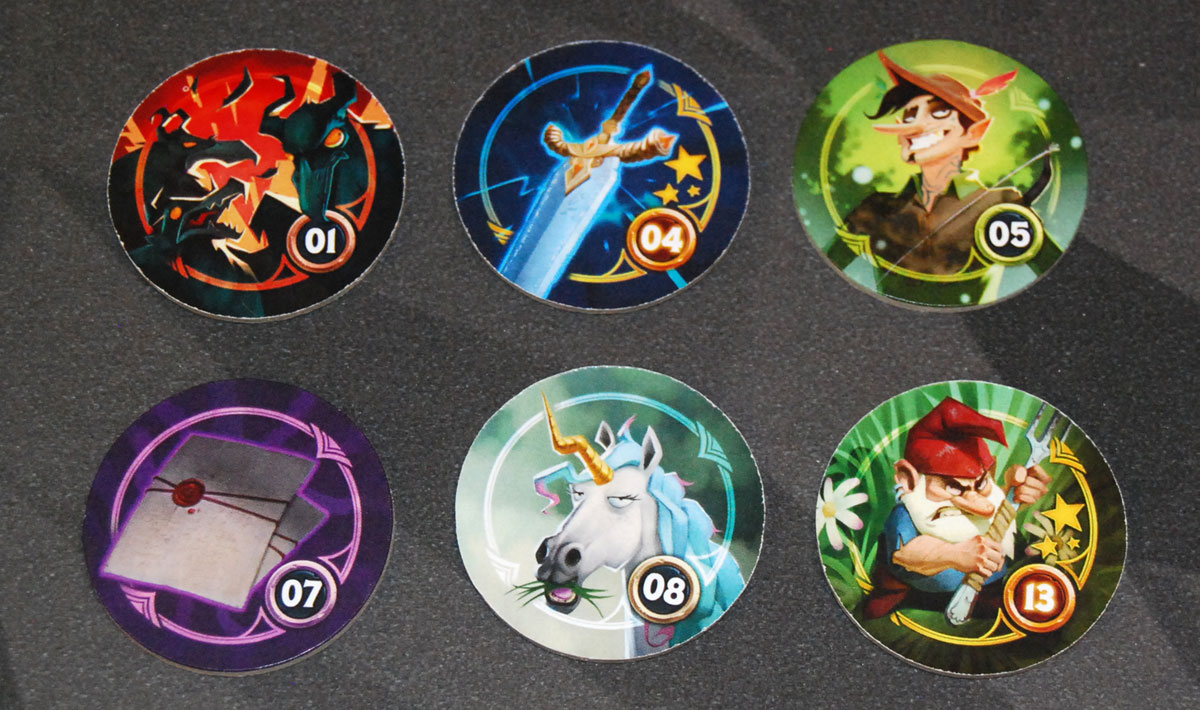
The adventure tokens are numbered, and illustrated with various creatures, characters, and items that you will encounter as you explore. A few are marked with stars—these mark encounters where it is possible to obtain one of the epic cards.
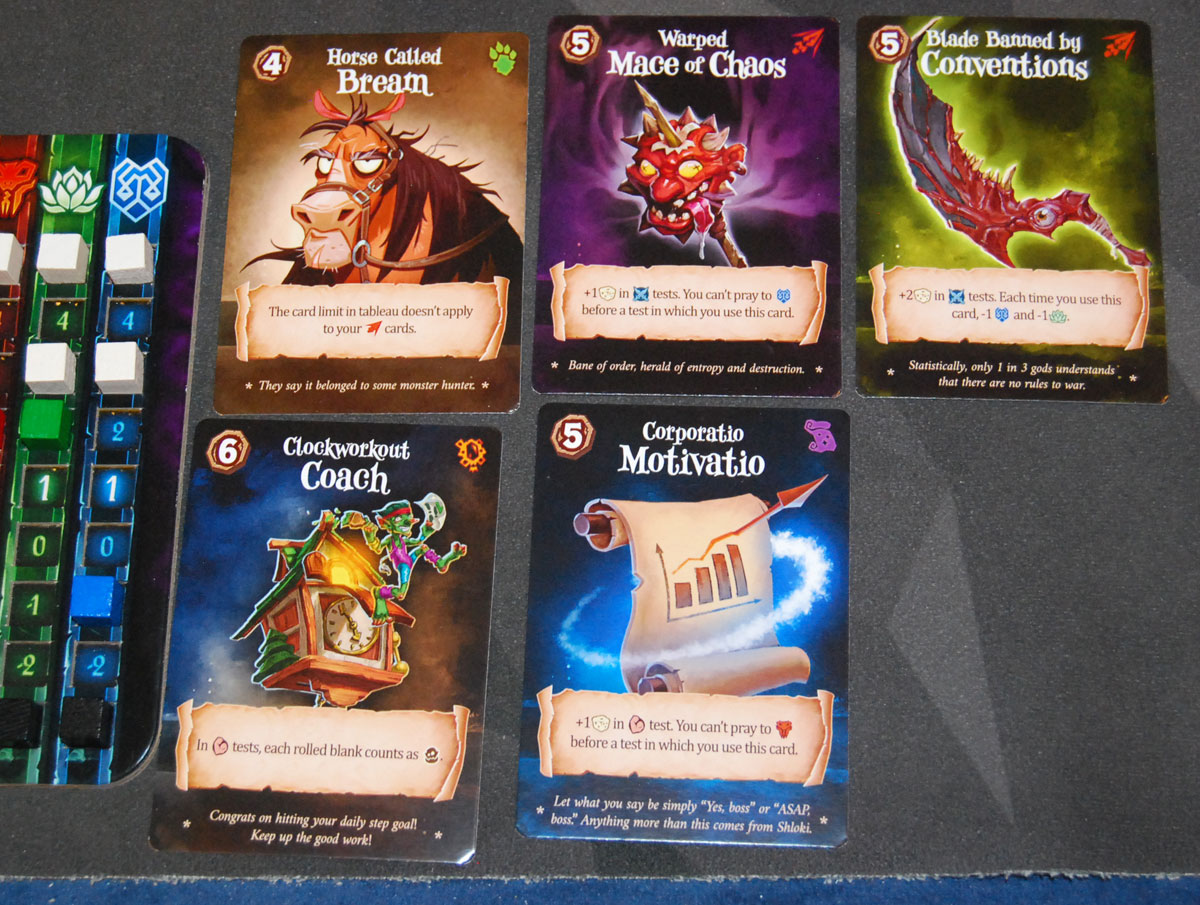
The item cards represent various things you can acquire in the markets: weapons, scrolls, amulets, and beasts, which give you various abilities. (Epic cards also fall into these four categories.)
Quest cards are numbered on the back, and they’re basically little reminder cards about quests and errands that you can complete. Usually you’ll be instructed to place one of your personal markers on a specific location type, and then to fulfill the quest you need to go to that location on a future turn. The prototype quest cards were just plain text but it looks like there will be illustrations in the final version.
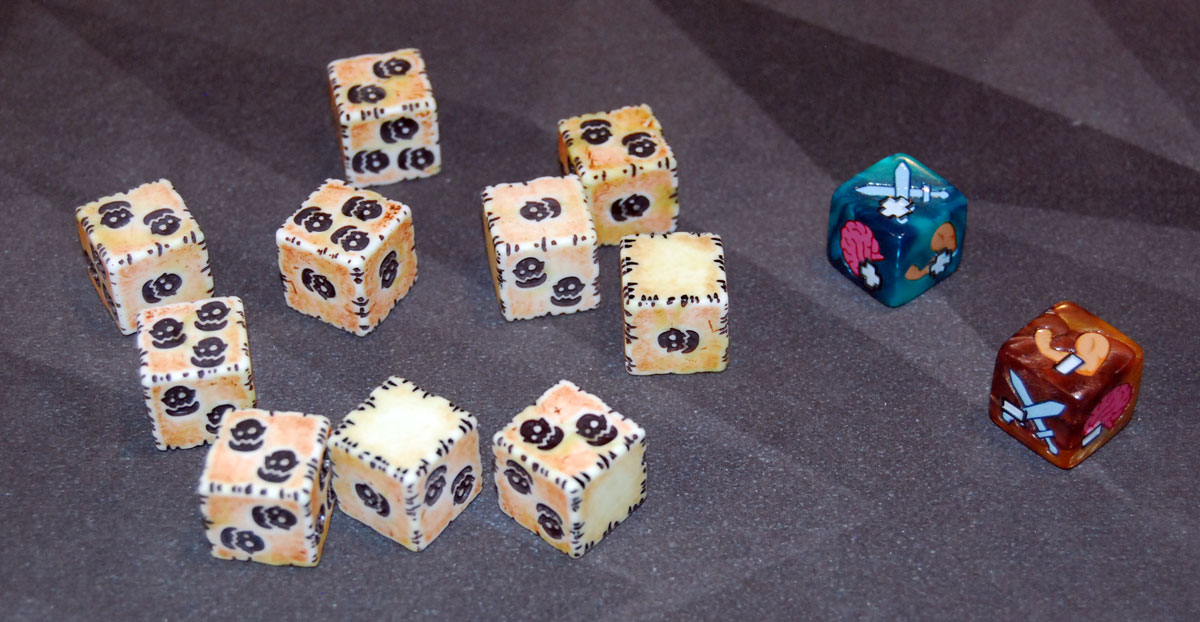
The test dice are six-sided dice that have 0 to 3 icons on them. The blessing and punishment dice have icons for the intelligence, strength, and weapons, with a “+” for the blessing and a “-” for the punishment.
How to Play Accidental Heroes
The Goal
The goal of the game is to be the first to acquire 2 different dragon eggs (so you can retire from being a hero and go raise dragons instead).
Setup
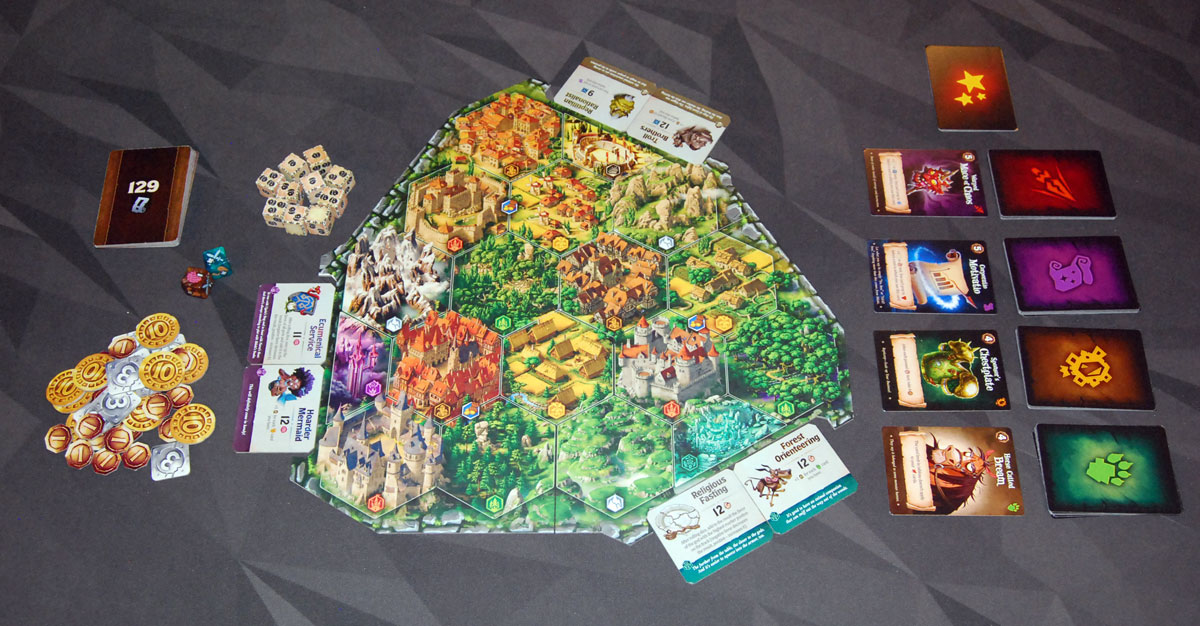
Assemble the main board. Randomly draw two final mission tiles of each type, placing them next to the regions with the special icons. Make a card market: shuffle each of the decks separately and reveal a weapon, a scroll, an amulet, and an animal. Set the epic cards and the quest cards nearby. Make a supply of coins and dice.
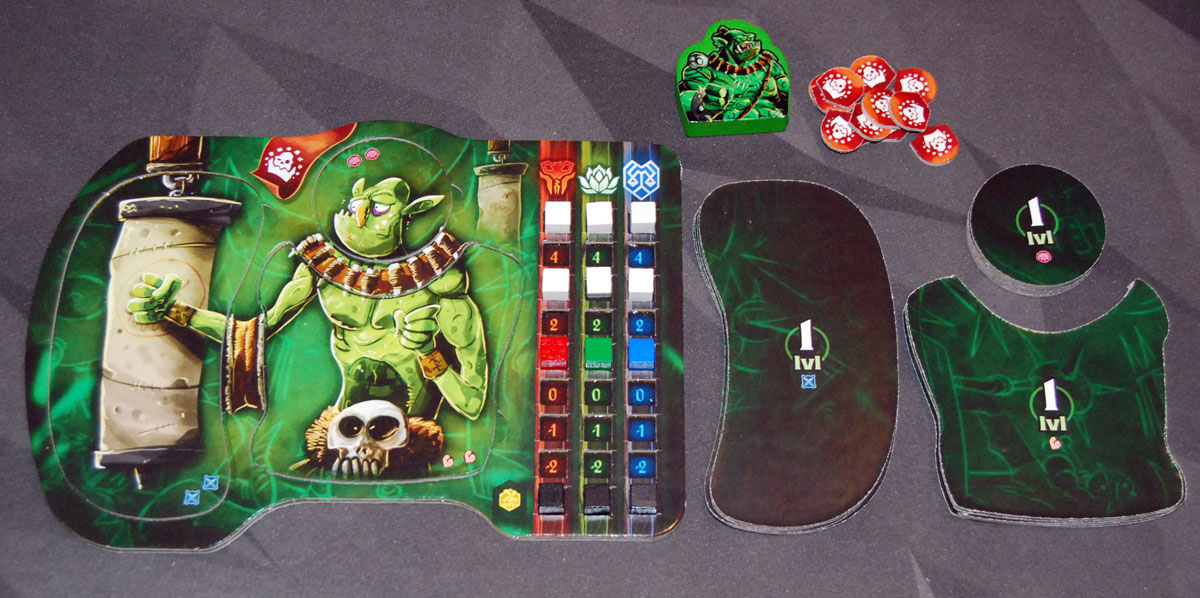
Give each player a set of their player components. Set up your player board by putting the level 2 portrait tokens on it, and set the rest of the portrait tokens nearby. On the divine favor tracks, place the colored cubes on level 1, the black cubes at the very bottom (on -3), and the white cubes on 3 and 5. Set the personal marker tokens nearby. Take your meeple and place it on a location matching your starting icon (shown at the bottom of your board, next to the divine favor tracks). Players will also start with some coins, depending on the player order.
Start up the app and let everyone select their character.
Gameplay
On your turn, you may move up to 2 spaces (including not moving at all).
If you pass through a market space, you may buy and sell things at the market. Each card has a coin cost shown in the top left corner, and you may have a maximum of 5 cards. You can sell cards back to the market (discarding them) for 2 coins less than the price. Also, you may spend 2 coins to refresh the market, discarding all of the visible cards and refilling them from the decks.
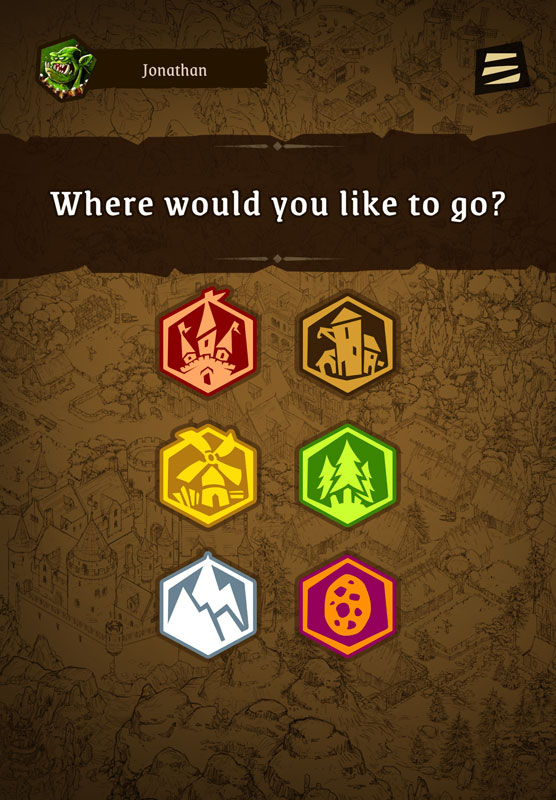
After your movement, tap the location type you’ve arrived at. (The egg icon is for the final mission spaces, if you’re ready to attempt one of those.) The app will ask you for a token number. If there isn’t an adventure token at your current location, draw one from the bag and place it there.
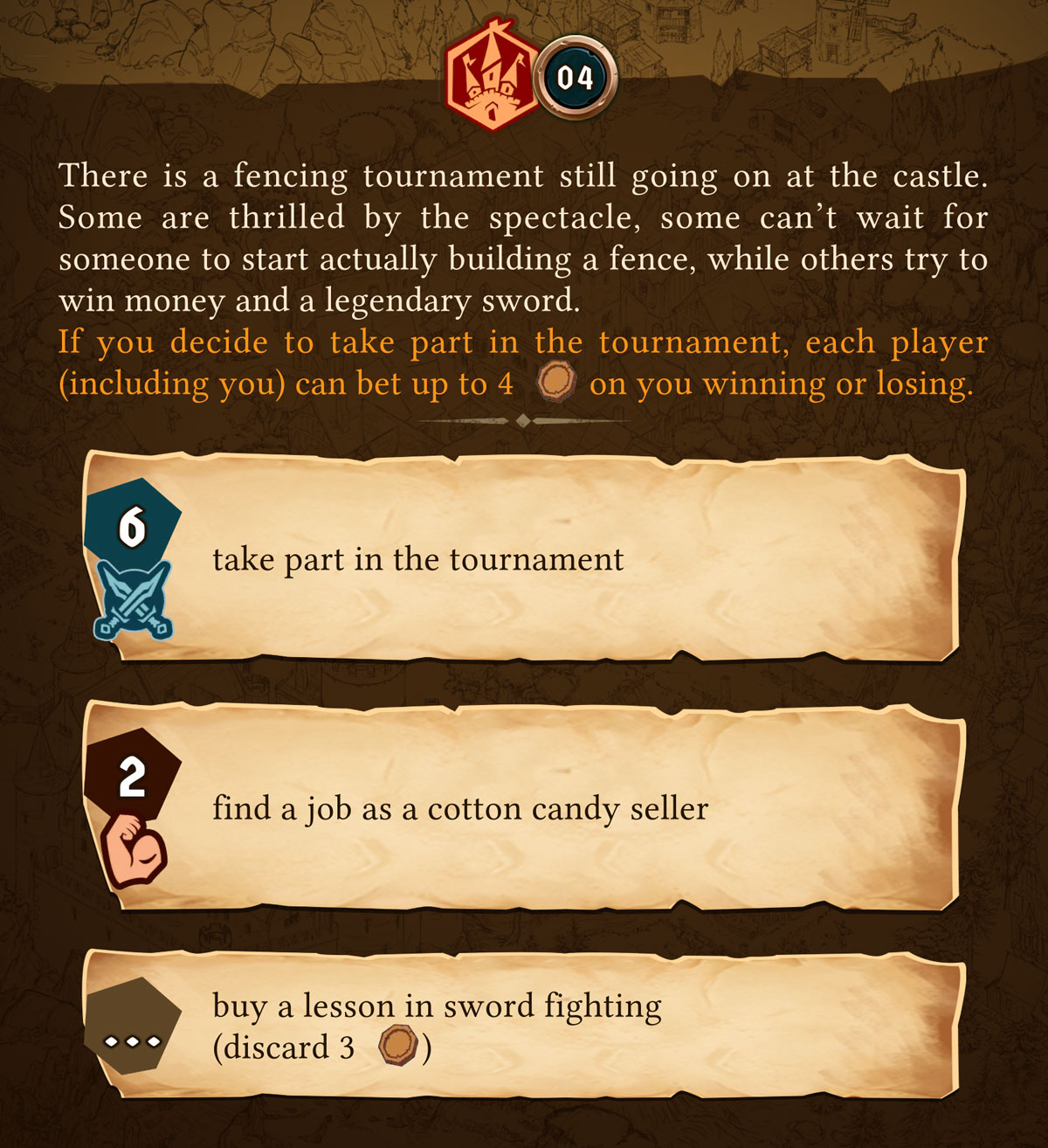
The combination of the adventure token and the location type will give you an encounter (so there are 5 possible encounters for each token). You’ll get a little bit of a story and then be presented with a number of options. Most of these will include some sort of skill test, but sometimes there may be other options like spending money or discarding a particular card type.
If you choose a skill test, then you get to roll test dice equal to your current level for that skill, and the number shown on the test is how many successes you must roll. You may also pray to the gods for help: for each space you move down on one of the divine favor tracks, you may roll an additional die (maximum 10 per test). You may only pray if you are at 1 or higher on a track. Item cards may also give you additional dice, successes, or other effects. After rolling, tap the “pass” or “fail” button in the app.
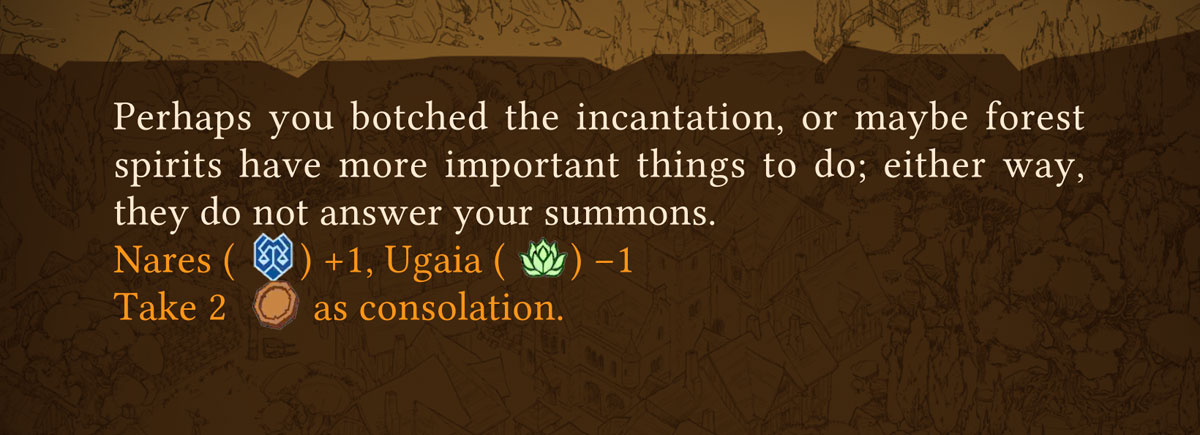
Whether you pass or fail, you’ll get another little bit of story, as well as some instructions on raising or lowering your divine favor tracks for one or more of the gods. The three gods are Nares, Ugaia, and Schloki, and you gain or lose favor with them based on the actions you select. Nares is all about power and order and toxic masculinity; Ugaia is about peace, love, and nature, and Schloki is about chaos and mischief. You may also be instructed to increase or decrease a level of a skill—if so, replace the current portrait tile. When you fail a test, you do get 2 coins as a consolation prize. The app will also indicate if the token should be discarded—many encounters are one-time-only, but some will stay until a particular result has been achieved.
On the divine favor tracks, there are white cubes for blessings and black cubes for punishment. The first time you reach one of these spaces, remove the cube and then roll the corresponding die, which increases or decreases that particular skill.
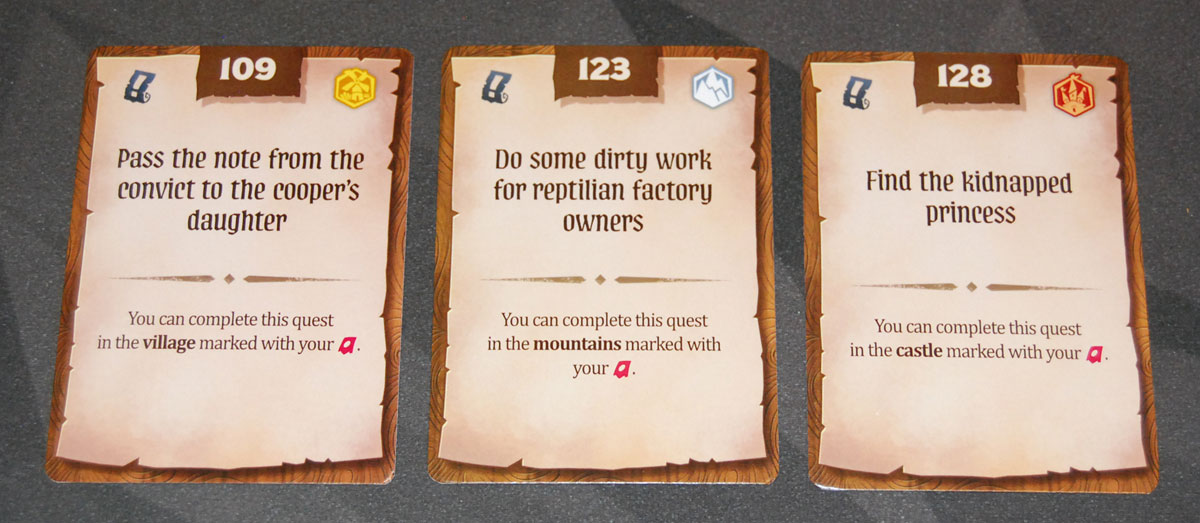
Some encounters will give you quests—for instance, you might be able to track down a bandit hideout or sell a painting. The app will give you a quest number and to place a personal marker on a particular location. Take the quest card of that number and place it in front of you as a reminder. If you visit that location, you may hit “Complete a Quest” before entering the adventure number to complete your quest.
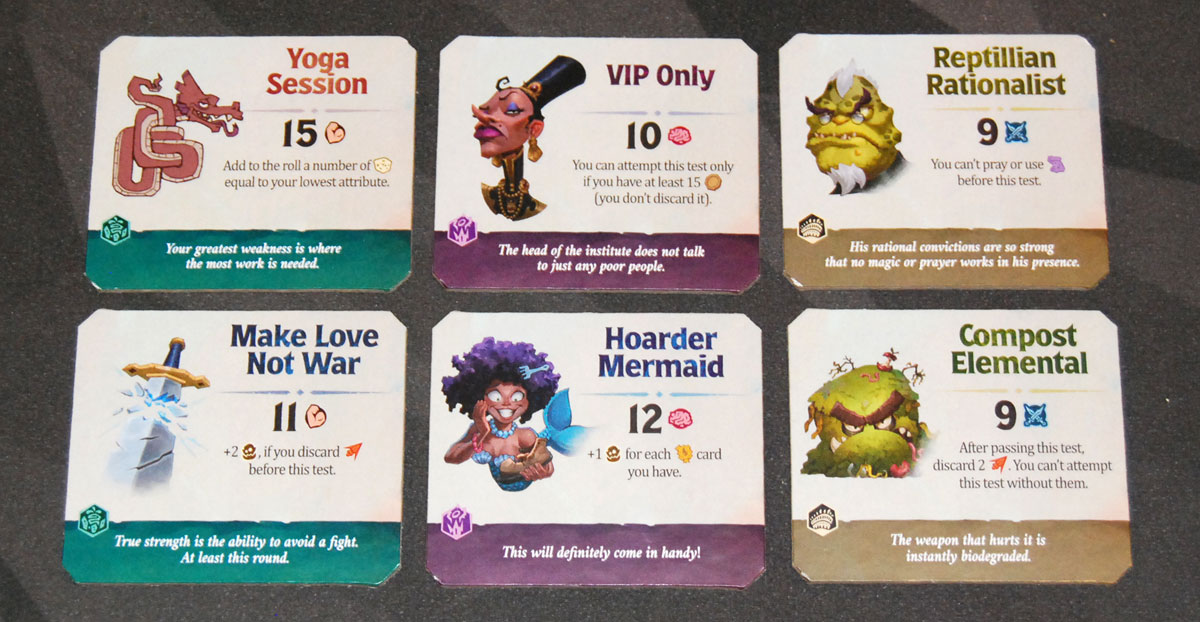
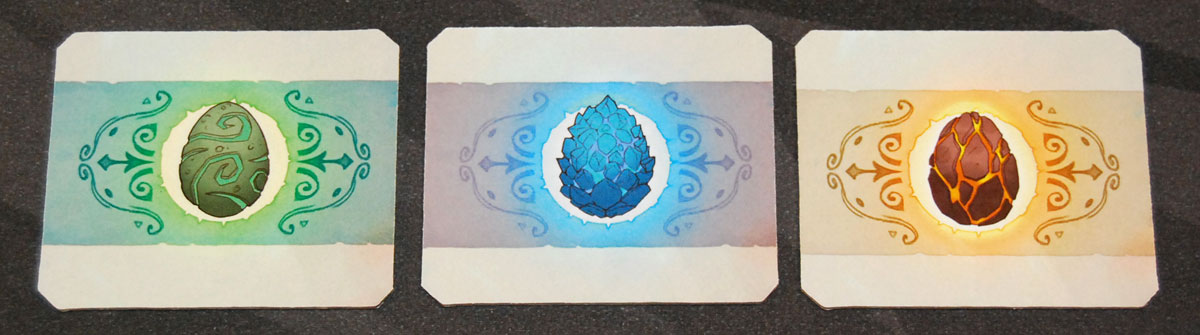
Finally, if you’ve built up your stats and equipped yourself with the right tools, you can attempt a final mission. Each of the final mission locations is tied to one of the three skills, and there are two missions of each type. These have higher test requirements than the usual encounters, but each one also has its own particular twist. If you go to a final mission location, tap the dragon egg location, and then attempt the challenge. If you fail, you’ll gain 2 coins as usual but nothing else happens. If you pass, you take the tile and flip it over to show the dragon egg side. All other players get 2 coins as a consolation.
Game End
The game ends when a player has acquired two different dragon eggs, and they win the game!
Why You Should Play Accidental Heroes
Accidental Heroes is, at its core, a race—you’re just trying to get your two dragon eggs so you can retire to your farm and put all this adventuring behind you. But in the meantime, it’s very easy to get caught up in the heroics (or villainy, if that’s your preference), going on quests, getting into fights, and buying cool things from the market. You can get distracted from your ultimate goal by the funny stories and your attempts to manage your status with the three gods.
Of course, some of this adventuring is necessary: you’re never going to succeed at passing a 12 Strength test when you’re at level 2 (the dice only have 3 successes each at most), so you’re going to have to build that up, or find an amulet to augment your strength, or build up enough divine favor that you can pray a whole lot before that test. And to afford those items at the market, you’ve gotta find profitable encounters. (Or, you know, fail a whole lot of tests.) The first portion of the game is all about leveling yourself up. Since you’ll need to pass two different skill tests for the two eggs, you can’t put all your bonuses in a single stat, either.
But, as in many games, there’s a shift to the second phase: as soon as somebody attempts a final mission, it’s a kick in the pants to all the other players. Maybe you need to just take a risk and try a final mission. But do you call in all of your favors for one huge turn, or risk failure? How many more attempts will you have? The final mission spaces are more than 2 spaces away from each other on the board, so if somebody gets their first egg, you know it will take them at least 2 turns (usually) to reach a second one, but that’s not very much time to catch up.
The app basically serves as a big lookup table, giving you the right story for any combination of adventure token and location type, and then listing the various options and results. The app instructs you to pass the device to the next player during your turn, so that somebody else reads you your choices and the results, but since things are only revealed as they’re resolved, you don’t have to worry about accidentally seeing the outcomes (the way you might in a game where everything is looked up in a physical book). Since there are about 200 possible encounters (and multiple options for each one), that would make for a pretty sizable book, and the app streamlines it and makes lookup really quick.
The app keeps track of which adventure tokens have been encountered and which ones have been discarded, but for the most part it leaves the actual game mechanics up to the players with the physical components. You just tap “pass/fail” when you do a test, but the app doesn’t track what level you are, how many dice you rolled, or what items you have in your possession. In terms of app-enabled games, Accidental Heroes can’t be played without the app, but despite that is primarily an analog game.
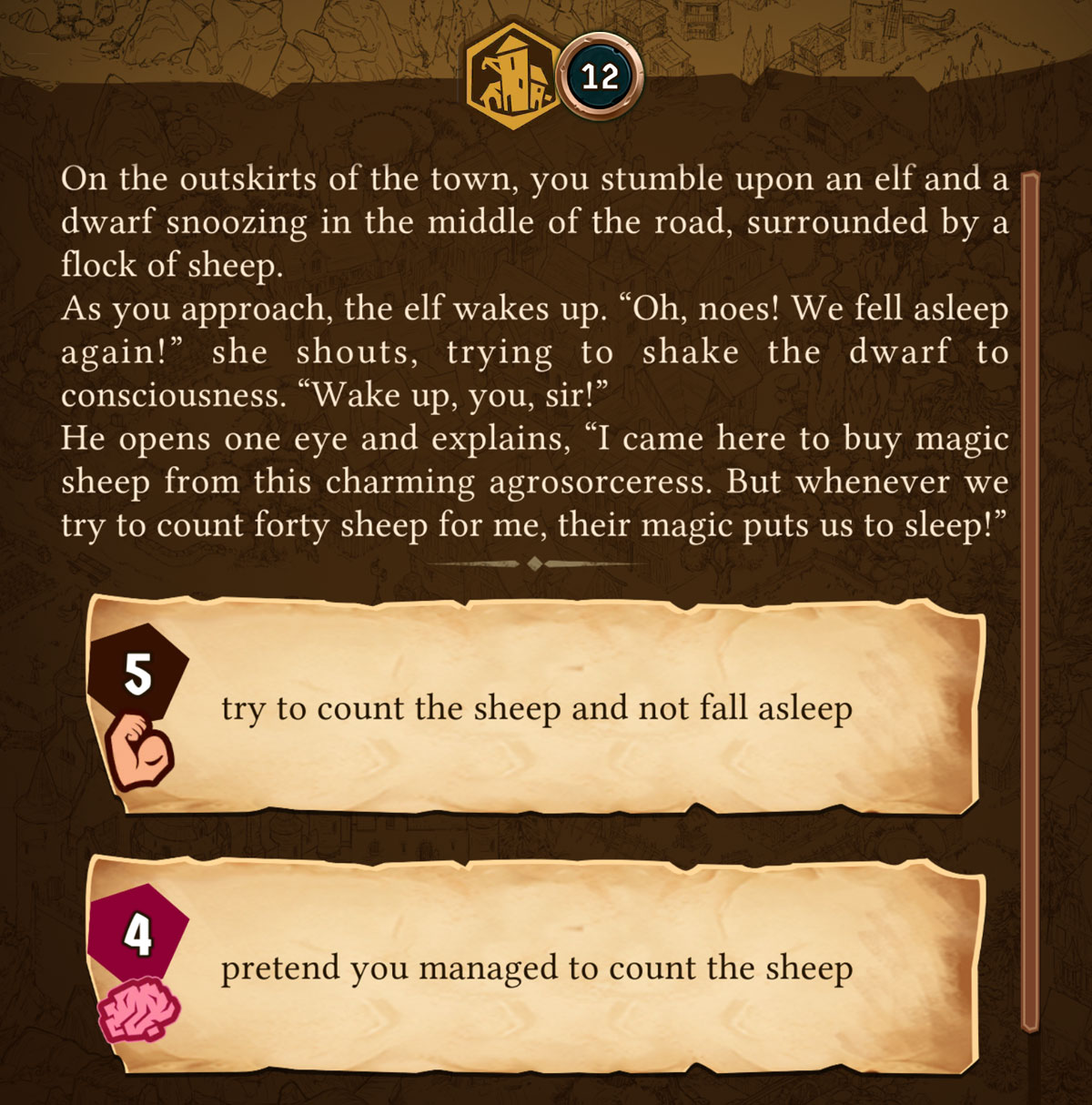
The encounters are quite entertaining—a customer trying to buy 40 magic sheep but both customer and merchant keep falling asleep when they count them; a wedding thrown into chaos by a drunk vampire bat that’s flying around crashing into things; two forest sprites who took a unicorn out for a joyride but damaged its horn. For each encounter, you get a variety of ways to respond, and it’s not always just a simple choice of brains, brawn, or blade. Often, your choices will let you side with one or the other party in a conflict: do you support the peasants or the reptilian overlords? Sometimes you might choose based on your skill levels and the tests required; at other times you might want to consider which gods will be pleased or displeased by each option. (Almost always, your choices are going to increase favor with one god and decrease it with another.)
There is a good bit of luck involved: you have some control over how many dice you get to roll, but since each die can roll anything from 0 to 3, there’s never an “automatic success” level just with the dice. You might be able to find items that give you bonus successes, but sometimes there are drawbacks to those, like not being able to pray when you use the item. Often you just prepare as much as you can, and then maybe say a couple prayers before you roll the dice.
I had a lot of fun with Accidental Heroes and I’m looking forward to playing the full game, since the prototype was limited to 2 players and only had a fraction of the adventure tokens. I’d recommend it for players who love a fun story and immersing themselves in the setting, not just thinking about the numbers and whether or not you’ve passed a check.
For more information or to make a pledge, visit the Accidental Heroes Kickstarter page!
Click here to see all our tabletop game reviews.
 To subscribe to GeekDad’s tabletop gaming coverage, please copy this link and add it to your RSS reader.
Disclosure: GeekDad received a prototype of this game for review purposes.


Jonathan H. Liu

Jonathan H. Liu is a stay-at-home dad in Portland, Oregon, who loves to read, is always up for a board game, and has a bit of a Kickstarter habit. I can be reached at jonathan at geekdad dot com.


