

Cultivate your miniature plant to become a bonsai master.
What Is Bonsai?
Bonsai is a tile-laying game for 1 to 4 players, ages 10 and up, and takes about 40 minutes to play. It retails for about $35 and is available in stores.
Bonsai was designed by Rosaria Battiato, Massimo Borzi, and Martino Chiacchiera and published by DV Games, with illustrations by Davood Moghaddami.
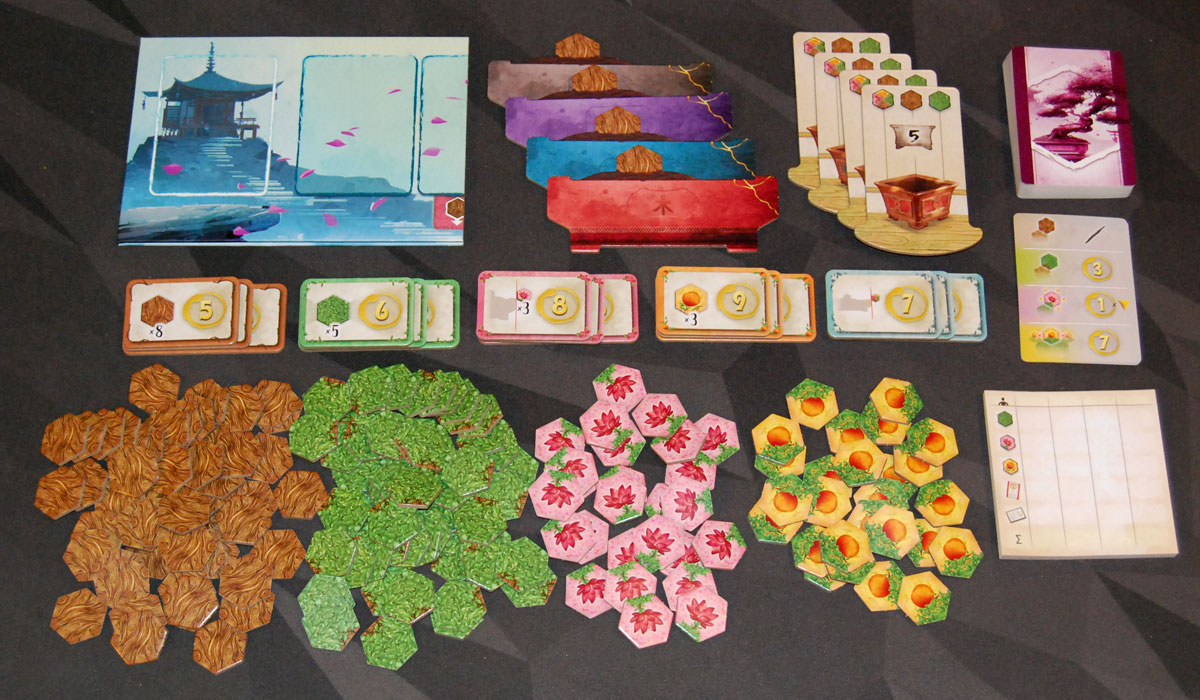
Bonsai Components
Here’s what comes in the box:
- Game Board
- 47 Zen cards
- 4 Summary cards
- 4 Seishi starting tiles
- 15 Goal tiles (3 each in 5 colors)
- 156 Bonsai tiles:
- 52 Wood
- 52 Leaf
- 26 Flower
- 26 Fruit
- 4 Pot tiles
- Score pad

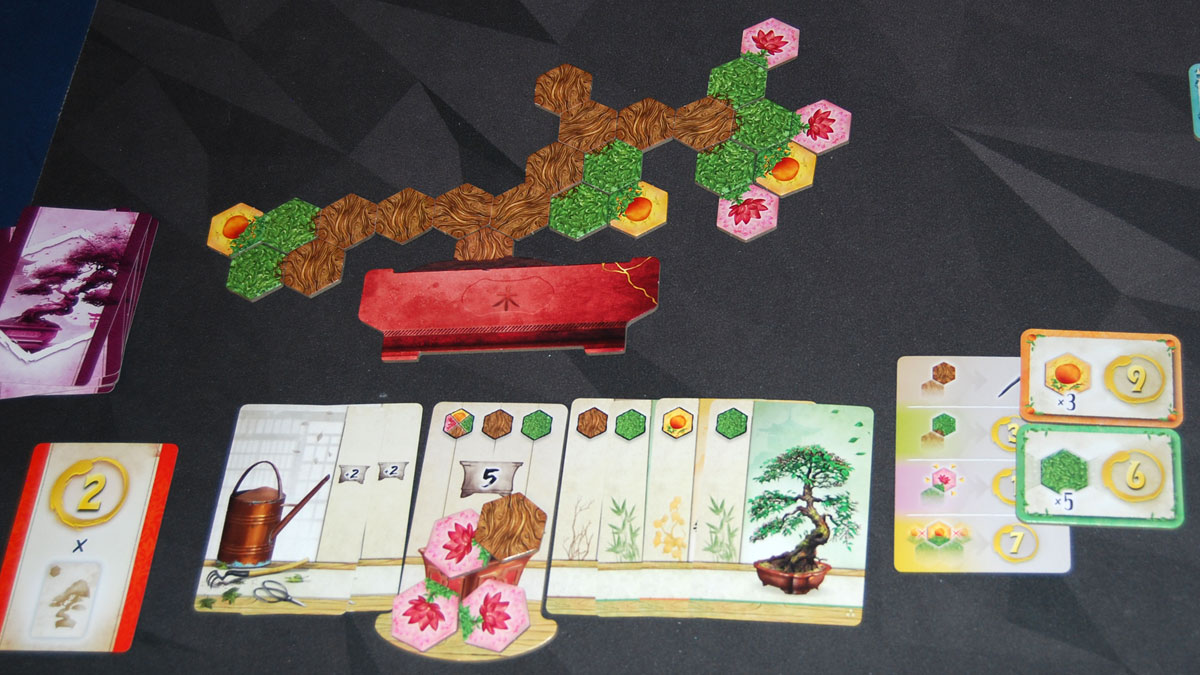
The bonsai plants in the game are made up of hex-shaped tiles, and the pot tile begins with a partial hex in the wood pattern as the start of the trunk. The hex tiles are illustrated in a way that helps you see how they connect: leaves have to connect to a bit of wood, so one edge shows a little bit of wood on it. The flowers must touch one leaf edge, and the fruits must touch two leaf edges, as shown on their tiles.
The Seishi tiles are where you store your bonsai tiles, and you also add tool and growth cards to either side of them, which allow you to store and place more tiles at a time.
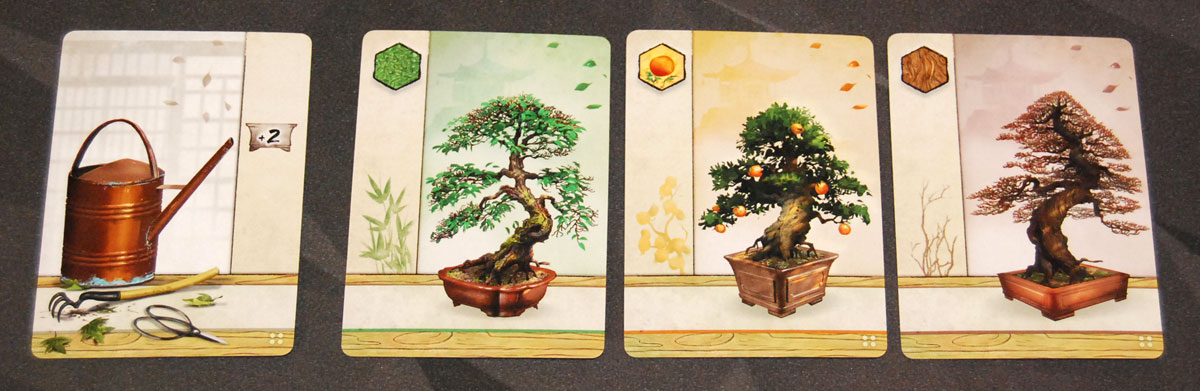
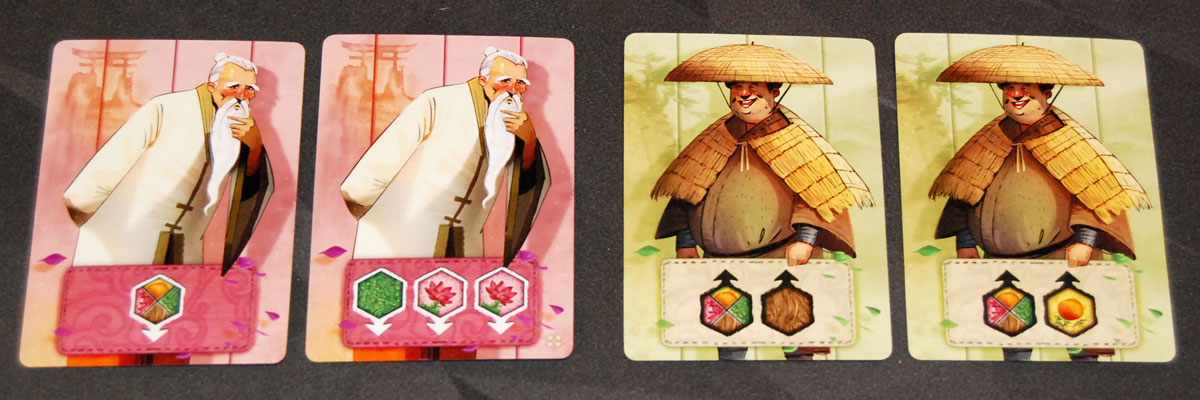
There are 5 different types of Zen cards: Growth, Tool, Helper, Master, and Parchment, all mixed into the deck. Growth and Tool cards help you build up an engine, Helpers and Masters let you place and collect tiles immediately, and Parchment cards are end-game scoring goals.
How to Play Bonsai
You can download a copy of the rulebook here.
The Goal
The objective of the game is to score the most points by growing your bonsai, meeting the requirements of goal tiles, and fulfilling parchments.

Setup
Place the board in the middle of the table, with the bonsai tiles nearby as a supply. Prepare the Zen deck by removing cards depending on the player count, and then shuffle the deck and place it on the first space of the board, revealing four cards.
Randomly select 3 of the 5 goal colors and place the corresponding goal tiles near the board (3 in each color).
Each player receives a pot tile and a Seishi starting tile. The oldest player is the first player, and players will receive some starting tiles based on player order.
Gameplay
On each turn, you either meditate or cultivate.
Meditate: Select one face-up card from the board and take it. If there are bonsai tiles shown below that space on the board, take those and add them to your personal supply. (Note that your personal supply is limited to 5 tiles unless you expand it using Tool cards—you must discard down to your limit at the end of your turn.)
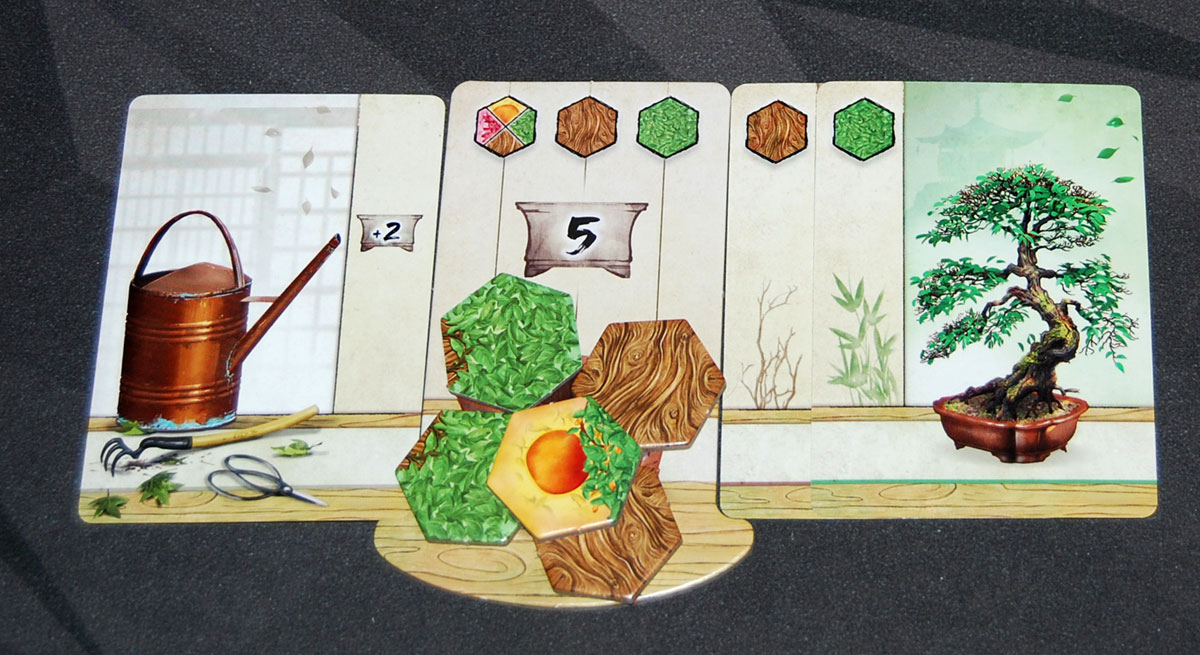
Tool and Growth cards are added to your Seishi tile. Helper and Master cards are used right away (to plant or gain tiles) and then kept in a face-down stack near your Seishi tile, and Parchment cards are kept in the same face-down stack and will score at the end of the game.
Slide all the cards to the left and reveal a new card.

Cultivate: This is how you grow your bonsai. Add tiles to your bonsai from your personal supply, based on the icons shown on your Seishi tile and any Growth cards you have. When you start the game, you may place one wood, one leaf, and one additional tile of your choice. As you gain Growth cards, each cultivate action will allow you to place more tiles at once.
- Wood tiles must touch another wood tile.
- Leaf tiles must touch one wood tile.
- Flower tiles must touch one leaf tile.
- Fruit tiles must touch two adjacent leaf tiles, and fruit tiles may not touch each other.
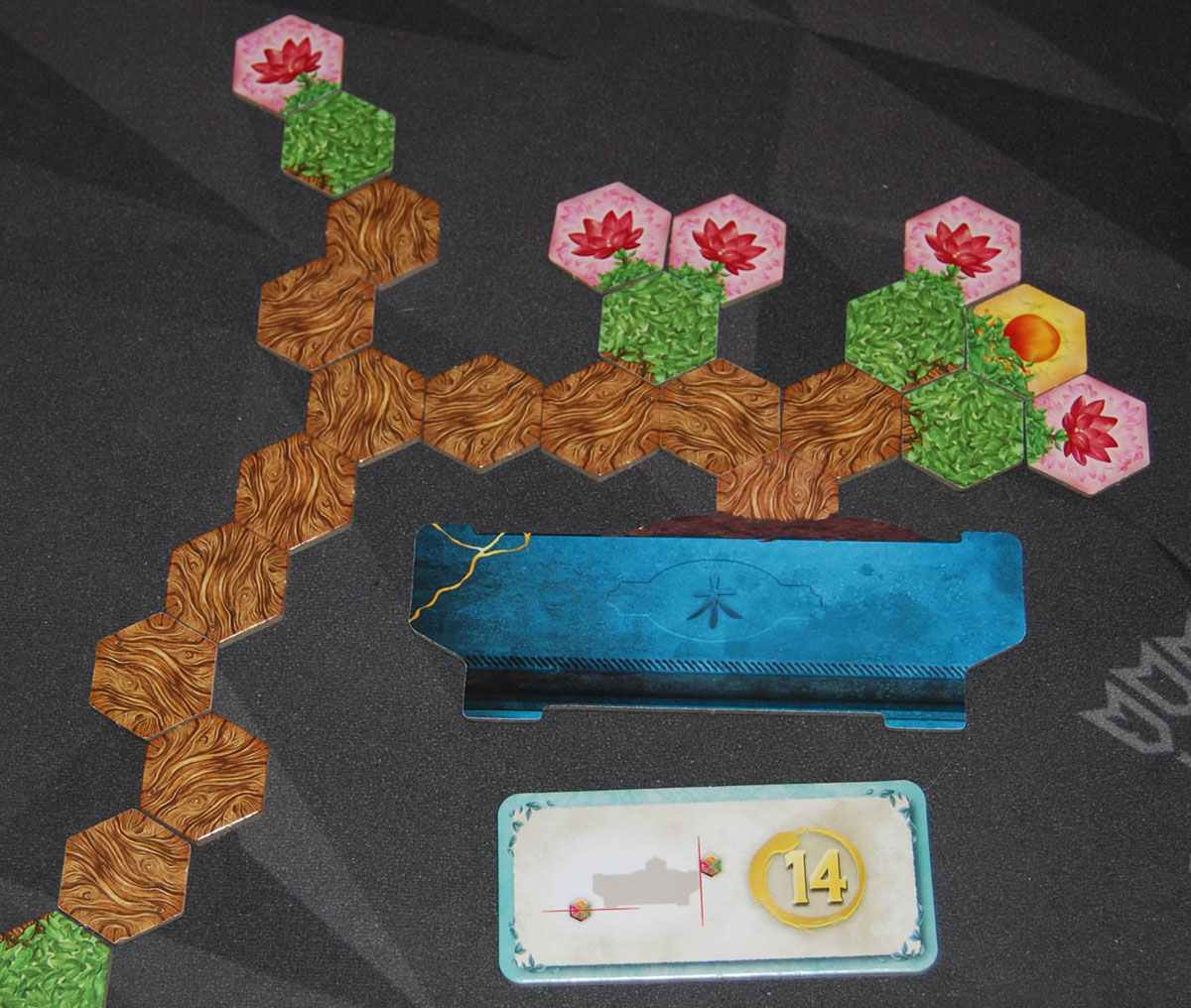
After cultivating, if your bonsai has met one of the requirements for a goal tile, you may claim it—or you may pass to try to gain a harder goal tile later. Note that if you pass on a goal tile, you may never go back and claim that one later. Also, you may only gain one goal tile of each color.
Game End
When the last card of the deck is revealed, everyone (including the player who revealed the last card) gets one more turn, and then the game ends.
Score points for tiles in your bonsai:
- Wood: 0 points
- Leaf: 3 points per tile
- Flower: 1 point for each edge not touching another tile (maximum 5 points)
- Fruit: 7 points per tile

Reveal the cards in your face-down tile, adding points for parchment tiles if you fulfilled their requirements.
Score points for the goal tiles you have collected.
The highest total score wins; ties go to the player farthest from starting player.
Solo Variant
In the solo game, you automatically discard a card from the market each turn whether you meditate or cultivate, and your goal is to claim at least one goal of each color and score above a particular point threshold before the game ends.
Why You Should Play Bonsai
Bonsai is originally from a few years ago but I didn’t manage to get it reviewed at the time; I brought it back to the table recently and have enjoyed it.
Before I dig into the gameplay, I wanted to touch on the subject of the game. In the past several years, I’ve become more conscious about both which cultures get represented in games, but also who’s creating them—for instance, if a game involves Asians, I look to see if there are any Asians in the credits. Representation matters, but it’s not sufficient if it’s always being done from the outside without any consultation, because that can lead to inaccuracies or stereotypes. Bonsai is from an Italian publisher, and most of the names in the credits appear to be Italian (though the artist’s name appears to be Iranian). However, they also note in the rulebook that they consulted with the Bonsai Specialists Italian Union on the subject matter, and there are three pages at the back of the rulebook about the origins of bonsai and the various styles of bonsai, which I appreciated.
Bonsai is a clever tile-laying game with a tricky tension between growing the plant itself and building your engine so that you can grow it more quickly. Each turn, you either take a card (and usually some tiles) or you add tiles to your plant, but collecting cards lets you accumulate more tiles and place more tiles at a time. However, the game end is triggered when the deck runs out, which means if players focus too much on taking cards even when they could cultivate, the game could end more quickly, so you may not have time to achieve the goals.
That said, you don’t have a lot of control over the pace of the game. If you don’t collect tools and growth cards as much, you end up bouncing back and forth between meditate (to get more tiles) and cultivate (to plant the tiles), since you can’t store as many and you can only grow a few at a time. If everyone does that, it can extend the length of the game a little bit because cultivate doesn’t remove cards from the market. However, that usually isn’t a great strategy—if somebody else keeps meditating and manages to build up a large store of tiles and can plant them all in one action, they can catch up to you or surpass you—and now they’ve got more cards for the next cycle. Finding the balance between the two is, of course, an important part of the tactics.
The base point values for the tiles encourages you to grow fruit and flowers as much as you can, but the arrangement matters. Flowers are worth more if they aren’t surrounded by other things, but spacing them out means you can’t grow as many. Fruit is worth even more, but they also have to be spaced out by requirement. Still, I don’t think I’ve ever seen anyone win just on the base points alone—you need to combine those with some parchment cards and goals.

The mix of goals varies from game to game, but basically there are goals for the four tile types—for the wood, leaf, and fruit, the goals are simply based on sheer numbers of them. For the flowers, the goals require a number of flowers that extend past one edge of your pot. The last goal type involves extending your bonsai beyond the edge of the pot, or even over the far side and then below the bottom edge. Depending on the combination of goals and the parchment cards you collect, sometimes pursuing your parchment conditions also fulfills goals, allowing you to double up on your work. I like the way that the goals give everyone some common objectives to race toward, while the parchments are individual goals to pursue.
There’s a “Tokonoma” variant in which you shuffle all of the parchment cards into the first half of the deck, so most of the competition for those end-game scoring conditions happens earlier in the game, which can feel a little less random. In the regular setup, a parchment that shows up late in the game may end up being great for one player because they happen to be set up for it, but not worth anything to other players other than as a blocking move.
Overall, Bonsai is a nice puzzle to solve. While each player is mostly focused on their own plant, there is still some indirection interaction because you’re competing for cards from the market, and racing to achieve the goals before other players do. It adds just enough that you want to keep an eye on your opponents’ plants, but there isn’t much “take that”—you aren’t sabotaging anyone’s plant, you’re just trying to make your own the best.
If you enjoy tile-laying games, Bonsai is worth checking out!
Click here to see all our tabletop game reviews.
 To subscribe to GeekDad’s tabletop gaming coverage, please copy this link and add it to your RSS reader.
Disclosure: GeekDad received a copy of this game for review purposes.


