Today I’ve got a few comic books for young readers—I’d say most of these are middle grade to middle school (always a little confusing that those aren’t the same thing, right?). I’ve got a pair of autobiographical books plus one that’s fiction but inspired by the author’s own life, all about some difficult struggles and how the kids work through them.
Disclosure: I received review copies of these books. Affiliate links to Bookshop.org help support my writing and independent booksellers!

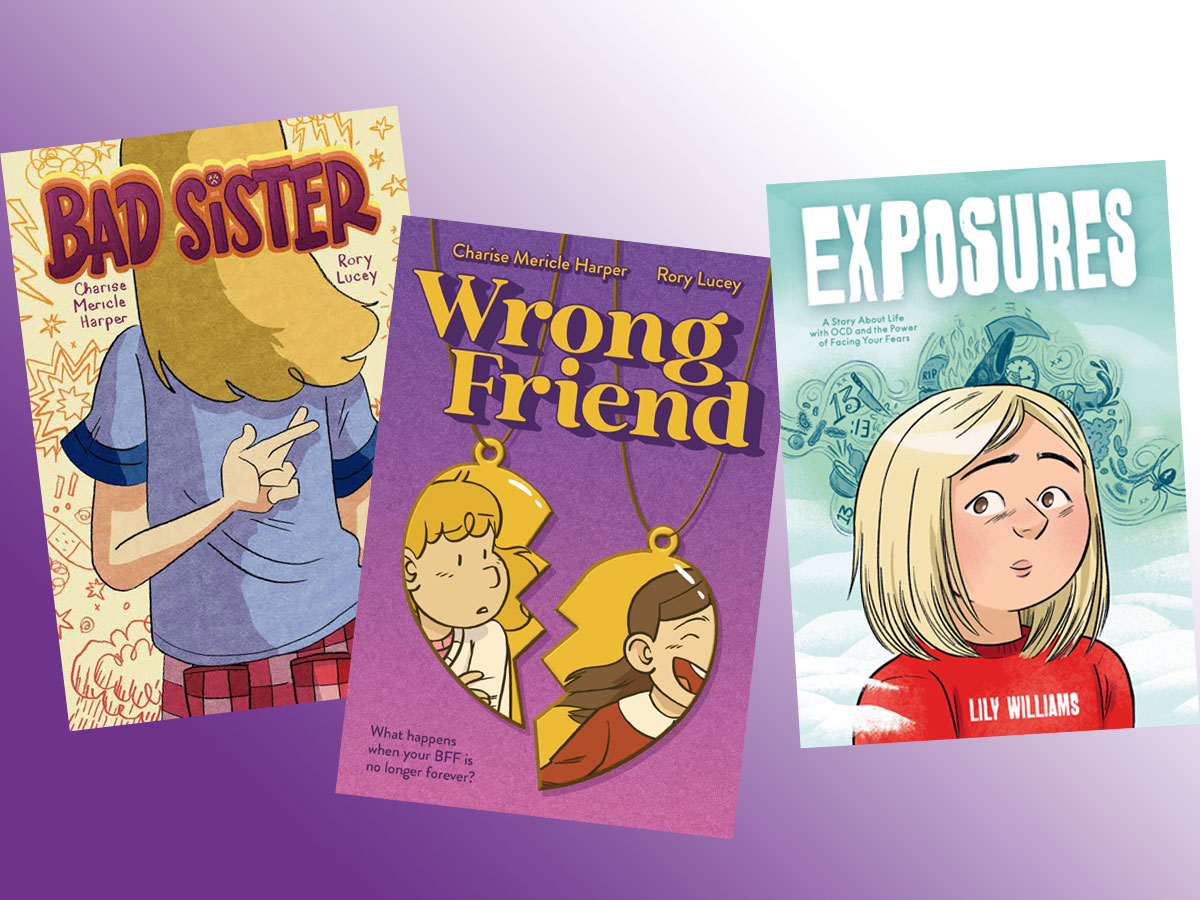
Bad Sister and Wrong Friend written by Charise Mericle Harper, illustrated by Rory Lucey
These two books, published about five years apart from each other, are about Charise’s own life as a kid and some of the struggles she had, both as an older sister and as a friend. (I’ll note that neither book has an introduction or afterword, so I’m not 100% sure that these are non-fiction, but the main character in the books is named Charise and there’s at least some indications in the dedication that it’s based on reality.)
Bad Sister is primarily about Charise’s relationship with her younger brother, Daniel. Charise was always full of energy and creative, thinking up games to play and activities to do. But she was also not very careful, and quite often Daniel ended up getting hurt—including a time when she broke Daniel’s tooth with a golf club! The book features several vignettes where she talks about her “powers”—her power to fool her brother, her power to invent things, her power to lead. But Daniel also has his own powers: he can see people and recognize them (apparently Charise has face-blindness), and most of all he seems to know how to be good in a way that just doesn’t come naturally for Charise.
It’s a poignant book: although Harper doesn’t give any detailed explanations, my impression is of a kid who might have had ADHD, back when we didn’t really have a very good understanding of it. She really didn’t know how to manage it, and her parents didn’t understand why she so often ended up doing things that they perceived as naughtiness.
Wrong Friend is about making friends, and in particular about trying to find a best friend. Charise and Casey have been best friends for years, but then one day Casey (who is two years older) suddenly treats Charise as if she’s invisible. She sort of understands that Casey is now a teenager and is interested in different things, but that doesn’t make it any less painful. Each chapter is something she discovers about friendship, as she makes new friends in her cooking class, in band, in the library—but which one is her best friend? How can one of them become her best friend if she’s spending time with different people?
Because the books are based on real life, they don’t have the same sort of story arc, where you can kind of tell what’s going to happen and then everything works out in the end. (Though they do at least both end on optimistic notes.) Instead, Harper lets the reader see the real struggles and heartache involved when there’s friction in a relationship, and especially when somebody is unsure whether they’re behaving in the right way. You get to see what it’s like to experience the uncertainty about the “rules” that drive relationships.
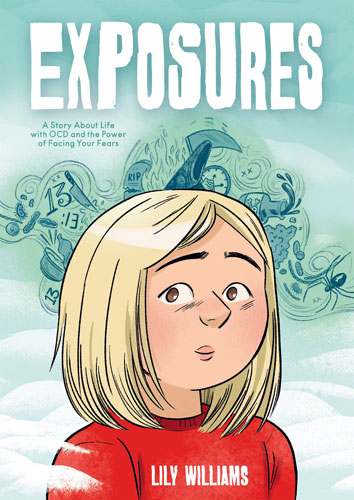
Exposures by Lily Williams
This book is fiction, but Williams explains that it is inspired by her own childhood experiences with OCD. Williams herself was not diagnosed until she was an adult, and she wrote this story in part to show a kid who was able to get help at a younger age.
Peyton has OCD: she has intrusive thoughts about illness and death. She can’t wear red, she can’t eat anything that she isn’t sure is clean, and she frequently throws up (especially when she is trying not to think about throwing up). She uses various rituals like counting and tapping, but those only go so far. She’s always done things with her twin sister Taylor—which helps, because then she thinks she can keep Taylor safe—but now they’re starting to have different interests, and the thought of being apart from Taylor causes her to have a breakdown.
Peyton’s parents had no idea any of this was happening—Peyton was pretty good at keeping it a secret, and Taylor sometimes helped cover for what she saw as her sister’s quirks. They find a behavioral specialist, who is able to diagnose Peyton and start walking her through exposure treatment—intentionally facing your fears so they gradually become less scary.
Williams does an excellent job of showing what it feels like inside Peyton’s head, the way that her obsessive thoughts circle around and around in her brain, and the compulsions she uses to soothe herself. It’s a story about being brave, and how difficult it is to go through this sort of therapy, but is also a reassurance that things can get better.
My Current Stack
I’ve been doing the Powell’s Books summer reading challenge, which has a grid that you fill in by reading books featuring particular topics or matching certain criteria. Most of them I’ve been able to fill out with books from my review stacks, but it also means that I’ve been jumping around a bit more and so the books I’ve read aren’t as easy to build a single column: a book in translation, a banned or challenged book, a book about girls or women in STEM, and so on. I’m almost done with the challenge, though, and I’ve managed to include most of the books I read in my Stack Overflow columns over the past several weeks.