
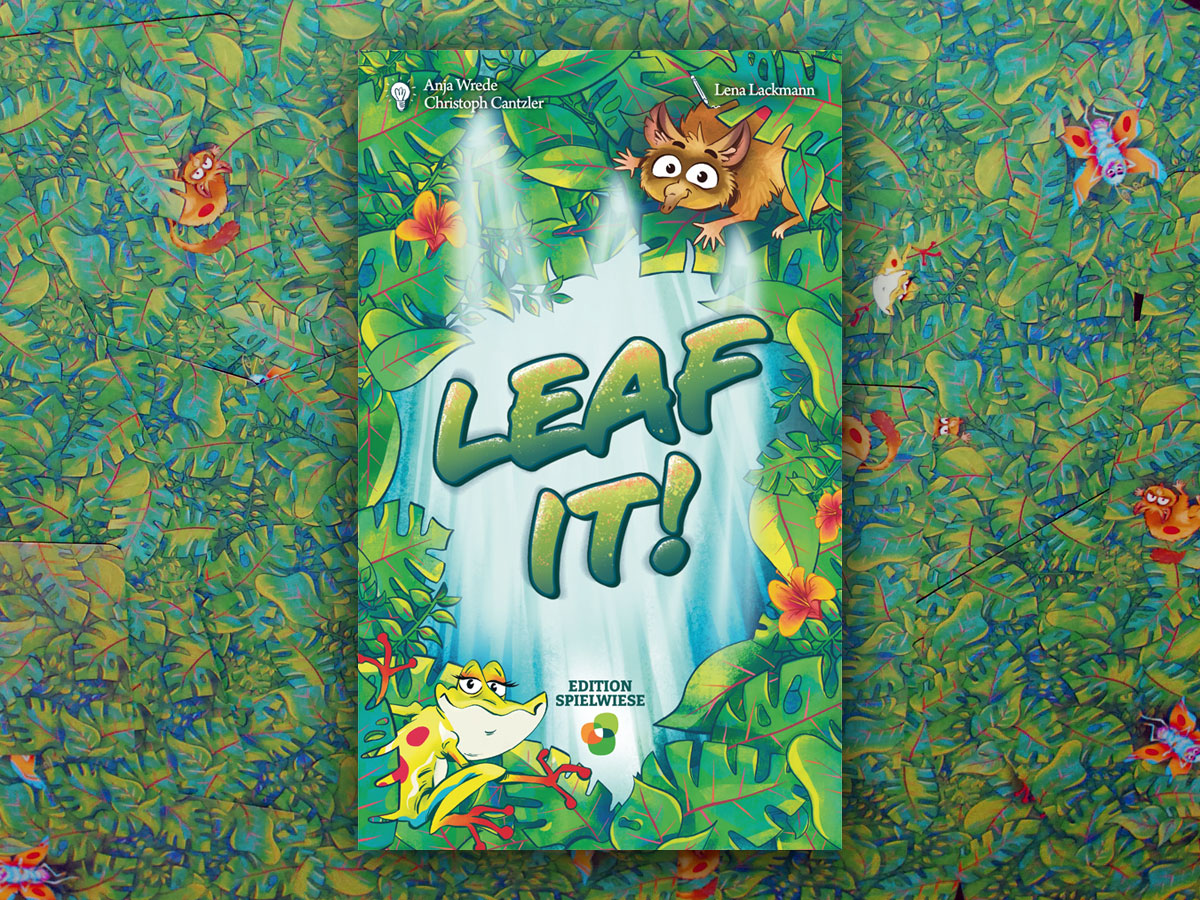
The animals are hiding in the treetops—can you find them without toppling the whole tree?
What Is Leaf It!?
Leaf It! is a card-based dexterity game for 2 to 4 players, ages 6 and up, and takes about 15 minutes to play. It retails for $14.99 and is available in stores and directly from Hachette Boardgames USA. The game does not require any reading, and only needs some simple counting for the final score—it’s mostly about balance (and a little memory), so younger kids shouldn’t have any trouble learning it. There’s a competitive mode and a cooperative mode.
Leaf It! was designed by Anja Wrede and Christoph Cantzler and published by Edition Spielwiese, with illustrations by Lena Lackmann. It’s distributed in the US by Hachette Boardgames USA, who provided me with a review copy.
Leaf It! Components
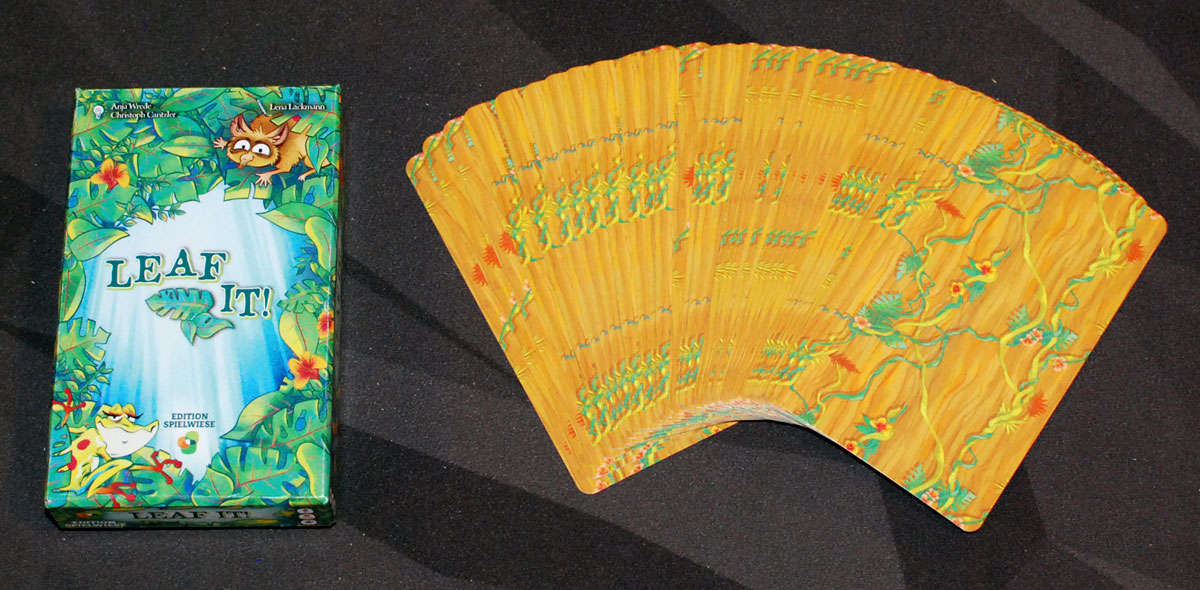
The components are simple: 40 leaf cards! These are tarot-sized cards, with a tree bark pattern on one side, and a leafy background on the other that features an animal. The box itself is a simple box with a lid, sized very close to the cards themselves, and is actually a game component, too, as you’ll see in the setup images.
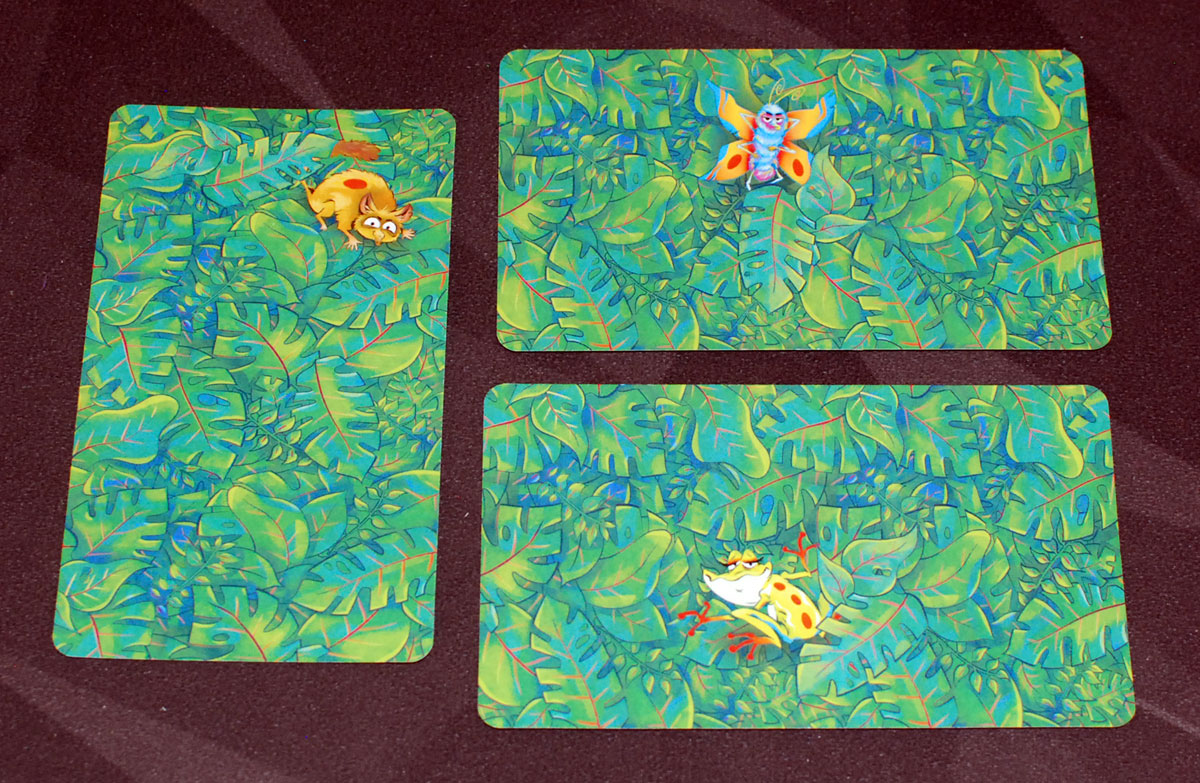
There are three animals: lemurs with 1 spot, butterflies with 2 spots, and frogs with 3 spots—these are also the point value of the animals. (Lemurs are the most plentiful, and frogs are the rarest.) The positioning of the animals varies from card to card, but lemurs are always closer to a corner of the card, butterflies are a little closer to the center, and frogs are the closest to the center of the card.
How to Play Leaf It!
You can download a copy of the rulesheet here. I’ll explain the competitive mode first, and the co-op variant below.
The Goal
The goal of the game is to score the most points by collecting animals (without collapsing the tree!).
Setup
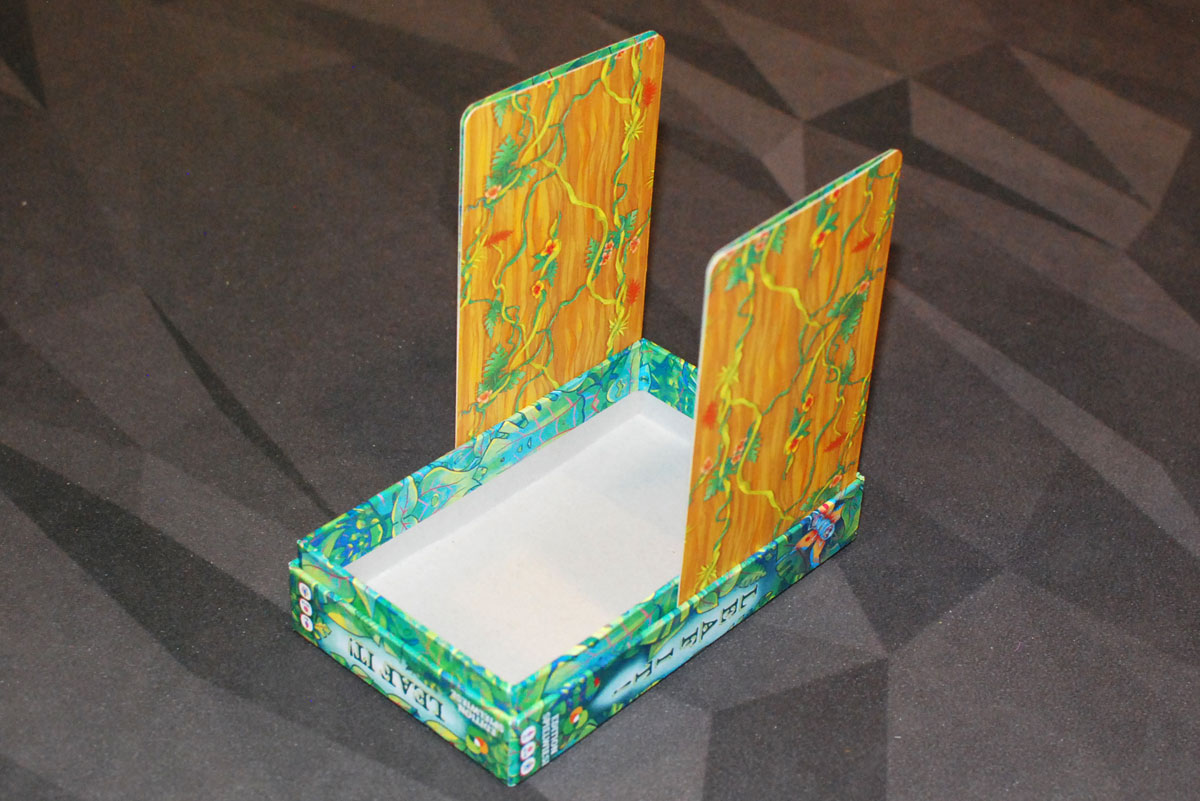
Create a base by turning the box lid upside down and nesting the box bottom inside it. Shuffle the deck, and then draw four cards and create a two-part tree trunk, with two cards slotted into the box on either side (with the wood images showing). Deal the rest of the cards to all the players as evenly as possible, in face-down stacks.
The player with the brightest eyes goes first!
Gameplay
The first half of the game is building the canopy, and the second half is dismantling it.
Building the Canopy
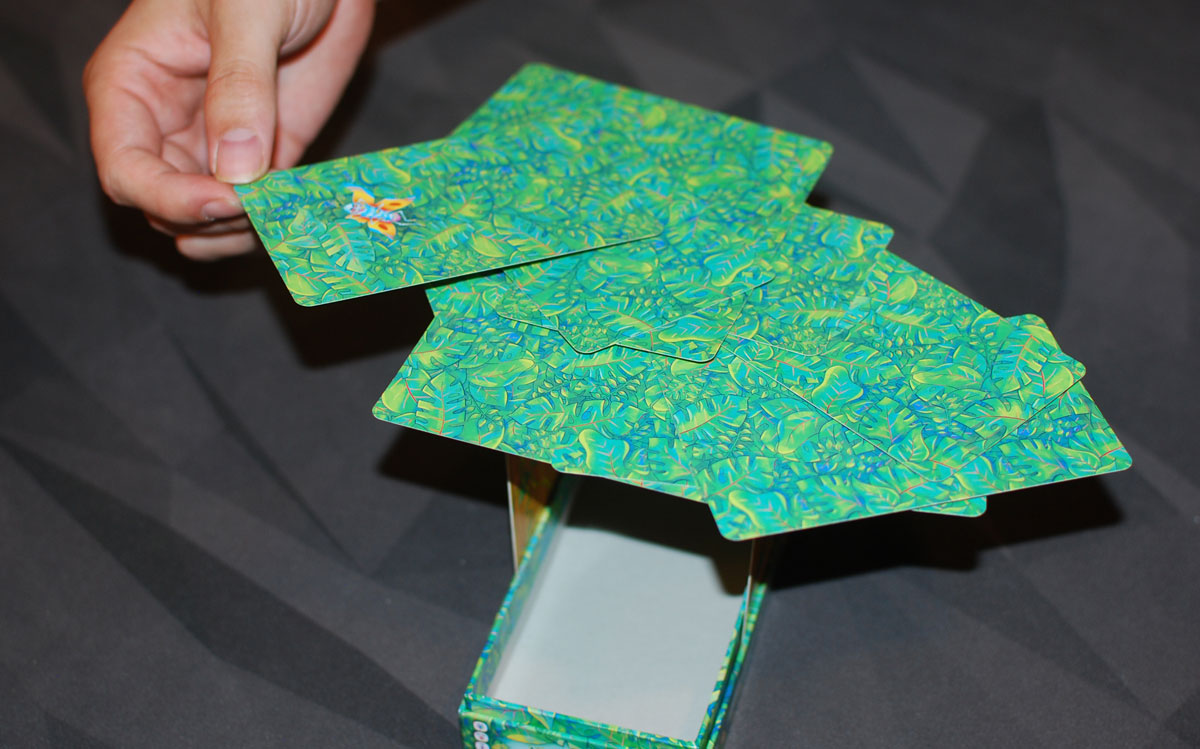
On your turn, you take the top card from your stack and then place it, leaf-side-up, onto the tree. The first card should be placed to make a bridge across the two trunk pieces. Every subsequent card must be placed so that the animal on the previous card is completely covered. This continues until all cards have been placed.
Dismantling the Canopy
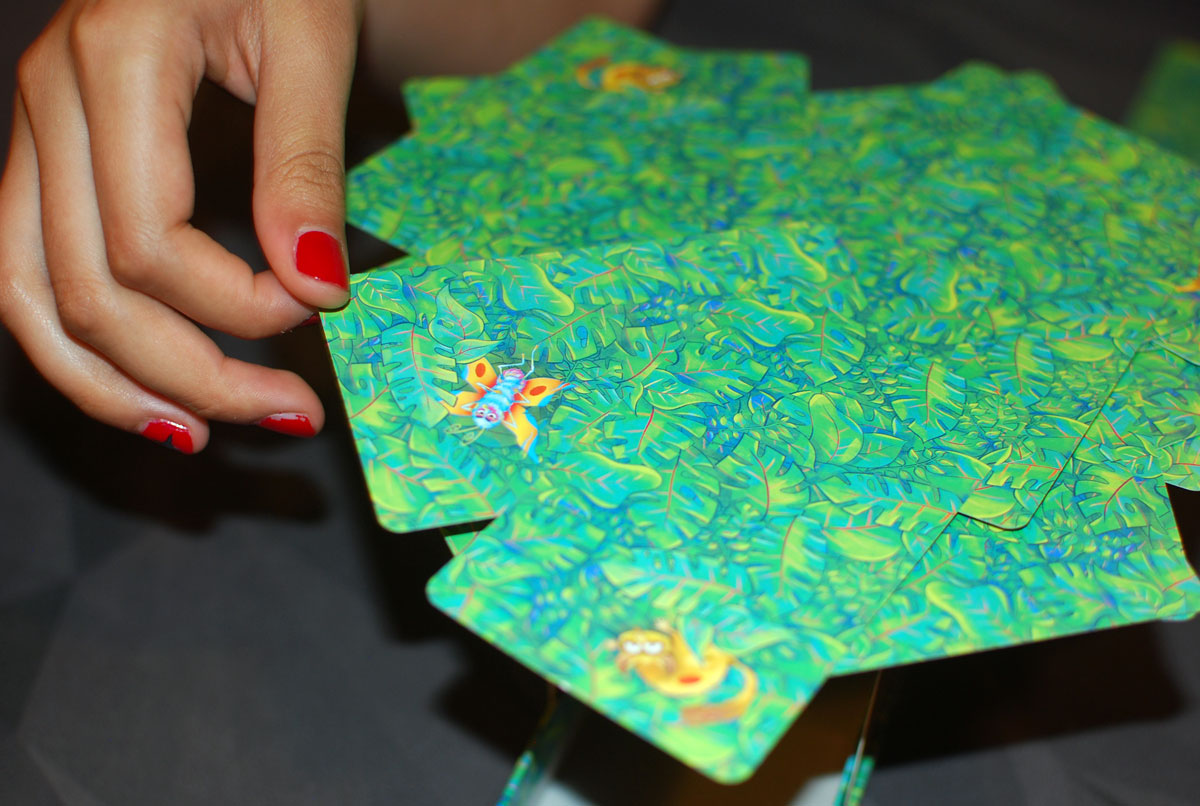
When the tree has been fully built, players will take turns removing cards from the canopy. You may take any single card from the canopy—but once you touch a card, that’s the one you must take! Place your collected cards in a scoring stack.
Falling Cards
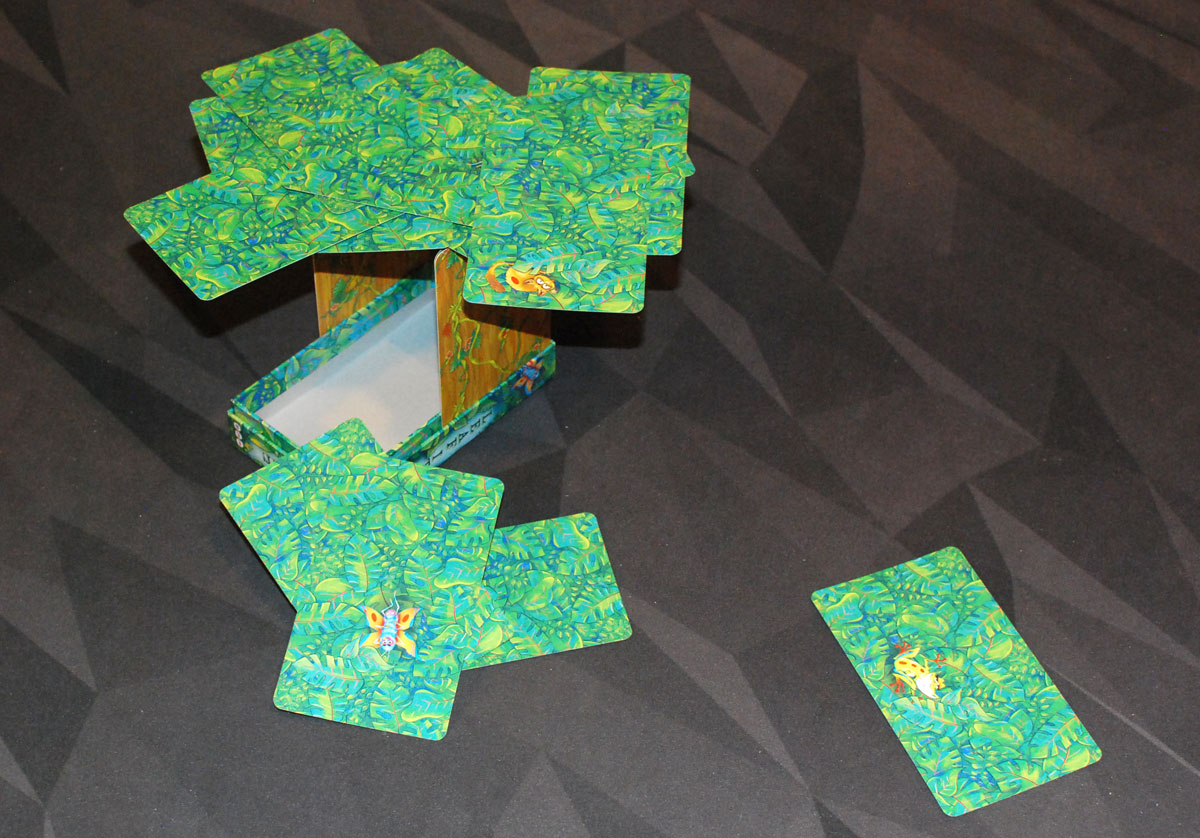
If any cards fall during your turn (in either phase) but there’s at least one card left on the trunk, there’s a penalty: collect all the fallen cards, shuffle them face-down, and let all the other players draw one at random for their scoring piles starting with the player to your left. Discard the rest, if any.
If the entire canopy collapses, the game ends immediately and you lose. Everyone else still gets one random face-down card from the fallen cards.
Game End
The game ends when there are no more cards on the tree, whether because they have all been collected or because somebody caused a total collapse.
Each animal is worth points equal to the number of red spots on it: lemurs are 1 point, butterflies are 2 points, and frogs are 3 points. The highest score wins!
Cooperative Variant
The cooperative mode involves building up the canopy. The goal is to have as many visible eyes as possible by the end of the game, so when you place your card, you do not need to cover up the animal as in the competitive version. You are allowed to insert cards between existing cards in the canopy, or use your card (but not your hands!) to move other cards around while placing yours.
If your card falls off, you can keep trying to place it. If other cards fall off, you just remove them from the game. If the entire canopy collapses, you all lose the game.
When the canopy is complete, count up the fully visible pairs of eyes, and compare them to the scoring table on the rules to see how you did!
Why You Should Play Leaf It!
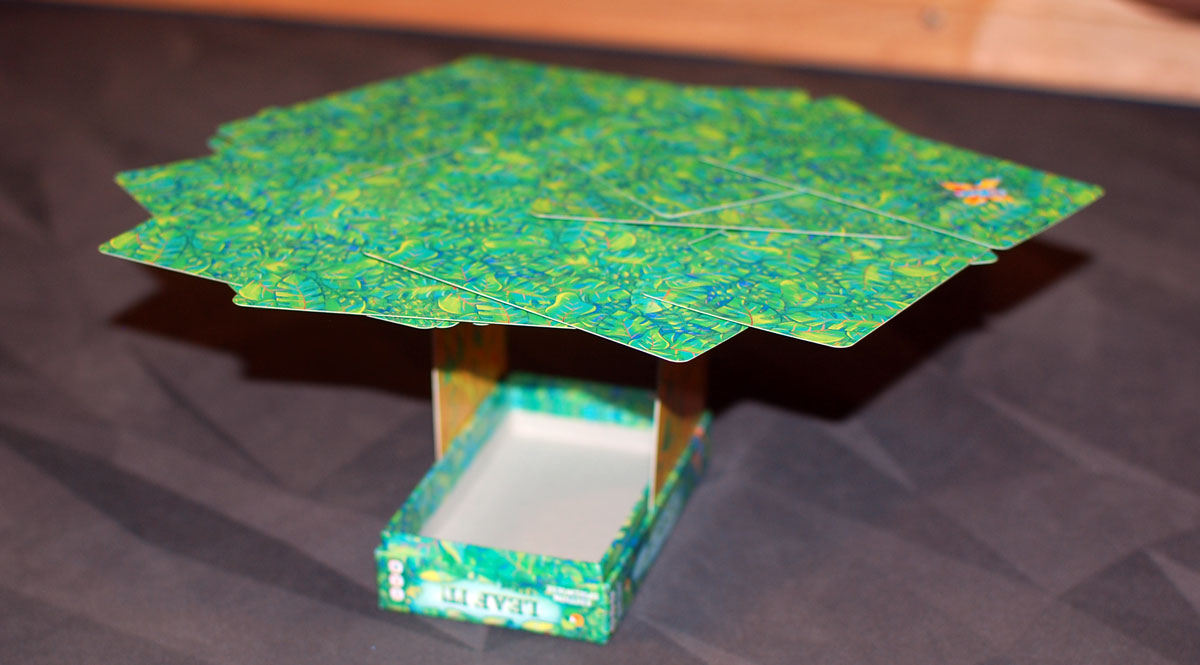
Leaf It! is a pretty simple concept, but it is still pretty entertaining. You’re trying to stack cards in such a way that it may force your opponent to collapse the canopy, without courting disaster yourself. The lemurs, which are the most common in the deck, are always close to one end of the large cards, so you can cantilever them out over the edge, tempting the next player to continue extending the precarious shelf. Eventually, somebody has to bring it back in, building back toward the center again—but it is still pretty impressive how broad the canopy can spread by the end of the game (assuming nobody knocks a bunch of it over).
While there are some games that involve stacking cards (like Rhino Hero, for instance), most of those involve folded cards that stack vertically and create more of a structure rather than a flat stack. I remember a game from about a decade ago called Garbage Day that involved stacking cards on top of a little plastic trash can—that one had holes in the cards and you had to place your card so the hole didn’t cover anything, which would eventually extend the pile too far. There’s also a little Oink Games title called Rafter Five where you extend cards out over the “sea” and place treasure chests on them, counterbalancing the cards with meeples that stand in the center of the raft. Leaf It! sticks to the fundamentals, with just cards.
The dismantling part seems really straightforward—collect a card without knocking anything over, right? Ah, but the cards are not all the same value. You don’t want to get stuck with a lowly lemur if you can find a frog instead. That means there’s actually a bit of a memory element to Leaf It! on top of the dexterity. Can you remember which corner of a card leads to the frog? And if so, can you swipe it without bringing the rest of the tree down with it? My son seemed particularly adept at remembering where the more valuable animals were hiding, while the rest of us relied on glimpses of them that would get revealed as cards were removed.
The cooperative mode adds a fun challenge for those who prefer not to go head-to-head, or for those playing with younger kids who might like a little assistance in balancing. Trying to fit the cards onto the stack while leaving holes for all the various eyes is a tricky business, and sometimes you have to decide when to sacrifice a pair of eyes for structural integrity.
If you enjoy dexterity games, Leaf It! is a compact game that you could take with you just about anywhere (though I recommend playing indoors to avoid breezes). With a quick play time, you could get a game in at a restaurant while waiting for your order, or fit in a round or two during game night.
For more information or to order a copy, visit the Hachette Boardgames USA website.
Click here to see all our tabletop game reviews.
 To subscribe to GeekDad’s tabletop gaming coverage, please copy this link and add it to your RSS reader.
Disclosure: GeekDad received a copy of this game for review purposes.


