The reason I’m calling today’s column “space-time” is because I’ve got two books set in space and two about time travel. Ta-da! Let’s start with the space books.
Disclosure: I received review copies of these titles. Affiliate links to Bookshop.org help support my writing and independent bookstores instead of billionaires.

Platform Decay by Martha Wells
Look, if you haven’t read any of the Murderbot Diaries series, you’re seriously missing out. Go check those out and then come back; I’ll wait.
All caught up now? Great.
Murderbot is on a rescue mission. You don’t find out immediately exactly who needs rescuing or why, so I’ll omit that, but what you do know is that Murderbot has teamed up with Three, the SecUnit that was recently liberated. Three is still trying to figure out how to behave with its newfound freedom, and Murderbot makes for a strange mentor. Since the last book, Murderbot has also installed a mental health module that is supposed to help it figure out how it is feeling, so we get the occasional report, along with Murderbot’s own snarky responses to it.
Murderbot and Three infiltrate a huge space station, where they have to use all of Murderbot’s hacking tricks to find and extract their rescuees. But it’s not that simple: they encounter somebody who, at least the last time they met, was not exactly friendly to Murderbot. And now they have to work together.
One of the best things about Murderbot isn’t the plot, but all of the internal monologue that Murderbot has while narrating the story. It suffers from social anxiety, but is working through it, despite Martha Wells’ insistence on putting Murderbot in situations that test its boundaries. Watching it figure out how to be a better “person”—and now trying to help Three figure out how to behave—is both touching and entertaining.

The Photonic Effect by Mike Chen
It’s been a while since the last Mike Chen novel, so I was happy to dive into this space opera. (And he’s got a young adult book coming later this year, too!) The Photonic Effect is set nearly three hundred years in the future, when humans have access to interstellar travel and have spread across the galaxy. The scientific starship Horizon got trapped in a gravity well, in which they encountered beings (including humans) from other universes and banded together for survival.
When they were finally able to escape the gravity well, they found themselves in the middle of a civil war, and since the Horizon belongs to the Galactic Cluster Fleet, the government has expectations for how the ship will be used in the war. In particular, its photonic engine—which uses technology from the light-based beings in the gravity well—could prove crucial to the war, if only they could get it to function reliably. The captain and crew of the ship are torn in their allegiances; many agree with the tenets of the Withdrawal Movement, and some aren’t even from this universe and don’t want to fight in this war at all. Meanwhile, they’ve also received a distress call from the gravity well, and they feel a responsibility to go to their aid.
The book is told in the third person, but each chapter focuses on one of the characters, so we get inside their heads a little more for that section. Captain Demora Kim has tried to keep the war outside of her ship, to be a neutral scientific research ship, but as the war progresses, the Horizon is called into duty. Neera, the engineer, is an alien who has a brilliant mind but has a hard time trusting his own judgment; he came from a world in which nobody questioned authority and just obeyed orders from above. Tanav Lexin was a musician—he was actually supposed to be playing a gig on an intergalactic cruise ship when it got pulled into the gravity well, and although he insists he’s not an officer, Demi often relies on his ability to read people and to bring people together.
The book really throws you right into the middle of things: there’s a brief timeline that hints at some of the things the Horizon and its crew have been through, but Chen really gives a sense of that shared history through their interactions, and lets you piece together the rest over the course of the book. It’s a galaxy-spanning tale that is also very intimate, as each of the characters has their own obstacles to overcome as they search for the best path forward.
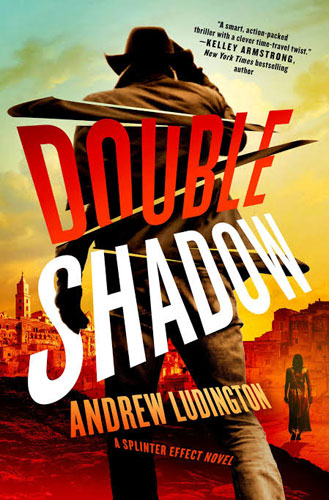
Double Shadow by Andrew Ludington
Okay, and now on to the time travel! Double Shadow is a sequel to Splinter Effect, sort of an Indiana Jones with time travel. Rabbit Ward is a chrono-archeologist: he goes back in time, tracking down artifacts at the moment they were lost (to war, to fire, or other disasters) and then hides them in a secure location. When he returns to the present, the Smithsonian is able to dig them up, rescued from obscurity.
In Double Shadow, Rabbit come across a murder in ancient Jerusalem while on a mission, and is surprised to hear the murderer speak English—he must be a time traveler. Back in the present, he gets a frantic text from Helen (his sometime adversary) asking him to track down somebody named Einar Eshek back in 68 CE. When he arrives, he discovers a younger Helen, who doesn’t recognize him, and they set off to look for Eshek.
As with the first book, there’s a lot of real history mixed in with the story: the time that Rabbit and Helen are running around Jerusalem is leading up to the war between the Jews and Rome, and tensions are high. In the meantime, they’re trying to figure out who Eshek is, and whether he’s also the time-traveling murderer. Ludington keeps you guessing about Eshek’s real identity, and even when you do find out, there’s still a lot involved in actually catching him.
We do get to find out a bit more about Helen in this book since she’s such an enigma in the first one, and Rabbit also has some personal growth, but most of the book is about the whodunnit, the extreme difficulty of tracking down a killer who can jump around in time. There’s plenty of action, a lot of history, and a bit more romance than the first book. (Also, a content warning: it is pretty gruesome at points.) And it looks like we can probably expect more adventures of Rabbit and Helen based on the ending.

The Traveler by Joseph Eckert
Scott Treder has a problem: he is jumping forward in time uncontrollably. It started at 7:52am on a random Monday in April, where he suddenly found himself in the same place, having lost 24 hours. Then it keeps happening every time it hits 7:52am. And each time he jumps, the length of the jump doubles.
The first half of the book is a harrowing thought experiment: can you imagine what it’s like, experiencing only 24 hours before you leap into the future? Even by the third jump, Scott’s wife Amy is struggling with his increasingly lengthy absences. Their precocious 7-year-old son, Lyle, announces that by the fifteenth jump, Scott will go 45 years into the future. How do you deal with that revelation? That you’ll only get a handful of days in your kid’s life before he’s older than you—and then only one or two more days with him before he’s dead of old age?
Scott tries to find help for what’s happening, but the physicists at the university can’t figure it out—and then word leaks, and the reporters descend on the family. Later, as Lyle grows up, he studies theoretical physics, promising his dad that he’ll find a solution, while Scott continues to fast forward through the years.
It reminded me a little of The Time Traveler’s Wife, though in this case it’s the time traveler’s son who ends up playing a bigger role. But where Henry’s jumps happened at unpredictable times and could send him forward or backward in time, eventually snapping him back to his “present,” Scott’s jumps are like clockwork, precise and unchanging. A mythology arises around him: when he appears exactly as predicted, it’s like a prophecy fulfilled, but people react in very different ways.
By the time we get into the second half of the book, though, Scott is leaping hundreds of years, thousands of years, and more. Civilizations rise and fall: we go from utopia to apocalypse and back again, and all the while Scott is left to wonder why this is happening to him, whether there is an end to it. I’ll admit: this is the part of the book that lost me a bit. It felt like part of it was an observation that we humans are just not great at progress: we make huge scientific advancements, and then we destroy each other, and then we rebuild. But that point probably could have been made in fewer pages. It also got more mystical, and the suspension of disbelief just got a little harder each time he jumped into the distant future. I found myself wishing we had more time to explore the first fifteen jumps or so, the emotional impact of trying to be a father when you’re absent for most of your kid’s life.
The one other thing that bothered me about the time travel is the inconsistencies. If you’re going to write a time travel story, one of the important rules is figuring out your timeline, right? Since we do get some actual dates in the course of the story, we’re able to pinpoint Scott’s initial jump to 2018. With the doubling, he soon goes from days to months to years. But later in the book he references COVID-19, which he wouldn’t have experienced, as well as the movie Oppenheimer, which he also would have jumped over. And there’s also one bit (when a physicist is explaining things to Scott) where he claims that Scott’s jumps prove determinism rather than a branching-path sort of multiverse. Now, I’ve spent a lot of time thinking about time travel, and I read and re-read that physicist’s explanation and came to the conclusion that it didn’t make any sense at all. Of course, you could always say that this character is just wrong, but he’s supposed to be one of the best theoretical physicists around, so that was frustrating to me. Accurate or not, though, it was definitely a thought-provoking book.