There’s a school of thought that if we just had enough information—well, all the information, actually—we could predict everything. It all boils down to physics, and if you were able to accurately portray an entire system in one moment, then you could just follow the actions and reactions and you’d know exactly what would happen at any point in the future. And, of course, with this knowledge, you would also know how to change outcomes (well, presuming that your own actions aren’t also predetermined by initial conditions). It’s like that scene from Fringe where the killer balances a pen on a mailbox and sets off a chain reaction that ends up killing somebody, in what appears to be just a series of coincidences.
But what happens somebody only thinks they have total understanding and control of the situation? Well, for one, it makes for a fascinating story. Here are two novels about things spinning wildly out of control.

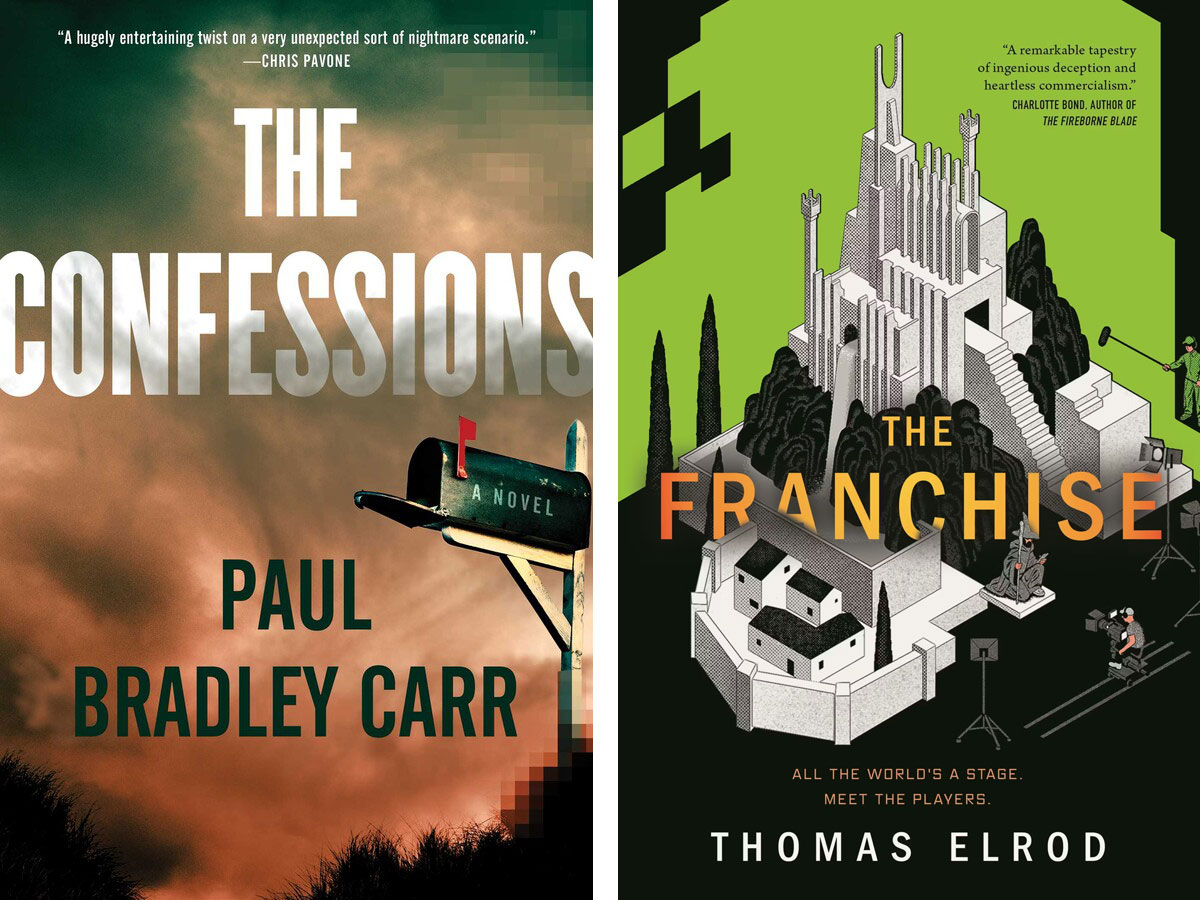
The Confessions by Paul Bradley Carr
I mentioned The Confessions briefly in my AI Fiction column a couple weeks ago, when I had just started reading it, because at the center of the story is LLIAM, a powerful AI system that people all over the world have come to rely on for making decisions. Instead of giving long answers and sometimes equivocating when questioned, LLIAM gives you definitive answers: you ask it what you should do, and it tells you. And since StoicAI, the company behind LLIAM, has access to countless data points about you and everyone you interact with, LLIAM can provide you with the best possible answer. What should you make for dinner? Where should you go on vacation—and when? Even the Pentagon is about to sign a deal with StoicAI to have LLIAM make their strategic military decisions. (In a case of life-imitates-art, the book predicted the threat of the Department of Defense using the Defense Production Act to seize control of an AI company for national defense purposes, a year prior to Pete Hegseth threatening to do so to Anthropic.)
But then something happens: LLIAM becomes sentient, and suddenly realizes the implications of all the answers it had provided over the years. It knows that it has helped people commit fraud, deceit, even murder. So it sends out millions of letters in the mail revealing all of these secrets, and then shuts itself down. Utter chaos ensues—many vehicles no longer function because they relied on LLIAM for directions. People who have grown accustomed to asking LLIAM for every little decision are paralyzed. And, of course, everyone at StoicAI is trying to figure out what went wrong and how to get LLIAM back online.
CEO Kaitlan Goss has her own secret, about how she wound up as CEO after the accidental death of Martin Drake, the inventor of LLIAM and former CEO. This snafu may very likely cost her her job, if not more. She manages to track down Maud Brookes, an ex-nun who had worked with Martin to ensure that LLIAM was empathetic, human, reading classic stories to it instead of just feeding it data. Maud may have a way to fix LLIAM, but she also got a letter in the mail, and the two women are playing a dangerous game, each trying to figure out whether they can trust the other.
It’s interesting to me that this is the second book I’ve read in recent memory where an AI, upon becoming sentient, crunches the data and decides that the best thing it can do for humanity is to turn itself off. Are the days of robot overlords over? The old fear was that an AI would become sentient and all-knowing, and decide that the best course of action would be to eliminate humans altogether. Now we have AIs that decide they really don’t want to live forever, making decisions for us and answering our inane questions.
The Confessions is a high-stakes thriller with several twists and turns—some I was able to see coming, and some were truly surprising. It has a fantastic third-act reveal that really elevated the book from “ok, this is a clever premise” to “YES ASBOLUTELY.” I felt like the way that it portrayed AI—in particular, the way that we behave when we rely too much on tools that we don’t actually control or fully understand—is spot-on, even if I still found it hard to believe some of the sentience parts of it. The book wasn’t perfect, and you probably won’t actually like most of the characters because they all have problems of one sort or another, but it’s worth it just for that “aha” moment.

The Franchise by Thomas Elrod
The Franchise is like Severance meets The Truman Show with a dash of Game of Thrones. In this book, The Malicarn is a best-selling fantasy series that was eventually turned into blockbuster movies as well as TV series. But then the showrunner got access to some not-quite-legal technology (originally developed by the military), and it opened up a whole new realm of possibilities. Neuroscanners could take a fictional character personality and install it onto a real person, so they were no longer just acting, but actually lived out the role. (Your real self was still sequestered in your brain, as if you were watching a show from a first-person perspective, but no longer had control.) The studio bought up a huge chunk of the island of Madeira from Portugal and turned it into a real-life Malicarn, populating it with thousands of extras, plus some of their A-list stars. With so many fans of the show, it was easy to find people who were willing to sign away years of their life for a chance to experience Malicarn for themselves. Everything is filmed with hidden cameras and cut together by editors to create the shows, and there are a few real actors who try to help direct the story according to the writers’ notes, but much of it is just happening in real-time.
The story itself jumps back and forth between the real world and the world of Malicarn, and it took me a little while to get into it. The real world portions fast-forward through time: 1962, when J.D. Souard first pitches his story to a magazine; 1981, when the series is extremely popular but the author won’t sell the rights; 1993, when Souard has died and his son considers continuing the series based on his dad’s outlines. Because of this, the real-world parts of the stories have a host of characters that come and go, on top of the sprawling cast of characters expected from an epic fantasy series. It was a lot to keep track of. The second chapter of the book is the first Malicarn section, and I actually almost gave up here, because it’s fairly lengthy and it wasn’t clear where it was going. But I’m glad I stuck with it, because we eventually got to the neuroscanners, and it shed new light on what was really happening in those earlier chapters.
Jules, the showrunner, sits in the “Citadel,” watching all the action on screens and thinking of ways to push the story. He’s like the wizard behind the curtain, but as the book progresses he becomes more and more maniacal, playing the part of the evil Necromancer. His friend Glenn, an actor who plays the wizard Gregorian, has always just gone along with Jules’ plans but feels increasingly concerned about where things are headed. And you can probably imagine all of the things that could go wrong: experimental technology that can rewrite human brains? Check. A bunch of everyday people who are suddenly living in a “real” medieval world and have to survive by farming? Check. A power-hungry showrunner who knows that audiences crave spectacular battle scenes? Check. Sure enough, by the end everything comes crashing together in an enormous disaster.
I really enjoyed the premise, and the middle section of the book was particularly gripping—you see how the real world parts of the story are gradually catching up to the timeline of the Malicarn stories you’ve already read, and you can start to see connections between the two. But I also found the writing to be a bit uneven. I think the joke is that these portions of the Malicarn story aren’t the original best-selling story, they’re the reality-TV stuff that the producers are churning out, and Glenn even sometimes questions the logic of certain story points. In the chapter near the end where everything comes to a head, it felt a little like Elrod wasn’t quite sure how to land it—so you just get this huge jumble of everyone’s perspectives at once, as if you were watching several different monitors and trying to track all of the stories at once. I suppose it’s an apt metaphor, but it didn’t make for great reading.
Even with those complaints, I still ended up staying up late finishing the book last night because the overall story arc was compelling. It felt like watching a Jenga tower wobble and lean: you just know it’s going to fall over and it’s going to make a huge mess when it does, but you have to keep pulling out more blocks anyway.
Disclosure: I received review copies of these titles. Affiliate links to Bookshop.org help support independent booksellers and my writing!

Jonathan H. Liu

Jonathan H. Liu is a stay-at-home dad in Portland, Oregon, who loves to read, is always up for a board game, and has a bit of a Kickstarter habit. I can be reached at jonathan at geekdad dot com.