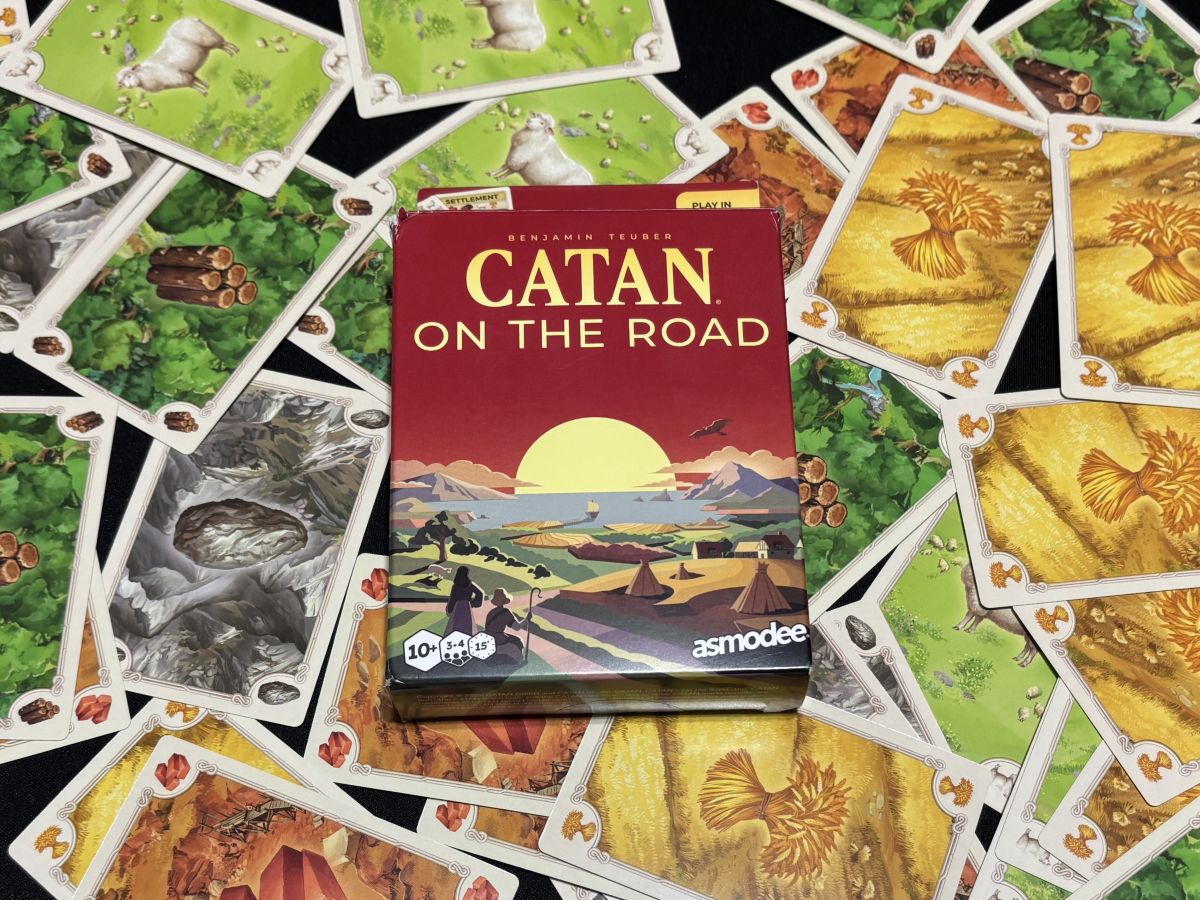
Settlers of Catan, now called just Catan, was first released in 1995. Since that time, there have been numerous expansions, spinoffs, and the theme converted into card and dice games. I have been playing several of these for nearly 30 years. Therefore I was interested in trying out a portable version of the game with a short play time called Catan: on the Road.
What Is Catan: On the Road?
Catan: on the Road is a card game for 3-4 players, ages 10 and up, and takes about 15 minutes to play. It’s currently available at your local game store as well as online retailers such as Amazon, selling for about $9.97 for a copy of the game. Catan: on the Road was designed by Benjamin Tauber and published by Asmodee, with graphic design by Az Sperry.
Catan: On the Road Components
Here is what you get in the box:
- 61 resource cards
- 34 building cards
- 4 starting road cards
- 4 starting settlement cards
- 4 metropolis cards
- 7 event cards
- 2 bonus VP cards
- 4 player aids
- 1 rulebook

Resource cards are the currency used to build settlements, roads, cities, and much more. There are 11 brick, 11 wood, 14 wool, 12 wheat, and 13 ore resource cards.

Building cards are purchased with resources and used to expand players control. There are 10 road, 11 settlement, 5 city, and 8 knight cards.
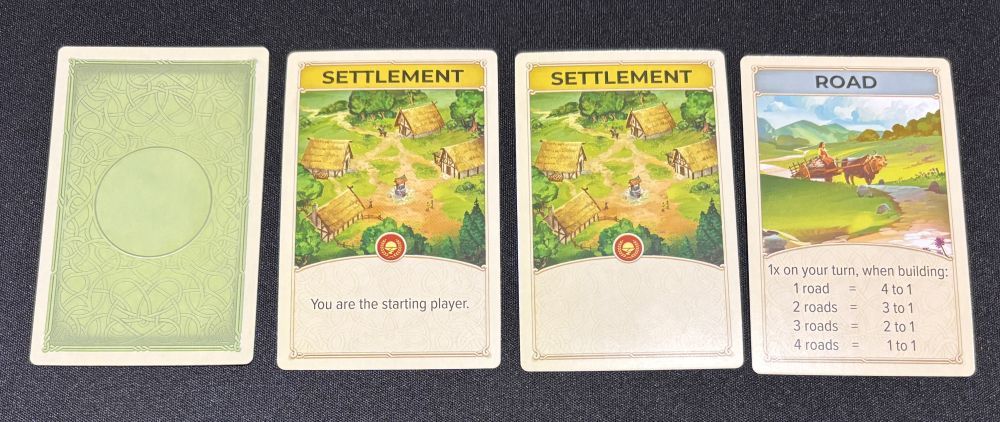
Each player begins with 1 starting settlement and 1 starting road cards. These begin in your play area and are the start of your territory.

Metropolis cards represent your cities growing larger. These cards have an ‘A’ and ‘B’ sides. All of the ‘A’ sides are the same. However, each ‘B’ side has a unique advantage. Players can choose whether to use the ‘A’ or ‘B’ sides for the game.
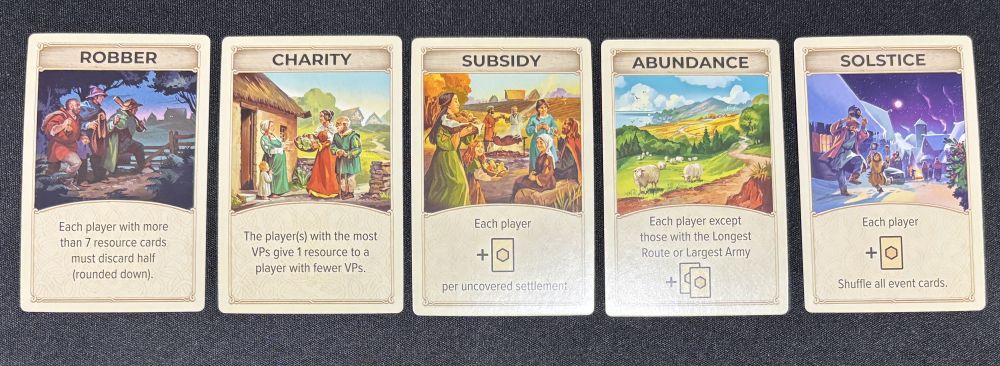
The seven event cards include four cards that give players resources as well as 3 robber cards which can take away resources.

The two bonus cards provide additional victory points for the player with the longest route or largest army. The first player to have three roads receives the longest road card. If another player builds more roads then the current card holder, they receive the card. The first player to have 2 knights in their area gets the largest army card and then it goes to whoever has more knights. Each of these bonus cards are worth two points.
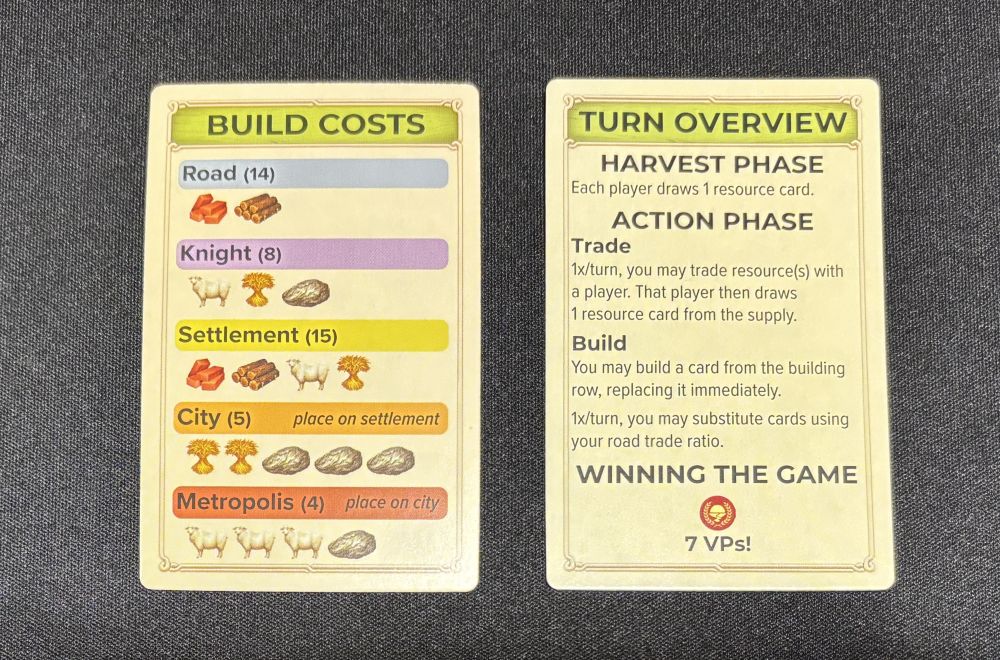
The player aid cards list the costs for building cards on one side and a turn overview on the opposite side.
How to Play Catan: On the Road
You can download a copy of the rulebook here.
The Goal
The goal of the game is to be the first player to reach 7 victory points (VP).
Setup
When setting up a game of Catan: On the Road, start by shuffling the building cards and placing them facedown in the center of the table. Flip over the top five cards and place them in a faceup row. Place the metropolis cards in a stack at the end of the building row. Use side A for your first game and then you can use side B in later games. Next shuffle the resource cards together and place them facedown in a deck within reach of everyone and then do the same with the event cards to create an event deck. Place the Longest Route and Largest Army bonus cards on the table as well. Shuffle the four starting settlement cards and deal one to each player. One of these settlement cards designates the starting player. Give each player a starting road card and a player aid card. Finally, deal each player two resource cards. You are now ready to start playing.

Gameplay
The game is played in turns with each turns consisting of two phases: the harvest phase and the action phase. During the harvest phase, each player draws 1 resource card form the deck, starting with the current player and continuing clockwise around the table. For each visible city and ‘B’ side metropolis, a player draws an additional resource card. ‘A’ side metropolis cards provide 2 additional resource cards. When drawing cards, a player will draw all of their cards before the next player draws their cards.
During the action phase, the current player can trade and build. For trading, the current player announces which resources they want and which resources they are willing to trade. Other players can accept the offer, make counteroffers, or make their own proposals. The current player can make only one trade with one player during the turn and the player who agrees to trade draws 1 card from the top of the resource deck.
For the build phase, the current player can spend resources from their hand to take any number of cards from the building row or metropolis stack and place them in front of them in their play area. After a card is taken from the building row, immediately replace it with one from the building deck. If there are ever five building cards that are the same in the row, shuffle them all back into the building deck and deal five new cards. Let’s take a look at the different types of building cards.
Road cards allow you to substitute other resources when getting a build card. At the start, since everyone has one road card, they can substitute four cards of the same resource for one card of another. Two roads change the ratio to 3:1, three cards to 2:1, and if you have four road cards, the ratio is 1:1. More than four roads does not provide any additional benefit other than to help gain the longest route card.

Settlements are placed next to each other in the play area and are worth 1 VP each. When you build a settlement, you draw an even card and resolve it. Within the even deck are three robber cards. When one of these is drawn, each player with more than seven resource cards must discard half of their cards, rounded down.
A city card is placed on top of a settlement card when purchased and represents that settlement growing. Cities are worth 2 victory points each and provide an additional resource during the harvest phase. Metropolis cards can be purchased when a player has city cards in play. They cover the city, which in turn covers a settlement. Metropolis cards are worth 3 victory points and provide either 2 additional resource cards during harvest, or one resource along with a unique advantage depending on which side the players are using for the game.
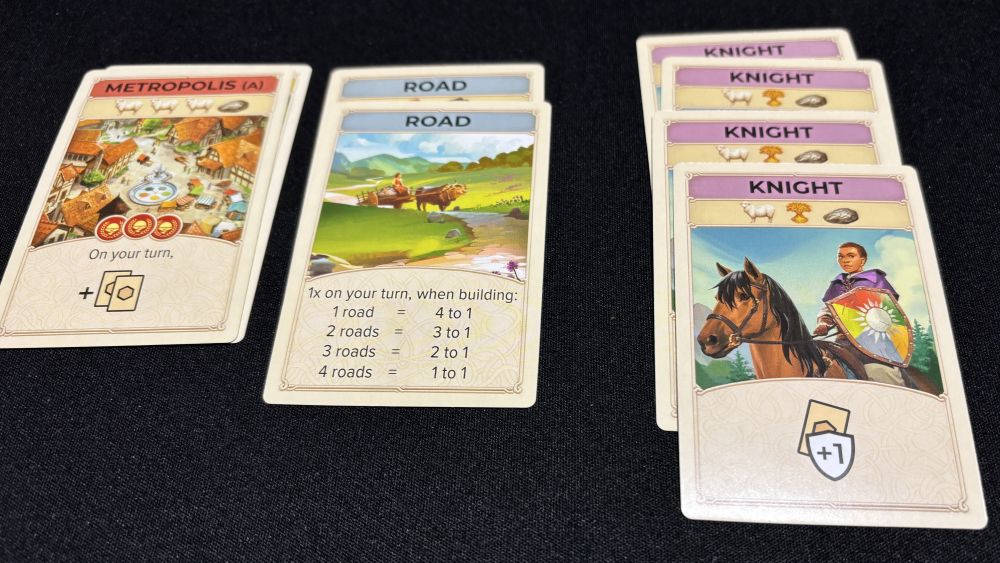
Knights increase the number of cards you can have in your hand without discarding when the robber event card is drawn. If you have two knights, then you can have nine cards in your hand without having to discard. Building knights can also help you gain the largest army bonus card.
Game End
The game ends when any player has 7 or more visible victory points during their turn. Victory points on settlements or cities that are covered by another card do not count.

Why You Should Play Catan: On the Road
There have been Catan card games released in the past. They were all designed for only two players and included a lot of unique features. I really enjoyed playing them and they were a bit more advanced than the board game on which they were based. However, Catan: On the Road does a wonderful job of maintaining the feel of the board game while remaining very accessible to new players. Since all it consists of are 120 cards, it is perfect for taking with you while travelling, camping, picnicking, or any other activity where it would be difficult to setup a tabletop game. There are no small pieces or tokens that can easily get lost.
My family played the first game with me and they really enjoyed it. We have played several of the Catan games together so it was easy to quickly explain that roads take the place of ports and are not needed to build settlements. I also had the opportunity to introduce Catan: On the Road to the students in the tabletop game club at the high school where I teach. None of them had ever played Catan before. The rules were easy to explain while I was setting up the game, focusing on each type of card as I placed them in the build row. In order to teach about the importance of knights, I also covered the robber card so they would not be surprised. A few did need a bit of coaching at first, but they all quickly caught on and really enjoyed it. Since it plays so quickly, we were able to get in a second game as well.
I am very impressed with how Catan: On the Road maintains the feel of the board game with a focus on building and trading. In fact, there seems to be more trading in this card game because resources are totally random and players are rewarded for trading with the current player by being able to draw a resource card for their effort. Since the game is not played on a map where players build next to resources, the strategy of placement is not necessary. As a result, I actually believe that Catan: On the Road makes a great introduction to Catan. Players learn about trading and spending resources while building settlements and then upgrading them into cities and then metropolises. They also learn about knights and the robber. Then when the time comes to play Catan, players already understand most of the mechanics. Even as an experienced Catan player, I enjoy the quick setup, fast gameplay, and easy clean up of this game. As a result, I recommend Catan: On the Road as a great game for those who are already fans of Catan as well as those who are new to the series.
For more information, visit the Catan: On the Road page!
Click here to see all our tabletop game reviews.
 To subscribe to GeekDad’s tabletop gaming coverage, please copy this link and add it to your RSS reader.
Disclosure: GeekDad received a copy of this game for review purposes.