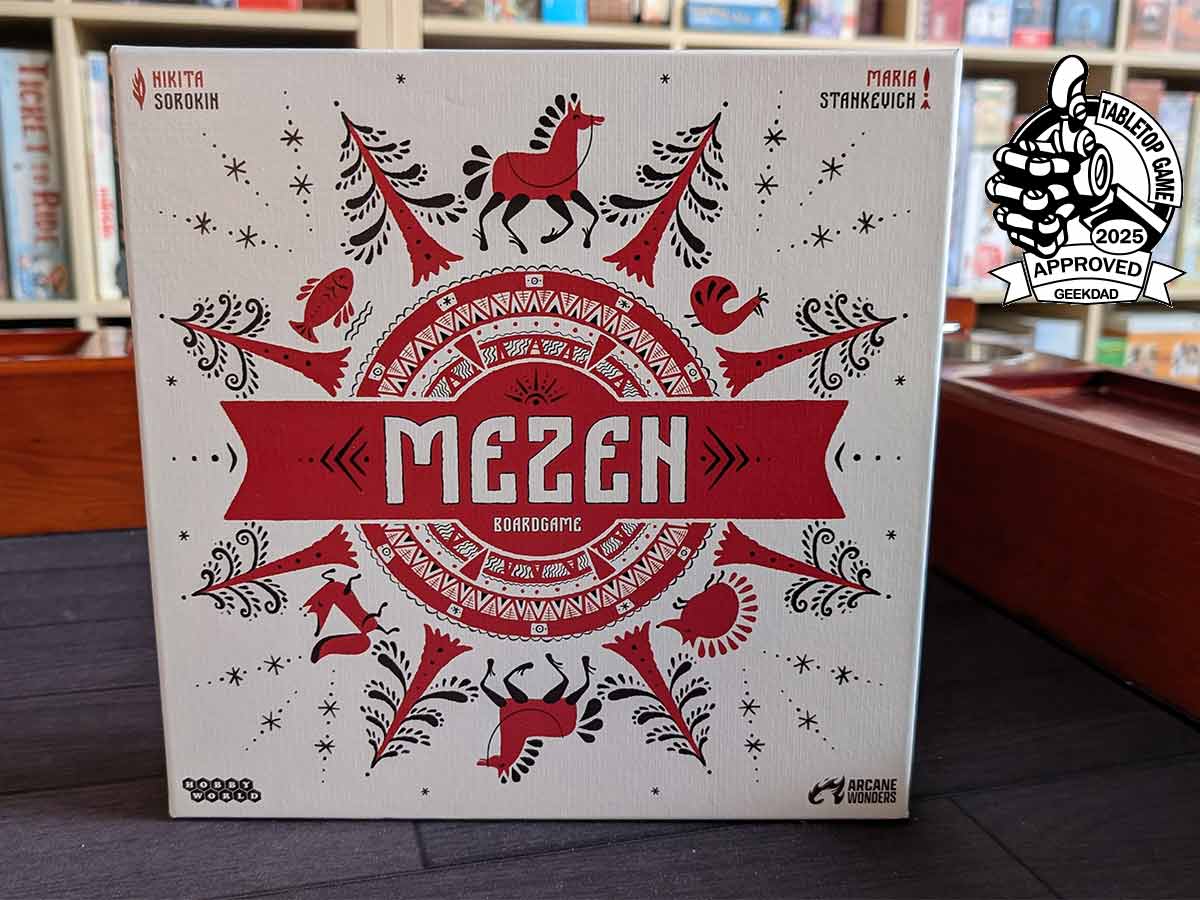
The river Mezen flows south from the Berents Sea into Siberia. 19th century artists used black and striking red paintings on household items. The red is from clay from the river–even now, if you look up the river on Google Maps, you can see why. In Mezen, players compete to collect sets tiles on either their white or black sides in specific patterns to score points. While it sounds simple, the game provides surprising layers of depth and complexity.
What Is Mezen?
Mezen is a game for 1-5 players, ages 8 and up, and takes about 30 minutes to play. It’s currently available on Amazon and other retailers.
Mezen was designed by Nikita Sorokin and published by Arcane Wonders, with illustrations by Maria Stankevich.
Mezen Components
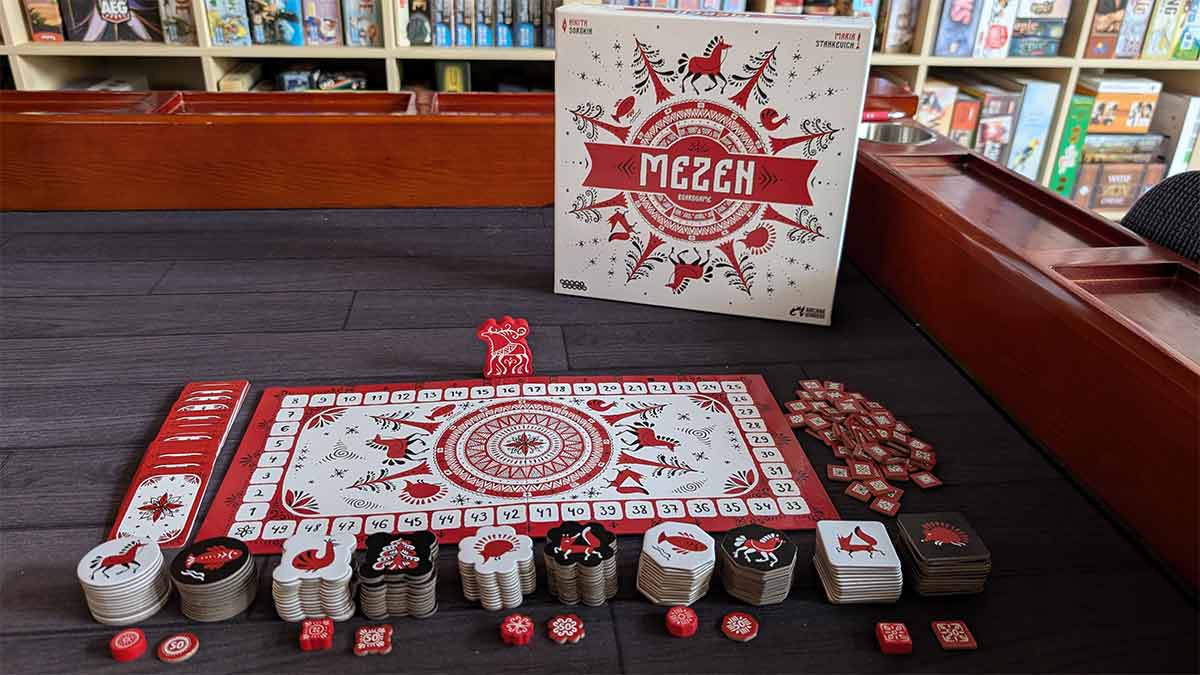
Inside the box, you’ll find:
125 double-sided cardboard Mezen painting tiles (25 in each of 5 shapes)
36 goal cards
5 cardboard 50/100 point tokens (one per shape)
5 wooden victory point tokens (one per shape)
75 cardboard amulets
1 wood active player piece
1 game board
All of the components are well made. One of the nicest parts is that the artwork and Mezen art style are carried across all components in the game. Nothing at all feels out of place, and it’s the kind of game were if a token were to be left out of the box accidentally, you would know instantly where it came from (unlike that very generic green wood cylinder that I found some time ago and still have absolutely no idea what games it belongs to.)

The Mezen painting tiles are big enough to be easy to handle, but not so big that the 5 x 5 grid takes up a ton of space. And they, like the rest of the components, contain nothing extraenous at all: all they need is the picture of the animal or tree, and so that’s all they have.

The point tokens, victory point markers, and amulets are likewise perfectly designed, being just the right size for the purpose in the game and not being filled up with meaningless flavor text or the like.

The board is also nice and simple. It’s really just a score and round tracker, so it has spaces around of the edge to keep score, and marked spots above and below to place the scoring cards for each round (which also serve as round markers.) The area in the middle provides a place to keep the pool of available amulets.

First, current, or active round markers are often not needed, and the active player miniature here is the one component that they could have done without, but it is at least pretty cool: a nice big wooden piece with a painting of a reindeer.
How to Play Mezen
You can download a copy of the rulebook here.
The Goal
The goal of the game is have the most points at the end of the tenth round. Points are earned by having tiles in your grid that match patterns on each round’s goal cards.
Setup

Setup is pretty simple. Place the board in the middle of the table. Draw 12 goal cards, all of which share one of six symbols. This ensures that you have a set of compatible goals. Deal 10 of those cards out and place five face-down in the spaces at the top of the board and 5 face-down at the bottom, returning the remaining cards to the box. Reveal the first two cards in the top row. The first card will be the scoring card for the first round, and the second, for the second round.

Each player takes the 25 tiles and the victory point marker for a single shape. They lay out the 25 tiles in a random order in a 5×5 grid, with the white side up, and place the marker on the starting space on the board. They each also take 5 amulets. All remaining amulet tokens are placed in a pile in the middle of the board.

The starting player–the last player to spend time in a forest–gets the Active Player piece.
Gameplay
To begin the game, the active player announces a single animal from the five available: bird, horse, fox, hedgehog, and fish. All players choose a single group of tiles on their grid matching that animal. A group can be one or more orthagonally-adjacent tiles. Then, they remove those tiles from their grid and flip them to their opposite side. Then, each player shifts the remaining tiles down in the columns to fill the spaces left by the tiles that were removed. Finally, the tiles that were removed are placed back into the grid, filling the tops of the columns. These tiles can be placed back in any order. Note that the symbols on the fronts and backs of each file are different, so in returning the tiles to the grid, you will be able to create new groups.
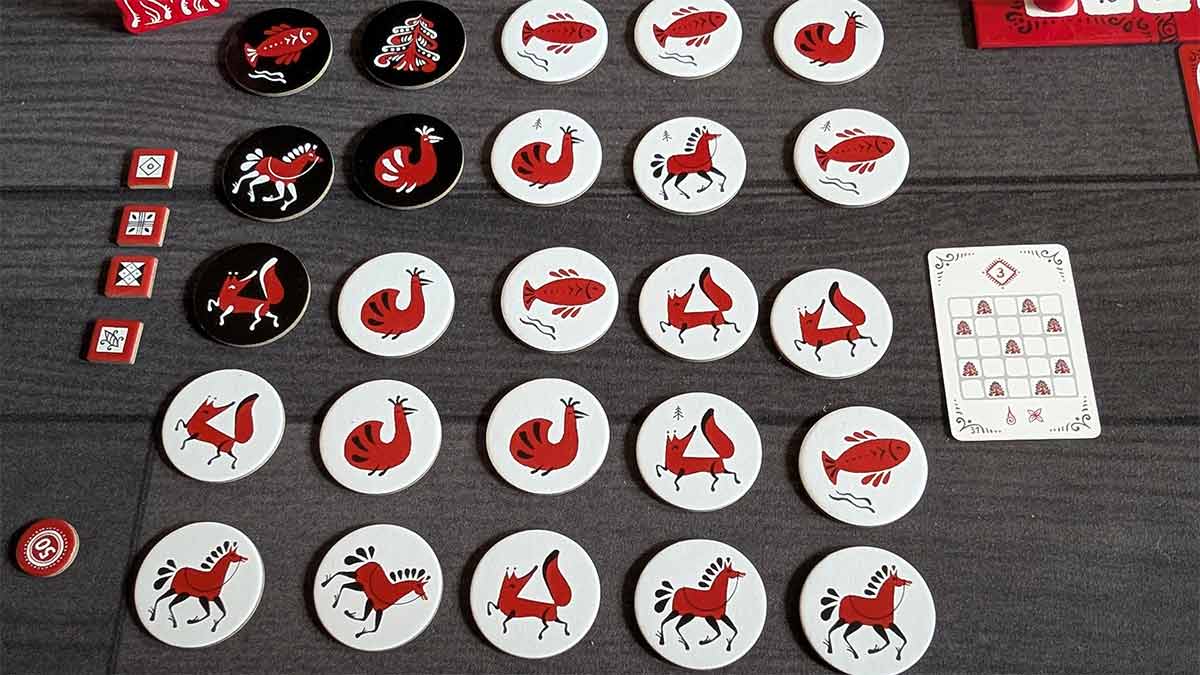
When returning tiles to the grid, players should be looking towards the scoring card for both this and the following round to try to set themselves up to score the most points possible.
If a player so chooses, they can give the active player one of their amulet tokens and choose a different animal instead of the one that was announced.

Players can also use the amulets to “bridge” groups. If a player has, for example, 3 hedgehogs in one group, and two in another, and those two groups are separated by some other animal, they can place an amulet on the different animal to bridge the two groups of hedgehogs so that all of them can be selected together. Note, however, that the tile with the amulet is not itself part of the group, and so will not be removed and flipped.
Conversely, a player can put an amulet on a tile that does match the announced group to exclude that tile from the group. If you have a very large group and it is not strategically advantageous to remove all of them, placing an amulet on a tile in the group may allow you to split the group into two smaller groups and only remove some of them.
In both cases, multiple amulets can be used to bridge more than one gap or to exclude more than one tile from a group.
Once used, amulets are returned to the pile on the board.
Once all players have placed the flipped tiles back into their grid, that round is scored. Each player looks at the scoring card for that round and scores tthe number of victory points indicated on the card for each tile that matches the pattern on the card. Alternately, players can refuse the points for that round and take 2 amulets instead.

Once scoring is complete, the scoring card for that round is flipped face down, and the card for the round after the next one is flipped face up. This way, there will always be two cards visible: the card for the round that is about to begin, and for the round after that. Note that the card for the fifth round is on the right side of the top row, and the sixth round is the card directly below that, so the cards for rounds 6-10 work in the opposite direction as those from 1-5.
At the end of the fifth round, players also score a bonus point for eany tile that is on the black side, regardless of the symbol.
Starting with the second round, players may have tiles with the sixth symbol, the spruce. These only appear on the black sides of the tiles. The spruce can never be selected as the active symbol for a round. Instead, any time players select a group of tiles, a spruce that connects to that group must be included in the group. This means that the spruce may be a link to creating a larger group. However, the spruce does not count as any symbol other than itself when scoring, so it should not be looked upon as a sort-of wild.
Game End
The game ends after the tenth round. At that point, players score the round as usual. They also get bonus points for every tile on the white side, a bonus point for each remaining amulet, and a point for each tile in their largest group, which may be spruces.
The player with the most points wins. If there’s a tie, the player with the most remaining amulets wins. If still tied, players share the victory.

Mezen is GeekDad Approved!
Why You Should Play Mezen
Mezen is one of those games that appears simple on the surface but has a lot going on just below that.
When first playing Mezen, it seems almost like a very simple tile matching game with a slight memory component. But, the constantly shifting board makes that much, much more complex than it appears. It’s hard to correctly see where tiles will shift as the selected group is removed, and because the backs of the tiles are all different, there’s an element of luck, at least early on. The game also has a memory element, as players try to correctly figure out which backs they want back on the next flip.
The game at first glance might appear to not have much player interaction–on each move, you’re really just focused on your grid and what you can do to maximize your points–but there can be an “gotcha” element as well, as you can definitely see what your opponents need, and might make choices in naming the animal for a round as much based on what won’t help your opponents as will help you.
The artwork for the game is gorgeous and nicely matches its theme. It’s a very pretty game to have on the table, and while it lacks the many dozens of pieces we may have come to expect in modern boardgames, its simpler table presence makes for a nice change of pace to a lot of what we see these days.
All in all, Mezen one of those games that ends up being almost relaxing to play, while still being highly strategic. It’s a game that likely has far broader appeal and will likely be enjoyed by most of your gaming group. It’s definitely a game worth checking out.
Click here to see all our tabletop game reviews.
 To subscribe to GeekDad’s tabletop gaming coverage, please copy this link and add it to your RSS reader.
Disclosure: GeekDad received a copy of this game for review purposes.