
Everyone knows two or three things about dragons: they love to hoard treasure, they’re easily distracted by shiny things, and when they get upset, stuff tends to get bad for people living nearby. In Please Don’t Burn My Village, players take on the roles of villagers who need to bribe the dragon to stay safe. But, you can’t just throw any old loot the dragon’s way: it wants only the most valuable stuff. Can you manipulate the market and keep the dragon happy?
What Is Please Don’t Burn My Village?
Please Don’t Burn My Village is a game for 2-5 players, ages 10 and up, and takes about 20 minutes to play. It’s currently available at your friendly local game store or from online retailers.
Please Don’t Burn My Village was designed by Simon Weinberg and published by Fireside Games, with illustrations by Ted Lambert.
I do want to mention that while the box says that this is “set in the world of Castle Panic” and the game includes a special card for that game, that’s where the similarities end. You definitely do not need to have played Castle Panic to fully enjoy Please Don’t Burn My Village.
Please Don’t Burn My Village Components
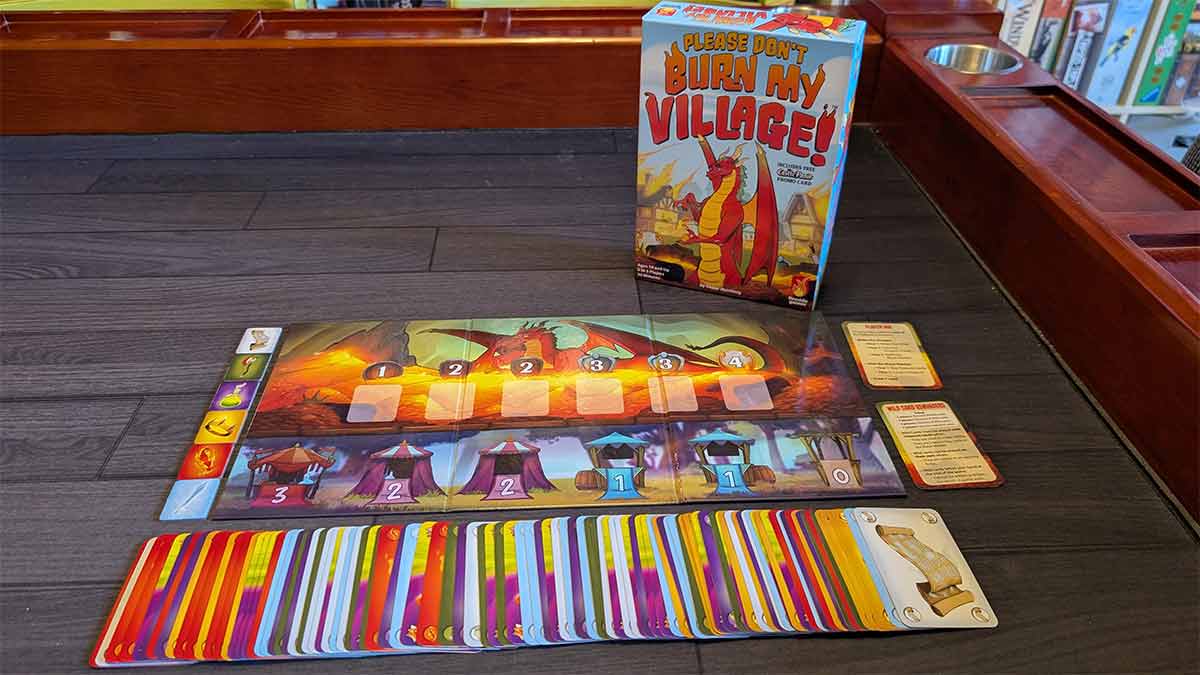
Included in the box:
84 Treasure cards (14 in each 6 treasures)
20 Wild cards
6 Treasure tokens (1 per treasure)
1 Board
5 Player Aids
The components are all of the qualifty you’d expect to see in a finished game from an established publisher.
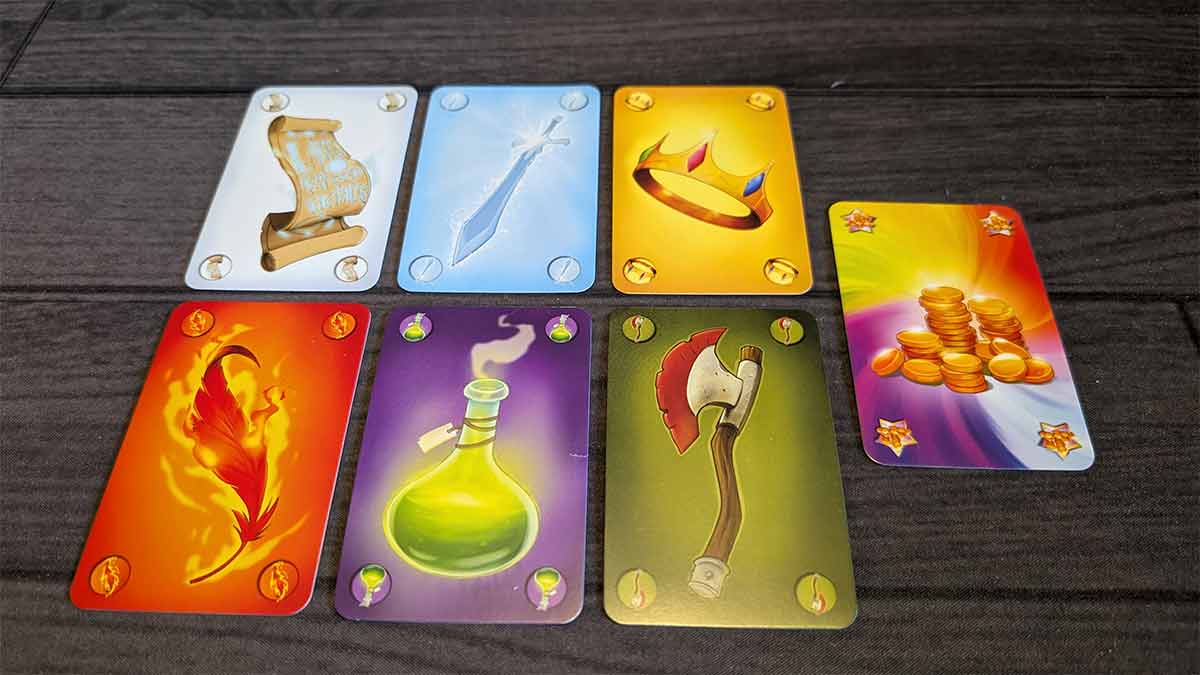
The cards are as simple as they can be: just an illustration of the treasure. I always appreciate it when designers don’t over design, and here artist Ted Lambert definitely didn’t do that. Each card is simple and can easily be seen from across the table.

The tokens match the design of each of the card, and are simple thick double-sided cardboard.
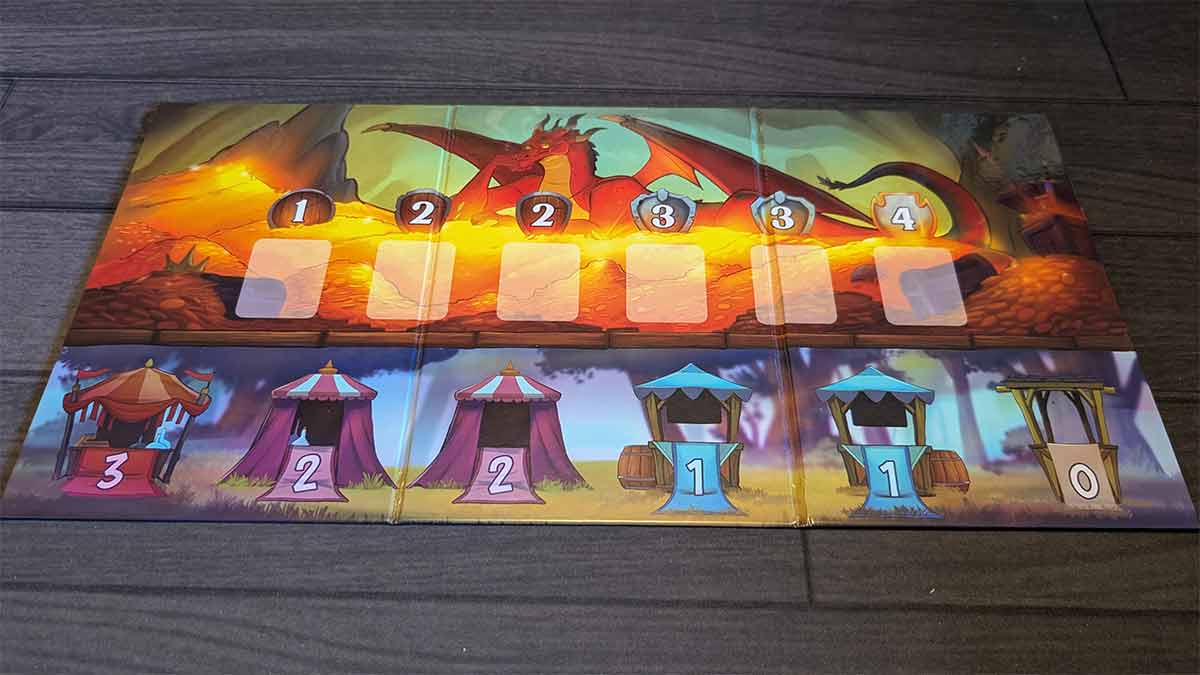
The board is likewise simple and does the job well. There’s a cool picture of a somewhat bored-looking dragon across the top, spaces for each token, and then illustrations for the placement of each of the columns for the market. Simple, simple, simple. And it all works very well.
How to Play Please Don’t Burn My Village.
Just like the artwork, both setup and gameplay are kept to a minimum.
The Goal
The goal of the game is to score the most points. Points are earned based on the final market value of each of the treasures each player has collected through the game.
Setup
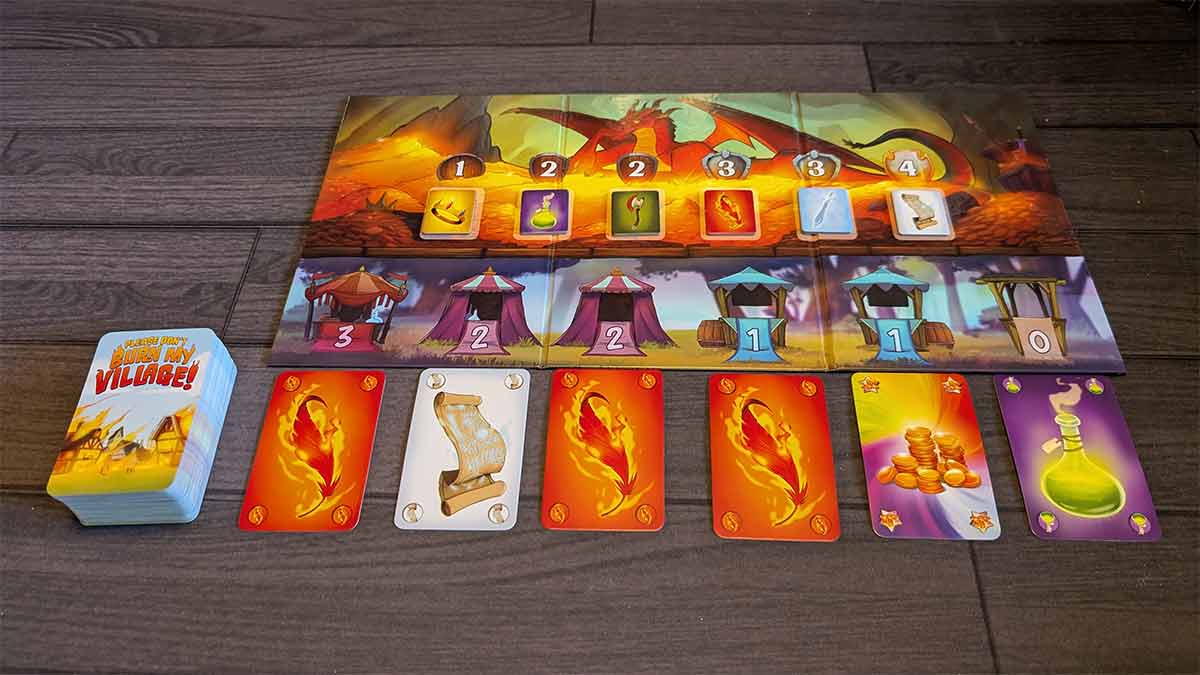
Place the board in the middle of the table. Randomly place a treasure token on each spot in the dragon’s favor row.
Depending on the number of players, remove 9/7/2/0 wild cards (for 2/3/4/5 players), then shuffle those into the treasure deck.
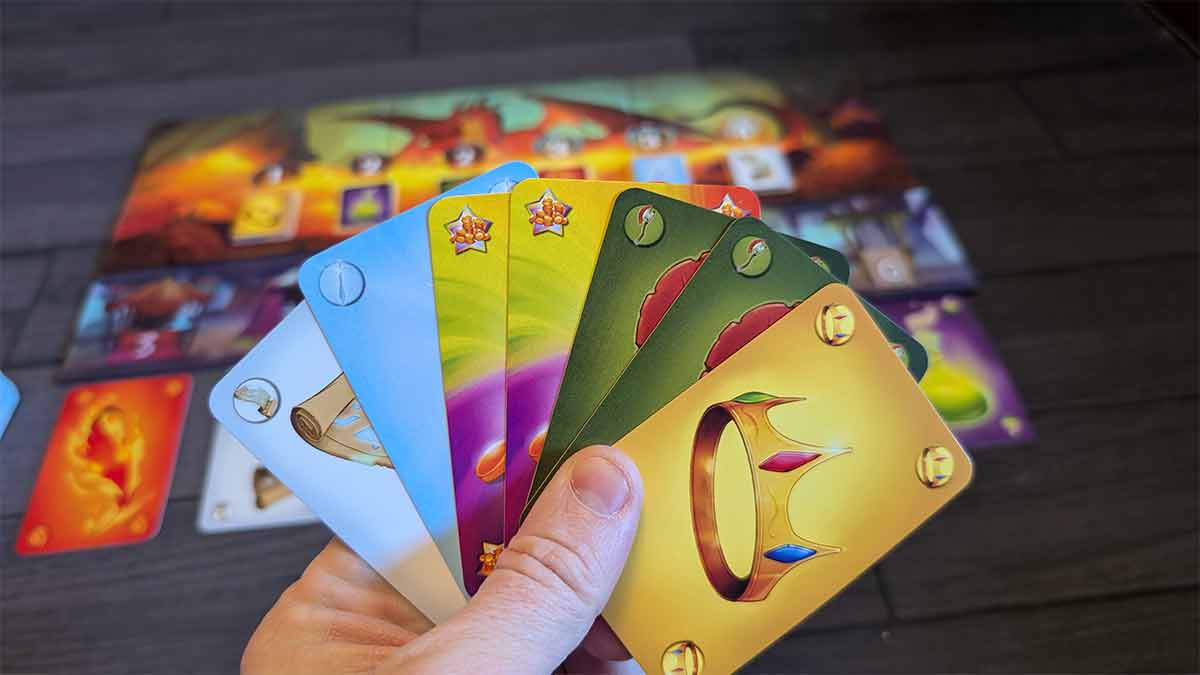
Deal 7 cards face down to each player as a starting hand.
Deal one card face up below the board under each of the six market spaces. Place the rest of the deck near the board with room for a discard pile.
The player who most recently set something on fire goes first.
Gameplay
Keeping with the game’s “simple is good” theme, gameplay is also very straight-forward.
On a player’s turn, they can do one of three things:
- Bribe the dragon
- Visit the black market
- Draw a card
Bribing the Dragon

You can place a bribe by playing a set of matching cards from your hand. A set can be one or more cards, as long as they’re all the same type of treasure. Wild cards can be added to this set, but it’s important to note that wilds cannot be played alone in their own stack.
The dragon is happy with your bribe, and yours being the most recent shiny thing it’s seen, it now values those treasures more, so you will adjust the value of the bribed treasure by shifting its token to the right on the dragon’s favor row by the number of cards you played. Treasure tokens you pass are shifted down one space. Tokens can not go above 4, so if you play more than that, you do not move the token further.
You can also add to an existing bribe: if you have more cards of a type you used to place a bribe earlier, you can add those to your existing bribe. You still adjust the dragon’s favor accordingly. Wild cards can be used here, even without other cards of that type.
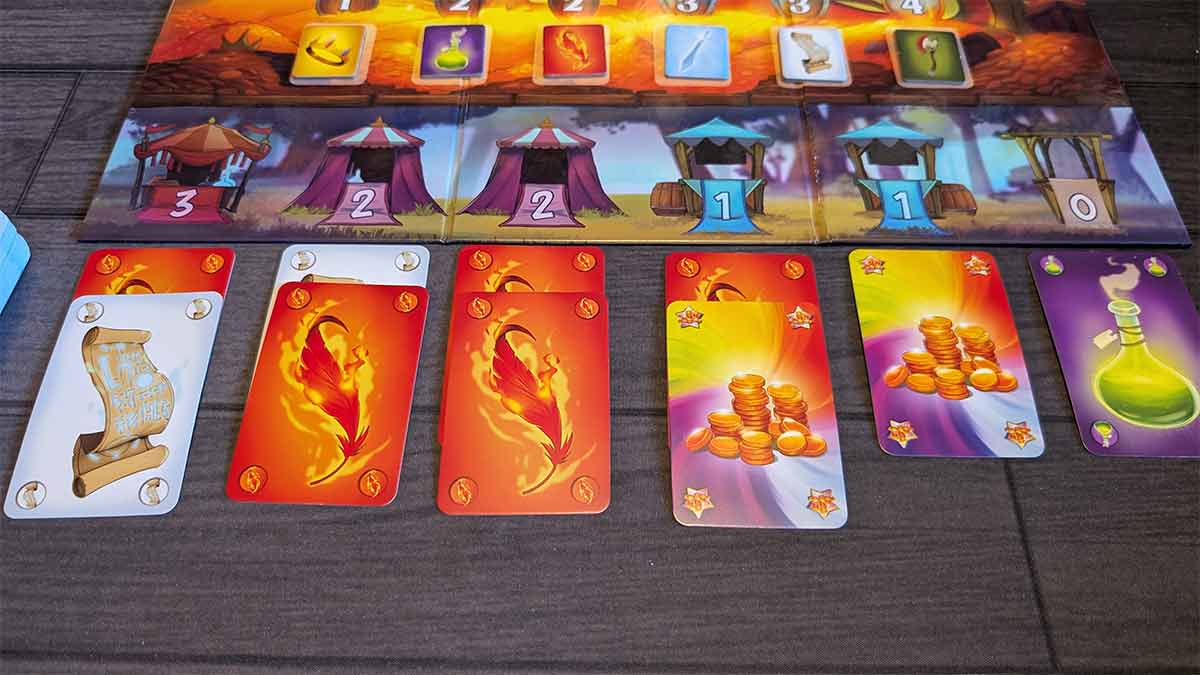
Once the bribe is placed and the market adjusted, you need to refill the black market. Always starting with the left-most space, draw cards from the deck and place one in each market space. Do this until you draw a card that is either a wild or one that matches the type used to bribe the dragon. If you reach the end of the row, start back at the left and continue.
Visit the Black Market

If you don’t have sets of cards you want to play, you can choose instead to visit the market. To do this, decide which market stall you want to collect from. Discard that number of cards to the discard pile and take all of the cards from that stall. Note that there are two stalls that require two cards, and two that require one, so you have the choice of either. The right-most column is always free to take, assuming there are any cards in it (and more often than not, there won’t be.)
While bribing the dragon pleases it and increases the value of items, taking from the market displeases the dragon and decreases the value of items. When you discard, you will select one of the cards you are discarding and put that on top. Then, you will decrease the value of that treasure by the number of cards you discarded.
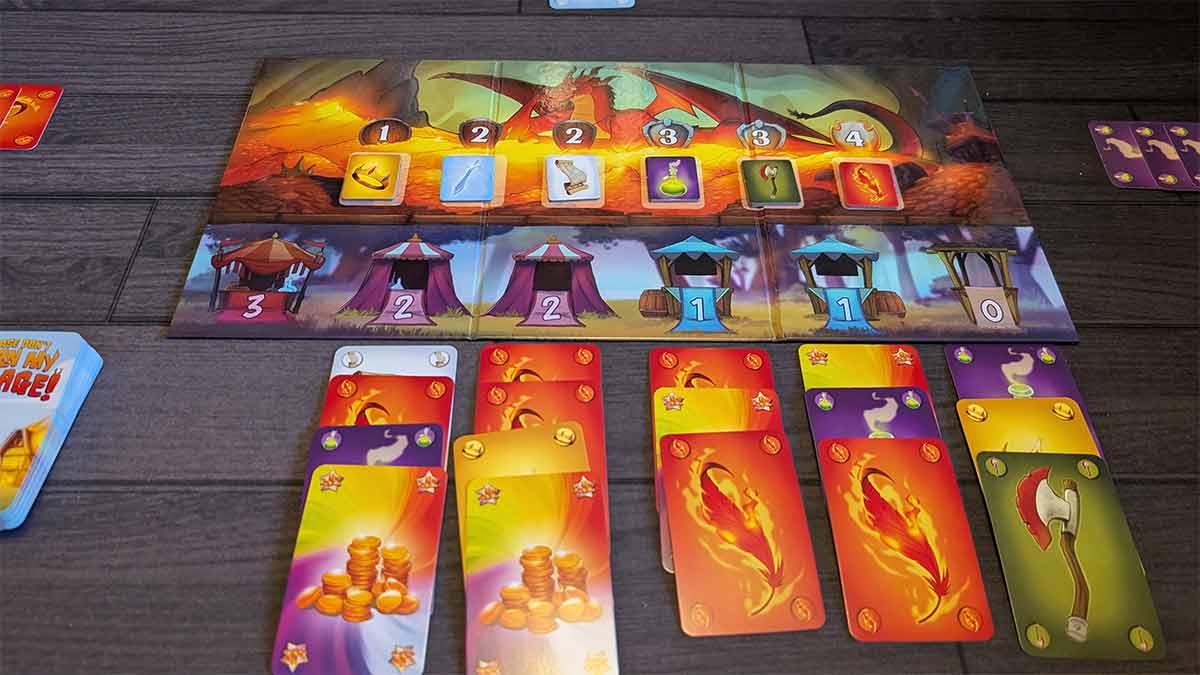
Note that you are allowed to discard wilds, but you cannot discard only wilds, and they cannot be the card you place on top.
There is no hand limit.
Draw a Card
Sometimes, you may not want to bribe the dragon and there may not be anything of interest in the market. (Or, you may not be able to do either because you’re out of cards.) In that case, your entire turn can consist of simply drawing the top card from the deck.
Game End

The game ends immediately when one of two conditions is met:
- A player is unable to draw a card from the deck because it’s empty
- A card cannot be added to the Black Market.
A few things to note. First, it’s possible for the game to end partway through a player’s bribing: if, in refilling the market, the deck runs out before a wild or card matching the bribe are drawn, the game is over immediately at that point.
But second, the game does not end the moment the last card is simply drawn from the deck. If a player draws the last card, or if, in filling the market after a bribe, the last card is either a wild or one that matches the bribe, then the game can continue. However, the only action that players can take without ending the game is visiting the market. While this adds cards to their hand, it also allows them to manipulate the market by devaluing treasures an opponent may be collecting.
Once the game is over, all players may try to empty their hand by playing any cards they have left on existing bribes they have. They canot create new stacks here, so they will be left with any cards that do not match something they’ve already played. Doing this does not alter the dragon’s favor row.
Wilds cannot be played at this time.
Scoring
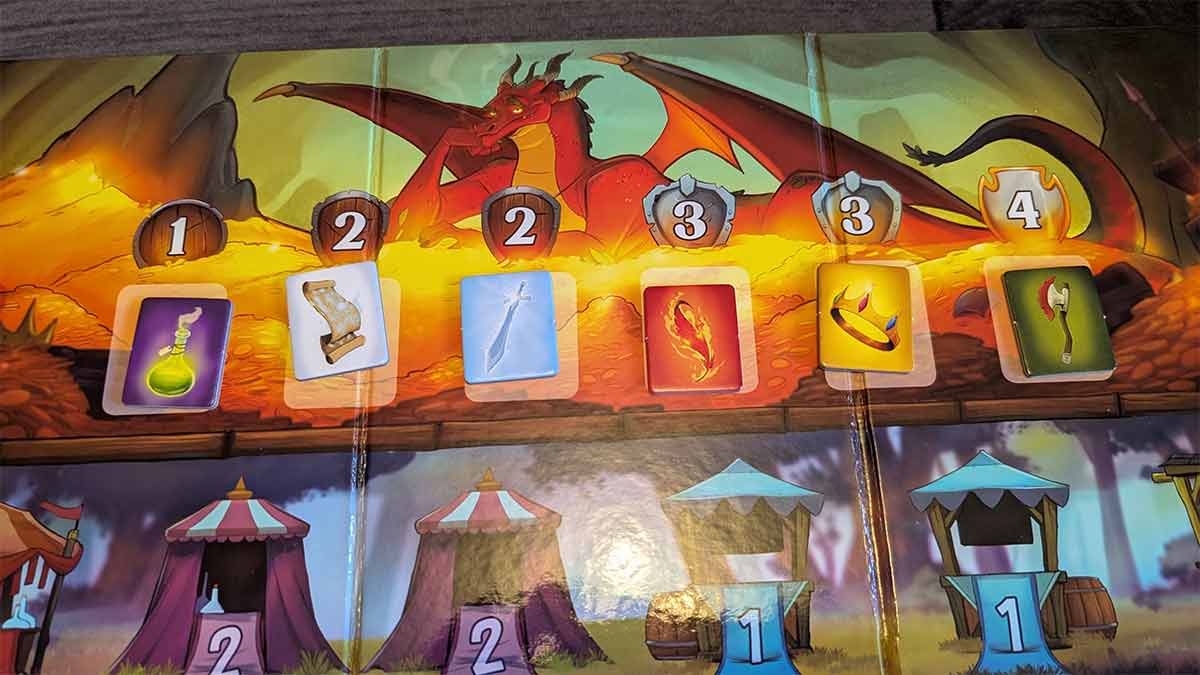
Players score points for each treasure they have in their bribes, based on that treasure’s final value. Wilds count as whatever treasure they were initially played as.
Players lose two points for each wild in their hand.

Players also lose points for every treasure card left in their hand at that treasure’s final value.
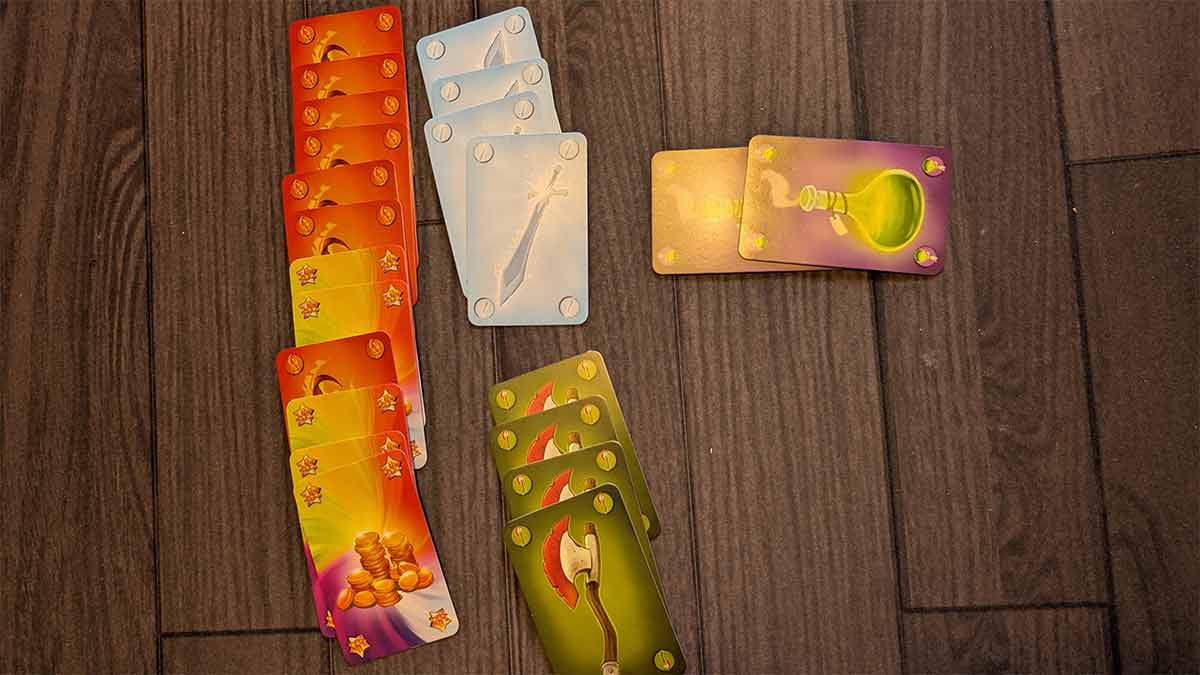
The player with the most points wins. If there’s a tie, the player with the most cards in the highest value treasure wins. If there’s still a tie, the winner is the player with the most cards in the second-highest treasure, and so forth.

Please Don’t Burn My Village is a 2025 GeekDad Game of the Year Finalist!
Why You Should Play Please Don’t Burn My Village
I’ve already mentioned that the game’s focus on simplicity is one of its strongest virtues. There’s no element in the game that is over designed, which makes it easy to pick up and learn and easy to play.
But, hidden in all of that simplicity is a surprising depth.
On every turn, you have to carefully consider which cards to play if you’re going to place a bribe. Obviously, you want to drive up the value of cards you have, but in so doing, are you actually helping an opponent who already has a lot of that? And when do you include wilds? There’s little point to ever playing more than the number of cards that will max out the value of the treasure, unless of course you’re competing with that other player for this treasure, and those wilds will give you the edge. But, is it still better to hold them to play later to drive the value back up?
When buying from the market, you’re always balancing the good versus the bad cards you’ll have to collect. But is that treasure you’ve decided to not care about really bad? You could take it and hold it, planning to use it in a later discard to drive the value down.
You also have to consider that every time you adjust the value of one treasure, you likely adjust the value of several others. Driving the value of a low-valued treasure decreases the value of everything above it, and vice-versa. This is one of the more interesting elements: a lot of market-manipulation games allow you to adjust one item without moving the rest, so your goal is to simply get whatever you care about the most value possible. But here, you have to weigh that against the other values, being careful not to increase one treasure you’re collecting withou negatively impacting another one you want as well.
The most interesting mechanic, though, is the reflling of the market. I like how it happens on turns where nothing is bought from the market–you replenish the market not when someone buys from it, but instead, when someone bribes the dragon. And, you never fill the market evenly: sometimes, a wild or the matching treasure will be the first one drawn, and so only the three spot gains cards. It’s been fairly common in my plays of the game to have those lower-level market stalls be empty for long portions of the game, thus ensuring that you always have to pay to get more than one card by blind draw.
You also have to factor in another element here: as each treasure is played as a bribe, and each treasure is discarded, the number of that treasure in the deck decreases. Therefore, as the game progresses, you are more and more likely to have to place many cards in the market for each bribe. This not only increases the number of cards in the stalls (and thus, decreases the amount you have to pay for those,) but it also hastens the end of the game. It’s entirely possible to look at the deck and assume you have several turns left, and then see just a few bribes come up on popular treasures and the deck get depleted very quickly. (If you’re the card counting type, there are only 14 of each treasure in the deck, and a total of 20 of wilds (minus those removed based on the player count.) You could therefore do some quick calculations to figure out the odds of a particular treason or a wild coming up in refilling the market.)
When I first got the game, it looked like a pretty straight-forward set collection/market manipulation game, and I thought it might be kind of fun as a quick game. As soon as I actually played it, though, I was impressed by the depth and the number of choices it presented. All in all, I think that while yes, it is a pretty straight-forward set collection/market manipulation game, it also has enough teeth to appeal to more intense gaming groups, and that’s why I’m giving it the GeekDad Approved seal.
Click here to see all our tabletop game reviews.
 To subscribe to GeekDad’s tabletop gaming coverage, please copy this link and add it to your RSS reader.
Disclosure: GeekDad received a copy of this game for review purposes.