Imagine being able to go back in time and get a do-over when things didn’t go perfectly. That’s the dream of so many time-travel stories, right? Change all the things you regret, try again, practice your Groundhog Day until you get it just right and have a perfect day.
In Omni Loop, Zoya Lowe (played by Mary Louise Parker) has that ability, in the form of a bottle of pills. When she takes one, it whisks her away to five days earlier, where she can try again. The problem is, she’s dying. She has a black hole growing in her chest, and it’s going to kill her, so her family is making the most of their time with her: going to the beach, making sure her will is in order, spending some time with her elderly mother, surprising her with an early birthday party. And when the time comes and the black hole is about to consume her, she pops a pill and wakes up in the hospital again.
And again.
And again.
Time travel is one of my favorite story genres, and time loops are a particular subset that I find really fascinating. How does the loop work—is it automatic or by choice? What does the looper take back with them: just knowledge or anything material? Are they going back to fix something, or is the goal to break out of the loop? (And in a sort of meta-story note, how is the time loop introduced to the audience—do we see the character learning they’re in a loop, or do we start somewhere in the middle when they’ve already looped some number of times?)
In Zoya’s case, we quickly realize that she’s already been through these five days countless times—I like that this is possible now, since the concept of time loops is more established now, so not every time loop story needs to start with the character discovering they’re in the loop and gradually figuring out the rules or boundaries of it. Omni Loop skips past all that and drops us at the point where Zoya is bored with keeping up this pretense that she doesn’t know what’s coming. She has had the same conversations with her family, with her lawyer, with her book publisher, with a random stranger at her mom’s nursing home. She is having a hard time acting surprised when her family brings out the birthday cake, and she’s just not sure how many more times she can do this.
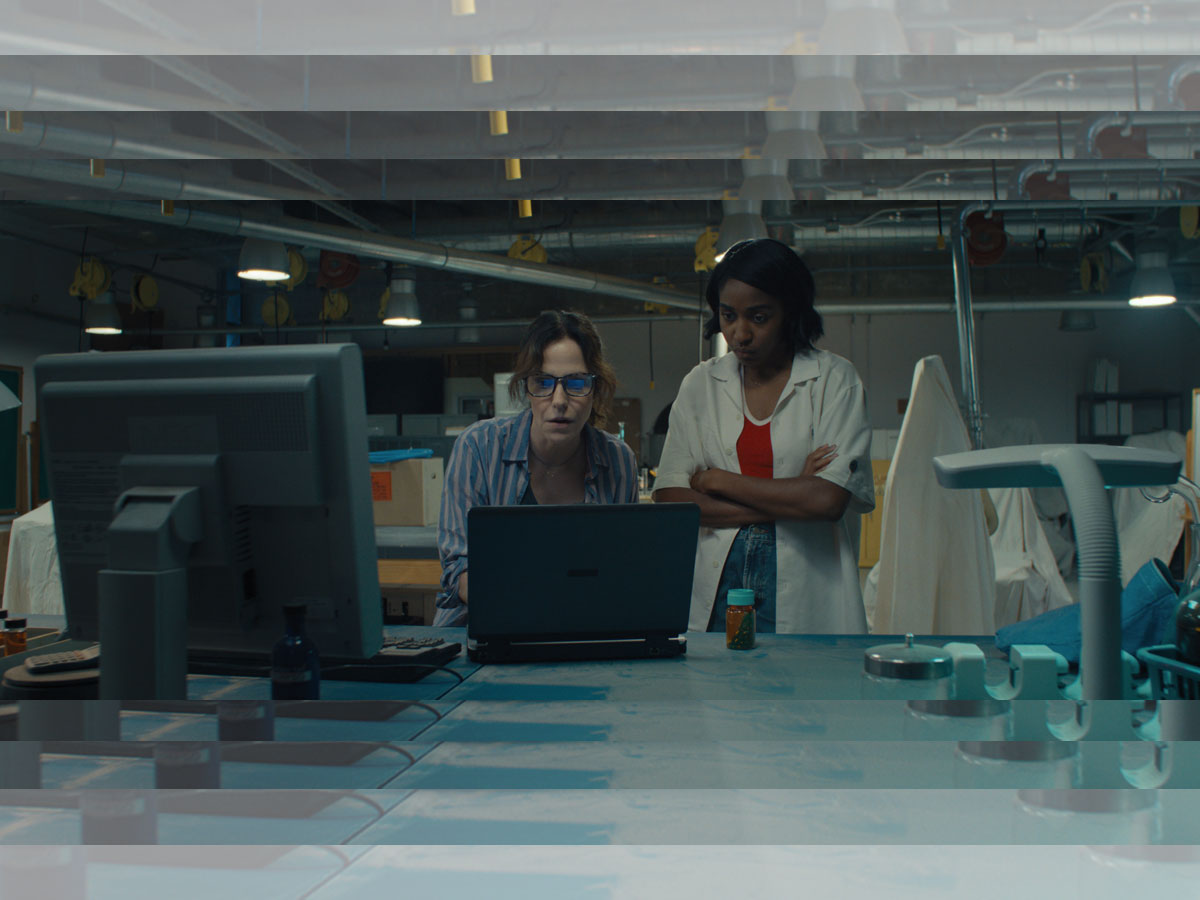
That’s when she runs into Paula Campos (played by Ayo Edebiri), a grad student who has access to the university lab, and she decides to take a different approach to her last five days. Instead of repeating the time with her family, she’s going to research these mysterious pills and see if she can somehow go back even further, in the hopes that she can buy herself more time to live the rest of her life. (And, of course, every time she goes back she has to find Paula again and re-explain what’s going on.)
The film makes use of quick-cut repetitions to show the blur of repeated passes through the timeline, like a rapid-fire slideshow of waking up in the hospital or talking to Paula for the “first” time, but there are also these longer, drawn-out moments that give the characters room to breathe, to talk, and sometimes just to sit with each other. Even though for Paula it is always only five days, for Zoya you can see that she’s spent a lifetime on this working relationship, which makes it even harder to have to start over each time.
Mary Louise Parker really shines in her role—you can feel her fatigue from endless looping, and her drive once she decides to try something else. And her camaraderie with Ayo Edebiri is fantastic, too: a good chunk of the movie just involves the two of them, and they play off each other well. In supporting roles, we have Carlos Jacott as Zoya’s loving but somewhat awkward husband and Hanna Pearl Utt as her adult daughter, the other characters that we see Zoya interacting with the most. They’re both believable as a family trying to put on happy faces and pretending everything is okay while knowing that these are Zoya’s final days.
Unlike many time travel stories, this one doesn’t try to tie everything up in a neat bow by the end, and it leaves you with a lot of unanswered questions, like where the pills came from in the first place or whether, in the world of the movie, it’s a common thing for people to have black holes in their bodies. There’s a touch of the surreal and the absurd—one of my favorite parts has to do with how they finally figure out the compounds in the pill—that you just have to roll with. It’s a time loop story that’s more about the relationships—Zoya and her family, Zoya and Paula—than about the technology that lets her travel, even though on the surface it seems like a lot of the plot is about figuring out that technology.
At the heart of the film is this question of who Zoya is, which does involve the sometimes overdone trope of career vs. family. She had a promising career but then gave it up to become a mom; now she has a chance to pick up where she left off. But the two are intertwined: on the one hand, she escapes from her family so she can go do this research, but her scientific pursuits are so she could live out her life with her family. It’s a bit of a paradox, but the movie lets Zoya really wrestle with this and try to figure it out.
Omni Loop will be in theaters and on digital starting Friday, September 20. Watch the official trailer here:
Disclosure: I was provided with access to watch the film for review purposes.