

Fantasy Flight Games has long been known for its H. P. Lovecraft-inspired series of games, which originally launched with the board game Arkham Horror. Now, they have teamed up with roleplaying game company EDGE Studio to deliver the first RPG offering in the Arkham Horror universe: the Hungering Abyss starter set.
What Is Arkham Horror RPG – Starter Set: Hungering Abyss?
Arkham Horror RPG – Starter Set: Hungering Abyss is a tabletop roleplaying game for up to 5 players and one game master, ages 14 and up, and takes 10-20 hours to play through the introductory adventure. This being a horror game with a Lovecraftian setting, there are references to monstrous acts (such as cannibalism and human sacrifice) and insanity, and as such, it’s not appropriate for younger players. It’s available to purchase for $34.99 from the EDGE Studio Store on Amazon or from your local game store.
Arkham Horror RPG – Starter Set: Hungering Abyss was written and developed by Leah Hawthorne, with system design by Sam Gregor-Stewart. It was published by EDGE Studio, under license by Fantasy Flight Games.
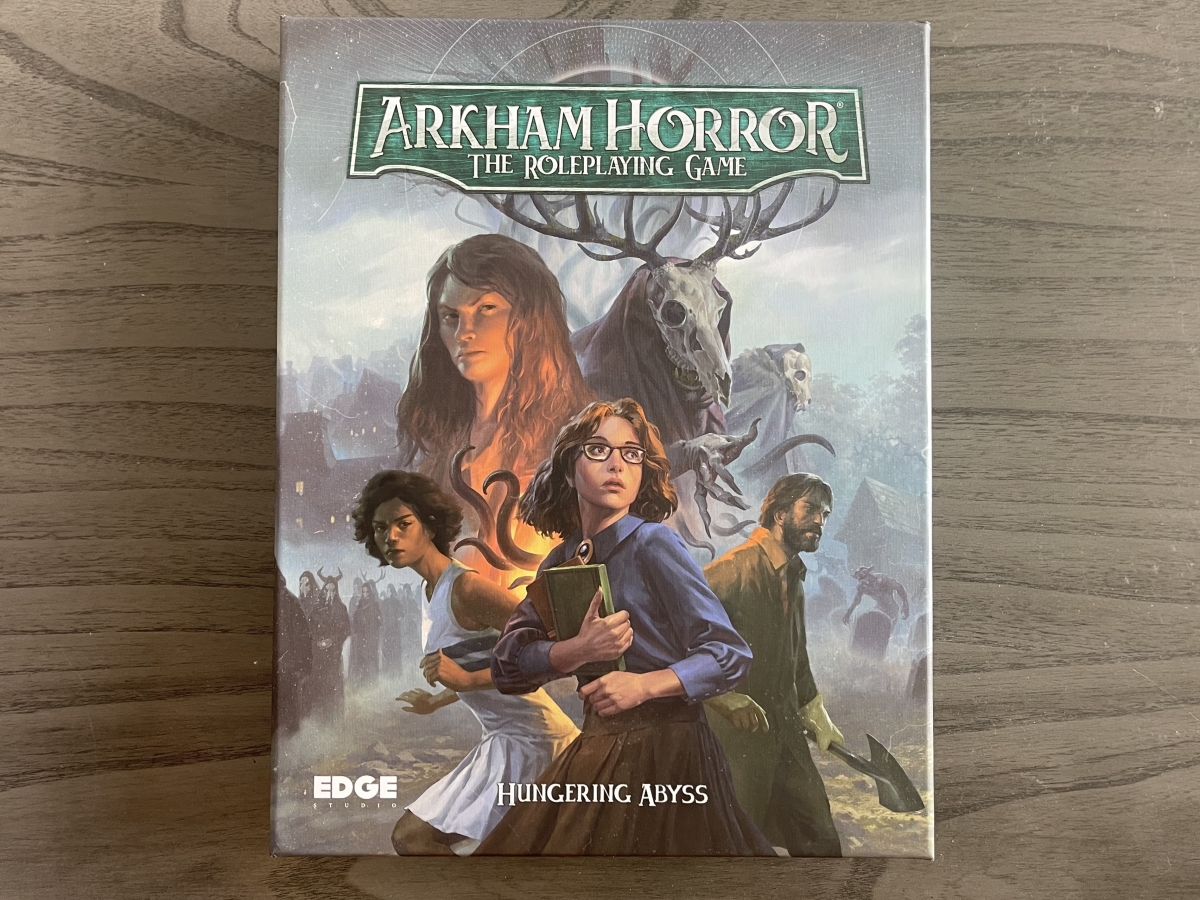
Hungering Abyss – The Story (Spoiler Alert!)
Note: be sure to read this section only if you are not intending to play as an investigator in this adventure!
In Hungering Abyss, a cult that worships a being known as Umôrdhoth, the Devourer Below, has been stealing corpses and abducting people in Arkham in an attempt to bring Umôrdhoth into the world. Each of the players plays an investigator who has their own reasons within their backstory for wanting to investigate the disappearances of both dead bodies and live citizens.
In the first scene of the adventure, the characters all gather at private investigator Joe Diamond’s home, where they compare notes. Each investigator has a couple of leads, which can be followed up on throughout the adventure. There are also instructions on how to incorporate some of the leads if all of the premade characters aren’t being used.
After an encounter with flesh-eating ghouls, the players start pursuing their various leads. With the help of Lita Chantler, an NPC whose husband was killed by the cult, the players discover that in order to defeat the cultists, they have to find out three things: the location of the ritual site, information on the ghouls’ weaknesses, and details about the ritual the cultists are planning so that the players can disrupt it. Pursuing the leads involves solving puzzles, interacting with NPCs, and fighting foes.
Once the players have gathered enough information, they proceed to the ritual site. Once there, a challenging encounter ensues, where they will face not only cultists and ghouls but Umôrdhoth itself, trying to break through into this dimension.
Arkham Horror RPG – Starter Set: Hungering Abyss – Components
The starter set includes the following:
- A Game Master’s Reference Board ( 11 x 8.5 in)
- An Adventure Booklet (48 pages)
- 5 Character Portfolios
- 24 Six-sided Dice (12 black and 12 green dice)
- 3 Double-Sided Poster Maps
- 16 Non-Playable Character Profile Cards
- 21 Item and Spell Cards
- 3 Punchboards (puzzles and tokens)
- Several handouts (evidence pieces – journal, letters, etc.)
Everything in the set speaks of a quality well above its price tag. Even the rulebook is printed on a thick, glossy stock, and the pages are bound with sewing rather than staples or glue.
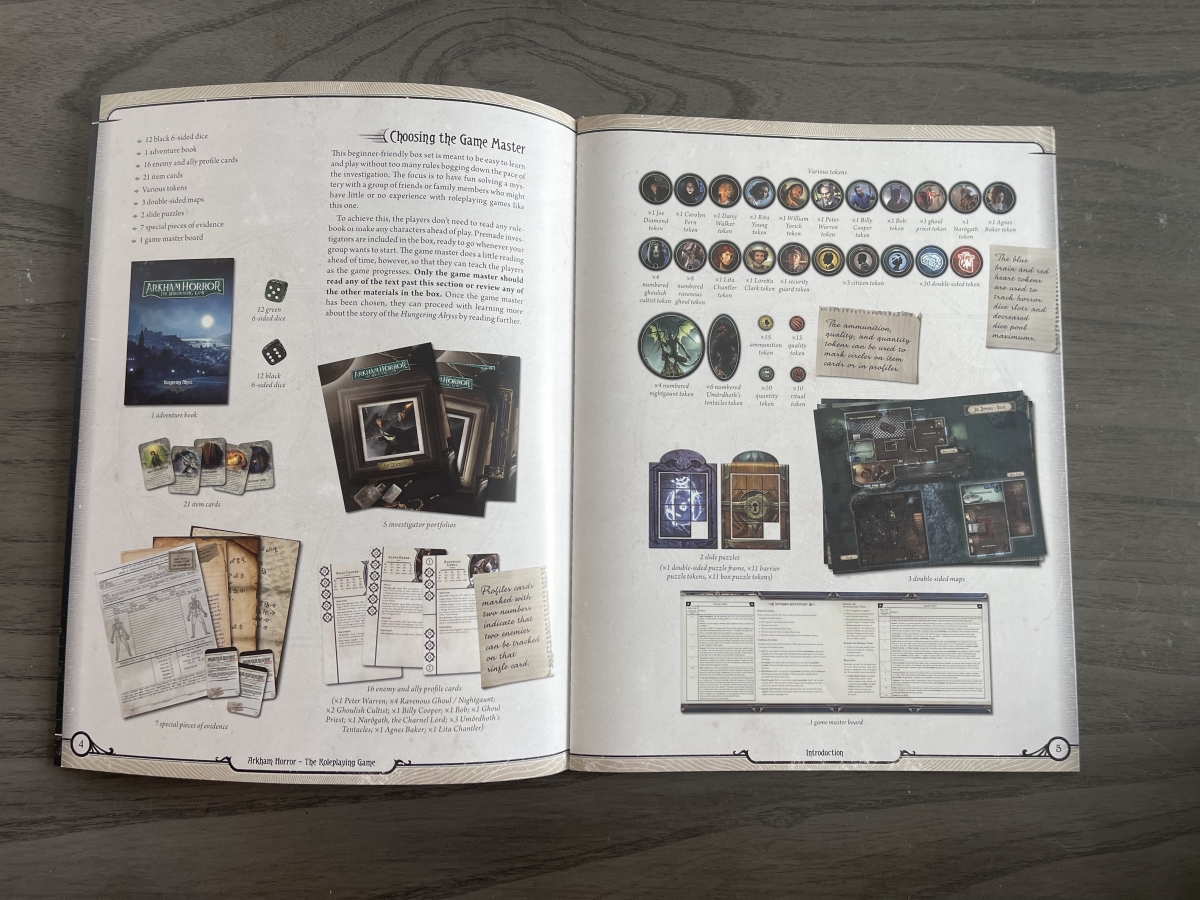
Arkham Horror RPG – Starter Set: Hungering Abyss was designed not just as an introduction to the Arkham Horror roleplaying game, but also, according to EDGE studio’s website, as “the most complete Starter Set ever made in TTRPG with a LOT of components.” And, as you can see from the list above, there’s a lot to be found inside the box.
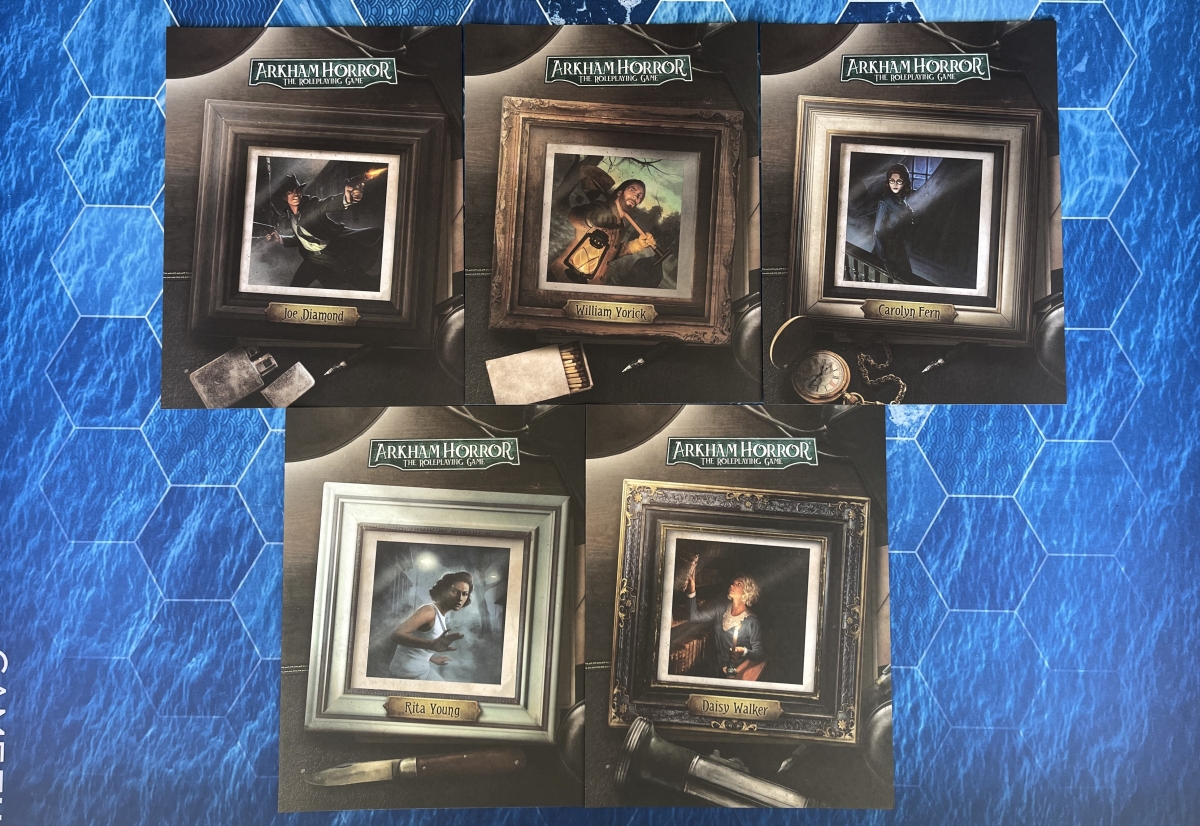
Most tabletop RPG starter sets come with pre-generated characters, but those are often simple character sheets. In the case of Hungering Abyss, there are foldout character portfolios printed on the same thick stock as the rulebook. There’s plenty of information in the portfolios as well, not just about the individual characters but also covering many of the game’s core rules.
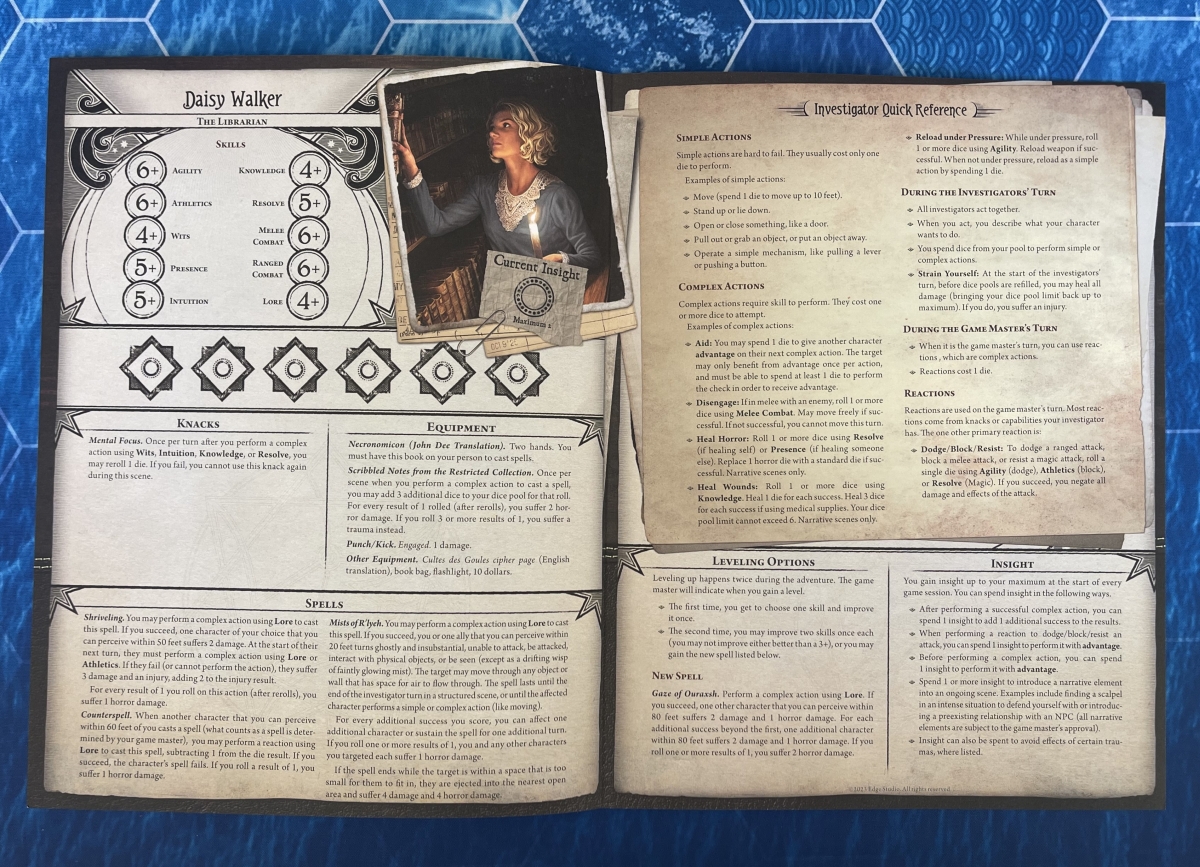
The back of each character portfolio has the character’s background, as well as listing any evidence that they have in their possession at the start of the game. This gives each player a great jumping-off point for roleplaying and participating in the narrative of the adventure.
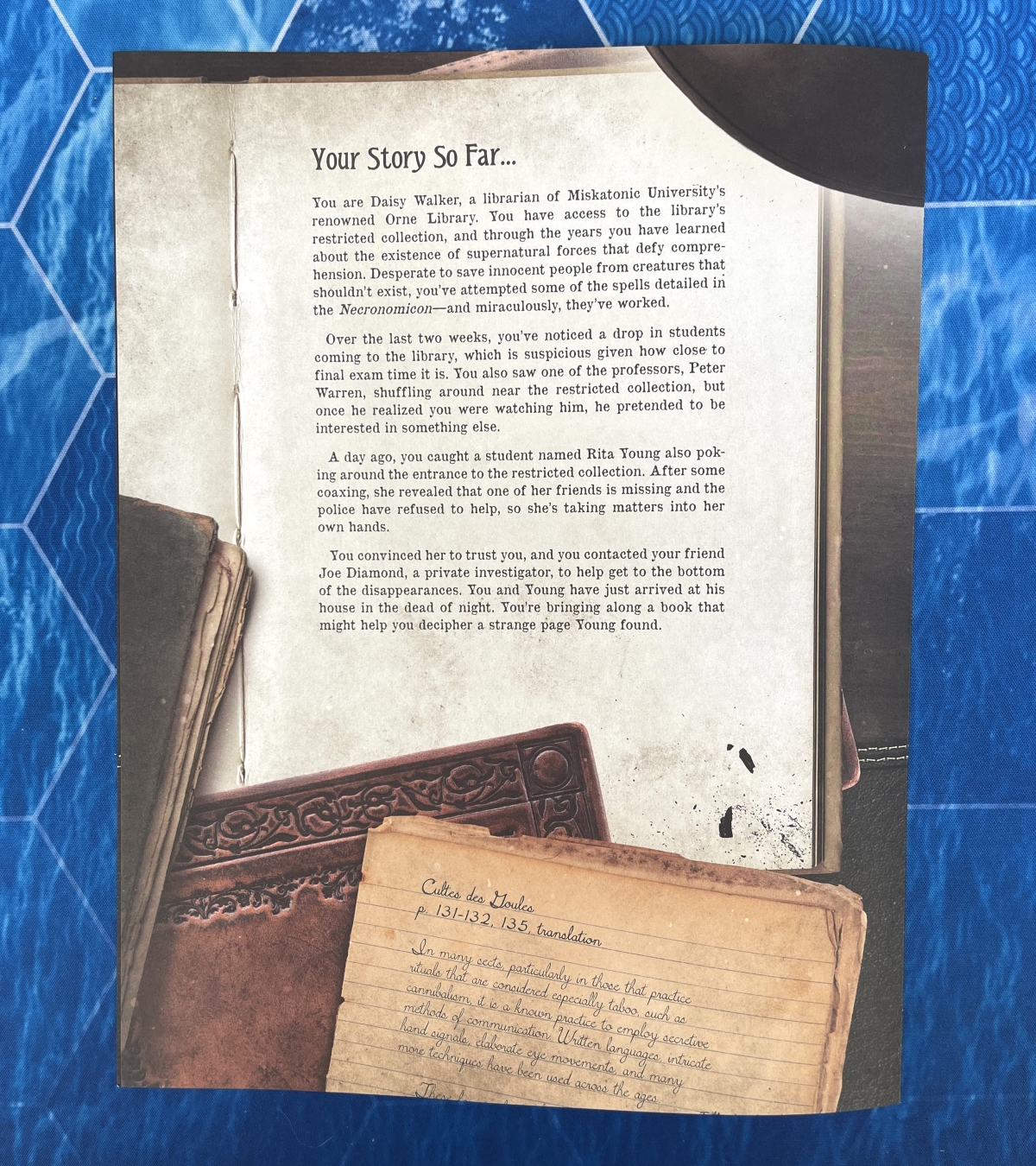
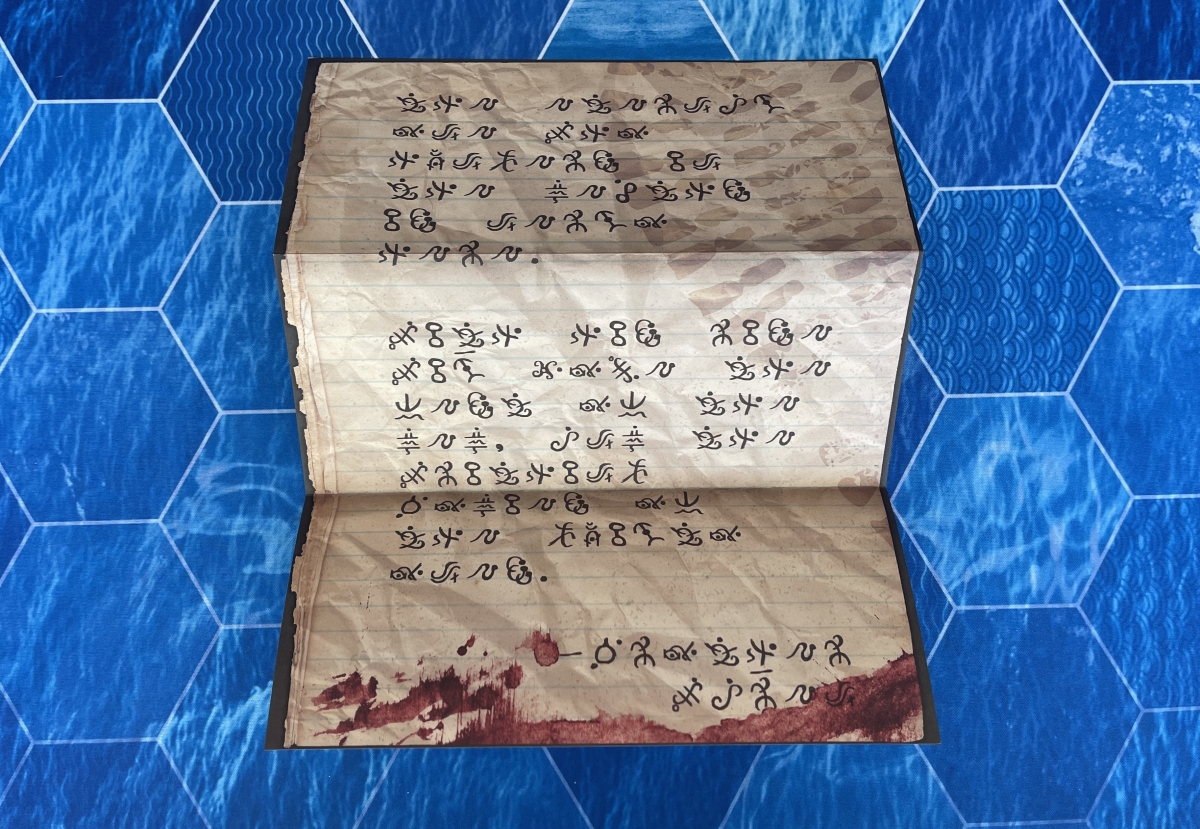
Speaking of evidence, there are a few handouts included with this set. These are very well-produced, printed on thick, quality paper with great graphic design that provides a lot of immersion for the players.
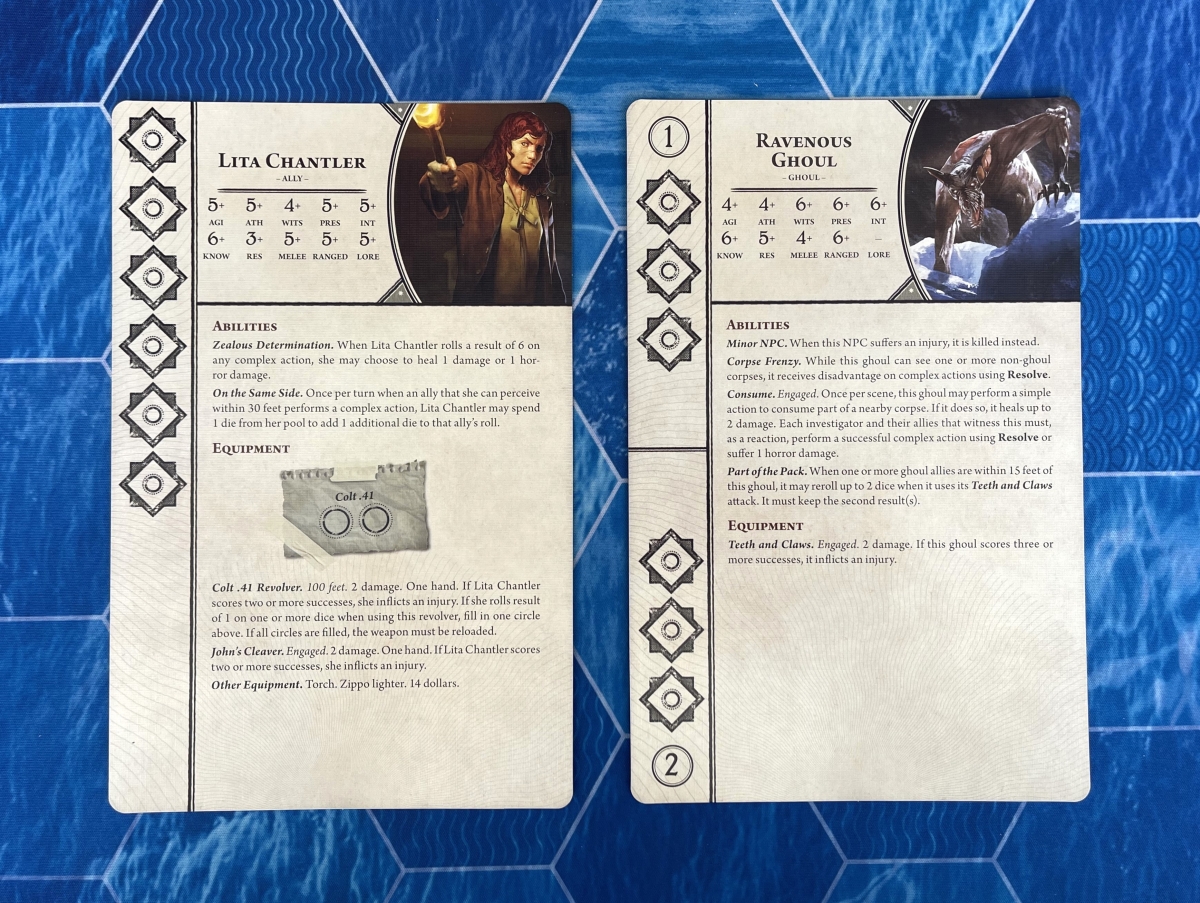
Rather than having to refer to NPCs inside of the rulebook, the GM has access to several oversized cards for those characters and monsters, detailing all of their stats, abilities, and equipment.
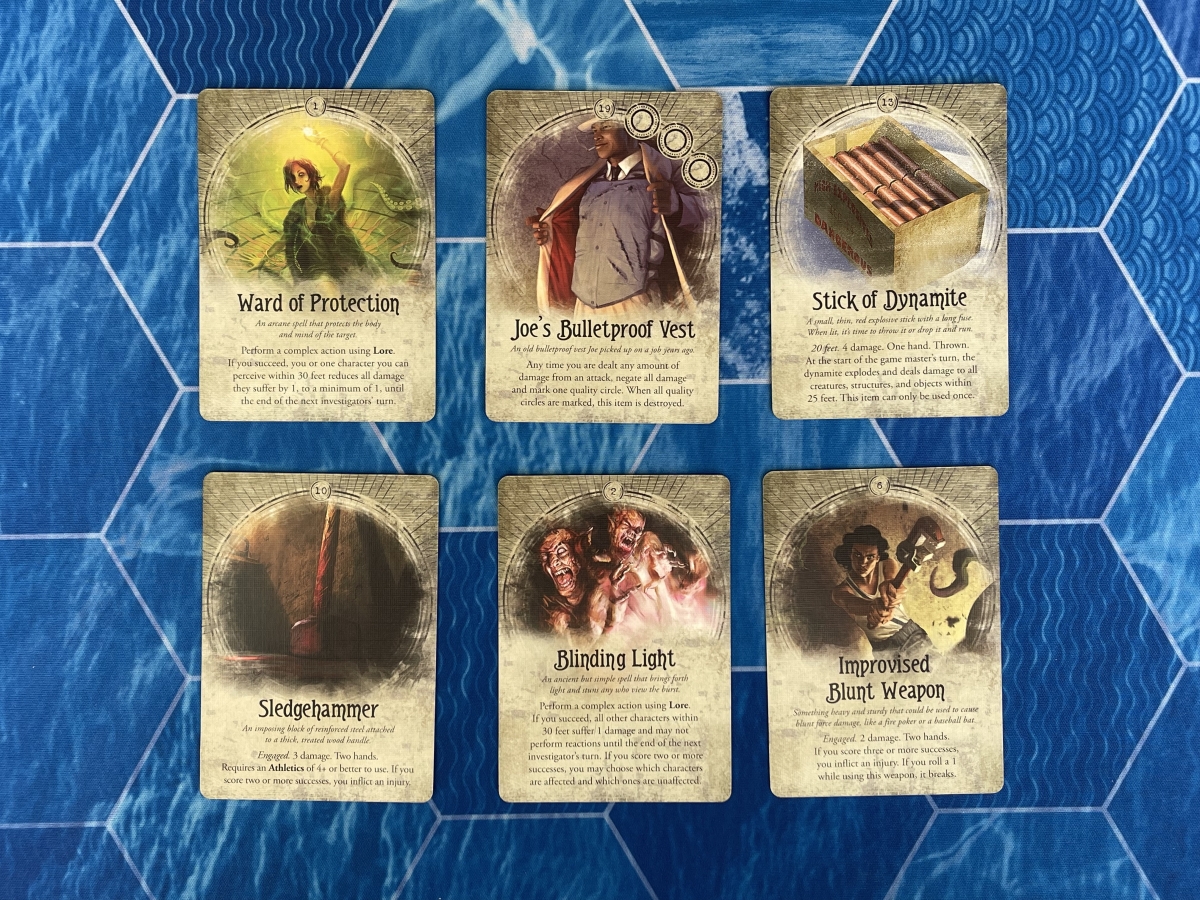
Similarly, there’s also a set of item and spell cards included in the set, which the Game Master can hand out to players as needed.
Besides two different cipher puzzles, there are also two physical puzzles included in the game. Both involve shifting 11 puzzle pieces around inside of a frame to try and recreate a picture. If you’re familiar with Mansions of Madness, a Fantasy Flight Games board game, then you’ve encountered similar puzzles before. In the Arkham Horror RPG, investigators will roll dice and compare it to their “Lore” stat. For each success, they will get 3 moves towards solving the puzzle.

Arkham Horror RPG – Starter Set: Hungering Abyss – Game Mechanics
Dynamic Pool System
The Arkham Horror RPG uses what they call the “Dynamic Pool System” of dice. Each character or creature has a pool of six-sided dice, which they can expend to perform different actions. There are two types of actions: simple and complex. Simple actions are ones like moving or opening an unlocked door. To take a simple action, you simply expend one die from your dice pool.
Complex actions require you to roll dice, comparing them to the appropriate skill. A skill will show a threshold for success; for example, a 3+ in Athletics would mean that any results of 3, 4, 5, or 6 on a roll would be a success. You can also choose to expend multiple dice on a complex action roll, but your dice pool doesn’t immediately refill.
When your dice pool refills depends on what type of a “scene” you are playing. There are two types: narrative and structured. For narrative scenes, there is no time pressure, and a player’s dice pool doesn’t refill until everyone else has expended theirs or has passed. This mechanic encourages equal participation by all players.
A structured scene is usually a scene involving combat. In these, the scene is a series of rounds where all the players and any allied NPCs get a turn, and then the Game Master and any enemy NPCs take a turn. The dice pools refill at the start of each player’s turn.
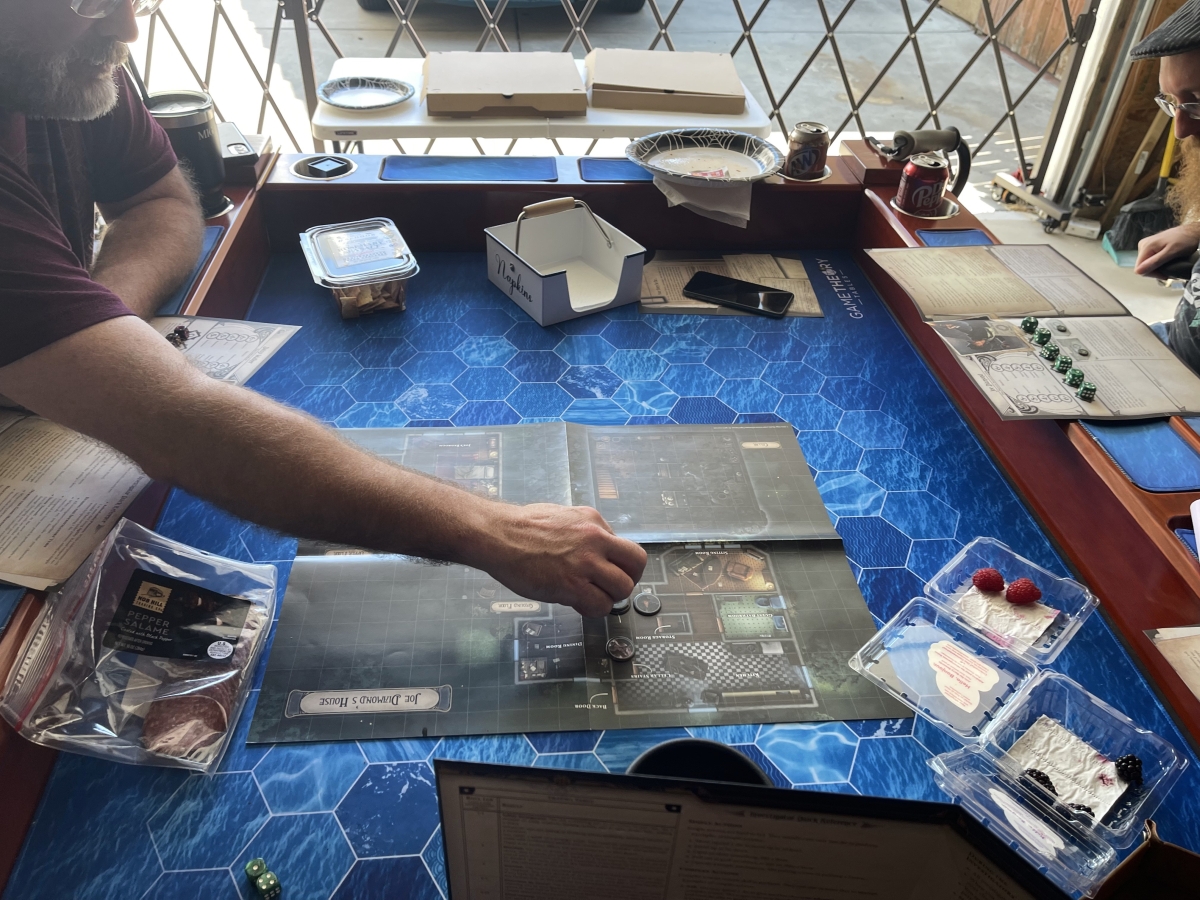
Injuries and Traumas
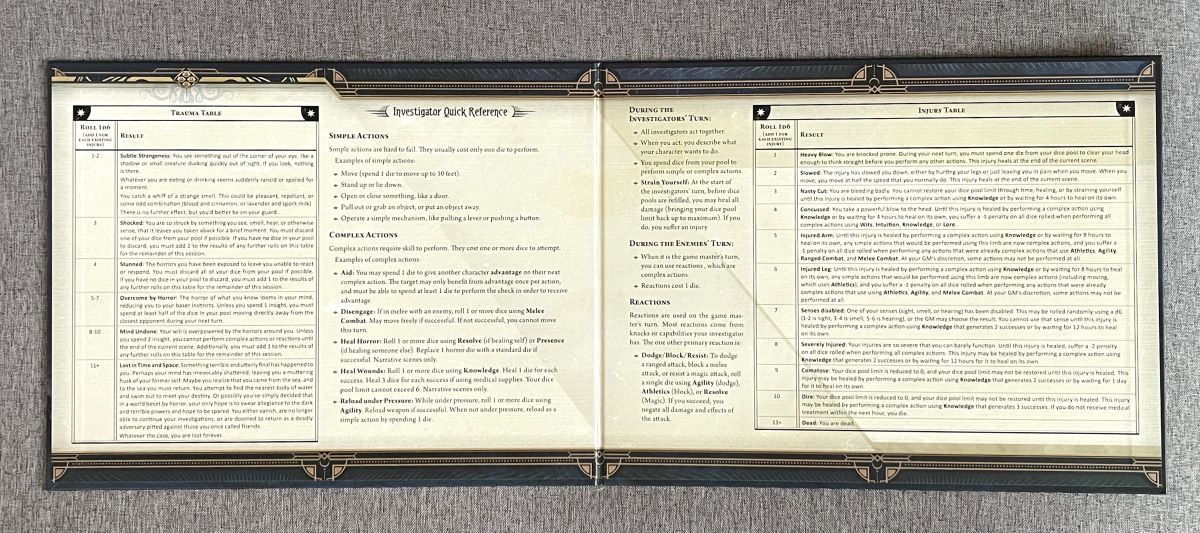
Combat isn’t as deadly in this game as it notoriously is in another Lovecraft RPG, Call of Cthulhu. Generally, when a character takes a wound, their dice pool is temporarily reduced. They will be able to heal this outside of combat. If significantly wounded, a player can choose to “strain” themselves, whereby they restore their dice pool but have to roll on the Injury table. There are results on the table that can turn simple wounds into much more serious injuries, where a player may find themselves at a disadvantage in their dice rolls, have their dice pool reduced to zero, or even die. Certain effects in the game can also cause injuries.
Some effects in the game cause players to exchange some of their dice with “horror” dice. Whenever a player rolls a 1 using one of the horror dice, they then need to roll on the Trauma table. While the Injury table represents physical damage, the Trauma table represents the mental damage that comes from being exposed to horror both terrestrial and unfathomable. Trauma can be anything from merely feeling unsettled to your mind completely cracking. As with wounds, horror dice can also be healed.
Arkham Horror RPG – Starter Set: Hungering Abyss – The Verdict
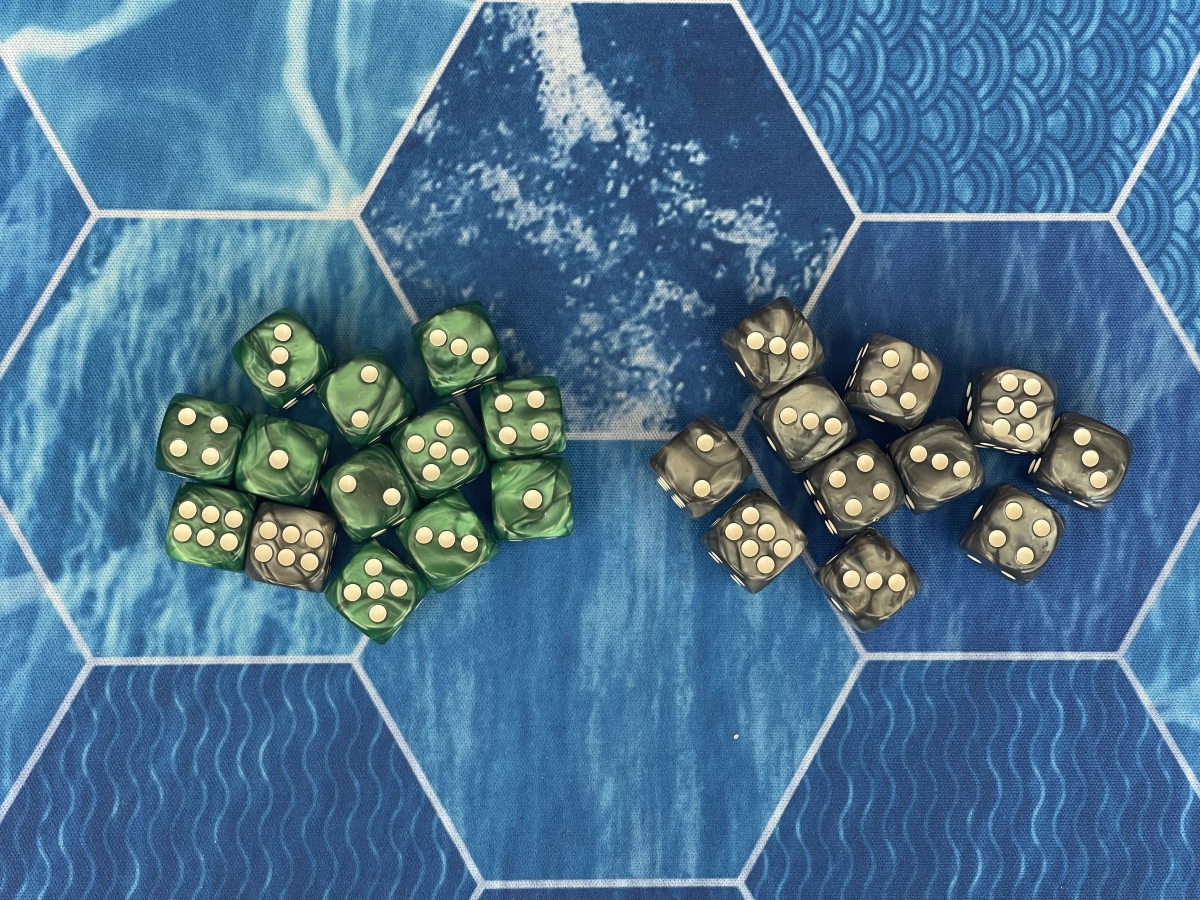
There’s a lot to love about this starter set. First off, considering the quality and quantity of what’s included, the $34.99 price tag is almost criminally low. The handouts in the game are almost to the level of quality you’ll find in a Beadle & Grimm’s D&D box set, and that’s saying a lot. Even the 24 included dice are high quality.
There are just enough rules to give you a taste of the mechanics of the game system without bogging new players down with details. I appreciated that the character portfolios also summarized the main rules, making it a handy reference for the players. As an experienced player, I would have liked to have seen a few more rules in print, but it didn’t impede the enjoyment of our playgroup when small issues arose. I suppose I’ll just have to wait for the publication of the actual rulebook for the solutions to those issues.
There were a few hiccups our game group encountered. For one, no one particularly enjoyed solving the physical puzzle. While that may have just been a quirk of our particular game group, the game designers doubled down by including a second picture puzzle to solve. Everyone agreed it would have been nice to have seen some kind of different puzzle instead of repeating the same one with just a different picture to solve.
It’s great that there are 6 maps included in the set, and everyone appreciated that there was a grid on each map for precise movement and positioning. However, parts of the hospital map were confusing, as it seemed like there were a few missing doors from the map. Also, the left corridor is mentioned with importance in the story, but it isn’t labeled on the map. Those omissions are inconvenient for an experienced game master but could be a serious stumbling point for someone new to running a TTRPG.

I wish that the Game Master’s reference board had been a traditional tri-fold board instead of only 2 panels. Not only does a tri-fold board work better to hide the Game Master’s pieces, but the print is quite small, and these eyes aren’t getting any younger. I often had to pick it up to read the information on it, revealing to my players everything behind the board.
While I understood that the point of spending dice during narrative scenes is to prevent an alpha gamer from dominating the roleplaying, in practice it bogged down the gameplay. As a group, we decided to only worry about spending dice on complex actions during those scenes. For structured scenes, it was unclear whether players had to complete all of their actions before another player took their turn or if they could intersperse actions. That latter point is likely to be cleared up once the full rulebook is released.
Story-wise, Hungering Abyss is a solid introduction to the 1920s Lovecraftian setting of Arkham. With each of the premade characters having their own motivations for investigating the disappearances, the players are immediately thrust into the narrative. It did feel at times like the town of Arkham was a very small town, with so many characters knowing each other. But then again, for an adventure that’s only supposed to last a few gaming sessions, you don’t want a ton of red herrings, either.
Interestingly, the flesh-eating ghouls are described to the Game Master as stealing bodies for food, but with how the narrative plays out, players are never witness to this cannibalism. It’s a striking omission and would have contributed to the overall horror of the story, as well as the players’ realization as to why the dead bodies have been disappearing from graves and the morgue.
Overall, Arkham Horror RPG – Starter Set: Hungering Abyss is a phenomenal value as an introduction to a gaming system. The components are of fantastic quality, especially at the very low price point at which it’s offered. While it’s hard to fully judge the Arkham Horror RPG system without reading the complete rule set, the general mechanics in the starter set work well for facilitating the storytelling. If you’re looking for an easy entry point into roleplaying in the Arkham Horror universe, then it’s hard to go wrong with this starter set.
For more information, visit the Arkham Horror RPG- Starter Set: Hungering Abyss page!
Click here to see all our tabletop game reviews.
 To subscribe to GeekDad’s tabletop gaming coverage, please copy this link and add it to your RSS reader.
Disclosure: GeekDad received a copy of this game for review purposes. As an Amazon associate, I may earn a small commission on qualified purchases.


