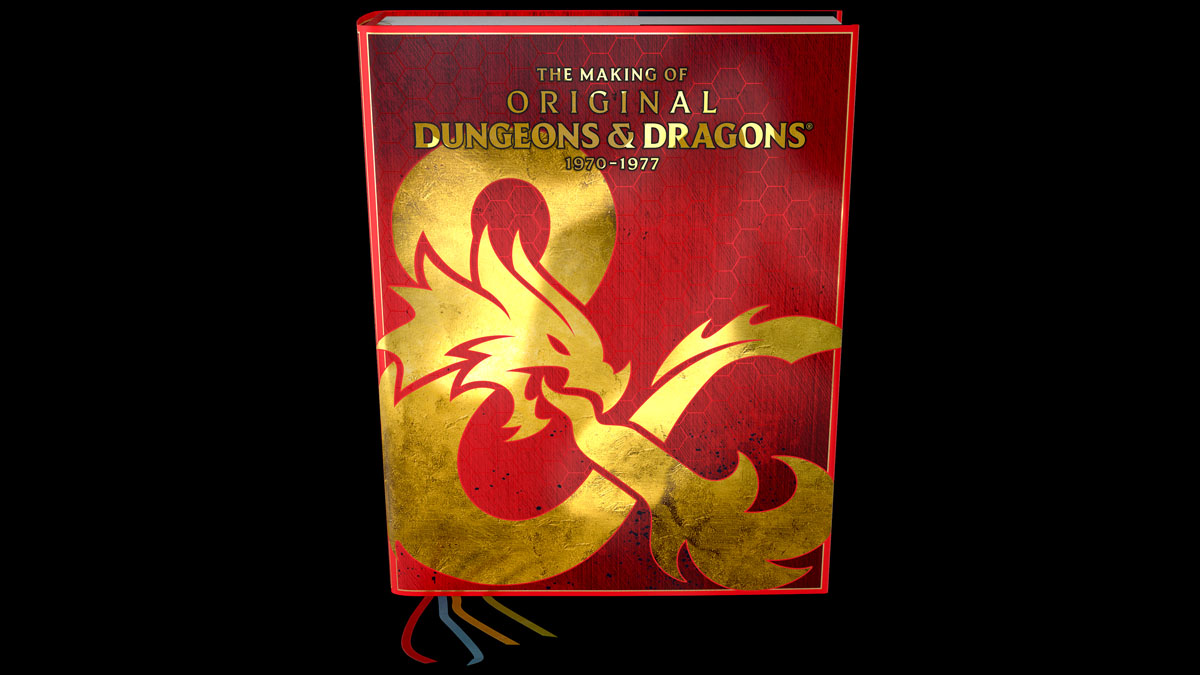
I’ll be the first to admit that when I first heard about The Making of the Original Dungeons and Dragons, I was not excited. The idea of another boring, distilled, and (usually) whitewashed monstrosity posing as the ultimate authority on a game I love was just not interesting. But after speaking with Jason Tondro (Senior Developer), Chris Perkins (Game Architect), and other senior developers at Wizards of the Coast, I cannot be more excited for the upcoming release. Not only is it a much more raw and comprehensive history than I expected, it also includes reprintings of several rulesets, making it a gameplay manual similar to the Player’s Handbook. You can preorder it for $99.99 starting now, but read on if you need some convincing, because there’s already a lot to say.
What’s Inside the Book?
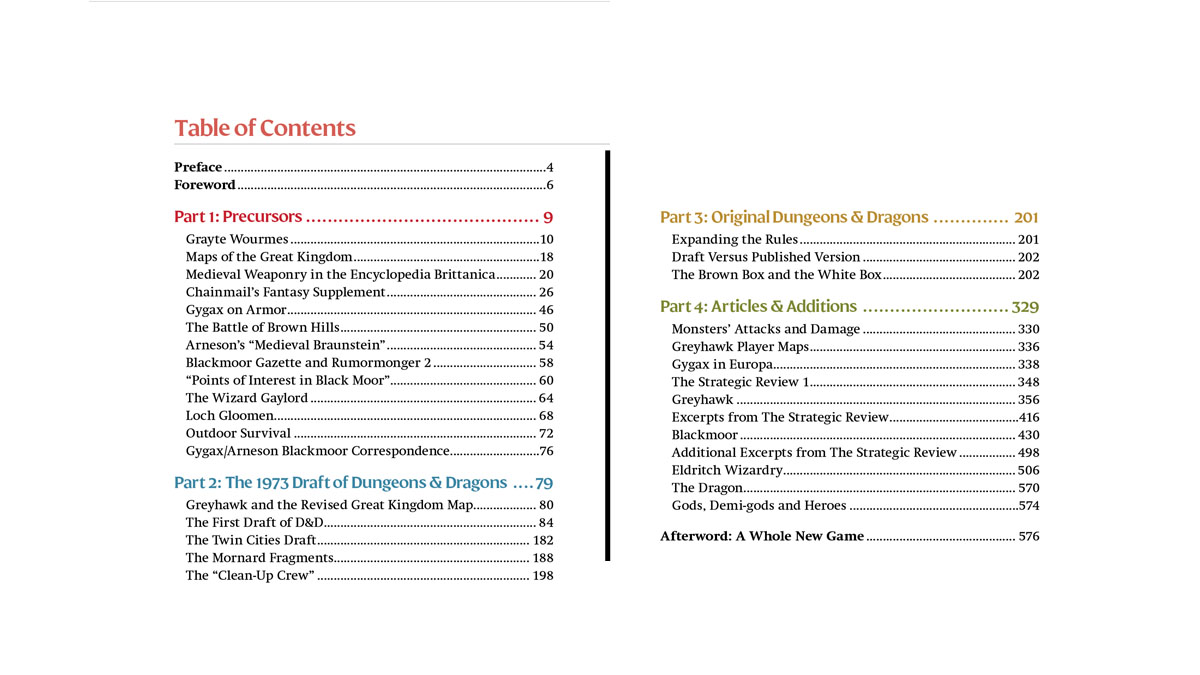
The first thing I want to note is that this book is massive. It features nearly 600 pages at 8″x11″, meaning there’s plenty of spread space to cram in extra details. The content is organized into four parts based on timeline. This timeline begins before work on Dungeons and Dragons began and runs right up to the creation of AD&D, which is not included in this work. Most notably, this is not a narrative; it’s a collection of historical documents. Most information is presented as a copy of the original document preserved by the historians at Wizards of the Coast, complete with coarse or inappropriate language which was included by the original humans who participated in the design of the game.
Part 1: Precursors
The first section shows you how Chainmail and other wargames were played, giving you context for the real-world situations that drove tabletop gaming, as well as the ever-evolving landscape that was becoming fantasy wargaming. Along with introductions to games like Chainmail, which was the beating heart of Dungeons and Dragons, readers can find page-by-page reproductions of correspondence, notes, and homebrewed rules as handwritten or typed by Gygax and his friends. For those who were not a part of the wargaming scene in the early 1970s, there is little better in the way of resources which allow you to really soak up what the scene was like.

Part 2: The 1973 Draft of Dungeons and Dragons
In the second section of the book, several versions of the 1973 draft are presented. Gary Gygax’s own draft appears alongside the drafts of his gaming friends from the Twin Cities, and the first introduction into the world of Greyhawk is also included in full. I’d like to note that the first draft covers about 100 pages of the book, so I’m hoping there are plenty of surprises to be found in this section. Jason Tondro (Senior Developer, Wizards of the Coast) did share that there are many documents from the TSR vault that have never been shared publicly that they are able to include for public consumption for the first time.

Part 3: Original Dungeons and Dragons
In this section of the book, the rules and contents of the Brown Box and the White Box are reprinted, in full. This makes this tome not only a history book, but a complete manual of the original game which players can use to experience Dungeons and Dragons in ways they might not have done for nearly 50 years.
Part 4: Articles and Additions
The last section features all of the extras that cropped up over time to enhance gameplay, clarify rules, etc. Supplemental publications for things like monster damage are included alongside Gary’s own expanded Greyhawk setting, and sharp-eyed readers can see how the game begins to evolve toward what would become Advanced Dungeons and Dragons. Other concepts addressed are the inclusion of religious figures, certain kinds of magic, and the Blackmoor campaign setting.
Other Considerations
As with all reviews, we should look at more than what a product is. Let’s look at some details that are easy to overlook.
What’s the Value?
Beyond the dizzying number of original documents included in the book, the sleeper value in this product is the game rules. There are rules and notes on play for games like Chainmail, as well as the full re-printings of the Brown Box and the White Box. Knockoffs and reprints of the White Box alone sell for hundreds of dollars on eBay, and having several versions of the rules (drafts, regional versions, etc.) just pushes the value of the book through the roof. Yes, it is still a spectacular resource for lore nerds and coffee-table book enthusiasts, but it is so much more.
A Nice Touch
I did want to note a nice touch in the production of this tome. Each book comes with four ribbon bookmarks attached, color-coded to the sections of the book. I like this partially because it tells me Wizards of the Coast knew that they were putting a lot of different things in a single book. I also like it because it recognizes that there are a lot of things to keep track of. From comments from Jason Tondro and Chris Perkins, it appears that they’ve put great effort into making the layout, transitions, and other publishing features as conductive to readers being able to utilize the whole book as is possible.
The Ugly
I try to find at least one thing I dislike with products which appear to be so well designed. In this case, it is the sheer mass of the book. It is 8″x11″ to make certain pages photo-copier friendly, such as character sheets. But that sheer size in page means the book is over two pounds, which can be very cumbersome for the reader. Definitely don’t read this one in bed where you might drop it on your own face if you doze off.
TL;DR:
The Making of the Original Dungeons and Dragons is a nearly 600-page tome revealing the history and development of the first versions of Dungeons and Dragons, as well as a collection of all-inclusive rulesets for early versions of the game and its predecessors, making this a resource book as much as a history book. Considering knock-offs of the White Box can sell for hundreds of dollars on eBay, the (still substantial) $100 price tag on this work is a lot more appealing than would normally be justified by a less nuanced “history of” book.

Rory Bristol

Rory is a nonbinary stepparent to two awesome geeklings. Rory is an advocate for gender, sexuality, and mental health causes and also records mental health videos at UpRoryUs. Any pronouns are fine.