

Today’s stack is a mixed bag of my recent reads, though several of the books are related to games—role-playing games, videogames, game-playing robots. I’ve got a middle grade novel, a comic book, and two non-fiction titles!
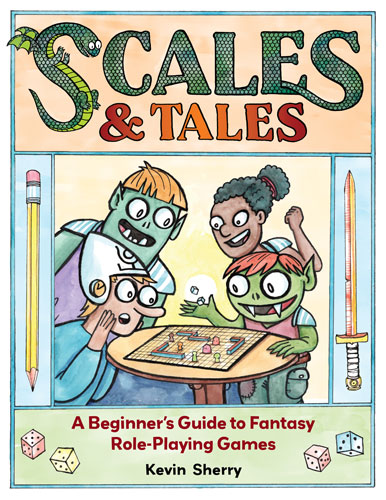
Scales & Tales: A Beginner’s Guide to Fantasy Role-Playing Games by Kevin Sherry
If you’re reading this site, there’s a good chance that you might already have some experience with role-playing games (RPGs), so if your own kids are interested in playing you’ve got it covered. But although I do play a whole lot of board games, RPGs are one of the areas where I’ve just never had a whole lot of experience (XP)—in fact, my older kids have actually played more RPGs with their friends than I’ve ever played myself. Well, if you’re as new to the genre as your kids but you’re wanting an easy way to give it a shot (without investing in a whole set of manuals), this book may be just what you’re looking for. Scales & Tales is a simple RPG-in-a-book, and all you’ll need to provide is some six-sided dice (d6) and at least one twenty-sided die (d20).
The book gives a quick overview of how to be a game-master (GM) and how to create your characters: just roll dice to determine things like your personality, backstory, and fears. There’s even a name generator in the back for players who (like me) have trouble coming up with names. Then, the second half of the book is a pre-written campaign to play, with tips and instructions for the GM, and some pages that include little tokens to cut out and use in the course of play. Kevin Sherry is also the creator of the kids’ comic series The Yeti Files, and the illustrations in this book have the same style—it’s cartoony with a touch of silliness, so the monsters tend to be more fun than really scary.

Zachary Ying and the Dragon Emperor by Xiran Jay Zhao
Xiran Jay Zhao is also the author of the YA novel Iron Widow (which I wrote about back in 2021), but this one is a middle grade book. What both books share, though, is that they’re heavily influenced by Chinese legends and folklore, weaving them in different ways into new stories and characters. Zack is in middle school, and he’s just trying to fit in and not get picked on—it’s why he throws away the homemade lunches his mom packs him, because the kids in elementary school always complained about the smell. And he doesn’t rock the boat at all when the captain of the school’s Mythrealm team asks to “borrow” various things in the augmented reality videogame.
Everything changes when Simon Li shows up at Zack’s school: after making an initial connection because they both play Mythrealm (and Simon has some amazing creatures in his collection), Simon starts talking about ancient Chinese history—the First Emperor, the Seven Warring States, and a whole bunch of other things that Simon doesn’t really care about. But he soon will, because as it turns out the First Emperor’s spirit wants him as a host—there’s a mission to seal the portal to the underworld before the upcoming Ghost Month, when undead spirits will break through and unleash chaos on the world. At least, that’s what Zack is told—but he soon realizes that the First Emperor Qin Shi Huang was a real tyrant, and Zack isn’t sure how much he can trust him, let alone the other emperors who show up (in other hosts). His life is suddenly filled with excitement: a demon who captures his mom’s spirit, the discovery that he can use Qin Shi Huang’s water magic (to a degree), and a trip to China to pull off an underwater heist.
The book mixes together figures from ancient China with videogame and pop culture references—one chapter title is “How the Creation of China Was Exactly Like American Idol,” and Zack serves as the reader’s point of view through it all. A lot of the myths and legends are well-known in China, but virtually unheard of in America, and even though Zack is Chinese, he’s mostly ignorant about most of these figures that he ends up encountering. Even as the characters in the book are explaining them to Zack, they’re also introducing them to the book’s readers, and making connections to more modern concepts really helps to make them stick.
If you’ve read the comic American Born Chinese or watched the TV series, the beginning of the story may feel similar: a Chinese-American kid who feels a little embarrassed to be seen with another Chinese kid, who turns out to be a lot more than what he initially appeared. Then the stories really go in different directions, though. As Zack learns more about Qin Shi Huang, he goes back and forth about how he feels about him: on the one hand, he did accomplish his goal of unifying China and inspiring long-lasting legends; on the other, he was cruel and distrustful and brought misery or death to countless people during his reign. Zack tries to reconcile these with the person he wants to be, and the story has more twist and turns than a Chinese water dragon.
The story also doesn’t shy away from some education about the politics of China, both ancient and modern. For instance, it includes a reference to China’s persecution of Uighur Muslims—Zack’s dad was executed for speaking out against it when Zack was only a baby, which is why he and his mom fled to the United States. They are also Muslims, and there are a couple scenes in the book where Zack visits halal cafes in China. Last year’s Hugo Awards were held in Chengdu, China, and there was a big scandal when many authors and works were deemed ineligible for the award at the last minute—Xiran Jay Zhao is one of the authors who was removed from the ballot, very likely because they have been outspoken about things like this in their books and on social media.
Overall, I found the book pretty intriguing: as an American-born Chinese person myself, I grew up with a little more of my cultural heritage than Zack (whose mom tried very hard to assimilate them) but there are still a lot of Chinese legends and myths that just never became as familiar to me, so it was fun to see this take on them, wrapped up in an adventure about videogames and magic.
One last note: if you get impatient waiting for books in a series, be forewarned that this book ends on a cliffhanger!

The He-Man Effect by Brian “Box” Brown
I always enjoy Box Brown’s comic books: they’re often informative, packed with a lot of trivia and details in an easy-to-digest format, and often with little visual references hidden here and there throughout the book. He’s written biographies of Andre the Giant and Andy Kaufman, as well as a history of Tetris. This book, with the subtitle How American Toymakers Sold You Your Childhood, is squarely about my generation—the kids who grew up watching Saturday morning cartoons, playing with Transformers and He-Man and G.I. Joe figures. It follows the story of shifting FCC regulations, the outsized effect that Star Wars had on toy merchandising, and a lot of other ways that toy companies ramped up marketing to kids in the 1980s.
For example, one thing I learned from the book was a tactic that toy companies used to get around rules about advertising to kids. The FCC didn’t allow cartoons in commercials for toys—but there weren’t any restrictions around advertising of comic books. So Hasbro worked with Marvel Comics to make comic books about G.I. Joe, and then they could make cartoon ads for the comics, which was allowed—even though they obviously also helped sell the toys themselves. As a kid, of course, all of this was behind the scenes, and I doubt even many parents were aware of how insidious things were at the time.
Reading this book made me realize there’s no surprise that my generation is so hooked on anything that gives us nostalgia for the 1980s. We were primed for Funko Pop miniatures and remakes of our favorite cartoons, and that’s programming that is really hard to ignore. Brown says in his afterword that he doesn’t hate these toy properties—he’s just as “hypnotized” as the rest of us—but he does recognize, after doing the research for this book, how much of it really is a “capitalist fantasy” created by powerful companies with a whole lot of money.

A Brief History of Artificial Intelligence by Michael Wooldridge
Artificial intelligence is in the news a lot these days, though the term “AI” isn’t always used in the same way. This book, originally published in 2020, certainly predates the way that the current usage is overwhelmingly about generative AI, whether with text or images, though even this book does include some early observations about software that could generate realistic images of people. There are mentions of chatbots but not ChatGPT, and the index doesn’t list anything like DALL-E, Midjourney, or OpenAI.
With that out of the way, what is this book about? Well, it’s about the story of AI: what it is and isn’t, the various technologies and breakthroughs that have advanced the field, as well as obstacles that were hard to overcome. It’s also about why general artificial intelligence—the idea of making a machine that can actually think and learn like a human—is so dang hard. The book traces some of the trends in AI—the approaches that were taken to training a system, the types of ways software would search for solutions to a problem, and so on. Wooldridge also touches on popular conceptions of AI—what we’re afraid of, and what we actually should be afraid of.
One thing I learned from the book is that the history of AI is filled with big promises, many (or most?) of them still unfulfilled. The dream of general artificial intelligence is still out there, but many people who work in AI aren’t necessarily pushing for that, and are instead working on creating systems that solve smaller, more specific problems. At the same time, some of the warnings that Wooldridge makes have already come true—the real danger of AI isn’t killer robots and a sentient internet that turns on humans, but things like algorithmic bias or making it exponentially easier to create fake news.
But there is one line in particular that stood out to me, in light of the way that everyone seems to be trying to shoehorn “AI” into everything these days: “Experience shows that systems operating as black boxes, making recommendations without the ability to justify them, are treated with great suspicion by users.” This was fairly early in the book, while describing a system that was able to explain its reasoning. If it gave you an answer, it also gave you the chain of logic it took to get there. Neural networks and machine learning systems are black boxes: while they often seem to work miracles, we generally just can’t know exactly what is going on inside them. But that hasn’t stopped people from relying on ChatGPT and other LLMs for information despite countless examples of them giving obviously inaccurate answers.
I really appreciated this overview of artificial intelligence, even though it already feels a bit outdated. I see that Wooldridge gave a talk this past December that addresses things like LLMs, so I’m planning to watch that later to hear his take on some of the advances made since his book was published.

The Beauty of Games by Frank Lantz
Frank Lantz is a videogame designer whose credits include Universal Paperclips, a clicker game in which you are an AI tasked with maximizing paperclip production—it’s based on a thought experiment in ethical AI design about including human values in the goals of your systems, and it’s quite fascinating and morbidly funny. This slim book is a series of essays that take on the question: Are games art? Well, Lantz kind of hedges a little bit because that feels like such a loaded question, so he rewords the question a bit: are games an aesthetic form? Of course, he defines that term and explains why he’s using it, but essentially the book explores the topic suggested by the title: it’s about creating and finding beauty in games.
Lantz tends to use the term “games” the way that I find many videogame folks use the word: it means videogames, really. Lantz does say the term includes non-digital games—he intentionally mentions things like Poker and Go and even some sports—but a lot of the times when he starts getting into specifics of what he means about beauty in games, it really feels like he has videogames in mind.
In any case, the book explores what it is about games that attracts us. What does it do to our brains when we play them, or when we think about them? How does this compare to other “aesthetic forms” like painting or dancing or music? The book is a bit academic (not a surprise, since it’s from MIT Press) so there are parts of it that can feel dense and may require multiple passes to digest, and there are definitely parts that went over my head a little. But overall it did give me some new ways to think about games and a renewed appreciation for them. Of course, Lantz is preaching to the choir—I’m not somebody who really needs to be convinced that games have some sort of artistic value or merit. Still, it doesn’t hurt to dive a little deeper into the subject matter with somebody who has clearly spent a lot of time studying and pondering the topic!
My Current Stack
I’m bouncing around a little in my queue, but I did just start a sci-fi novel called Time’s Agent by Brenda Peynado. It involves travel between pocket worlds—tiny dimensions that are accessible from our world through strange doorpoints. The narrator traveled to a pocket world, only to find when she re-emerged that many years had passed and corporations had taken over the pocket worlds. I’ve just gotten started but I’m very intrigued to see where this one is going.
Disclosure: I received review copies of the books in today’s column. Affiliate links to Bookshop.org help support independent booksellers and my writing!


